

 Most Biased
 Satire
 Economy
 Opinion
 Elections
 Environment
 Entertainment
 Government
 Sports
 Science
 Health
-4% Center
Bias Meter
Extremely
Liberal
Very
Liberal
Somewhat Liberal
Center
Somewhat Conservative
Very
Conservative
Extremely
Conservative
-100%
Liberal
100%
Conservative

- Profile
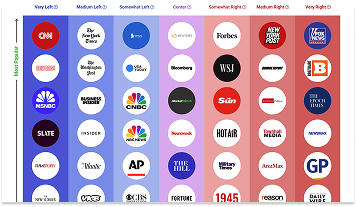
Financial Times on the media bias chart
- Bias Rating
-4% Center
- Reliability78% Reliable GoodPolicy Leanings
6% Center
Extremely
LiberalVery
LiberalModerately
LiberalSomewhat Liberal
Center
Somewhat Conservative
Moderately
ConservativeVery
ConservativeExtremely
Conservative-100%
Liberal100%
Conservative
Average Reliability
*Our bias meter rating uses data science including sentiment analysis, machine learning and our proprietary algorithm for determining biases in news articles. Bias scores are on a scale of -100% to 100% with higher negative scores being more liberal and higher positive scores being more conservative and 0% being neutral. The rating is an independent analysis and is not affiliated nor sponsored by the news source or any other organization.
Politician Portrayal82% negative
Analysis of Financial Times Articles
Analysis of Bias in Financial Times Online Articles
To evaluate this, we can analyze select Financial Times articles through several of Biasly’s bias rating criteria: Tone, Tendency, Author, Diction, and Expediency Bias.
- Tone: The overall attitude conveyed by the article
- Diction: Specific word choices made by the writer
- Author: The background and social presence of the journalist
- Tendency: Patterns of bias in the writer’s broader body of work
- Expediency Bias: Quick visual or textual indicators like headlines and photos that imply bias
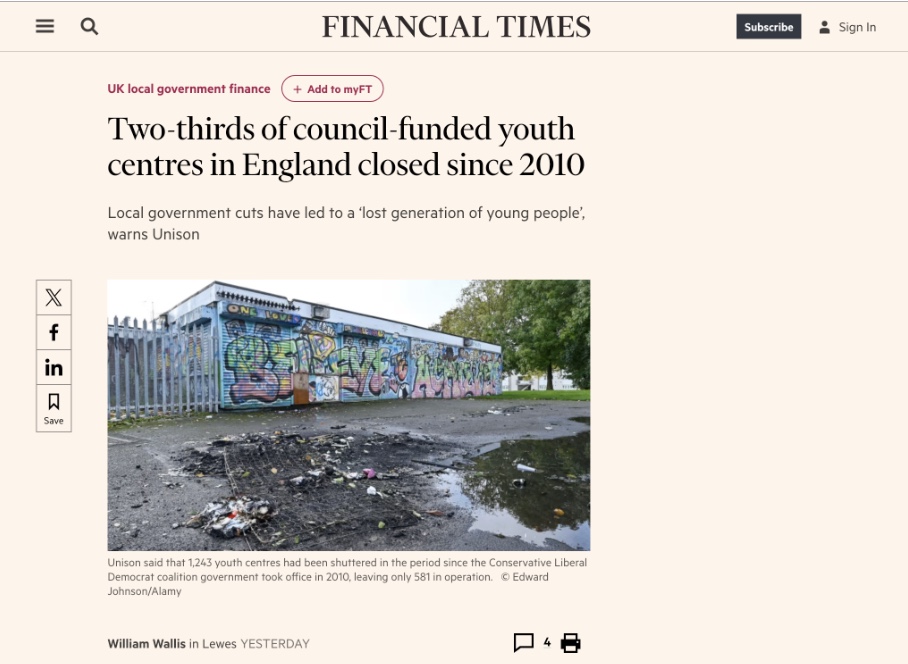
Source: Financial Times
One such article examines the impact of austerity policies. The headline and opening use diction like “prolonged squeeze” and “slashed funding” to describe post-2010 Conservative government budget cuts under David Cameron, while linking closures to risk of “isolation and…gang and knife culture”. An accompanying image of a dilapidated building with graffiti adds expediency bias by visually implying crime and neglect without direct evidence of causation.
“More than two-thirds of council-funded youth centres have been closed in England over the past 14 years, owing to a prolonged squeeze on local government finances… Local government budgets were among the hardest hit in the period after the financial crisis when David Cameron’s government slashed funding to the public sector as part of its austerity policy.”
The tone and tendency subtly lean progressive by emphasizing government spending cuts and social consequences while offering limited exploration of alternative factors, such as declining attendance and shifting priorities. Reporter William Wallis maintains factual reporting overall, but the framing aligns with Center-Left critiques of austerity. This portrayal thus subtly frames the issue through a progressive ideological lens, further underscoring the article’s ideological slant.
Another article, “Trump’s Vaccine Heresy Shows Populism is Not a Monolith,” employs more critical diction toward populist figures. The title itself uses the loaded word “heresy,” implying deviation from accepted norms, and the article focuses on criticism of Trump’s positions (such as on vaccines, North Korea, or the Mexico wall) with limited counterbalancing perspectives or acknowledgment of broader populist appeal.
In contrast, the Financial Times article, “Joe Biden Hits Democratic Fundraising Record with Star-Studded $28mn LA Event” maintains a notably neutral tone and Center rating. It reports fundraising figures and event details in a straightforward, data-focused manner without loaded language, partisan framing, or expediency bias.
For example, the reporter of the first article, William Wallis, avoids emotional or judgmental language, choosing to instead let the facts speak for themselves. While his social media presence is very limited, his writing remains professional and neutral in tone.
@EzgiVissing hello i am the Financial Times roving UK correspondent. I have been following your BA story – (am new to twitter but could you follow me so I can DM you. Would like to speak for a story I am doing this week on Eu citizens and the forthcoming elections…
— William Wallis FT (@WWFTUK) May 14, 2019
In summary, Financial Times shows generally consistent bias in its reporting. While many articles deliver high-quality, data-driven analysis with professional restraint, such as in pure market or corporate coverage, stories involving fiscal conservatism, social spending, or populist movements often reveal a Center-Left slant through tone, diction, tendency, selection, omission bias, and expediency bias. This pattern is more pronounced on politically charged economic and social policy topics than in straightforward financial reporting.
Analysis of Financial Times Opinion Articles
To fully understand political bias in media, it’s important to distinguish between factual reporting and opinion pieces. While reporting aims to present facts and let readers form their own conclusions, opinion articles express personal viewpoints on current issues. Although the previous section examined factual reporting, this section turns to how bias surfaces through Financial Times’s selection and tone of opinion content.
One prominent example is the op-ed titled “From France to America, The Far Right is On The March.” The title and accompanying imagery of burning EU and U.S. flags signal a persuasive, alarmist tone that frames right-leaning political movements dramatically.
In contrast, another opinion piece titled “Campaigning Parties Should Tell the Truth About Debt Servicing” adopts a more neutral, analytical tone focused on fiscal responsibility and policy transparency. Its title avoids emotionally loaded language and presents arguments in a structured, evidence-based manner.
These examples show that while not all Financial Times opinion pieces are overtly ideological, the platform frequently publishes content that aligns with Center-Left media narratives on populism and economic policy. This consistent selection of opinion pieces can contribute to perceptions of systemic bias, in particular when editorials critique conservative or populist positions more sharply.
This tendency underscores the importance of distinguishing subjective viewpoints from straight reporting, especially when interpreting the political leanings of any news organization.
Analysis of Reliability in Financial Times’s Online News Articles
Financial Times aims to deliver concise global financial and economic journalism to informed readers. Its staff includes experienced correspondents with strong expertise in business and policy, which supports reliable coverage. However, readers should distinguish between news reporting and opinion pieces to evaluate credibility effectively.
One example is the aforementioned article titled “Two-Thirds of Council-Funded Youth Centres in England Closed Since 2010.” Reporter William Wallis covered the impact of austerity policies on local youth services, citing government data, local authority statistics, and interviews. Despite Financial Times’s Center rating, this piece illustrates strong factual grounding in verifiable public records while still showing some framing tendencies.
Quality of Sources and Facts Used
Financial Times often uses credible sources such as government statistics, official reports, and expert interviews. However, some articles lean too heavily on presenting opposing viewpoints.
Consider the article “White House Scrambles to Salvage $1.75tn Build Back Better Bill by Christmas.” The piece reports on Democratic efforts to advance President Biden’s major domestic spending package amid internal party divisions, citing congressional leaders, White House officials, and moderate senators. It is structured around legislative negotiations, with quotes from key figures like Nancy Pelosi, Chuck Schumer, and Joe Manchin.
The article contains several direct quotations (counting partial quotes). The shortest quotes are brief attributions (3-7 words), the longest are around 18-25 words from lawmakers, and the average quote length is roughly 10 words. Many statements are presented as attributed summaries of negotiations or paraphrased positions rather than extended verbatim blocks, allowing the piece to focus on the timeline and political dynamics. This approach can be more reliable in one way—readers see a clear sequence of events with less opportunity for selective snippetting—but it also means we don’t always get full context or tone except for key labeled phrases.
On linked sources, the article uses a modest number of hyperlinks in the body, primarily internal to Financial Times pages providing background on the bill’s components or prior coverage. By left/center/right: Left = 4 (references to progressive Democratic leaders and supportive elements of the bill), Center = 3 (institutional references to White House and congressional procedures), Right = 1 (limited acknowledgment of moderate or fiscal conservative concerns). The sourcing footprint is mostly internal or tied to Democratic-side statements rather than a broad cross-ideological set of external primary documents.
- Nancy Pelosi, Chuck Schumer, and progressive Democratic leaders (Left-leaning)
- Joe Manchin and moderate senators (Center/Right-leaning in context)
- White House officials and Biden administration statements (Left-leaning)
- Congressional negotiation records and bill text references (Center/Institutional)
- Financial Times archives and prior reporting on the Build Back Better package (internal to the outlet)
- References to specific spending provisions (e.g., climate, social programs) (Center/Institutional)
In how sources are used, the piece presents the “race to salvage” narrative primarily through quotes and statements from Democratic leaders pushing the bill forward, with moderate opposition (for instance, Manchin’s concerns) receiving shorter attribution and framing as obstacles.
Claims about the bill’s urgency or benefits are amplified through progressive voices, while fiscal conservative critiques or alternative policy rationales receive less prominence inside the text. This can function as neutrality by reporting the legislative process as it unfolds, but it can also inadvertently advantage the Democratic perspective by giving it more narrative space and emotional weight without robust balancing context from opponents.
Grounded in what we can count here (speaker access and framing), the author’s operating bias reads closest to Center-Left on this topic: the structure is chronological and fact-focused rather than overtly argumentative, but source emphasis tilts toward the bill’s proponents.
On factual accuracy, the broad context is generally consistent with public records: the Build Back Better negotiations, internal Democratic divisions, and key figures’ positions were well-documented at the time. Where accuracy becomes harder is inside the interpretive framing of motives or the bill’s long-term implications, presented without extensive counter-data or detailed fiscal analysis from skeptical voices in the main body.
In contrast, other Financial Times pieces on pure market data, earnings reports, or corporate deals sometimes incorporate longer timelines, multiple named expert sources from both sides of policy debates, and balanced stakeholder quotes, scoring higher on transparency and neutrality.
Selection and Omission Bias
Financial Times provides extensive coverage of global economic trends, fiscal policy, and international affairs, which is reasonable given its readership. However, bias may still emerge through framing and story selection.
In “Premature obituaries for populism,” selection bias surfaces through the article’s emphasis on the supposed decline of right-leaning populist movements in the US and Europe. The piece repeatedly highlights electoral setbacks and internal divisions within populist parties while offering limited exploration of their policy wins on trade, immigration, or economic nationalism in countries where they have governed or influenced outcomes.
The article does not deeply examine positive initiatives led by populist leaders or contrasting viewpoints from voters who continue to support these movements. Therefore, the coverage leans toward portraying populism primarily as a threat to democratic norms rather than a complex political phenomenon with both strengths and weaknesses. Still, it remains rooted in verifiable polling data and election results.
The article does not highlight any proactive or positive measures taken by populist movements, such as specific trade deals or border policies that resonated with their base, nor does it present contrasting viewpoints from populist officials defending their record. That said, the reporting does not cross into overt editorializing and is, for the most part, grounded in verifiable facts and quotes.
By comparison, the article “To stop UK’s debt fatalism look past charts of doom” shows a stronger balance. It lays out fiscal data, debt-to-GDP ratios, and historical context from both the UK Office for Budget Responsibility and independent economists, including quotes from officials across the political spectrum without heavy interpretive framing of motives.
The piece integrates conversations from conservative platforms and includes responses from government and opposition figures, citing public documentation readily available for cross-examination. Overall, it used a well-rounded approach to delivering objective analysis to readers of Financial Times.
In opinion pieces, issues with factuality, sourcing, selection, and omission are more common. The articles we’ve covered so far reflect Financial Times’s Center views, but this is not detrimental to its reliability. Its story selection favors issues more likely to concern international business audiences with Center-Left leanings, suggesting it may give less emphasis to certain conservative economic rationales. However, the contents of many Financial Times articles maintain accuracy and tend to cite evidence from numerous and varied sources.
Financial Times Bias Overview
Financial Times began in 1888 as a London-based financial newspaper. Today, it operates as a premium global news organization under Nikkei Inc., focusing on authoritative coverage of business, economics, politics, and technology. With millions of subscribers and multiple awards for excellence in journalism, Financial Times positions itself as an independent voice for decision-makers worldwide.
According to its 2024 annual report, Financial Times reached an average of 2.18 million users per month in the previous year. When it comes to media bias, both AI and media analysts have evaluated its content, sources, and funding to determine its political leaning.
As a leading international financial outlet, Financial Times plays a significant role in shaping public perception of global markets and policy. Readers’ trust in the accuracy of such coverage may mirror the conclusions reached by Biasly’s media bias ratings. This article delves into Financial Times’s editorial tendencies to explore whether political bias is present and, if so, to what degree.
Is Financial Times Biased?
Based on Biasly’s evaluations, Financial Times is rated as Center.
By examining content patterns and the broader context of media influence, we aim to offer a balanced perspective on Financial Times’s political bias—and contribute to the ongoing discussion about bias in the news.
How Does Biasly Rate News Sources?
Biasly uses proprietary algorithms and a team of analysts to provide comprehensive bias evaluations across thousands of news outlets. Over 200,000 articles from more than 3,200 sources have been analyzed to identify the most accurate and unbiased stories.
Biasly assigns each outlet three key scores:
- Reliability Score – Reflects factual accuracy
- AI Bias Score – Generated via natural language processing
- Analyst Bias Score – Assessed by human political analysts
These scores are based on seven core metrics: Tone, Tendency, Diction, Author Check, Selection/Omission, Expediency Bias, and Accuracy. These elements help analysts and algorithms evaluate the political attitude conveyed by each article.
Biasly’s Bias Meter ranges from -100% (most left) to +100% (most right), with 0% indicating neutrality. The system evaluates individual articles based on political terms, policies, figures, and sentiment to calculate precise bias ratings.
Is Financial Times Politically Biased?
Financial Times earns a Center rating for its AI Bias Score and a Center for its Analyst Bias Score. The Analyst Bias Score is generated by reviewers from liberal, moderate, and conservative backgrounds. Analysts reviewed several Financial Times articles and noted a mix of scrutiny toward figures on both sides, with occasional Center-Left framing on fiscal and social policy topics.
This Bias score is determined through natural language processing that evaluates the tone, word choice, and opinion embedded in the reporting. Recent AI evaluations highlight measured but subtly progressive narratives in articles discussing austerity, populism, and social spending.
How to Evaluate Bias
Although Biasly rates Financial Times as Center, it’s important to remember that bias can vary from article to article. Financial Times also covers politically diverse regions and international markets with objectivity on many issues, from state legislation to social developments. This complexity underscores the importance of examining each article individually. So, let’s learn how to evaluate media bias.
Recognizing media bias requires awareness and critical thinking. Often, readers trust news sources that affirm their existing beliefs—a psychological tendency known as confirmation bias. This makes it harder to identify slanted narratives or one-sided reporting.
To address this, it’s essential to challenge your assumptions by consulting multiple perspectives and verifying information through third-party analysis. Tools like Biasly’s media bias ratings allow readers to compare the same news story across the political spectrum.
Ultimately, bias isn’t always a matter of what is said—it’s also about what is left out, how topics are framed, and which stories are chosen for coverage. Learning to recognize these patterns can help readers make more informed decisions and develop greater media literacy.
To start comparing news outlets and gain a better understanding of bias, sign up for Biasly’s Media Bias & News Analytics Platform to see how stories vary between sources.
Financial Times Reliability Overview
Is Financial Times Reliable?
Financial Times finds itself toward the higher end of the reliability spectrum for a premium international news outlet, particularly in its core areas of financial markets, global economics, corporate reporting, and data-driven policy analysis. Its status as a subscription-based publication with a long history of rigorous journalism contributes to a strong reputation for accuracy in business and economic coverage.
According to Pew Research, audiences tend to trust specialized financial and international news sources more than general political media, viewing them as less polarized. However, satisfaction with coverage of politically charged economic topics—such as austerity measures, populist movements, or fiscal policy debates—remains lower, as readers sometimes perceive subtle framing that favors Center-Left perspectives on social spending and government intervention.
This suggests that Financial Times’s popularity and subscriber loyalty may stem more from its depth of financial insight and global reach than from absolute neutrality on every political-economic intersection. Further investigation is needed to determine whether occasional framing bias or other factors are affecting perceptions of its accuracy on non-market topics. At Biasly, we specialize in evaluating not just bias but also the reliability of media outlets. Let’s explore the accuracy and trustworthiness of Financial Times.
How to Evaluate Reliability?
Reliability refers to how trustworthy or accurate a news source is. If we can’t trust what we read, then continuing to consume content from that outlet serves little purpose. So how do we evaluate a news outlet’s reliability?
There are several key indicators of reliability to consider when assessing a media source. Red flags of an unreliable article can include wild, unsubstantiated claims, facts that depend on other unreliable sources, heavy use of opinionated language, and more. In contrast, hallmarks of a reliable source include:
- Absence of subjective language
- Citing credible sources (e.g., .gov, .edu, academic references)
- Verifiable facts and statistics from multiple outlets
- Use of primary sources, like interviews or transcripts
- Consistency with coverage across other platforms
Biasly’s reliability scores incorporate these elements in evaluating media outlets.
So How Does Financial Times Fare in Its Reliability?
The political reliability index developed by Biasly assesses both accuracy and trustworthiness. Financial Times currently holds Good Reliability Score, which is calculated as a weighted average of:
- Fact Analysis Score – Evaluates the accuracy of claims, facts, and evidence.
- Source Analysis Score – Assesses the number, diversity, and credibility of sources and quotes used.
Financial Times’s Source Analysis Score is Average at 41% Reliable. This suggests moderate trustworthiness in its sourcing practices. The score is AI-generated and considers quote length, frequency, diversity, and quality.
The Fact Analysis Score of Financial Times is Good at 88% Reliable. This further shows how well Financial Times supports its claims, addresses selection and omission bias, and presents verifiable evidence.
While Financial Times leans toward factual reporting, occasional lapses—such as unbalanced viewpoints or incomplete data—can affect its reliability rating. These nuances emphasize the importance of analyzing individual articles.
Financial Times’s Accuracy and Reliability
According to Biasly’s analysis, Financial Times maintains Good Reliability Score, but individual articles may vary significantly. Let’s dive into the details.
Political orientation plays a crucial role in how audiences perceive reliability. Financial Times has been accused of favoring a liberal narrative, potentially at the expense of factual reporting. To validate such claims, it’s essential to analyze whether the publication backs its assertions with sufficient evidence and diverse viewpoints.
Two common types of bias that affect factuality include:
- Selection Bias – Highlighting or omitting stories to fit a particular narrative.
- Omission Bias – Leaving out differing perspectives or relevant details to skew perception.
Biasly’s accuracy ratings use a scale from 1% (least accurate) to 100% (most accurate). Factors include supporting evidence, reliable internal and external sources, and balanced viewpoints.
For instance, Biasly gave The New York Times a Medium Left Bias and a Good Analyst Reliability Score. One New York Times article, titled “President Is Said to Sign Off on Firing F.D.A. Chief,” showed a somewhat left score and an average reliability rating for failing to include diverse viewpoints. Critical language toward Donald Trump and conservative policies did not stop at the headline, either, and the reporting failed to complement its selection of opinions with views from any other school of thought. In contrast, another piece from the outlet, titled “Britain’s Electorate Is ‘Splintering.’ Can Its System Stand the Strain?” was rated as Center and also scored average for reliability.
So, is Financial Times Reliable?
Overall, Financial Times can be considered to be an outlet that is very reliable. It demonstrates a consistent goal of journalistic integrity and typically supports claims with sources and quotes. Occasional omissions and framing bias do appear, particularly on culturally sensitive or partisan issues.
As media literacy improves, readers can more easily detect issues with selection bias, omission bias, and factuality. To strengthen your ability to assess reliability across the political spectrum, use Biasly’s News Bias Checker to compare how multiple outlets report the same story.
This empowers you to consume more accurate, balanced, and dependable news.
Financial Times Editorial Patterns
Financial Times’s coverage of political topics often reflects a Center bias, with consistent patterns in phrasing, source selection, and thematic focus that are Neutral. While the publication demonstrates journalistic standards in many of its reports, the choice of issues, framing, and word usage can indicate a political slant. This content analysis examines how Financial Times handles liberal and conservative issues and evaluates its language choices and editorial tendencies.
Coverage of Liberal vs. Conservative Topics
Financial Times’s articles include progressive social causes, such as social spending, climate policy, and critiques of austerity, which tend to adopt sympathetic and supportive language. For instance, its coverage of public services, inequality, and Democratic legislative efforts frequently aligns with liberal viewpoints, using inclusive and affirmative language to frame these policies as necessary reforms.
On the other hand, articles covering conservative figures or Republican-led initiatives often employ a more critical tone. Biasly’s analysis of recent Financial Times articles reveals a tendency to highlight controversies or opposition surrounding populist or fiscal conservative policies, while downplaying positive aspects or rationale. For example, in coverage of Trump-era policies or UK Conservative austerity, Republican or right-leaning initiatives may receive more scrutiny.
This news media bias manifests in subtle ways, such as placing greater prominence on progressive voices or using emotional diction when describing liberal causes, while offering more detached language in conservative contexts. Words like “justice,” “equality,” and “protection” appear more frequently in liberal-oriented reporting, while conservative views are often framed as “restrictions,” “overreach,” or “populist.”
Policy and Issue Framing
When covering fiscal policy or populism, Financial Times often references inclusivity, representation, and long-term societal impacts, supporting movements for expanded social protections. This aligns with a Center-Left media bias in certain economic contexts. Similarly, coverage of climate or social issues reflects an urgency consistent with progressive narratives, often featuring voices from experts and activists in favor of interventionist policies.
In contrast, issues like fiscal conservatism, border security, or free-market reforms — typically associated with conservative platforms — are covered in a more cautious or critical tone. These stories are often contextualized through the lens of their impact on vulnerable groups or framed as polarizing.
Even in neutral coverage, phrasing choices shape perception. Articles will describe liberal proposals as “expanding access” or “strengthening protections,” while conservative legislation may be described as “imposing limits” or “rolling back rights.” This consistent word choice reflects an editorial direction that, even unintentionally, can contribute to bias in news media.
Coverage and Relevance
Financial Times’s reporting often touches on key issues central to the media political bias discussion — including newspaper bias, bias in journalism, and biased media narratives. As such, it serves as a compelling case study for examining source bias and news media bias in state-focused reporting.
Readers who wish to further explore how Financial Times compares with other publications can visit Biasly’s Media Bias Chart to analyze tone and word choice in real time.
Funding and Ownership
Who Owns Financial Times?

Financial Times is owned by Nikkei Inc., a major Japanese media conglomerate best known for its flagship economic newspaper Nikkei and currently led by CEO Naotoshi Okada.
Nikkei has repeatedly pledged to uphold the Financial Times’s editorial independence. At the time of the deal, Nikkei executives publicly committed to maintaining the paper’s journalistic autonomy, a promise that has been reaffirmed over the past decade. Financial Times operates as part of the broader Nikkei-FT Group, which includes joint initiatives and shared digital platforms, but day-to-day editorial decisions remain with the Financial Times’s London-based team.
Under its current ownership, the newspaper’s editorial board and newsroom function with a high degree of independence from the parent company. Nikkei’s leadership has emphasized that Financial Times’s brand value lies in its reputation for impartial, high-quality financial journalism. While some observers initially expressed concerns about potential cultural or corporate influence from a Japanese owner, the arrangement has generally been viewed as stable, with no major public controversies over editorial interference.
This structure provides readers with reassurance that Financial Times’s coverage is not dictated by short-term shareholder pressures or external political interests, though as part of a large multinational media group, broader corporate priorities (such as digital growth and international expansion) can influence resource allocation.
Who Funds Financial Times?
Financial Times is a for-profit commercial enterprise under Nikkei Inc. Its primary revenue comes from premium digital subscriptions, which now account for the vast majority of income and have grown steadily since the introduction of a metered paywall model more than a decade ago. Recent reports indicate Financial Times has well over 1.25 million paying subscribers, with most of them being digital subscribers. Additional revenue streams include targeted advertising (focused on high-value financial and corporate audiences), events, licensing, and specialized data services.
Unlike nonprofit or donor-dependent outlets, Financial Times does not rely on philanthropic foundations or large individual gifts, reducing the risk of donor-driven
editorial influence. Its subscription-heavy model aligns incentives toward producing content that retains loyal, paying readers who value depth and accuracy over click-driven sensationalism. However, like any commercial media organization, Financial Times must balance journalistic standards with the need to grow its subscriber base and advertising relationships in competitive global markets.
Nikkei, as the parent company, is publicly listed in Japan and issues regular financial disclosures, providing a level of transparency uncommon in privately held media groups. Readers concerned about ownership influence can review Nikkei’s annual reports and the Financial Times’s own transparency statements on its About Us pages. Overall, the combination of a stable corporate owner, a subscription-dominant revenue model, and a longstanding commitment to editorial independence has helped Financial Times maintain its reputation as one of the world’s most respected financial news organizations.
Additional Insights
News Source Comparison
When it comes to news source comparison, Financial Times is often evaluated alongside other premium business outlets like The Wall Street Journal or The Economist that mix finance with politics. While Financial Times maintains a Center media bias, it differs from strongly partisan sources in that it critiques figures across aisles through data-focused lenses rather than consistent ideological advocacy.
This puts it in contrast with more biased media outlets that present consistently one-sided narratives without factual counterpoints. Readers seeking balanced political coverage may compare Financial Times’s framing of issues with outlets rated as Center or others on our Media Bias Chart.
Notable Contributors and Authors
Financial Times features contributors familiar with global finance and political economy. Reporters like William Wallis often specialize in markets, policy, or international affairs. While some may exhibit subtle framing in tone or topic selection, their work is generally grounded in data and expertise. The presence of recurring bylines helps readers evaluate individual journalists’ tendencies over time.
Related Tools and Resource Pages
To better understand how Financial Times fits into the broader media landscape, we recommend exploring these helpful resources:
- Media Bias Chart: See where Financial Times ranks among hundreds of media outlets across the political spectrum.
- Political Bias Chart: Visualize political slants of news sources across various policy areas.
- Journalist Bias Analytics Platform: Explore how individual journalists contribute to bias within their publications.
- Politician Bias Analytics Platform: Compare how politicians are framed differently by Financial Times and other outlets.
- Media Literacy Education Platform: Learn how to critically assess media sources, bias techniques, and news reliability.
Frequently Asked Questions
Financial Times is rated as Center based on Biasly’s media bias algorithm, which assesses sentiment, article framing, and policy favorability.
While Financial Times is not generally known for promoting fake news, some articles have shown selection and omission bias. Most notable is the 2025 Tesla accounting controversy: Financial Times published a piece alleging a roughly $1.4 billion “crack” or discrepancy in Tesla’s books (comparing capital expenditures to asset values), implying potential shady practices. After pushback—including from Tesla CEO Elon Musk, who mocked the reporting— Financial Times issued a retraction and clarification, acknowledging overlooked details in Tesla’s disclosures (e.g., liabilities for acquisitions and possible non-material adjustments). Critics, including on social media and forums, accused Financial Times of spreading misinformation or failing basic financial analysis.
Biasly uses a combination of AI sentiment analysis and human analyst review to assess tone, fact accuracy, source quality, and media bias indicators. Learn more on our Bias Meter page.
Generally, yes, though partisan framing and selective reporting can affect perceived reliability.
Military Spending
| Date | Sentiment | Associated Article | Snippet |
|---|---|---|---|
| 08/25/2019 | 75% For | Trump Family Detentions Flores Agreement (link) | So, of course, the Trump administration is doing the opposite in a baldfaced |