

 Most Biased
 Satire
 Economy
 Opinion
 Elections
 Environment
 Entertainment
 Government
 Sports
 Politics
 Health
-30% Somewhat Left
Bias Meter
Extremely
Liberal
Very
Liberal
Somewhat Liberal
Center
Somewhat Conservative
Very
Conservative
Extremely
Conservative
-100%
Liberal
100%
Conservative

- Profile
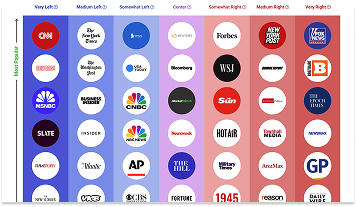
FiveThirtyEight on the media bias chart
- Bias Rating
-30% Somewhat Left
- Reliability87% Reliable GoodPolicy Leanings
4% Center
Extremely
LiberalVery
LiberalModerately
LiberalSomewhat Liberal
Center
Somewhat Conservative
Moderately
ConservativeVery
ConservativeExtremely
Conservative-100%
Liberal100%
Conservative
Average Reliability
*Our bias meter rating uses data science including sentiment analysis, machine learning and our proprietary algorithm for determining biases in news articles. Bias scores are on a scale of -100% to 100% with higher negative scores being more liberal and higher positive scores being more conservative and 0% being neutral. The rating is an independent analysis and is not affiliated nor sponsored by the news source or any other organization.
Politician Portrayal73% positive
Analysis of FiveThirtyEight Articles
Analysis of Bias in FiveThirtyEight Online Articles
FiveThirtyEight has found that in-depth coverage of elections is one of the most effective ways to drive subscriptions. It’s essential to ask: is FiveThirtyEight truly biased?
To evaluate this, we can analyze select FiveThirtyEight articles using several of Biasly’s bias-rating criteria: Tone, Tendency, Author, Diction, and Expediency Bias.
- Tone: The overall attitude conveyed by the article
- Diction: Specific word choices made by the writer
- Author: The background and social presence of the journalist
- Tendency: Patterns of bias in the writer’s broader body of work
- Expediency Bias: Quick visual or textual indicators like headlines and photos that imply bias
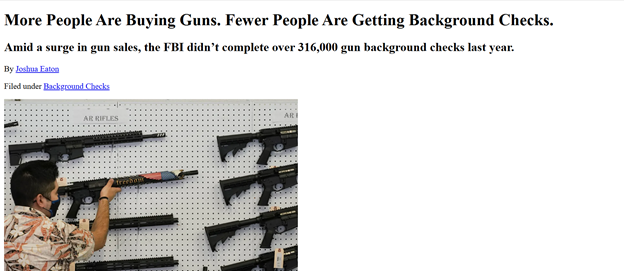
The first article we will review is “More People are Buying Guns. Fewer People Are Getting Background Checks.” It is an article representative of FiveThirtyEight’s general story, an analysis of metrics within the United States. The author’s pro-gun-control tone is evident, particularly in the imagery used in this article. This particular image is tied to the heading of gun purchases, establishing an image in the readers’ minds of larger weapons throughout the article.
The tone of the article is Somewhat Liberal, reflected in the author’s introductory paragraph. While he focuses on objective information, the introduction presents his views that the current gun control system is insufficient. This is heightened by his appeal to fear, correlating firearm sales with the surge in violent crime.
“America’s gun background check system, designed to keep weapons out of the hands of people who might use them in crimes, has struggled to keep up with record firearms sales over the past year — even as violent crime has risen dramatically in many U.S. cities.”
His language is written to support and uphold gun control laws, insinuating that the system has been inefficient. While it does not vilify gun ownership, nor any particular political party, it is fairly consistent throughout to show support for stricter gun control laws associated with liberalism.
In contrast to the tone, the diction is mostly neutral throughout the story. His vocabulary is never overtly liberal or republican, but rather matter-of-fact. Consider his references to both the democratic and republican sources:
“The National Shooting Sports Foundation, which represents the firearms industry, has worked to get more state and local records — especially ones related to mental health — into the background check system in order to cut down on delays.”
When referring to the issues, he advocates for both sides of the argument. His personal biases cannot be inferred from these passages alone, and, in turn, the article becomes more informative for the reader. The evidence and individuals mentioned are presented objectively, simply addressing the numbers associated with gun ownership and background check completion. For example, when referring to proponents of either party, he uses neutral terms such as “gun-control advocates” and “opponents”.
Joshua Eaton, the author, appears to lean Somewhat Liberal based on his X feed. The majority of his media content relates to his work as an investigative journalist and to education. He occasionally tweets that are critical of conservatives.
I’ve noted this before, but can’t stress it enough: My first feature as a journalist was covering work Catholic Charities did with migrants at the border in 2014.
Ted Cruz and Glenn Beck were there *celebrating* that work.
The shift among some conservatives since has been huge. https://t.co/kXDWfS1ZP8
— Jack Jenkins (@jackmjenkins) March 23, 2024
Overall, the article is “Somewhat Liberal,” despite remaining largely as an objective analysis of data received directly from the FBI regarding background checks and gun purchases. While it does promote liberal ideas on gun control throughout its framing, the diction keeps the information moderate. This aligns with the author’s social media activity, which shows occasional liberal-leaning commentary.
The FiveThirtyEight live blog covering the 2022 midterm elections presents information in a largely neutral and fact-focused manner. Its tone and diction remain consistent with the publication’s reputation for analytical journalism, and the article shows little overt political bias. However, subtle forms of bias still appear through content selection, framing, and the amount of data used.
The tone of “How Election Week 2022 Went Down” is neutral and informational. The writer avoids emotionally charged language, opinionated phrasing, or persuasive rhetoric. Instead, the entries focus on reporting developments, vote counts, projections, and context. This neutral diction contributes to the perception that the article is fair and balanced.
Because the blog updates in real time, the writing tends to be concise and descriptive rather than interpretive. Statements are often framed cautiously, emphasizing uncertainty where results are incomplete.
Nathaniel Rakich, such as election analysts associated with the site, are generally viewed as fair and data-driven. Their public social media activity typically centers on election news and analytical commentary, with occasional personal interests (such as sports) that do not suggest strong partisan alignment. This reinforces readers’ perception that the coverage is objective.
The title of the live blog suggests a straightforward account of events rather than an argument or narrative. It signals that the content will present facts as they unfold. The live-blog format itself also reduces opportunities for editorializing because entries must be brief and timely.
Although FiveThirtyEight is known for heavy use of statistical models and polling analysis, this particular live blog relies less on deep data analysis than many of the site’s feature articles. It often reports results and developments without extensive statistical interpretation.
This limited use of data can introduce subtle bias by omission. Without detailed context, such as historical comparisons, demographic breakdowns, or model probabilities, readers may not fully understand the significance of events. The absence of strong quantitative analysis may make the coverage feel more descriptive than analytical.
Even neutral reporting involves choices about what to include. The blog highlights certain races, states, or storylines more than others, which can shape readers’ perceptions of what matters most. This type of bias is not ideological but structural.
Additionally, brief updates may lack competing perspectives or deeper explanation, simply because of time constraints. As a result, the narrative that emerges depends heavily on which developments are reported first or most prominently.
Overall, the article demonstrates minimal explicit bias. Its neutral tone, factual language, and lack of emotional persuasion support an impression of objectivity. However, subtle biases still exist. These factors do not indicate partisan bias but rather reflect the constraints of the live-blog format.
The FiveThirtyEight midterm election live blog is largely fair and balanced, presenting information in a neutral, fact-driven style. While it avoids overt political bias, it shows mild structural bias through selective coverage and reduced use of data. Overall, it serves as an informative real-time record of events rather than a deeply analytical or opinionated piece.
In summary, FiveThirtyEight shows inconsistent bias in its reporting. Despite attempts at balance in some reporting, FiveThirtyEight’s tendency to frame stories through a liberal-leaning lens indicates an overall left-leaning orientation, particularly when covering elections.
Analysis of FiveThirtyEight Opinion Articles and Podcasts
To fully understand political bias in media, it’s important to distinguish between factual reporting and opinion pieces. While reporting aims to present facts and let readers form their own conclusions, opinion articles express personal viewpoints on current issues. Although the previous section examined factual reporting, this section turns to how bias surfaces through FiveThirtyEight’s selection and tone of opinion content.
FiveThirtyEight does not publish articles labeled as opinion articles. While they do have podcasts, even their podcasts are focused on analyzing poll data rather than discussing subjective opinions. Some of the polls may focus on an issue that is Republican or Democratic, but each focuses on objective reporting of the polls that occur. An example of an article that appears more partisan than others is Neil Lewis Jr.’s publication titled, “Why Many Americans Can’t See The Wealth Gap Between White And Black America.”
From the title alone, it is clear that the author is promoting liberal ideas about race in America. Throughout the article, he promotes liberal ideas about race, for example, he writes,
“The reality is that our nation is still racially segregated. And it’s segregated in ways that limit our opportunities to learn about each other’s life experiences.”
While his claims are backed by objective evidence, they are used to promote liberal ideology without addressing counterarguments or differing perspectives.
The FiveThirtyEight Politics podcast episode “Why Biden Is Losing Support Among Voters Of Color” from FiveThirtyEight, hosted by Galen Druke, shows only mild political bias and maintains a generally neutral tone. The episode focuses on interpreting polling data rather than promoting a political agenda, which is consistent with FiveThirtyEight’s reputation for data-driven analysis. The discussion examines recent surveys suggesting that President Biden’s support among voters of color may be declining and evaluates which polls are reliable and which may be misleading.
The tone throughout the podcast is calm, analytical, and professional. Druke does not use emotionally charged language or overt criticism. However, some phrasing frames the situation as concerning for Biden, which can subtly influence the audience’s perception. Words like “losing support” and references to troubling polling trends create a negative framing, even though the discussion itself remains measured. This kind of framing is common in political analysis and does not necessarily indicate strong bias.
A key factor reducing bias is the reliance on polling data and expert interviews rather than personal opinions. Druke speaks with political researchers from organizations that study voters of color, allowing multiple perspectives to be heard. The podcast also discusses the limitations of polling and emphasizes that early election data can be unreliable. This balanced approach helps prevent the episode from becoming one-sided.
Bias can also appear through topic selection. By focusing specifically on declining support among voters of color, the episode highlights a challenge facing the Democratic Party rather than discussing areas where Biden may be strong. This does not make the piece unfair, but it does shape the narrative toward potential weakness.
Overall, only a slight left-leaning bias is detectable. FiveThirtyEight is generally considered centrist or center-left, and the episode does not strongly defend Biden nor attack him. Instead, it treats the issue as a political problem to analyze. Druke’s moderation style is notably restrained, and he avoids endorsing specific political viewpoints.
The title sounds informative rather than sensational, suggesting an explanatory purpose. However, it also primes listeners to expect negative news about Biden before hearing the evidence. This is a subtle form of framing rather than overt bias
Overall, the podcast demonstrates mostly neutral reporting with minimal bias. The discussion relies on data, includes expert perspectives, and avoids inflammatory language. Any bias present comes mainly from framing choices, such as emphasizing negative polling trends rather than explicit opinion. As a result, the episode is best described as a balanced analysis with a slight left-leaning perspective.
FiveThirtyEight does not post many articles or podcasts that can be considered straight opinion. However, most opinionated works from FiveThirtyEight are fair, data-driven, and only hold a small left-leaning bias at most.
Analysis of Reliability in FiveThirtyEight’s Online News Articles
FiveThirtyEight aims to serve voters with objective, fact-based reporting. Its staff includes writers from varying ideological backgrounds, which can help balance coverage. However, readers should distinguish between news reporting and opinion pieces to evaluate credibility effectively.
“The View from New Hampshire” episode of the FiveThirtyEight Politics Podcast, produced by FiveThirtyEight, is generally considered a reliable source of political analysis, particularly regarding elections and polling. The show is known for its data-driven approach, its use of empirical evidence, and contributions from professional analysts rather than anonymous commentators. While discussions about voter sentiment in New Hampshire may include anecdotal observations from interviews or on-the-ground reporting, these are typically contextualized with polling data and historical trends.
However, as with any political commentary, interpretations can reflect the analysts’ assumptions, methodological choices, or uncertainties inherent in polling. Overall, the episode is best viewed as credible analytical journalism, strong on statistical insight but not immune to perspective, especially when forecasting or interpreting voter behavior.
“Joe Biden currently favorite in wide-open Democratic race: FiveThirtyEight forecast” is generally considered a reliable piece of political reporting, particularly regarding polling and election forecasts. The article summarizes a statistical model that incorporates indicators such as polling data, endorsements, and fundraising, emphasizing probabilities rather than definitive predictions.
For example, it reports that Joe Biden had about a 42% chance of winning a majority of delegates at that stage, highlighting the uncertainty of a large primary field rather than asserting a guaranteed outcome. However, because the story relies on modeling and interpretation of early-stage data, its conclusions are inherently contingent on assumptions and subject to change as new information emerges. Overall, the article is best viewed as credible data-driven journalism, strong on methodology and transparency about uncertainty, though not a definitive prediction of real-world results (at least at the time, we of course know now that Biden did win the primary and general election in 2020).
Quality of Sources and Facts Used
FiveThirtyEight often uses credible sources from across the political spectrum. They are known for their in-house tracking of election data.
Consider the following article, “Why Many Americans Can’t See The Wealth Gap Between White And Black America,” written by Neil Lewis Jr. While the article uses graphs that showcase racial disparity and separation, similar to other FiveThirtyEight articles, it does not provide arguments that support the other side or define why this is the case. The article provides no quotes regarding the topic, but does provide data. When considering data, it is important to remember the variety of sources used and the inherent bias of those who collected it. The article includes these sources:
- 2010 Census Block Data from Michigan (non-partisan)
- 2014 survey from PRRI (non-partisan)
- Perspectives on Psychological Science (non-partisan)
- Rhea Boyd (left-leaning)
- Sage Journals (non-partisan)
While Lewis uses several data sources to support his claims, most of the interpretation and explanation of that data comes from the author himself or sources with similar perspectives. The lack of quotes and external opinions from right-leaning sources makes the piece inherently more biased. Without diversity of thought, regardless of the accuracy of the data used, it becomes much more liberal-leaning.
However, the data used is accurate. The census data is an example of objectively accurate information about American demographics, regardless of one’s political alignment. Similarly, the studies used are peer-reviewed from non-partisan sources. Such studies are generally more reliable because of the peer-review process. However, it lacks the necessary information to provide a holistic perspective on the issue of race in America, making it potentially an untrustworthy source, regardless of its quality.
“The Senate Is Losing One Of Its Few Remaining Moderate Republicans” is another strong case study in this publication’s sourcing and facts. The article is focused on Mitt Romney not running for re-election in the 2024 election. The article relies on data from both inside FiveThirtyEight and external sources such as Quinnipiac University. This data helps strengthen the article’s factual basis.
However, the lack of quotes can make their conclusions seem uncertain. For example, the article claims Mitt Romney didn’t run for re-election because of relatively low numbers in pre-election estimates. However, this is fully reliant on the data. We don’t hear from anyone associated with Romney or other political experts.
Selection and Omission Bias
In Lee Drutman’s “Why The Two-Party System Is Effing Up U.S. Democracy,” the article primarily opposes the two-party system rather than any particular political party; however, it tends to place more blame on Republicans for the national division over politics. Typical of the majority of FiveThirtyEight articles, few quotes are used, but three sources are cited.
This includes Levi Boxell, Matthew Gentzkow, and Jesse M. Shapiro’s work, Jonathan Rodden, Noam Gidron, James Adam, and Will Horne’s book “American Affective Polarization in Comparative Perspective.” The sole quote provided comes from Boxell, Gentzkow, and Shapiro:
“[O]ur central conclusion — that the U.S. stands out for the pace of the long-term increase in affective polarization — is not likely an artifact of data limitations.”
They are left-leaning, with the other sources’ political affiliations unknown. While they may be partisan, the conclusion itself is not. It is simply a reflection of data on political division in the United States compared with other countries. Regardless, the article finds Republicans primarily responsible for political division in the United States and uses language to cast them in a negative light. This includes the insistence that a majority of Republicans believed Trump was still president in 2020 without discussing Republicans who had opposed these ideas.
“What Americans Think Of The Biden Impeachment Inquiry” is one of the strongest examples of an article having no selection or omission biases. This article begins by noting that most Americans believe Hunter Biden profited from Joe Biden’s positions of power. This is important to say, even if it goes against later points.
They cite several sources to show that most Americans don’t believe Joe Biden was complicit in his son’s actions. They also show Biden’s overall decline in popularity. Most publications would’ve omitted this, but FiveThirtyEight wanted to showcase the full story. They even issue a correction about a statement from Rep. Kevin McCarthy (R-Calif.). Overall, this article is willing to present all the facts, even those that go against its main point.
FiveThirtyEight Bias Overview
Founded in 2008 by Nate Silver, FiveThirtyEight was established to provide data-driven insights across politics, sports, economics, and culture. Nate Silver, a statistician and writer, came up with the idea after successfully predicting election outcomes using statistical models. The publication aims to inform readers by using data and statistical methods to explain complex issues and predict future outcomes, making it a valuable resource for those interested in understanding the numbers behind the news.
A unique aspect of this publication is its name, which refers to the total number of electors in the United States Electoral College. This reflects the site’s original focus on political forecasting and elections, but it has since expanded to cover many other areas using data analysis.
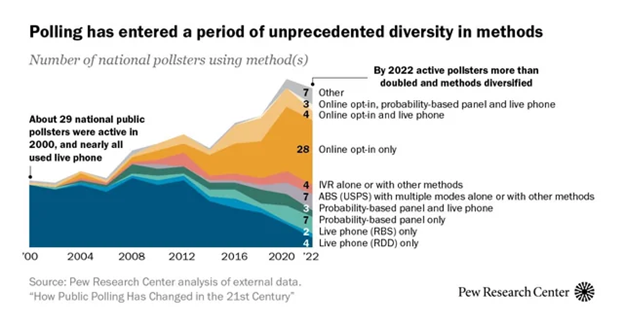
Source: Pew Research
As a leading media outlet for elections, FiveThirtyEight plays a significant role in shaping public perception. Readers’ trust in the accuracy of news may mirror the conclusions reached by Biasly’s media bias ratings. This article delves into FiveThirtyEight’s editorial tendencies to explore whether political bias is present and, if so, to what degree.
Is FiveThirtyEight Biased?
Based on Biasly’s evaluations, FiveThirtyEight is rated as Somewhat Left.
By examining content patterns and the broader context of media influence, we aim to offer a balanced perspective on FiveThirtyEight’s political bias—and contribute to the ongoing discussion about bias in the news.
How Does Biasly Rate News Sources?
Biasly uses proprietary algorithms and a team of analysts to provide comprehensive bias evaluations across thousands of news outlets. Over 200,000 articles from more than 3,200 sources have been analyzed to identify the most accurate and unbiased stories.
Biasly assigns each outlet three key scores:
- Reliability Score – Reflects factual accuracy
- AI Bias Score – Generated via natural language processing
- Analyst Bias Score – Assessed by human political analysts
These scores are based on seven core metrics: Tone, Tendency, Diction, Author Check, Selection/Omission, Expediency Bias, and Accuracy. These elements help analysts and algorithms evaluate the political attitude conveyed by each article.
Biasly’s Bias Meter ranges from -100% (most left) to +100% (most right), with 0% indicating neutrality. The system evaluates individual articles based on political terms, policies, figures, and sentiment to calculate precise bias ratings.
Is FiveThirtyEight Politically Biased?
FiveThirtyEight earns a Somewhat Left rating for its AI Bias Score and a Somewhat Left for its Analyst Bias Score. The Analyst Bias Score is generated by reviewers from liberal, moderate, and conservative backgrounds. Analysts reviewed FiveThirtyEight articles and noted preferences in areas like coverage of liberal politicians. However, the outlet maintained objectivity on most other topics.
This bias score is determined through natural language processing that evaluates the tone, word choice, and opinion embedded in the reporting.
How to Evaluate Bias
Although Biasly rates FiveThirtyEight as Somewhat Left, it’s important to remember that bias can vary from article to article. This complexity underscores the importance of examining each article individually. So, let’s learn how to evaluate media bias.
Recognizing media bias requires awareness and critical thinking. Often, readers trust news sources that affirm their existing beliefs—a psychological tendency known as confirmation bias. This makes it harder to identify slanted narratives or one-sided reporting.
To address this, it’s essential to challenge your assumptions by consulting multiple perspectives and verifying information through third-party analysis. Tools like Biasly’s media bias ratings allow readers to compare the same news story across the political spectrum.
Ultimately, bias isn’t always a matter of what is said—it’s also about what is left out, how topics are framed, and which stories are chosen for coverage. Learning to recognize these patterns can help readers make more informed decisions and develop greater media literacy.
To start comparing news outlets and gain a better understanding of bias, sign up for Biasly’s Media Bias & News Analytics Platform to see how stories vary between sources.
FiveThirtyEight Reliability Overview
Is FiveThirtyEight Reliable?
FiveThirtyEight is generally considered reliable by evaluators and readers alike. Their strong usage of facts and multiple sources gives them a strong reputation. One area they could improve on is using quotes. Although data is their focus, it can sometimes be difficult for the reader to understand. Good quotes could help the reader understand the data being shown.
At Biasly, we specialize in evaluating not just bias but also the reliability of media outlets. Let’s explore the accuracy and trustworthiness of FiveThirtyEight.
How to Evaluate Reliability?
Reliability refers to how trustworthy or accurate a news source is. If we can’t trust what we read, then continuing to consume content from that outlet serves little purpose. So how do we evaluate a news outlet’s reliability?
There are several key indicators of reliability to consider when assessing a media source. Red flags of an unreliable article can include wild, unsubstantiated claims, facts that depend on other unreliable sources, heavy use of opinionated language, and more. In contrast, hallmarks of a reliable source include:
- Absence of subjective language
- Citing credible sources (e.g., .gov, .edu, academic references)
- Verifiable facts and statistics from multiple outlets
- Use of primary sources, like interviews or transcripts
- Consistency with coverage across other platforms
Biasly’s reliability scores incorporate these elements in evaluating media outlets.
So How Does FiveThirtyEight Fare in Its Reliability?
The political reliability index developed by Biasly assesses both accuracy and trustworthiness. FiveThirtyEight currently holds Good Reliability Score, which is calculated as a weighted average of:
- Fact Analysis Score – Evaluates the accuracy of claims, facts, and evidence.
- Source Analysis Score – Assesses the number, diversity, and credibility of sources and quotes used.
FiveThirtyEight’s Source Analysis Score is Average at 66% Reliable. This suggests moderate trustworthiness in its sourcing practices. The score is AI-generated and considers quote length, frequency, diversity, and quality.
The Fact Analysis Score of FiveThirtyEight is Excellent at 93% Reliable. This further shows how well FiveThirtyEight supports its claims, addresses selection and omission bias, and presents verifiable evidence.
While FiveThirtyEight leans toward factual reporting, occasional lapses—such as unbalanced viewpoints or incomplete data—can affect its reliability rating. These nuances emphasize the importance of analyzing individual articles.
FiveThirtyEight’s Accuracy and Reliability
According to Biasly’s analysis, FiveThirtyEight maintains Good Reliability Score, but individual articles may vary significantly. Let’s dive into the details.
Political orientation plays a crucial role in how audiences perceive reliability. FiveThirtyEight has been accused of favoring a liberal narrative, potentially at the expense of factual reporting. To validate such claims, it’s essential to analyze whether the publication backs its assertions with sufficient evidence and diverse viewpoints.
Two common types of bias that affect factuality include:
- Selection Bias – Highlighting or omitting stories to fit a particular narrative.
- Omission Bias – Leaving out differing perspectives or relevant details to skew perception.
Biasly’s accuracy ratings use a scale from 1% (least accurate) to 100% (most accurate). Factors include supporting evidence, reliable internal and external sources, and balanced viewpoints.
For instance, Biasly gave Quartz a Center (slightly center-left) Bias and a Good Reliability Score. The outlet primarily focuses on international business, economics, and global affairs, and its reporting style is generally data-driven and nonpartisan. Analysts note that Quartz articles tend to rely on factual information, expert sources, and neutral tone rather than ideological framing, though occasional selection or omission bias may appear depending on the topic. Because Quartz publishes relatively few overt opinion pieces and emphasizes explanatory reporting, its content is often considered dependable for readers seeking straightforward coverage of economic and global issues. Overall, Biasly characterizes Quartz as a largely objective news source with limited political slant and consistently solid accuracy.
So, is FiveThirtyEight Reliable?
Overall, FiveThirtyEight can be considered an outlet that is very reliable. The site regularly publishes fact-based reporting and demonstrates a commitment to credible sourcing across most of its content. While some opinion or editorial framing may appear, particularly in commentary sections, the majority of its coverage maintains journalistic integrity and a balanced presentation of perspectives. Occasional gaps in attribution or depth may occur, but they do not significantly undermine the outlet’s overall trustworthiness.
As media literacy improves, readers can more easily detect issues with selection bias, omission bias, and factuality. To strengthen your ability to assess reliability across the political spectrum, use Biasly’s News Bias Checker to compare how multiple outlets report the same story.
This empowers you to consume more accurate, balanced, and dependable news.
FiveThirtyEight Editorial Patterns
FiveThirtyEight’s coverage of political topics often reflects a Somewhat Left bias, with consistent patterns in phrasing, source selection, and thematic focus that are Slightly Liberal. While the publication demonstrates journalistic standards in many of its reports, the choice of issues, framing, and word usage can indicate a political slant. Their editorial patterns generally lean closer to the liberal end of the political spectrum.
Coverage of Liberal vs. Conservative Topics
FiveThirtyEight is best known for its coverage of elections. They cover presidential, gubernatorial, and congressional elections extensively. When covering elections where a Democrat is favored, they tend to focus more on the data and projections. Meanwhile, in elections where a Republican is favored, they will focus more on mistakes or gaffes they make on the campaign trail. Republican politicians generally face more scrutiny from FiveThirtyEight.
When they do cover other political issues, FiveThirtyEight is generally able to avoid bias. FiveThirtyEight is reliant on the use of data to make its claims. However, news media bias manifests in subtle ways, such as placing greater prominence on Democratic voices or using emotional diction when describing liberal causes.
Policy and Issue Framing
Although election coverage from FiveThirtyEight can show occasional bias, their coverage of many of the top issues in the United States is very balanced. Abortion is the political issue they tend to cover the most. Biasly has analyzed 34 FiveThirtyEight articles about abortion as of Feb. 23. Border control and criminal justice are also issues that are talked about consistently by FiveThirtyEight. With all these issues, FiveThirtyEight can address them from a neutral perspective.
Even in neutral coverage, phrasing choices shape perception. Articles will describe liberal proposals as “expanding access” or “strengthening protections,” while conservative legislation may be described as “imposing limits” or “rolling back rights.” This consistent word choice reflects an editorial direction that, even unintentionally, can contribute to bias in news media.
Coverage and Relevance
FiveThirtyEight’s reporting often touches on key issues central to political campaigning, including campaign financing, campaign trails, and election results. As such, it serves as a compelling case study for examining source bias and news media bias in reporting.
Readers who wish to further explore how FiveThirtyEight compares with other publications can visit Biasly’s Media Bias Chart to analyze tone and word choice in real time.
Funding and Ownership
Who Owns FiveThirtyEight?

Nate Silver, Founder, FiveThirtyEight – source: Wikimedia Commons
FiveThirtyEight was acquired by ESPN in March 2014 from founder Nate Silver. In 2018, operations were transferred to ABC News. Both ABC News and ESPN are owned by The Walt Disney Corporation. In 2023, founder Nate Silver left the company. G. Elliot Morris was put in charge of the site and was tasked with creating a new prediction model. In March 2025, FiveThirtyEight was dissolved, and the remaining 15-person staff was let go. This was a part of a larger downsizing by the Walt Disney Corporation.
Who Funds FiveThirtyEight?
In the early days of FiveThirtyEight, they made money through licensing of their predictive models. Specifically, they often collaborated with the New York Times. After being acquired by ESPN, they became exclusive to companies owned by the Walt Disney Corporation. From 2014 on, they made their money through ads and funding from their parent company.
Additional Insights
News Source Comparison
When comparing news sources, FiveThirtyEight is often evaluated alongside other regional and national outlets that focus on election coverage. Sources like AP News, NPR, and Politico often present similar tones and editorial philosophies. While FiveThirtyEight maintains a Somewhat Left media bias, it differs from strongly partisan sources in that it includes opposing viewpoints and strives for a balanced regional coverage.
This contrasts with more biased media outlets that consistently present one-sided narratives without factual counterpoints. Readers seeking balanced political coverage may compare FiveThirtyEight’s framing of issues with outlets rated as Center or Lean Right on our Media Bias Chart, or explore other papers on our Similar Sources page.
Notable Contributors and Authors
FiveThirtyEight features a diverse range of reporters and columnists, many of whom are deeply familiar with elections. In March 2025, FiveThirtyEight employed 15 reporters.
Nathaniel Rakich was one of their most notable reporters. He got his start in journalism for his college paper, “The Harvard Crimson.” He worked several analyst jobs before being hired by FiveThirtyEight in 2019. He was named senior editor in 2023, a role he held until the company shut down in 2025. He is currently a managing editor at Votebeat. Biasly considers him a somewhat left-leaning reporter, but reliable.
Amelia Thomson-DeVeaux was also one of their top reporters. She started her writing career as a writing fellow for The American Prospect in 2013. She was hired as a Senior Politics Reporter in 2019. She was named a senior editor in 2023. She left the company in December 2023. AP News hired her shortly after. Biasly considers her a left-leaning reporter with average reliability.
Related Tools and Resource Pages
To better understand how FiveThirtyEight fits into the broader media landscape, we recommend exploring these helpful resources:
- Media Bias Chart: See where FiveThirtyEight ranks among hundreds of media outlets across the political spectrum.
- Political Bias Chart: Visualize political slants of news sources across various policy areas.
- Journalist Bias Analytics Platform: Explore how individual journalists contribute to bias within their publications.
- Politician Bias Analytics Platform: Compare how politicians are framed differently by FiveThirtyEight and other outlets.
- Media Literacy Education Platform: Learn how to critically assess media sources, bias techniques, and news reliability.
Frequently Asked Questions
FiveThirtyEight is rated as Somewhat Left based on Biasly’s media bias algorithm, which assesses sentiment, article framing, and policy favorability.
While FiveThirtyEight is not widely known for spreading fake news or misinformation. However, critics have occasionally pointed to selection or omission bias in its political reporting, in which certain perspectives or contextual details may be underrepresented. Despite these criticisms, its reporting is generally considered fact-based and reliable. The outlet is also known for its predictive models and data-driven analysis, though it notably mispredicted the outcome of the 2016 U.S. presidential election by forecasting a victory for Hillary Clinton.
Biasly uses a combination of AI sentiment analysis and human analyst review to assess tone, fact accuracy, source quality, and media bias indicators. Learn more on our Bias Meter page.
Generally, yes, though partisan framing and selective reporting can affect perceived reliability.
Military Spending
| Date | Sentiment | Associated Article | Snippet |
|---|---|---|---|
| 08/25/2019 | 75% For | Trump Family Detentions Flores Agreement (link) | So, of course, the Trump administration is doing the opposite in a baldfaced |