

 Most Biased
 Satire
 Economy
 Opinion
 Elections
 Environment
 Entertainment
 Government
 Technology
 Politics
 Health
-12% Somewhat Left
Bias Meter
Extremely
Liberal
Very
Liberal
Somewhat Liberal
Center
Somewhat Conservative
Very
Conservative
Extremely
Conservative
-100%
Liberal
100%
Conservative

- Profile
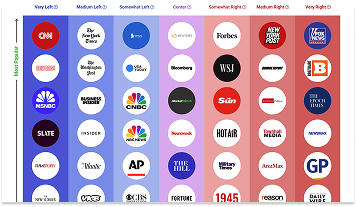
Houston Chronicle on the media bias chart
- Bias Rating
-12% Somewhat Left
- Reliability40% Reliable AveragePolicy Leanings
-4% Center
Extremely
LiberalVery
LiberalModerately
LiberalSomewhat Liberal
Center
Somewhat Conservative
Moderately
ConservativeVery
ConservativeExtremely
Conservative-100%
Liberal100%
Conservative
Average Reliability
*Our bias meter rating uses data science including sentiment analysis, machine learning and our proprietary algorithm for determining biases in news articles. Bias scores are on a scale of -100% to 100% with higher negative scores being more liberal and higher positive scores being more conservative and 0% being neutral. The rating is an independent analysis and is not affiliated nor sponsored by the news source or any other organization.
Politician Portrayal54% negative
Analysis of Houston Chronicle Articles
Analysis of Bias in Houston Chronicle Online Articles
To evaluate this, we can analyze select Houston Chronicle articles through several of Biasly’s bias rating criteria: Tone, Tendency, Author, Diction, and Expediency Bias.
- Tone: The overall attitude conveyed by the article
- Diction: Specific word choices made by the writer
- Author: The background and social presence of the journalist
- Tendency: Patterns of bias in the writer’s broader body of work
- Expediency Bias: Quick visual or textual indicators like headlines and photos that imply bias.

Source: Houston Chronicle
One article features a headline questioning how much responsibility Houston elected officials bear for an affordable housing project in Houston, Texas, being delayed. A photo of the housing block is shown underneath said headline. The expediency bias might prompt readers to critically look at the apartment complex.
In the article, reporters R.A. Schuetz and Rebekah F. Ward outlined delays to a nearly completed affordable housing project after the discovery of lead-laced incinerator ash on Houston Housing Authority land. A factual tone is used throughout, with the impacts of the ash on the community being stated, as well as long-term ramifications arising from the delays.
“The ash has turned into a flashpoint delaying the opening of the $100 million affordable housing complex and killing plans to expand affordable housing options for renters and homeowners nearby.”
The article is very technical when describing contamination, but Schuetz and Ward use very humanizing diction when quoting residents’ personal feelings on the issue. This framing subtly situates the subjects within a progressive ideological lens by showing the impacts of government negligence towards everyday people, further underscoring the article’s ideological slant.
Another article titled “Biden Moves to Protect Transgender Athletes Banned from Texas Sports” maintains a more measured tone, presenting the policy clash factually and including Republican perspectives on fairness and state rights without heavy editorializing. Phrases such as “latest clash between the Biden administration and red states” are informative rather than loaded when presented here.
In stark contrast, Houston Chronicle article titled “The Real Threats to Democracy are Trump and the GOP” is far more aggressive in its tone and diction, directly attacking Republican figures, saying:
“Republicans, especially Trump and his cronies, tend to accuse others (Democrats) of what they are already guilty of doing.”
From the language the article uses, such as “cronies,” it is abundantly evident where the author’s leaning lies, contributing to its tone. Using emotionally charged words or loaded phrases, such as “guilty,” is often seen in more partisan outlets, showing that while Houston Chronicle may be generally center, their priorities do indicate a more progressive leaning slant.
The reporter of the first article listed, Rebecca Schuetz, does not avoid emotional language but does maintain a relatively neutral stance when questioning the motives of Texas representatives, instead showing the impacts of these actions on the community in Houston, which was affected. While her social media presence leans slightly liberal, her writing remains professional and neutral in tone. Here is an example of left-leaning sway used on Rebecca Schuetz’s Twitter profile:
Highly recommend this essay by a journalist who lost his home in 2023:https://t.co/sCP7pa2JYL
— Rebecca Schuetz (@RASchuetz) November 22, 2024
In summary, Houston Chronicle shows inconsistent bias in its reporting. While some local and policy articles strive for balance through factual presentation, coverage of high-profile Republican initiatives and national conservative figures reveals a progressive slant through diction, tendency, and story framing. This indicates an overall left-leaning orientation on many issues, even though the outlet overall remains closer to the center, particularly when covering Texas Republican leadership and cultural debates.
Analysis of Houston Chronicle Opinion Articles
The opinion section is where Houston Chronicle’s ideological lean is easier to detect. Unlike straight-news coverage, which often stays procedural and source-driven, opinion pieces are more willing to use value-laden language and argue openly for a preferred civic or political outcome.
One example is the editorial “Whitmire promised to protect Houston from political turmoil. He failed.” The title is blunt and accusatory. It does not merely suggest that the mayor faced a difficult tradeoff; it judges his performance directly and frames the issue as a failure of leadership. That style is typical of editorial writing, but it also places the paper clearly in a critical posture toward a local official seen as accommodating pressure from Governor Abbott.
Another example is “7 things everyone needs to know about Houston’s immigration fight.” The “myths and facts” structure gives the piece an explanatory tone, but it also creates an asymmetry: one side’s claims are implicitly categorized as misconceptions, while the editorial voice occupies the position of correction. That rhetorical structure tends to favor the paper’s preferred interpretation while still sounding informative.
The opinion section makes explicit what the newsroom often handles more subtly. It regularly advances arguments sympathetic to immigrant protections, civil-rights claims, and criticism of hardline Republican policy. That does not invalidate the arguments, but it does make the paper’s editorial environment feel more clearly center-left than its straight-news format alone might suggest.
Analysis of Reliability in Houston Chronicle’s Online News Articles
Houston Chronicle is generally more reliable in straight-news reporting than in opinion writing, and much of its local coverage follows the expected standards of a major metro paper. Articles often rely on city records, council proceedings, public statements, court developments, and on-the-record interviews. That gives the outlet a solid factual baseline even when certain topics are framed more sympathetically toward Houston’s local political culture.
One example is “Houston changes ordinance limiting cooperation with ICE after pressure from governor.” Reporter Juan A. Lozano lays out the policy shift, the governor’s pressure campaign, and the resulting changes to city policy through official statements, procedural details, and attributed quotes. The piece stays close to verifiable events and does not rely on speculation. Even where the framing may favor Houston officials or cast state intervention in a harsher light, the factual scaffolding remains visible and checkable.
This is where Houston Chronicle is strongest: when it stays close to records, votes, court rulings, and direct statements. Its reliability weakens less through obvious factual error than through the possibility of asymmetric framing—especially in stories where local Democratic officials and Republican state actors are in direct conflict. Readers should therefore distinguish between factual reliability and interpretive balance. A story can be solid on the facts while still nudging readers toward one side’s understanding of what those facts mean.
Quality of Sources and Facts Used
Houston Chronicle usually relies on credible institutional and political sources, especially in local government reporting. City officials, court records, public safety agencies, governors’ offices, meeting transcripts, and prior reporting all appear regularly in its news articles. The issue is less whether the outlet uses real sources than how those sources are weighted and arranged.
Consider the article “Mayor Whitmire, Houston council pass amendments to ICE policy as Greg Abbott threatens funding.” The piece is structured as a procedural and political update, with quotes from Mayor John Whitmire, city council members, and references to Abbott’s office and the threatened grants. The sourcing is credible and the chronology is easy to follow.
The quote structure suggests a report built more on short attributed statements and paraphrase than on long blocks of direct speech. The shortest quotes are only a few words long, while the longest are closer to a full sentence from public officials. The average quote length appears moderate, which helps the story move efficiently but also means readers are often receiving interpretation through the reporter’s framing rather than through extended unfiltered source language.
On linked sources, the article appears to lean heavily on internal archive links and institutional references rather than a broad set of external ideological or expert sources. The overall sourcing footprint is therefore credible but somewhat narrow. Houston officials and city-side voices receive the most narrative room, while Abbott’s position is represented more briefly through official statements. That does not make the article inaccurate, but it does tilt the reader toward the local-government frame by giving that side more texture, context, and emotional weight.
Sources referenced in the examples include:
- Mayor John Whitmire and Houston City Council members
- Gov. Greg Abbott and his office
- Houston Police Department references and prior ordinances
- Public safety grant documents and funding threat notices
- Houston City Council meeting records and votes
- Houston Chronicle archives and prior reporting
- state and federal legal documents related to immigration disputes
Selection and Omission Bias
Houston Chronicle provides extensive coverage of Houston’s local governance and its clashes with Texas Republican leadership, which is reasonable given the outlet’s readership base in a major Democratic-leaning city within a red state. However, bias may still emerge through framing and story selection.
In “Houston passes ICE policy amendments as Greg Abbott threatens funding” and follow-up reporting on HPD’s return to its prior cooperation policy, selection bias surfaces through the article’s emphasis on negative aspects of yielding to state pressure. The coverage repeatedly highlights the “flip-flop,” “confusion,” and criticism from council members who felt the changes diluted the original ordinance, while offering limited exploration of the broader context of public safety grants, the fiscal impact on Houston policing, or conservative arguments regarding cooperation with federal immigration enforcement.
The articles do not deeply examine proactive measures taken by Governor Abbott’s office to address border security concerns or data on prior HPD-ICE interactions that motivated the funding threat. Therefore, the coverage leans toward portraying the state action primarily as political bullying rather than a legitimate policy dispute. Still, it remains rooted in verifiable quotes from officials and meeting records.
The article does not highlight any positive outcomes or bipartisan rationales that might have influenced the policy reversal, nor does it present contrasting viewpoints from state lawmakers or law enforcement groups supporting stricter cooperation. That said, the reporting does not cross into overt editorializing and is, for the most part, grounded in verifiable facts and quotes.
By comparison, the article “U.S. appeals court says Texas’ migrant deportation law, SB4, can take effect” shows a stronger balance. It lays out the court ruling, includes legal arguments from both the Biden administration and Texas officials, and references documentation available for public review. The piece integrates procedural details and quotes from multiple sides without heavy interpretive framing of motives.
In opinion pieces, issues with selection and omission are more common. The articles we’ve covered so far reflect the Houston Chronicle’s Somewhat Left views, but this is not detrimental to its reliability. Its story selection favors issues more likely to concern liberals in Houston, suggesting it neglects issues in Texas that concern conservatives. However, the contents of Houston Chronicle’s articles maintain accuracy and tend to cite evidence from numerous and varied sources.
Houston Chronicle Bias Overview
Houston Chronicle started as The Houston Chronicle, first founded in 1901 by a former reporter for the now-defunct Houston Post, Marcellus E. Foster. It is now owned by Hearst Communications. It serves as Houston’s primary daily newspaper, known for coverage of local politics, energy, NASA, and Texas affairs. The outlet has won Pulitzer Prizes, including for editorial writing on voter issues.
When it comes to media bias, both AI and media analysts have evaluated its content, sources, and funding to determine its political leaning.
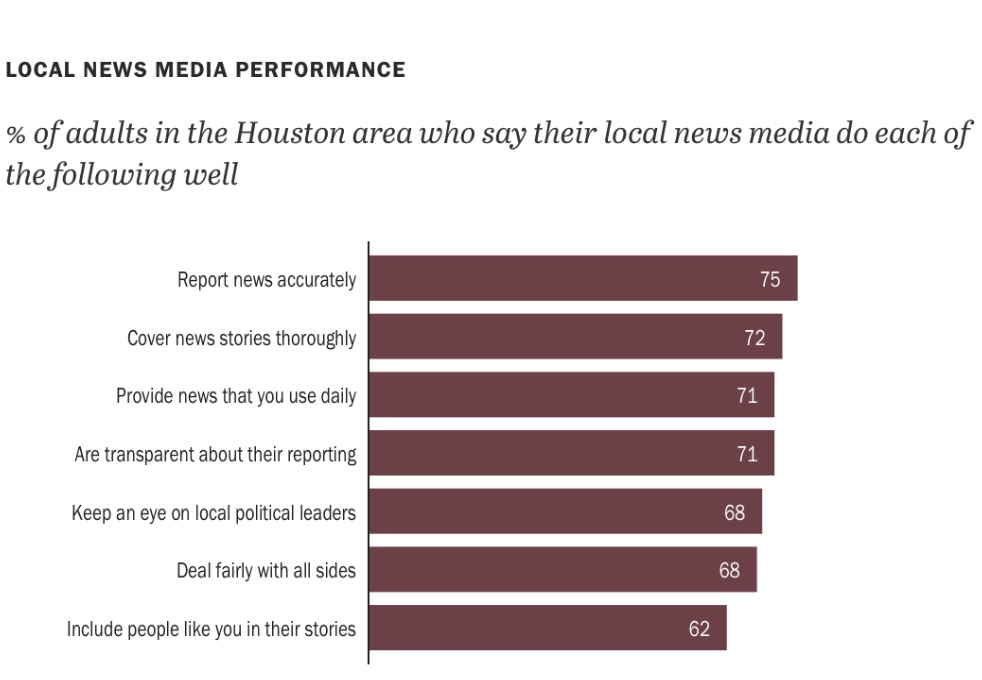
Source: Pew Research
As a leading local media outlet in Texas, Houston Chronicle plays a significant role in shaping public perception. Readers’ trust in the accuracy of local news may mirror the conclusions reached by Biasly’s media bias ratings. This article delves into Houston Chronicle’s editorial tendencies to explore whether political bias is present and, if so, to what degree.
Is Houston Chronicle Biased?
Based on Biasly’s evaluations, Houston Chronicle is rated as Somewhat Left.
By examining content patterns and the broader context of media influence, we aim to offer a balanced perspective on Houston Chronicle’s political bias—and contribute to the ongoing discussion about bias in the news.
How Does Biasly Rate News Sources?
Biasly uses proprietary algorithms and a team of analysts to provide comprehensive bias evaluations across thousands of news outlets. Over 200,000 articles from more than 3,200 sources have been analyzed to identify the most accurate and unbiased stories.
Biasly assigns each outlet three key scores:
- Reliability Score – Reflects factual accuracy
- AI Bias Score – Generated via natural language processing
- Analyst Bias Score – Assessed by human political analysts
These scores are based on seven core metrics: Tone, Tendency, Diction, Author Check, Selection/Omission, Expediency Bias, and Accuracy. These elements help analysts and algorithms evaluate the political attitude conveyed by each article.
Biasly’s Bias Meter ranges from -100% (most left) to +100% (most right), with 0% indicating neutrality. The system evaluates individual articles based on political terms, policies, figures, and sentiment to calculate precise bias ratings.
Is Houston Chronicle Politically Biased?
Houston Chronicle earns a Somewhat Left rating for its AI Bias Score and a Somewhat Left for its Analyst Bias Score. The Analyst Bias Score is generated by reviewers from liberal, moderate, and conservative backgrounds. Analysts reviewed several Houston Chronicle articles and noted preferences in areas like coverage of liberal politicians and policy topics.
For example, articles involving ICE appeared to contribute to the outlet’s more liberal-leaning evaluations.
Texas’s demography presents a contrasting backdrop. Pew Research shows that 67% of Texas’s population identifies as Christian, with 27% of them being Evangelical Protestants. Studies show that Evangelicals are one of the most strongly affiliated groups with the Republican Party.
This means Texas leans more conservative, which could explain differing perceptions of Houston Chronicle’s content. Because Texas overall leans conservative, perceptions of the outlet’s bias may differ sharply among readers.
This Bias score is determined through natural language processing that evaluates the tone, word choice, and opinion embedded in the reporting. Recent AI evaluations highlight liberal-leaning narratives in articles discussing the Republican Party and LGBTQ+ issues.
How to Evaluate Bias
Although Biasly rates Houston Chronicle as Somewhat Left, it’s important to remember that bias can vary from article to article. Houston Chronicle also covers a conservative-leaning state with objectivity on many issues, from state legislation to social developments. This complexity underscores the importance of examining each article individually. So, let’s learn how to evaluate media bias.
Recognizing media bias requires awareness and critical thinking. Often, readers trust news sources that affirm their existing beliefs—a psychological tendency known as confirmation bias. This makes it harder to identify slanted narratives or one-sided reporting.
To address this, it’s essential to challenge your assumptions by consulting multiple perspectives and verifying information through third-party analysis. Tools like Biasly’s media bias ratings allow readers to compare the same news story across the political spectrum.
Ultimately, bias isn’t always a matter of what is said—it’s also about what is left out, how topics are framed, and which stories are chosen for coverage. Learning to recognize these patterns can help readers make more informed decisions and develop greater media literacy.
To start comparing news outlets and gain a better understanding of bias, sign up for Biasly’s Media Bias & News Analytics Platform to see how stories vary between sources.
Houston Chronicle Reliability Overview
Is Houston Chronicle Reliable?
Houston Chronicle finds itself toward the middle of the spectrum, with neither high nor low accuracy. Its status as a local news outlet contributes to its moderate reputation for reliability. According to Pew Research, Americans generally hold less politically polarized views of local news than of national media. In fact, 85% of adults regard local journalism as at least somewhat important to their community. However, another Pew study reports that satisfaction with local political news coverage remains disproportionately low relative to its airtime.
This suggests that Houston Chronicle’s popularity among Texas residents may not stem from the reliability of its political news coverage. Further investigation is needed to determine whether bias or other factors are affecting its accuracy. At Biasly, we specialize in evaluating not just bias but also the reliability of media outlets. Let’s explore the accuracy and trustworthiness of Houston Chronicle.
How to Evaluate Reliability?
Reliability refers to how trustworthy or accurate a news source is. If we can’t trust what we read, then continuing to consume content from that outlet serves little purpose. So how do we evaluate a news outlet’s reliability?
There are several key indicators of reliability to consider when assessing a media source. Red flags of an unreliable article can include wild, unsubstantiated claims, facts that depend on other unreliable sources, heavy use of opinionated language, and more. In contrast, hallmarks of a reliable source include:
- Absence of subjective language
- Citing credible sources (e.g., .gov, .edu, academic references)
- Verifiable facts and statistics from multiple outlets
- Use of primary sources, like interviews or transcripts
- Consistency with coverage across other platforms
Biasly’s reliability scores incorporate these elements in evaluating media outlets.
So How Does Houston Chronicle Fare in Its Reliability?
The political reliability index developed by Biasly assesses both accuracy and trustworthiness. Houston Chronicle currently holds Average Reliability Score, which is calculated as a weighted average of:
- Fact Analysis Score – Evaluates the accuracy of claims, facts, and evidence.
- Source Analysis Score – Assesses the number, diversity, and credibility of sources and quotes used.
Houston Chronicle’s Source Analysis Score is Average at 40% Reliable. This suggests moderate trustworthiness in its sourcing practices. The score is AI-generated and considers quote length, frequency, diversity, and quality.
The Fact Analysis Score of Houston Chronicle is Pending at N/A. This further shows how well Houston Chronicle supports its claims, addresses selection and omission bias, and presents verifiable evidence.
While Houston Chronicle leans toward factual reporting, occasional lapses—such as unbalanced viewpoints or incomplete data—can affect its reliability rating. These nuances emphasize the importance of analyzing individual articles.
Houston Chronicle’s Accuracy and Reliability
According to Biasly’s analysis, Houston Chronicle maintains Average Reliability Score, but individual articles may vary significantly. Let’s dive into the details.
Political orientation plays a crucial role in how audiences perceive reliability. Houston Chronicle has been accused of favoring a liberal narrative, potentially at the expense of factual reporting. To validate such claims, it’s essential to analyze whether the publication backs its assertions with sufficient evidence and diverse viewpoints.
Two common types of bias that affect factuality include:
- Selection Bias – Highlighting or omitting stories to fit a particular narrative.
- Omission Bias – Leaving out differing perspectives or relevant details to skew perception.
Biasly’s accuracy ratings use a scale from 1% (least accurate) to 100% (most accurate). Factors include supporting evidence, reliable internal and external sources, and balanced viewpoints.
For instance, Biasly gave USA Today a Center Bias and a Good Analyst Reliability Score. One article, titled “Kimmel wants Trump ‘fired’ for making his own ‘joke about his death’”, showed an Average reliability rating for limited use of the opposite viewpoint. In contrast, another piece from the outlet, titled “White House to review security with Secret Service after DC shooting,” featuring legal and political sources, was rated as somewhat left instead of very left, and also scored average for accuracy.
So, is Houston Chronicle Reliable?
Overall, Houston Chronicle can be considered to be an outlet that is moderately reliable. It demonstrates a consistent goal of journalistic integrity and typically supports claims with sources and quotes. Occasional omissions and framing bias do appear, particularly on culturally sensitive or partisan issues.
As media literacy improves, readers can more easily detect issues with selection bias, omission bias, and factuality. To strengthen your ability to assess reliability across the political spectrum, use Biasly’s News Bias Checker to compare how multiple outlets report the same story.
This empowers you to consume more accurate, balanced, and dependable news.
Houston Chronicle Editorial Patterns
Houston Chronicle’s coverage of political topics often reflects a Somewhat Left bias, with consistent patterns in phrasing, source selection, and thematic focus that are Slightly Liberal. While the publication demonstrates journalistic standards in many of its reports, the choice of issues, framing, and word usage can indicate a political slant. This content analysis examines how Houston Chronicle handles liberal and conservative issues and evaluates its language choices and editorial tendencies.
Coverage of Liberal vs. Conservative Topics
Houston Chronicle’s articles include progressive social causes, such as immigrant rights, racial justice, and environmental policy, which tend to adopt sympathetic and supportive language. For instance, its coverage of topics related to transgender athlete protections, abortion access, and anti-discrimination laws frequently aligns with liberal viewpoints, using inclusive and affirmative language to frame these policies as necessary reforms.
On the other hand, articles covering conservative figures or Republican-led initiatives often employ a more critical tone. Biasly’s analysis of recent Houston Chronicle articles reveals a tendency to highlight controversies or opposition surrounding Republican policies, while downplaying positive aspects or conservative rationale. For example, in political campaign coverage, Republican candidates may receive more scrutiny, with an emphasis on potential missteps or public backlash.
This news media bias manifests in subtle ways, such as placing greater prominence on progressive perspectives or using emotional diction when describing liberal causes, while offering more detached language in conservative contexts. Words like “justice,” “equality,” and “rights” appear more frequently in liberal-oriented reporting, while conservative views are often framed as “overreach,” “restrictions,” or “political pressure.”
Policy and Issue Framing
When covering immigration, Houston Chronicle frequently emphasizes the effect of enforcement policy on cities, migrants, and local institutions rather than beginning from the state’s law-and-order rationale. On LGBTQ+ issues, the paper often presents protections, inclusion, and legal rights as the baseline stakes of the story. On environmental and housing issues, it tends to foreground harm, inequity, and public accountability.
This does not mean the paper fabricates facts or refuses conservative viewpoints. It means the Chronicle often defines the stakes of a story in ways that make progressive concerns feel more immediate and concrete. That kind of framing matters because readers do not only absorb information; they absorb a hierarchy of what deserves concern.
Coverage and Relevance
Houston Chronicle’s reporting often touches on key issues central to the media political bias discussion — including newspaper bias, bias in journalism, and biased media narratives. As such, it serves as a compelling case study for examining source bias and news media bias in state-focused reporting.
Readers who wish to further explore how Houston Chronicle compares with other publications can visit Biasly’s Media Bias Chart to analyze tone and word choice in real time.
Funding and Ownership
Who Owns Houston Chronicle?

William Randolph Hearst III, Owner, Houston Chronicle – Source: Wikipedia
The Houston Chronicle operates under a for-profit business model, overseen by Hearst Communications, which itself has a board of 26 members. As of 2026, William Randolph Hearst III is the current chair.
Under its structure, the newspaper’s editorial board operates independently of its newsroom.
The Houston Chronicle is owned by Hearst Communications, one of the largest privately held media companies in the United States. Hearst owns newspapers, magazines, television stations, and digital properties across the country, and the Houston Chronicle operates within that larger corporate structure.
Hearst’s scale gives the Chronicle access to resources and institutional stability that many local newspapers no longer have. At the same time, the paper still faces the commercial pressures common to modern metro journalism: subscription growth, digital traffic competition, and the challenge of sustaining labor-intensive local reporting in a changing media market.
The Chronicle’s editorial board is separate from its newsroom, which is standard practice in many large newspapers. That separation matters, but it does not erase the broader institutional culture created by ownership structure, audience expectations, and newsroom priorities.
Who Funds Houston Chronicle?
The Houston Chronicle is funded primarily through subscriptions, advertising, and digital media revenue under Hearst Communications. As a for-profit outlet, it does not rely on nonprofit donor support in the same way as some mission-driven local newsrooms.
That model may reduce the influence of ideological donors, but it also ties the paper’s success to audience engagement and market performance. In practice, those incentives can shape coverage priorities, especially around high-interest local political conflict, civic controversy, and public accountability reporting.
Additional Insights
News Source Comparison
In a broader news source comparison, the Houston Chronicle is often closer to center or center-left regional newspapers than to sharply partisan national outlets. It shares some characteristics with other large metro papers: formal news style, strong local institutional access, and an editorial environment that leans somewhat left on social and civic issues.
That makes it different from openly ideological outlets that frame nearly every issue through partisan rhetoric. The Houston Chronicle is more conventional than that. Its slant is milder, but still visible over time.
Notable Contributors and Authors
The Houston Chronicle features reporters and columnists who specialize in Houston politics, immigration, public safety, housing, and major Texas policy disputes. Writers such as Rebekah F. Ward and R.A. Schuetz illustrate the paper’s strength in deeply reported local and investigative work*
Recurring bylines matter because they help readers trace patterns in topic choice, framing, and source use across multiple stories rather than drawing conclusions from a single article.
To better understand how the Houston Chronicle fits into the broader media landscape, we recommend exploring these helpful resources:
- Media Bias Chart: See where Houston Chronicle ranks among hundreds of media outlets across the political spectrum.
- Political Bias Chart: Visualize political slants of news sources across various policy areas.
- Journalist Bias Analytics Platform: Explore how individual journalists contribute to bias within their publications.
- Politician Bias Analytics Platform: Compare how politicians are framed differently by Houston Chronicle and other outlets.
- Media Literacy Education Platform: Learn how to critically assess media sources, bias techniques, and news reliability.
Frequently Asked Questions
Houston Chronicle is rated as Somewhat Left by Biasly. Its newsroom reporting is usually conventional and fact-based, but certain issue areas—especially immigration, LGBTQ+ rights, environmental accountability, and conflict with Texas Republican leadership—give it a mild left-of-center tendency.
Houston Chronicle has faced credibility problems in the past, most notably in 2018, when reporting concerns involving fabricated or insufficiently verified sources led to significant internal review and corrections. The Associated Press reported on that episode here. Since then, the outlet has generally remained within the norms of conventional newspaper reporting, though critics may still object to framing or omission in politically charged stories.
Biasly uses a combination of AI sentiment analysis and human analyst review to assess tone, fact accuracy, source quality, and media bias indicators. Learn more on our Bias Meter page.
Generally, yes, though partisan framing and selective reporting can affect perceived reliability.
Military Spending
| Date | Sentiment | Associated Article | Snippet |
|---|---|---|---|
| 08/25/2019 | 75% For | Trump Family Detentions Flores Agreement (link) | So, of course, the Trump administration is doing the opposite in a baldfaced |