

 Most Biased
 Satire
 Economy
 Opinion
 Elections
 Environment
 Entertainment
 Government
 Sports
 Politics
 Health
How News Sources Portray Voting Rights Policy
This chart shows how major news sources across the ideological spectrum frame voting rights policy, from left to right-leaning perspectives.











Voting is a main way that people in a democracy can exercise their freedoms and ensure that their voice is heard. However, many groups have had to fight for their right to vote, including minorities and women. Voting rights are largely affected by political bias and different types of bias, and it’s important to understand and acknowledge different biases.
Voting rights policies have changed drastically over time, especially with the addition and revision of the 19th Amendment and the Voting Rights Act of 1965. Republicans and Democrats differ slightly in their perceptions of voting policies, as voting rights have, historically speaking, been a partisan issue. State policies greatly vary across the U.S. – blue states tend to have more lenient voting requirements, whereas red states tend to have stricter voting requirements.
A Brief History of Voting Rights Policies
The 19th Amendment was added to the U.S. Constitution in 1920, which prohibited the denial of the right to vote based on sex. This granted women the right to vote nationwide, and states could no longer deny women at voting booths. The addition of the 19th Amendment was a landmark achievement for gender equality, which later played an important role in extending the right to vote to minorities later in the 20th century.
The Voting Rights Act of 1965 was enacted in the U.S. to reduce racial discrimination in voting, and mainly focused on barriers that prevented African Americans from exercising their right to vote under the 15th Amendment. Section Two prohibited voting obstructions that encouraged subtle racial discrimination (such as literacy tests). Section Five established a preclearance requirement, where states must seek approval from the federal government to change voting laws in their state, and focused on areas with a history of racial discrimination (mostly in the South). Overall, the VRA of 1965 was the most effective policy to get African Americans to vote.
The Voting Rights Act was then revised in 1982. Congress amended Section Two (which prohibited racial voting discrimination) and altered the preclearance requirements to eliminate the intent requirement. In 1982, the Supreme Court case Thornburg v. Gingles established a “results test,” whereby plaintiffs must demonstrate discriminatory results and effects of a law for the Supreme Court to agree that a new redistricting map has a racially discriminatory impact. The Gingles test was then made, which consisted of a three-pronged test that determined if a law resulted in vote dilution of the minority group.
Another Supreme Court case, Shelby County v. Holder, ruled that the previous preclearance requirements were unconstitutional. After this case, voters or groups must sue states that enact redistributing plans that they believe violate Section Two of the VRA and have racially discriminatory intent. The preclearance requirements seen in Section Five of the VRA of 1965 were then eliminated, though they still remain present in the VRA today.
Republican Stance on Voting Rights
The Republican stance on voting rights is generally more negative – that is, they’re less likely than Democrats to make it easier for people to vote. Polling shows that 28% of Republicans say that everything possible should be done to make it easier to vote. Republicans view voting as a privilege, as 67% of Republicans say voting is a privilege that comes with responsibilities and can be limited. Another survey shows that 38% of Republicans favor automatically registering all eligible citizens to vote. They also tend to oppose absentee voting (mail-in voting), believing that voters must provide documentation for missing in-person voting. Red states, therefore, generally have stricter voting rights and more barriers that prevent people from voting as easily.
Furthermore, Republicans generally frame their stance on voting rights around election integrity, security, and citizenship requirements. They support policies such as voter ID laws, proof-of-citizenship rules, paper ballots, and stricter controls on mail-in voting and ballot drop boxes. Republicans argue that these measures help prevent fraud, ensure that only eligible U.S. citizens vote, and increase public trust in election results. They also tend to support state control over election rules, meaning they believe states should have significant authority to decide how elections are run.
At the same time, Republican voting-rights policies are often criticized by Democrats, voting-rights groups, and scholars who argue that stricter voting rules can make it harder for eligible people to vote, especially racial minorities, low-income voters, students, elderly people, and people with disabilities. Critics also argue that Republican-led states have used restrictions on mail voting, voter ID, and redistricting to gain political advantages. Overall, Republicans defend their approach as protecting election security and lawful voting, while critics view many of these policies as limiting voting access.
Politicians Who Support Voting Rights

28% of Republicans say that everything possible should be done to make it easier to vote.

Ronald Reagan
“Citizens must have complete confidence in the sanctity of their right to vote, and that's what this legislation is all about. It provides confidence that constitutional guarantees are being upheld and that no vote counts more than another... As I've said before, the right to vote is the crown jewel of American liberties, and we will not see its luster diminished. The legislation that I'm signing is the longest extension of the act since its enactment and demonstrates America's commitment to preserving this essential right.”
George Bush
“The right of ordinary men and women to determine their own political future lies at the heart of the American experiment, and it is a right that has been won by the sacrifice of patriots... The Voting Rights Act is one of the most important pieces of legislation in our Nation's history. It has been vital to guaranteeing the right to vote for generations of Americans and has helped millions of our citizens enjoy the full promise of freedom.”
Democratic Stance on Voting Rights
The Democratic stance on voting rights is more positive, and they want any citizen to vote however they can. 85% of Democrats believe that the government should do everything possible to make it easy to vote, compared to just 28% of Republicans. Democrats view voting as a right, as 78% of Democrats say voting is a fundamental right for every U.S. citizen and should not be restricted. A survey reflects that 82% of Democrats favor automatically registering all eligible citizens to vote. Democrats are more in favor of absentee voting, as they believe voters don’t require documentation for missing in-person voting on election day. Blue states, therefore, have more lenient voting guidelines that allow more people to vote.
Democrats generally frame voting rights as an issue of access, fairness, equality, and civil rights. They support making it easier for eligible citizens to vote through policies like automatic voter registration, same-day registration, early voting, and mail-in voting. They also favor stronger federal protections, such as laws that restore and expand parts of the Voting Rights Act, because they believe voting access should not depend too heavily on state rules that could restrict participation.
Democrats usually oppose strict voter ID laws, aggressive voter-roll purges, and partisan gerrymandering because they argue these policies can make it harder for eligible people—especially racial minorities, low-income voters, elderly voters, students, people with disabilities, and formerly incarcerated people—to participate in elections. Overall, Democrats believe elections can be secure while still being accessible, and they argue that expanding voting rights strengthens democracy by encouraging more people to vote.
Politicians Who Support Voting Rights
85% of Democrats believe that the government should do everything possible to make it easy to vote.
Lyndon Johnson
“Every American citizen must have an equal right to vote. There is no reason which can excuse the denial of that right. There is no duty which weighs more heavily on us than the duty we must ensure that right.”
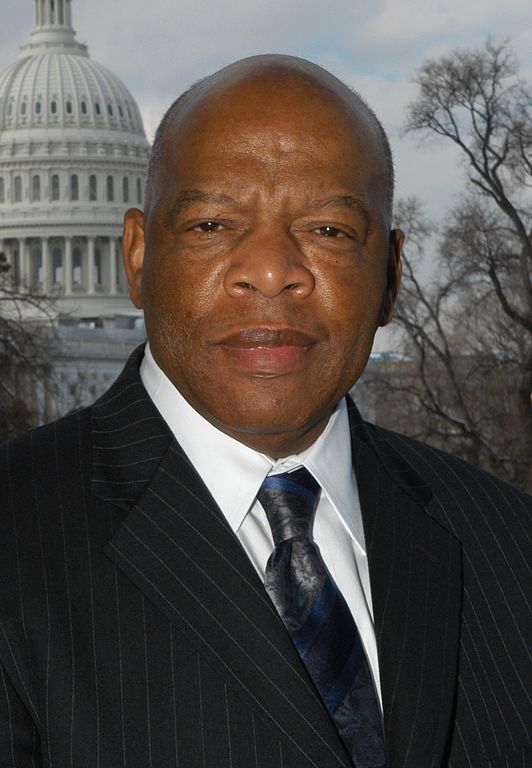
John Lewis
“The vote is precious. It is almost sacred. It is the most powerful nonviolent tool we have in a democracy.”
State Voting Policies
State voting legislation varies around the country. Since the 2020 presidential election, at least 30 states enacted 79 restrictive laws, and in 2024, at least 10 states enacted 19 restrictive laws. Restrictive laws make it harder for eligible Americans to cast their vote, thus placing more barriers around voting access. Additionally, some states enact what’s called election interference legislation – that is, measures that allow partisan interference in elections. They harm existing election administrations and undermine the voters’ trust in the security of elections. Two states (Louisiana and South Dakota) have enacted election interference legislation. Since 2020, at least 15 states have passed 33 election interference laws.
Some states have enacted policies that help citizens vote more easily. Pro-voter legislators seek to expand access to voting and create what are called expansive laws. In 2024, at least 21 states enacted 32 expansive laws.
States differ on several policies, including the presence of automatic voter registration, absentee voting with/without excuse, drop boxes, vote by mail, ID requirements, online registration, and more. Comparing some very left-leaning versus very right-leaning states, California accepts or has online registration, automatic voter registration, vote by mail, election day registration, and does not require an ID to vote. Arkansas, however, does not accept or have online registration, automatic voter registration, vote by mail, election day registration, and an ID is required to vote. Looking at the purple state (i.e., states that are neither left- nor right-leaning) Georgia, it does not offer election day registration or vote by mail, and an ID is required to vote. Georgia accepts or has online registration, drop boxes, and automatic voter registration, which is an even split.
To learn more about biases and party affiliation, visit www.biasly.com. Biasly also offers a Premium Membership for an in-depth analysis of current news and access to bias analytics, discussions, and more.
