

 Most Biased
 Satire
 Economy
 Opinion
 Elections
 Environment
 Entertainment
 Government
 Sports
 Politics
 Health
-14% Somewhat Left
Bias Meter
Extremely
Liberal
Very
Liberal
Somewhat Liberal
Center
Somewhat Conservative
Very
Conservative
Extremely
Conservative
-100%
Liberal
100%
Conservative

- Profile
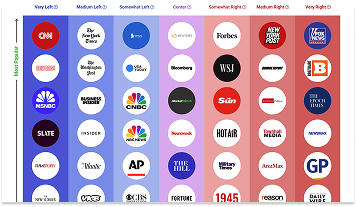
Axios on the media bias chart
- Bias Rating
-14% Somewhat Left
- Reliability75% Reliable GoodPolicy Leanings
-8% Center
Extremely
LiberalVery
LiberalModerately
LiberalSomewhat Liberal
Center
Somewhat Conservative
Moderately
ConservativeVery
ConservativeExtremely
Conservative-100%
Liberal100%
Conservative
Average Reliability
*Our bias meter rating uses data science including sentiment analysis, machine learning and our proprietary algorithm for determining biases in news articles. Bias scores are on a scale of -100% to 100% with higher negative scores being more liberal and higher positive scores being more conservative and 0% being neutral. The rating is an independent analysis and is not affiliated nor sponsored by the news source or any other organization.
Politician Portrayal44% positive
Analysis of Axios Articles
Analysis of Bias in Axios Online Articles
Given that Axios seeks to serve as a middle ground between more comprehensive political news reporting and social media commentary, its content may be more easily understood by a general audience. This underscores the importance of understanding whether Axios is delivering unbiased, reliable content to its readers.
When determining bias, some of the most common metrics used include Tone, Tendency, Author, Diction, and Expediency Bias, which are the primary metrics we’ll focus on below.
- Tone: This represents the attitude of the writing, formed distinctively but related to the author’s word choices or diction.
- Diction: The specific words chosen by the writer.
- Author: A metric related to the article’s author, taking into account their history of stance on issues based on past articles and social media posts.
- Tendency: It measures how consistently an author exhibits bias in their work, including factors such as tone and perspective.
- Expediency Bias: It refers to the immediate impression created by elements such as the article’s headline, images, or summary, which may indicate whether they favor a particular viewpoint.
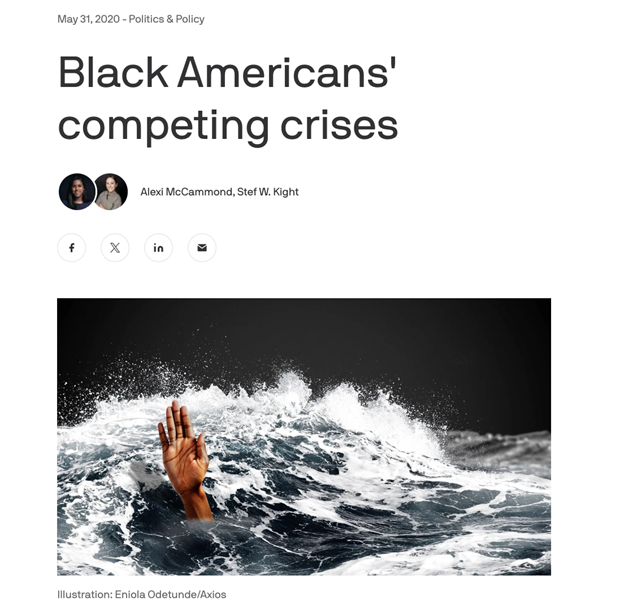
Source: Axios
An article we will examine is titled “Black Americans’ Competing Crises”. The article’s title generalizes the crises facing Black Americans as a shared experience for the race. The caption under the image highlights the apparent issues Black Americans face. The language used illustrates drowning and desperation with problems that seem to have no end in sight. The image correlates with the diction used in the caption. According to Axios, the crises Black Americans face are simultaneous, thus creating a feeling of drowning in issues.
Biasly has rated this article as Very Left. The Tone rating has influenced Biasly’s rating on this article. Throughout the article, the authors focused on Black Americans facing violence and death at the hands of police with very extreme language.
“But if you leave the house, you open yourself up to new worlds of risk, including from law enforcement that are supposed to protect you.”
“It is coldblooded to expect any group of people who are being constantly terrorized, brutalized, and killed by police officers to never react in violent rage,”
The tone in the article paints a bleak picture of life as a Black American who faces multiple threats to their well-being. Using this tone serves to show the reader that Black Americans are truly struggling and are at constant risk of violence by police. It can be perceived as broadly generalizing policing behavior, which may increase perceived bias. Stating that the violence is constant pushes the narrative that American police are ALWAYS out to inflict violence and pain on Black Americans, which is not the case.
The article tends to lean toward left-leaning views on race in America. In general, the authors often used statistics and talking points that fit left-leaning narratives on race. They explored ideas of healthcare inequality based on race and used quotes to demonstrate that African Americans are struggling with multiple problems simultaneously.
This writing style consistently appealed to left-leaning readers concerned about race relations in America. The authors focus on the relationship between policing and Black Americans. Combining issues of police violence with health inequality and the economic state of the Black American population further leans into left-leaning views.
“If you’re a person of color wearing a mask, you may be viewed differently by store clerks or police than a white person.”
“But if you don’t wear a mask, you may jeopardize your own health as well as the health of others — or risk a penalty for violating social distancing rules.”
This quote shows how health issues intersect with policing. Written during the COVID-19 pandemic, Axios implies that Black Americans who are taking care of their health by wearing a mask are also at risk of experiencing police violence compared to a white person wearing a mask. Explaining the trade-off between wearing a mask or being at risk of police violence is Axios’ attempt to emphasize the racial significance of these problems. The authors try to justify the claim later in the article. They write about a statistic that concludes that Black Americans are twice as likely to be shot by police compared to whites. Furthermore, they mention another statistic comparing the disproportionate COVID-19 death rates between blacks and whites. The addition of these statistics shows their attempt at justifying their claim. The discussion of how violence and disease hurt African Americans more than White Americans is the authors’ justification that there is a supposed trade-off. To them, the trade-off represents the racial significance of policing and healthcare issues.
Strategic use of diction can further add to possible bias in articles. The stronger the diction, the more likely the reader is to be moved emotionally when reading an article. The authors of this article used strong diction in several instances. This was especially noticeable when they discussed the consequences of issues faced by Black Americans.
“But if you leave the house, you open yourself up to new worlds of risk”
“People who are already left behind are now facing even greater (and sometimes fatal) blows to daily life”
Use of such diction is meant to create a reaction from the reader. In this case, the authors hope to evoke sympathy and anger towards the situation African Americans face. In these quotes, the author paints a bleak picture of life as an African American. Using words like “risk” and “fatal” in this context evokes a sense of desperation. The diction in the article aims to lead readers to believe that African Americans face danger in their everyday lives. Through this, they side with left-leaning views on race. It could evoke emotions in the reader, which could move them to support the author’s stance on the issue.
When examining the authors’ backgrounds, the online presence of Stef W. Knight shows that she reposts the work of other journalists. These works covered election and Congressional news, with little bias detected in the headlines. For example, she tweeted three images showing a statement released by Senator Rick Scott. In the tweet, she adds a simple headline stating that the Senator is seeking to become the next Republican leader in the Senate.
NEWS: Sen. Rick Scott announces bid for Senate GOP leader in letter to colleagues
Says the position should be term-limited to 6 years pic.twitter.com/QCx8XIokRd
— Stef Kight (@StefWKight) May 22, 2024
The article’s second author, Alexi McCammond, maintains a different online presence than Knight. She also retweets other journalists’ work when it relates to the issues she reports on. However, there is an instance of a retweet showing possible left-leaning bias. The tweet highlights a The New York Times opinion article discussing the extent to which Donald Trump is a threat to democracy. The original author of the tweet says that the article covers this topic through “bothsideism”.
McCammond’s retweet of this opinion shows she disagrees with the way the article was written, suggesting that she would rather see it written more against Trump. The idea of Trump being a threat to democracy is a view shared by left-leaning individuals. McCammond’s retweet demonstrates her public stance and affirms her political leaning, as the article shows.
More misleading stuff from one of resistance Twitter’s favorite accounts. This is a pretty standard liberal op-ed about how Trump has shattered norms in a dangerous way that threatens the integrity of America’s systems. But for engagement, it’s presented here as bothsidesism. https://t.co/pFTGUB8YRB
— Max Tani (@maxwelltani) May 31, 2024
It is important to note that McCammond has left Axios and is an opinion editor for The Washington Post and a political analyst for MS NOW. Considering the left-leaning nature of those two outlets, there is a possible connection that explains the liberal bias of this article.
Both authors attempt to explain to the audience that African Americans faced multiple crises during the COVID-19 pandemic and were at a crossroads. It was clear that they faced issues in healthcare and conflicts with policing. However, their tone skews the information to cater to left-leaning readers.
News outlets can have articles that vary in bias. A different Axios article, titled “Congress’ partisan divide on paid family leave”, is an informational article that focuses on the facts of the issue. The author, Jacob Knutson, explains the chronological events in Congress that have led up to this inflection point. He explains how both parties are approaching the idea of paid family leave.
“Democrats back creating a federal fund for new parents that would be financed with a payroll tax increase”
“Republicans have proposed plans that would allow new parents to dip into their future federal benefits.”
Once introducing the stances and solutions to the reader, Knutson explains that there is a bipartisan bill. He does not deliver an opinion about which solution is better. Rather, he writes that the bill is based on child tax credits and does not match the idea Democrats have proposed. According to Biasly analysts, the tone, tendency, diction, author, expediency, and accuracy were rated as zero or neutral. Their rating supports the content of the article and its ability to deliver political news with no bias.
Analysis of Axios Opinion Articles
Opinion articles are published by many news organizations, including Axios. Opinion articles allow authors to write about their personal views on current issues. The opinion articles are written by guest authors from different backgrounds. One example will cover the work of Matthew Ridenhour, a Marine Corps veteran from Charlotte, North Carolina.
Ridenhour’s op-ed, “I’m a Marine Corps veteran. Now I understand why people kneel for the anthem,” explains his thoughts during the 2020 protests following the death of George Floyd while in police custody. According to Ridenhour, the Founding Fathers’ vision of “A More Perfect Union” needed more work, as shown by the protests. He writes about how he, as a white man, does not need to worry about looking dangerous or thinking about being arrested while doing errands. In contrast, Ridenhour explains his realization that African Americans face the opposite situation.
This Axios opinion article shows that the company values authors’ insights. They welcome different viewpoints but may not fully accept works that conflict with the left-leaning articles they have previously published.
For example, another op-ed, “I’m an immigrant who just voted in my first presidential election. What a powerful experience it was,” tells the story of an immigrant who moved from Costa Rica in pursuit of the American dream. She tells a story about the anti-immigrant attacks she faced and that other immigrants face daily. She also criticizes President Trump for policies that she perceives as negatively affecting the immigrant community. While this is an important perspective, it also underscores that Axios focuses disproportionately on the positive aspects of immigration rather than the negative aspects.
Analysis of Reliability in Axios’s Online News Articles
News companies are under constant scrutiny regarding potential pitfalls in their accuracy and reliability. In a society where misinformation is prevalent, it is important to ensure that the news is accurate and reliable. To better understand the extent of these two factors in relation to Axios’s work, we will focus on accuracy and selection/omission ratings.
Selection bias occurs when stories and facts are selected or deselected, often on ideological grounds, to create a narrative that supports the new sources’ ideology. Omission bias, on the other hand, is when different opinions and political views regarding a situation are left out so that the reader is only exposed to the ideological perspective supported by the author. It’s important to keep in mind these two types of biases when trying to assess an article’s level of accuracy.
Biasly assigns a percentage score for accuracy, with 1 being the least accurate and 100 the most accurate. Ratings are calculated by weighing assertions against supporting evidence, the number of reliable internal sources, and the number of reliable external sources. News sources can vary in accuracy from article to article. A contrast to Axios would be The Gazette. It is rated by Biasly as Somewhat Conservative and carries a good overall reliability score. One of their articles, “Iowa Sen. Dan Zumbach called DNR director over Supreme Beef feedlot owned by his son-in-law,” had neutral scores for selection and accuracy. In general, Biasly analysts found that The Gazette never had accuracy or omission ratings that strayed from the neutral position.
An Axios article we can examine is “Two people killed in Virginia Beach shooting incidents”, which received a Somewhat Left rating. Oriana Gonzalez does a good job summarizing the situation and its immediate impact. However, many of the facts are vague. For example, when talking about the shootings, she writes,
“The third shooting was unrelated to the others and resulted in a second person killed”
It would have been helpful for the readers to have a better context on how the first two shootings were related. Leaving this information out or not explaining why it was not provided may change the reader’s perception of policing or the state of Virginia Beach as a city.
The author’s sources are not diverse. Information in the article came from the police through press conferences and press releases. Adding eyewitness accounts would have made the story well-rounded and inclusive of different perspectives beyond the investigation.
The lack of explanation about a police intervention shooting could support views on police being too violent. It may be an unintended consequence, but omitting an explanation of the situation does not make the article thorough on the topic.
Although the sources are from a limited perspective and are subject to selection and omission bias, which leaves room for interpretation, the article can still be considered mostly reliable because its information comes from those investigating the crime and is not written in an opinion format.
Analysis of Reliability in Axios Opinion Pieces
Opinion pieces are a way for journalists and individuals to express their beliefs on current or emerging issues. These articles are not as trustworthy because they are based on opinion rather than fact. It can be useful to understand how people see issues in various ways.
Axios has opinion pieces from different viewpoints. For example, Axios had a veteran who identified as Republican write about his understanding when it came to national anthem protests in the name of racial injustice. Although it favored Axios’s overall rating as a Somewhat Left source, the piece was based on the author’s beliefs and observations and excluded personal political ideology. Opinion pieces such as these are meant to educate readers on different perspectives. However, opinion pieces do intertwine with politics and can be questionable sources for reliable information.
Quality of Sources and Facts Used
Articles can increase their reliability based on the quality of the sources and facts they use. Additionally, the number and length of quotes influence an article’s perceived reliability. Let us examine this article: “The slippery slope of protest surveillance,” which focuses on how protestors were watched after the death of George Floyd. The article had three quotes from individuals’ Twitter accounts and embedded links to statements from a legal expert, the Department of Justice, and the ACLU.
- President Donald Trump (Member of the Republican Party)
- Representative Matt Gaetz (Member of the Republican Party)
- Statement from Attorney General William Barr (Appointed by Trump)
- American Civil Liberties Union (Initiatives lean left)
- An article by Lori Robertson from factcheck.org with quotes from:
- Mary McCord, director of Georgetown University Law Center’s Institute for Constitutional Advocacy and Protection
- Hina Shamsi, former Department of Justice official and ACLU national security project director
There are a considerable number of sources. Some sources consist of perspectives that are different from Axios’s Somewhat Left bias. Two sources in the article came from those who are politically biased, as they are politicians who are members of the Republican Party. Furthermore, the information is selected to present a right-leaning view of surveilling protestors. One quote came from Representative Matt Gaetz, who is a member of the Republican Party. Matt Gaetz has been labeled as one of the more right-leaning members of the Republican caucus in the House. The author uses a tweet by Matt Gaetz to suggest the general stance of Republicans on the issue of protesters:
“suggested acting along those lines in a tweet this week seeking to explain his call for antifa adherents to be ‘hunt[ed] down.”
Including a quote that contains extreme language can interfere with an accurate portrayal of one side’s beliefs. Rather than providing statements from reputable officials, the author turns to online posts by political figures who are biased rather than neutral. Using a quote with extreme language, such as “hunted,” portrays the right-leaning stance in a harsher light. It helps make the reader feel that one political stance is fully against protestors, while the other protects their right to protest.
On the other hand, the statement included by William Barr is a good example of providing more objective information. Although Barr holds a position he was appointed to by Republican President Donald Trump, his job is to prosecute individuals who have committed federal crimes and ensure the safety of Americans. His statement covered actions the FBI would take rather than an opinion that used extreme language. Barr states a plan on how the Department of Justice would resolve the issue:
“To identify criminal organizers and instigators, and to coordinate federal resources with our state and local partners, federal law enforcement is using our existing network of 56 regional FBI Joint Terrorism Task Forces.”
There are two other factors that are used to assess reliability. The length of a quote and the number of quotes used in an article can influence reliability. The quotes were short, and the article should have added more. Including quotes from the Attorney General’s statement would lend more credibility to the article. It allows readers to see the other side’s perspective through their own interpretation rather than relying on the author for analysis.
Paraphrasing and only stating that experts said certain things makes the writing vague. Excluding direct quotes and treating opinionated quotes as facts about one side shows that the article adopts the left-leaning stance of Axios. These opinionated quotes show conservative people and policies in a negative light. As previously shown, the quote used from Matt Gaetz contains extreme language. This language can lead readers to infer that all conservatives hold stances similar to Gaetz. It does not tell the full story about protest surveillance in the United States.
The issues with this article and its sources show the importance of where the author gets their information. Offering quotes from individual political figures, such as Matt Gaetz, and then using them to portray a broader stance is not an accurate way to report information. The way the article was written suggests it was meant to evoke emotion in left-leaning readers who may protest or intensify their opposition to right-leaning figures and ideas. The constant mentions of how those in government are attempting to crack down on protestors are meant to show readers that their rights are in danger. Mentioning the beliefs of those in Congress and the increasing capability of police are presented as threats to protestors.
Selection and Omission Bias
In another Axios opinion article, “The policies that could help fix policing”, authors Stef Knight and Sam Baker lay out possible solutions that would fix policing after the death of George Floyd. Four quotes are from a former police chief, a policy analyst, and the NAACP president. The quotes are opinionated but are from someone with significant experience with police and their practices.
“We have to change this viewpoint that people have of: ‘Well, there’s a few bad apples, we just have to get rid of them, and everything will be fine.’ If that was the case, we would already be where we need to be.”
This quote from former Albany police chief Brendan Cox establishes the stance the authors are taking. The authors will support the idea of broad police reform and demonstrate this in the ideas they present in the article. Rather than focusing on the practices of local police departments, they support nationwide reforms in policing.
Language is used to portray that there is no accountability on the police, such as the quote:
“Police who cross the line rarely face criminal prosecution.”
This quote assumes that police lack accountability through criminal or civil prosecution.
Cases where police departments or those who work with police are held accountable are neglected by the author. Additionally, the article says that police have a broad authority to use force. However, there is no definition of their broad authority or of why it is a problem. The absence of this information makes it harder to understand why policing has become a major issue.
The author states the Governors of Wisconsin and New Jersey, President Obama, and Vice President Biden are among those who support these solutions. It is important to note that these individuals are members of the Democratic Party. However, the author does not mention possible plans introduced by Republicans to address policing issues.
Excluding the actions of Republicans and opinions associated with right-leaning politics makes this article less reliable. Not including the viewpoints of the other major American party caters the article to left-leaning audiences. It can create a perception that only Democrats and left-leaning figures are taking action against unjust policing practices.
Opinion articles have difficulty maintaining reliability because of issues with sources and the omission of details or viewpoints.
The articles analyzed show gaps in accurate reporting in opinion pieces. Oftentimes, they are used to show an author’s belief rather than to illustrate the full story by including all sides. Axios, being a left-leaning news company, has an incentive to publish such articles to sustain readers and attract new ones.
Axios Bias Overview
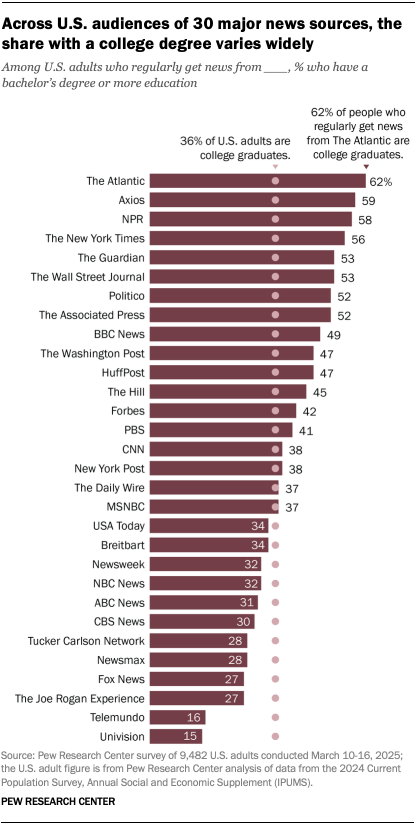
Axios is a short-form online news website based in the United States. It focuses on delivering relevant political news to readers in under 300 words, functioning as a mix of a typical political news organization and a social media site such as Facebook or X. In recent years, Axios has gained prominence, particularly after a combative interview with President Donald Trump that went viral ahead of the 2020 presidential election. Based on an analysis by Pew Research Center, Axios’s audience is disproportionately college-educated relative to other news organizations throughout the country.
Is Axios Biased?
Based on Biasly’s evaluations, Axios is rated as Somewhat Left.
By examining content patterns and the broader context of media influence, we aim to offer a balanced perspective on Axios’s political bias—and contribute to the ongoing discussion about bias in the news.
How Does Biasly Rate News Sources?
Biasly uses proprietary algorithms and a team of analysts to provide comprehensive bias evaluations across thousands of news outlets. Over 200,000 articles from more than 3,200 sources have been analyzed to identify the most accurate and unbiased stories.
Biasly assigns each outlet three key scores:
- Reliability Score – Reflects factual accuracy
- AI Bias Score – Generated via natural language processing
- Analyst Bias Score – Assessed by human political analysts
These scores are based on seven core metrics: Tone, Tendency, Diction, Author Check, Selection/Omission, Expediency Bias, and Accuracy. These elements help analysts and algorithms evaluate the political attitude conveyed by each article.
Biasly’s Bias Meter ranges from -100% (most left) to +100% (most right), with 0% indicating neutrality. The system evaluates individual articles based on political terms, policies, figures, and sentiment to calculate precise bias ratings.
Is Axios Politically Biased?
Axios earns a Somewhat Left rating for its AI Bias Score and a Somewhat Left for its Analyst Bias Score. The Analyst Bias Score is generated by reviewers from liberal, moderate, and conservative backgrounds. Praise for liberal politicians and policies, as well as dislike toward Republican policies and politicians, contribute to this rating. Biasly’s scores closely align with determinations by other third-party bias research agencies.
Before we begin, we need to discuss bias. Bias is a natural human function, and we can express it both consciously and unconsciously. Bias is one of the most fundamental forms of pattern recognition in humans. This isn’t to lower the bar and say that “all things are biased,” but to explain the process by which we may come to trust certain news organizations that display patterns of coverage.
On the media’s part, there is an incentive to retain audiences, encourage them to subscribe, and encourage them to rate products positively. Bias is a two-way street: people want to see news stories about things they care about, and the media needs viewers to sustain its operations. This creates a positive feedback loop that influences what stories are covered and from what perspective. This also explains the actions of more liberal news organizations.
According to Pew Research, CNN, ABC, and NBC are considered the most trusted news sources by those identifying as left-leaning or liberal. There is no published research about where Axios falls in terms of trust among left-leaning individuals. However, based on Pew’s research, it can be reasonably inferred that there are a large number of left-leaning people who use Axios as a trustworthy news source.
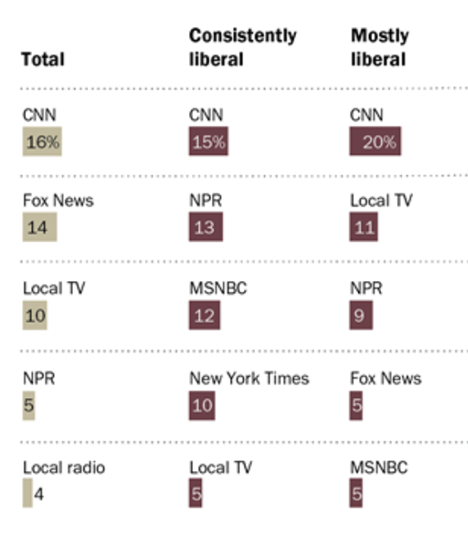
Source: Pew Research
How to Evaluate Bias
Although Biasly rates Axios as Somewhat Left, it’s important to remember that bias can vary from article to article. So, let’s learn how to evaluate media bias.
Recognizing media bias requires awareness and critical thinking. Often, readers trust news sources that affirm their existing beliefs—a psychological tendency known as confirmation bias. This makes it harder to identify slanted narratives or one-sided reporting.
To combat this, it’s essential to challenge your assumptions by consulting multiple viewpoints and verifying news through third-party analysis. Tools like Biasly’s media bias ratings allow readers to compare the same news story across the political spectrum.
Ultimately, bias isn’t always a matter of what is said—it’s also about what is left out, how topics are framed, and which stories are chosen for coverage. Learning to recognize these patterns can help readers make more informed decisions and develop greater media literacy.
To start comparing news outlets and gain a better understanding of bias, sign up for Biasly’s Media Bias & News Analytics Platform to see how stories vary between sources.
Axios Reliability Overview
Is Axios Reliable?
According to Biasly, Axios is rated as a Somewhat Left news source and is considered reliable overall. Axios has become more common in the news, making it important to assess its reliability.
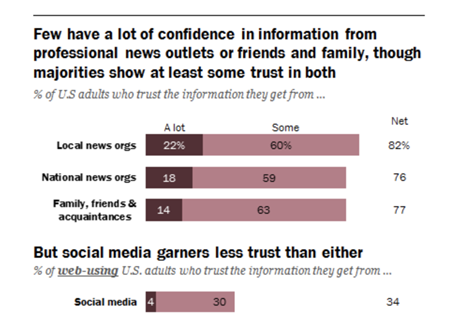
Source: Pew Research
As shown by Pew Research’s work, national news organizations such as Axios report that 59% of American adults say they have some confidence in the information they receive from these organizations. Trust in news sources comes from knowing whether a source is reliable. Reliability stems from factors such as accuracy and selection/omission. In this article, we will examine how these factors are present in Axios’s articles and determine how reliable they are.
How to Evaluate Reliability?
Reliability refers to how trustworthy or accurate a news source is. If we can’t trust what we read, then continuing to consume content from that outlet serves little purpose. So how do we evaluate a news outlet’s reliability?
There are several potential measures of reliability to look out for when trying to determine whether a media source is reliable or not. Red flags for an unreliable article can include the presence of wild, unsubstantiated claims, facts dependent on other unreliable sources, heavy use of opinionated language, and more. In contrast, hallmarks of a reliable source include:
- Absence of subjective language
- Citing credible sources (e.g., .gov, .edu, academic references)
- Verifiable facts and statistics from multiple outlets
- Use of primary sources, like interviews or transcripts
- Consistency with coverage across other platforms
Biasly’s reliability scores incorporate these elements in evaluating media outlets.
So How Does Axios Fare in Its Reliability?
The political reliability index developed by Biasly assesses both accuracy and trustworthiness. Axios currently holds Good Reliability Score, which is calculated as a weighted average of:
- Fact Analysis Score – Evaluates the accuracy of claims, facts, and evidence.
- Source Analysis Score – Assesses the number, diversity, and credibility of sources and quotes used.
Axios’s Source Analysis Score is Average at 45% Reliable. This suggests moderate trustworthiness in its sourcing practices. The score is AI-generated and considers quote length, frequency, diversity, and quality.
The Fact Analysis Score of Axios is Good at 83% Reliable. This further shows how well Axios supports its claims, addresses selection and omission bias, and presents verifiable evidence.
Taken together, these scores suggest that Axios is a reliable online source of information. However, the organization could benefit from higher-quality sourcing and greater diversity in the number, length, and uniqueness of sources.
Axios’s Accuracy and Reliability
According to Biasly’s analysis, Axios maintains Good Reliability Score, but individual articles may vary significantly. Let’s dive into the details.
Political orientation plays a crucial role in how audiences perceive reliability. Axios has been accused of favoring a liberal narrative, potentially at the expense of factual reporting. To validate such claims, it’s essential to analyze whether the publication backs its assertions with sufficient evidence and diverse viewpoints.
Two common types of bias that affect factuality include:
- Selection Bias – Highlighting or omitting stories to fit a particular narrative.
- Omission Bias – Leaving out differing perspectives or relevant details to skew perception.
Biasly’s accuracy ratings use a scale from 1% (least accurate) to 100% (most accurate). Factors include the presence of supporting evidence, internal and external reliable sources, and balanced viewpoints.
For instance, Biasly assessed CNN with a Very Left Bias and a Good Reliability Score. One article, titled “Senate Democratic leaders want members to hold firm against ‘lethal’ GOP amendments on relief bill”, focuses entirely on the Senate Democrats and their efforts to pass the 2021 coronavirus relief bill. The article focuses solely on the liberal side without any quotes from conservative members of Congress. Another article, “Clyburn ‘absolutely’ open to ID requirement in voting rights bill”, describes conservative voting rights efforts as “restrictive” without further explanation, almost as if to imply that there is no valid argument for voter ID requirements or similar initiatives.
So, is Axios Reliable?
Overall, Axios can be considered to be an outlet that is very reliable. It demonstrates a consistent goal of journalistic integrity and typically supports claims with sources and quotes. Occasional omissions and framing bias do appear, particularly on culturally sensitive or partisan issues.
As media literacy improves, readers can more easily detect issues with selection bias, omission bias, and factuality. To strengthen your ability to assess reliability across the political spectrum, use Biasly’s News Bias Checker to compare how multiple outlets report the same story.
This empowers you to consume more accurate, balanced, and dependable news
Axios can be considered a mostly reliable news source because it has shown it can be neutral in its reporting. However, their opinion pieces do raise reliability concerns due to source and omission issues. The lack of transparency from Axios about whether an article is an opinion piece makes it harder for the reader to determine whether the information is reliable. Because of this, using Biasly’s News Bias Checker will assist you in ensuring that the news articles you read are reliable and provide you with correct information.
Axios Editorial Patterns
Axios’s coverage of political topics often reflects a Somewhat Left bias, with consistent patterns in phrasing, source selection, and thematic focus that are Slightly Liberal. This content analysis examines how Axios handles liberal and conservative issues and evaluates its language choices and editorial tendencies.
Coverage of Liberal vs. Conservative Topics
When it comes to racial issues in America, Axios appears to align more with the liberal stance. More than one article attempts to relay sympathy concerning the way African Americans in the United States have been treated over time, including discussion about how they are treated differently by police, suffer from unequal access to healthcare, and are more fearful of their lives day-to-day relative to White Americans. This framing is not surprising given that the articles were released in 2020 during the height of the coronavirus pandemic and the George Floyd protests, but this is a good example of how bias can creep into reputable organizations.
Policy and Issue Framing
Axios’s articles tend to vary between framing some topics neutrally while tilting more toward the liberal side in other cases. For example, in the article, “Congress’ partisan divide on paid family leave,” the story discusses both the liberal and conservative positions, highlighting Republicans’ opposition to taxes and Democrats’ support for increased government intervention. By contrast, in the article, “Rep. Ritchie Torres: “demonization” of transgender community has been “taken to a new extreme,” only one Democratic representative is discussed. There is no conservative commentary on the issue of LGBTQ equality. Implicit bias in issue framing is also seen in the article, “Immigrants on the front lines in the coronavirus fight.” It includes the following quote:
“New data provided to Axios spells out just how outsized a role immigrants play on the high- and low-skilled ends of the economy keeping Americans alive and fed during the coronavirus crisis.”
In this case, the article’s sole purpose is to underscore the importance of immigrants throughout the coronavirus pandemic. The aforementioned quote discusses how immigrants kept Americans “alive and fed” during the epidemic. In other words, the article focuses solely on the positive impact of immigration and not necessarily the negative effects that may also exist. From DACA to the border wall to ICE, immigration has long been a controversial subject that highlights the need for balanced reporting and coverage of all sides.
Coverage and Relevance
Axios covers national and even international news that is consumed by countless people in America and around the world. This underscores the importance of ensuring news organizations are cognizant of their biases and overall reliability.
Readers who wish to further explore how Axios compares with other publications can visit Biasly’s Media Bias Chart to analyze tone and word choice in real time.
Funding and Ownership
Who Owns Axios?

Cox Enterprises, Source: Wikimedia
Axios is a subsidiary of the privately held Cox Enterprises. Upon launch, Axios received investment from NBC News and the owners of Atlantic Media. The company does have other holdings, which include the major cable television provider Cox Communications. Cox Enterprises is owned by the Cox family and is operated by James C. Kennedy and Alexander C. Taylor.
The Cox family traces its origins to James Cox, a Democrat who served as governor of Ohio. When he passed, control moved to his three children. While there is no reporting on the political stances of Cox’s children or those currently controlling the company, assumptions can be made based on the background of its founder.

Mike Allen, Executive Editor of Axios – Source: Wikipedia
Currently, Axios’s CEO is Jim Vandehei, with Roy Schwartz serving as President. Mike Allen is the executive editor. These three are also the founders of Axios. Jim Vandehei’s career consisted of working at The Washington Post and helping create Politico. Mike Allen has worked for TIME, The New York Times, and Politico. There is no information about their political affiliations other than where they have worked.
Considering the background of Axios from its start to being a subsidiary of a cable company, it is easy to see the origins of its left-leaning work. A founder with Democratic roots and investors who are seen as left-leaning support the conclusion that Axios will favor left-leaning ideology and causes through its publications.
Who Funds Axios?
Axios received initial funding from venture-capital firms Greycroft Partners and Lerer Hippeau Ventures. Other backers, such as NBCUniversal, Emerson Collective, and the chairman of Walmart, contributed to initial fundraising. The Athletic initially sought a merger deal with Axios but eventually joined The New York Times instead. In 2022, Axios was sold to Cox Enterprises for $525 million.
Additional Insights
News Source Comparison
When comparing news sources, Axios is often evaluated alongside other regional and national outlets that lean left or center-left. Sources like The Guardian, Los Angeles Times, or ABC News often present similar tones and editorial philosophies. While Axios maintains a Somewhat Left media bias, it differs from strongly partisan sources in that it occasionally includes opposing viewpoints and strives for a balanced regional coverage.
This contrasts with more biased media outlets that consistently present one-sided narratives without factual counterpoints. Readers seeking balanced political coverage may compare Axios’s framing of issues with outlets rated as Center or Lean Right on our Media Bias Chart, or explore other regional papers on our Similar Sources page.
Notable Contributors and Authors
The most well-known contributor to Axios is Jonathan Swan. In August 2020, he conducted an interview with President Donald Trump on a wide range of topics, including the ongoing coronavirus pandemic. Swan sharply questioned the president and repeatedly fact-checked Trump’s claims. The interview went viral online, both for Swan’s sharp line of questioning and for his facial expressions in response to the president’s commentary. In 2021, Axios won the Emmy Award for Best Edited Interview thanks to Swan’s interview. In 2023, Swan joined The New York Times.
Related Tools and Resource Pages
To better understand how Axios fits into the broader media landscape, we recommend exploring these helpful resources:
- Media Bias Chart: See where Axios ranks among hundreds of media outlets across the political spectrum.
- Political Bias Chart: Visualize political slants of news sources across various policy areas.
- Journalist Bias Analytics Platform: Explore how individual journalists contribute to bias within their publications.
- Politician Bias Analytics Platform: Compare how politicians are framed differently by Axios and other outlets.
- Media Literacy Education Platform: Learn how to critically assess media sources, bias techniques, and news reliability.
Frequently Asked Questions
Axios is rated as Somewhat Left based on Biasly’s media bias algorithm, which assesses sentiment, article framing, and policy favorability.
In 2019, Axios reported that President Donald Trump suggested using nuclear weapons to disrupt hurricanes. In response, Trump criticized the organization for spreading fake news, claiming that “[t]he media in our Country is totally out of control!”
Biasly uses a combination of AI sentiment analysis and human analyst review to assess tone, fact accuracy, source quality, and media bias indicators. Learn more on our Bias Meter page.
Generally, yes, though their lack of transparency in differentiating factual news reporting from opinion pieces may confuse audiences.
Military Spending
| Date | Sentiment | Associated Article | Snippet |
|---|---|---|---|
| 08/25/2019 | 75% For | Trump Family Detentions Flores Agreement (link) | So, of course, the Trump administration is doing the opposite in a baldfaced |