









How News Sources Portray Congressional Term Limits Policy
This chart shows how major news sources across the ideological spectrum frame congressional term limits policy, from left to right-leaning perspectives.
Under current law, members of Congress face no limits on the number of times they can seek reelection. House members serve two-year terms and can run indefinitely, while Senators serve six-year terms with the same unlimited reelection eligibility.
Proposals to change this through a constitutional amendment have been debated for decades, with recent proposals typically calling for a limit of three terms (six years) in the House and two terms (twelve years) in the Senate. Because the Supreme Court ruled in 1995 that states cannot impose congressional term limits on their own, any enforceable term limits would require a constitutional amendment, proposed either by a two-thirds vote in both chambers of Congress or by a convention called by two-thirds of the state legislatures, and then ratified by three-fourths of the states.
How News Sources Portray Congressional Term Limits Policy
Many of the media biases we observe in both news coverage and political rhetoric stem from the fundamental differences in policy stances held by the major political parties. One such key point of conflict is congressional term limits. As public frustration with career politicians and entrenched incumbency has grown, the debate over whether to constitutionally limit how long members of Congress can serve has re-emerged as a significant political issue, one that cuts across some conventional partisan lines while also reflecting deep ideological disagreements about democracy, expertise, and the proper structure of representative government.
Understanding the public and legislative dynamics surrounding congressional term limits is important for voters, civic educators, and policymakers. Voters in both parties broadly support term limits. The divide is mainly among lawmakers: the push to write term limits into the Constitution has been led largely by Republicans, while most Democrats in Congress oppose it.
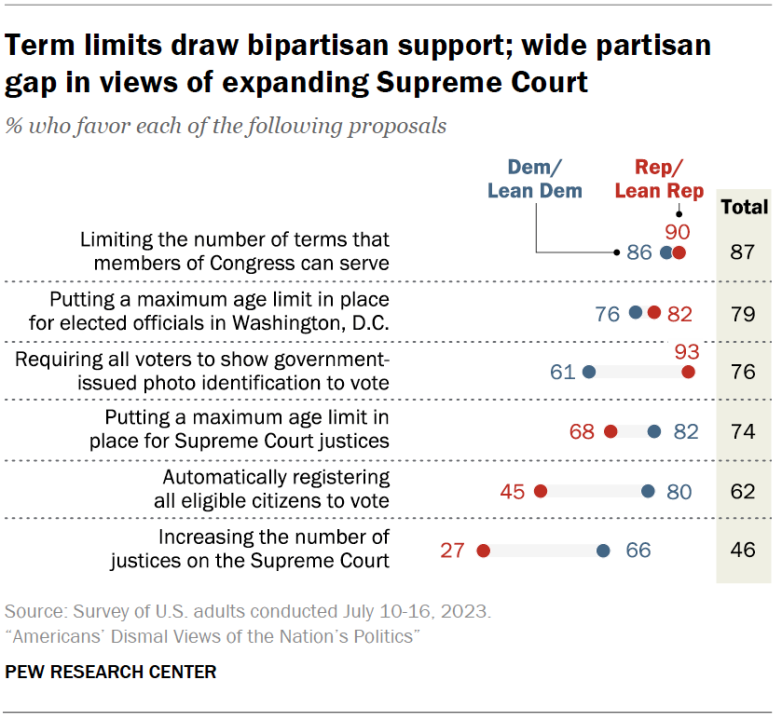
According to data from the Pew Research Center, an overwhelming majority of Americans, including 90% of Republicans and Republican-leaning independents and 86% of Democrats and Democratic-leaning independents, favor limiting the number of terms members of Congress can serve.
The Republican Stance on Congressional Term Limits
Congressional term limits have become a recurring theme in Republican reform messaging, and the legislative push to actually implement congressional term limits has been predominantly Republican-led. Republicans frame term limits primarily as a solution to what they describe as a political class of career politicians who have become disconnected from the voters they represent, entrenched in Washington power structures, and more focused on self-preservation than public service.
The central Republican argument for term limits is straightforward: the longer politicians stay in office, the more they prioritize their own incumbency over the needs of their constituents. Republicans argue that forcing regular turnover would bring fresh perspectives into Congress, reduce the influence of special interests that cultivate long-term relationships with senior members, and open the institution to a more diverse range of Americans with real-world experience outside of politics. Many conservative advocates connect term limits to an ideal of citizen legislators who serve temporarily before returning to private life, as opposed to a permanent political class that treats elected office as a career.
In January 2025, Senator Ted Cruz (R-TX) introduced a resolution (S.J.Res. 1), with Senator Katie Britt (R-AL) among its original co-sponsors, to limit House members to three two-year terms and Senators to two six-year terms. Representative Ralph Norman (R-SC) introduced the House companion, H.J.Res. 12. As of October 2026, the Senate resolution has 19 co-sponsors, all Republicans, and the House resolution has 115 co-sponsors: 107 Republicans and eight Democrats. Both resolutions have stalled in committee.
Republicans have also advanced term limits at the state level. In March 2025, Indiana became the 11th state to pass a resolution applying for a constitutional convention limited to congressional term limits. As of October 2026, 14 state legislatures have passed such single-subject applications, a count that matches U.S. Term Limits’ tally and is confirmed by state legislative records: Alabama, Arizona, Florida, Indiana, Kansas, Louisiana, Missouri, North Carolina, Oklahoma, South Carolina, South Dakota, Tennessee, West Virginia, and Wisconsin.
Cruz’s own record has drawn criticism. He sponsored S.J.Res. 2 in January 2023, which would limit Senate terms to two, the fourth time he had sponsored such a measure, while running for a third term in 2024. When asked about the disconnect, Cruz replied: “I’ve never said I’m going to unilaterally comply… I will be more than happy to comply with the same rules that apply to everyone.” The gap between his advocacy and his own time in office remains a recurring criticism of Cruz.
Politicians Who Support Congressional Term Limits

90% of Republicans and Republican-leaning independents say they support limiting the number of terms members of Congress can serve.

Donald Trump
“Additionally, Congressional term limits are necessary to curb the rise of career politicians—the reelection rate for House members is 94% and over the past half century has not fallen below 80%. The re-election rate for the Senate in 2022 was 100% and has not fallen below 75% since 1982.”
Ted Cruz
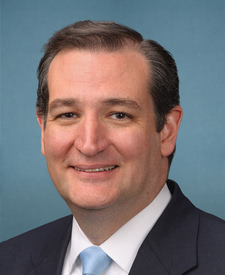
“Term limits are critical to fixing what’s wrong with Washington, D.C. The Founding Fathers envisioned a government of citizen legislators who would serve for a few years and return home, not a government run by a small group of special interests and lifelong, permanently entrenched politicians who prey upon the brokenness of Washington to govern in a manner that is totally unaccountable to the American people. Term limits bring about accountability that is long overdue, and I urge my colleagues to advance this amendment along to the states so that it may be quickly ratified and become a constitutional amendment.”
The Democratic Stance on Congressional Term Limits
The Democratic stance on congressional term limits is broadly one of opposition, though it is more nuanced than a simple rejection of the concept. Most Democratic lawmakers argue that term limits are a superficially appealing answer to real problems (congressional dysfunction, entrenched incumbency, and voter frustration) that would make those problems worse rather than better. That opposition is not universal: eight House Democrats, including original co-sponsor Jared Golden (D-ME), have signed on to Norman’s H.J.Res. 12.
Research and policy analysis back up the opponents’ case, particularly on legislative expertise and institutional knowledge. Philip Wallach, a senior fellow at the center-right American Enterprise Institute, told The Washington Post in 2023:
“The workhorses in Congress know the value of having been there for a long time, and they know how to make public policy better because of the expertise they have and the care they’ve taken to build relationships with other members.”
Opponents of term limits argue that forcing experienced legislators out of office doesn’t drain the swamp; it drains Congress of the policy expertise required to govern effectively. Consequently, removing senior lawmakers leaves unelected actors, such as lobbyists, congressional staff, and executive branch bureaucrats who face no term limits of their own, with significantly more relative influence and leverage over the legislative process.
Democratic lawmakers also argue that term limits take choices away from voters. In their view, elections already function as term limits: if voters want to keep an effective representative in office, a constitutional amendment that forces that representative out overrides the will of constituents.
A 2018 analysis for the Brookings Institution by Casey Burgat reaches a similar conclusion. Members who know their time in Congress is limited face less pressure to develop expertise on specific issues, because that knowledge won’t be nearly as valuable in a few short years. Burgat argues that term limits would impose “a tremendous brain drain on the institution,” and that fewer experienced policymakers would mean more influence for special interests “ready and willing to fill the issue-specific information voids.”
Opponents also argue that term limits may not produce the changes supporters envision, because experience and effectiveness often go together. According to the Center for Effective Lawmaking, the representatives who got the most work done in the 117th Congress (2021-23) from each party were Gerald Connolly (D-VA), serving his seventh term, and Don Bacon (R-NE), serving his third.
The most effective senators were Gary Peters (D-MI), serving his second term, and John Cornyn (R-TX), serving his fourth. These examples illustrate that some highly effective lawmakers have accumulated substantial congressional experience, supporting the argument that longer tenure can coincide with legislative effectiveness and productivity.
To see individual politicians’ stances on different policies, please visit the Politicians’ Stances Tracker.
Politicians Who Oppose Congressional Term Limits

As of October 2026, only 8 of the 115 House co-sponsors of H.J.Res. 12 are Democrats, and none of the 19 Senate co-sponsors of S.J.Res. 1 are.

Glenn Ivey
“I disagree with the concept of term limits for members of Congress and most legislative bodies… let’s not impose a statute, or a constitutional effort here, that requires people to step down even though their voters think they should stay, even though they want to stay and even though they’re doing a good job.”
Political Polarization and Public Policy on Congressional Term Limits
Voters and lawmakers are far apart on this issue. A 2023 Pew Research Center study found that 87% of Americans favor limiting the number of terms members of Congress can serve, with nearly identical support among Republicans and Democrats. That level of agreement across party lines is rare in today’s polarized political environment.
A separate 2023 survey by the Program for Public Consultation measured something different: how voters judge the main argument for term limits. Asked whether incumbents are so secure in their seats that they become less responsive to their constituents, 87% of registered voters found that argument convincing, including 90% of Republicans, 88% of independents, and 84% of Democrats. The same survey found 83% support for a constitutional amendment establishing term limits.
And yet, term limits legislation has repeatedly stalled in Congress. Supporters argue that this is because the members who would need to vote for it are the ones whose careers it would end. Opponents say their resistance rests on the merits: term limits would drain Congress of experience and expertise and take away voters’ freedom to reelect a representative they want to keep. For supporters, the gap between what voters say they want and what lawmakers do is itself one of the strongest arguments for term limits.
Opposition among lawmakers does not fall neatly along party lines, either. When the House Judiciary Committee rejected Norman’s amendment 17–19 in September 2023, four Republicans joined the committee’s Democrats in voting no. One of them, Representative Harriet Hageman (R-WY), made the voter-choice argument more often associated with Democrats: “Haven’t we learned from Democrat stunts against President Trump that it’s a terrible idea to undemocratically remove candidates from the ballot for arbitrary reasons? Term limits would deny voters a choice they may want to make.”
At a high level, the divide between the parties can be summarized as follows:
- Republican approach: Support for a constitutional amendment establishing firm term limits on House and Senate service, framed as a solution to career politician entrenchment and a return to citizen-legislator ideals
- Democratic approach: Opposition to term limits as a constitutional mechanism, with preference for voter accountability through elections, arguing that term limits reduce expertise and increase the influence of lobbyists and unelected staff
Key public concerns shaping the debate include:
- The perception that career politicians are more focused on self-preservation than constituent service
- Concerns about the loss of experienced legislators with deep policy expertise
- The constitutional complexity of implementing term limits, which requires a formal amendment
- Whether term limits would actually produce the diverse, reform-minded Congress supporters envision
- The risk that term limits increase the relative power of lobbyists, bureaucrats, and unelected staff who face no such limits
A Brief History of Congressional Term Limits Policy in the U.S.
The idea of limiting congressional terms is nearly as old as the republic itself. The Articles of Confederation included term limits for delegates to the Continental Congress, and several Founders debated whether the Constitution should include them as well, ultimately deciding against mandatory limits in favor of regular elections as the mechanism for accountability.
The modern term limits movement gained significant momentum in the early 1990s, driven by public frustration with congressional incumbency and the broader anti-establishment sentiment. This push became a cornerstone of national reform messaging, culminating in its inclusion in the 1994 “Contract with America.” By 1995, 23 states had adopted term limits for their members of Congress, 21 of them through voter-approved ballot initiatives such as Arkansas’s. However, that state-level movement was effectively halted by the Supreme Court’s landmark decision in U.S. Term Limits, Inc. v. Thornton (1995).
This case was decided on May 22, 1995, by the United States Supreme Court, holding that states cannot impose qualifications for prospective members of Congress stricter than those specified in the Constitution. The Supreme Court decided 5-4 to affirm the decision of the Arkansas Supreme Court. Justice John Paul Stevens, writing for the majority, concluded that the qualifications for congressional service — age, citizenship, and residency — were fixed in the Constitution and could not be supplemented by state law.
The ruling established that any enforceable term limits would require a constitutional amendment under Article V, a process requiring either a two-thirds vote in both chambers of Congress or an Article V convention called after applications from two-thirds of state legislatures, followed by ratification by three-fourths of the states.
In 1995, the new Republican House majority brought a term limits constitutional amendment to the floor, as its 1994 campaign platform had promised. It failed to achieve the required two-thirds majority. Since then, term limits amendments have been regularly introduced in Congress, almost exclusively by Republicans, and have regularly stalled. In January 2023, Representative Ralph Norman (R-SC) introduced H.J.Res. 11, a joint resolution to enact three-term limits for Representatives and a two-term limit for Senators. The House Judiciary Committee voted 17–19 against advancing it in September 2023, and the resolution died in committee when the 118th Congress (2023–2024) ended. Norman reintroduced it in January 2025 as H.J.Res. 12.
Current Federal and State Policy on Congressional Term Limits
At the federal level, there are currently no term limits on members of Congress. The most recent significant legislative effort is the pair of joint resolutions introduced in January 2025 by Senator Ted Cruz (S.J.Res. 1) and Representative Ralph Norman (H.J.Res. 12), which would limit House members to three two-year terms and Senators to two six-year terms. As of October 2026, both remain in committee, and neither has received a floor vote.
At the state level, the constitutional convention route has gained traction as an alternative pathway. As of October 2026, 14 states, including Indiana in 2025 and Kansas and Arizona in 2026, have passed single-subject applications for a convention to propose a congressional term limits amendment. Under Article V of the Constitution, 34 states would need to apply before a convention could be convened, so the effort remains well short of that threshold.
Presidential term limits, established by the 22nd Amendment in 1951, provide the closest existing model for congressional term limits. Supporters of congressional term limits frequently cite the 22nd Amendment as evidence that term limits are workable, constitutional (when properly enacted through amendment), and consistent with democratic principles.
What the Future Holds
The future of congressional term limits depends on whether an amendment can win a two-thirds vote in both chambers. Supporters argue that the biggest obstacle is self-interest, since members would have to vote to limit their own careers. Opponents say their resistance reflects real concerns about lost expertise and voter choice. Either way, a policy that nearly 9 in 10 Americans support in polls has never been enacted.
Several factors could shift the dynamic. Growing public frustration with congressional dysfunction has kept term limits in the conversation, and the advanced ages of many prominent members have fueled a separate debate over age limits. In a 2026 poll reported by Newsweek, support for age limits on members of Congress stood at 78% among Democrats, 83% among Republicans, and 79% among independents. Age limits are a different policy from term limits, but the numbers suggest voters are open to structural limits on congressional tenure more broadly.
The constitutional convention pathway pursued by states is an alternative way to propose an amendment without a two-thirds vote in Congress. It would still require applications from 34 states to convene, and any amendment it proposed would still need ratification by three-fourths of the states. The route has never been used and raises its own questions about scope and process. If more states apply, Congress could face pressure to act first.
What is clear is that congressional term limits sit at the intersection of the most fundamental questions in American democracy: Who should serve, for how long, and through what mechanisms voters can best hold their leaders accountable? The debate is unlikely to be resolved soon, but it is unlikely to fade, as long as public frustration with career politicians and entrenched incumbency remains as high as it is today.
To explore how each political party views other key policy topics, visit Biasly’s full list of Political Party Policy Stances.
