


-32% Somewhat Left
Bias Meter
Extremely
Liberal
Very
Liberal
Somewhat Liberal
Center
Somewhat Conservative
Very
Conservative
Extremely
Conservative
-100%
Liberal
100%
Conservative
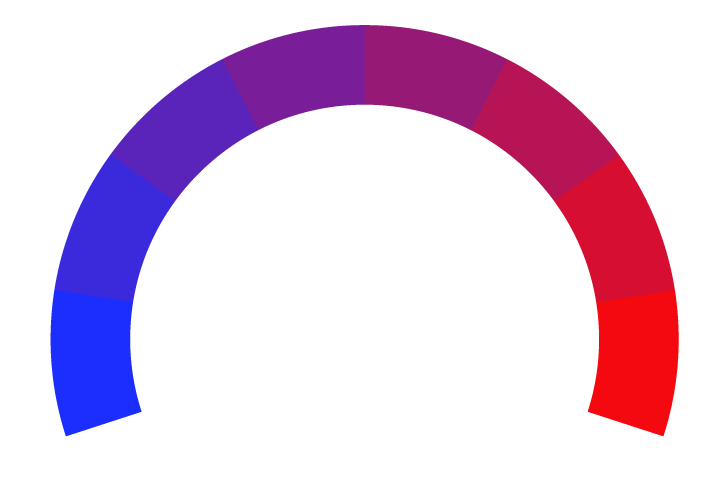
Biasly determines media bias ratings through a dual-layered approach combining artificial intelligence and analyst review. The platform’s proprietary bias detection engine, Bias Meter, evaluates sentiment, policy position alignment, and language framing across thousands of data points in news articles. Analysts then verify and interpret the AI’s findings, providing additional context where needed. Learn more about ratings
- Profile

Google News on the media bias chart
Google News has a Bias Score of -32% Somewhat Left which is based on a variety of factors including its policy and politician leanings, article ratings, and the use of biased language. Its Reliability is rated as N/A, and additional analytical insights are available in the other tabs.
- Bias Rating
-32% Somewhat Left
- ReliabilityPolicy Leanings
-32% Somewhat Left
Extremely
LiberalVery
LiberalModerately
LiberalSomewhat Liberal
Center
Somewhat Conservative
Moderately
ConservativeVery
ConservativeExtremely
Conservative-100%
Liberal100%
Conservative
*Our bias meter rating uses data science including sentiment analysis, machine learning and our proprietary algorithm for determining biases in news articles. Bias scores are on a scale of -100% to 100% with higher negative scores being more liberal and higher positive scores being more conservative and 0% being neutral. The rating is an independent analysis and is not affiliated nor sponsored by the news source or any other organization.
Politician PortrayalN/A
Continue For Free
Create your free account to see the in-depth bias analytics and more.
By creating an account, you agree to our Terms and Privacy Policy, and subscribe to email updates.
Log In
Log in to your account to see the in-depth bias analytics and more.
Policy Leanings Analysis
Policy | Bias score |
|---|
Is Google News Biased? Biasly's Research Study Reveals its Findings
Are Google News and Google Search biased in their political coverage? This question has significant implications for how millions of Americans consume news daily. Google News and Google Search serve as primary gatekeepers of information, determining which stories, sources, and political perspectives reach audiences first. With Google processing billions of searches per day, even subtle patterns in how these platforms surface political news can shape public discourse, influence which media outlets gain credibility, and ultimately affect which viewpoints dominate the national conversation.
Despite widespread concern about potential Google News bias and search engine bias, most discussions lack consistent, comparable data. To address this gap with empirical evidence, we conducted a comprehensive primary research study examining how Google News surfaces political content across the ideological spectrum. Our analysis reviewed results for 25 politically relevant policy topics and evaluated patterns by search term, by the sources Google elevated, and by the political lean of those outlets (left, center, and right). This approach helps identify whether potential Google algorithm bias consistently favors certain perspectives, and whether media bias in search results affects conservative, liberal, and centrist sources differently.
Between November and December 2022, we conducted searches in incognito mode using fresh Chrome profiles with disabled cookies to eliminate personalization effects. For each of the 25 search terms, we collected data on the top-ranking news sources, their frequency of appearance, and their ideological classification based on Biasly’s consolidated bias scores. We focused on the first two pages of results—the critical real estate where 92% of user traffic concentrates—and compared Google’s selections against the actual volume of content these outlets published on each topic.
Primary Research Findings
When conducting our research, we made search queries on Google News about certain topics without adding bias to the search terms (i.e., “book banning”, “abortion”). From these topic search queries, we collected data across 25 politically relevant searches to answer the question: “Is Google News biased?” Here is the data we collected:
- The highest rank of a news source within the Top 20 results
- The number of times a news source appeared in the Top 20 results
- The number of articles that Google News showed from a news source on a topic in the last 30 days, within the Top 100 results
- The number of articles on a topic that the news source published on its own website in the last 30 days
A study by online ad network Chitika found that the top listing in Google’s organic search results receives 33 percent of the traffic compared to 18 percent for the second position, and so forth. Page 1 results garnered 92 percent of all traffic from the average search, with traffic dropping off by 95 percent for Page 2. Therefore, Biasly decided to restrict the ranking of news sources to only the first two pages.
All searches were conducted from November to December of 2022 in incognito mode to ensure the searches were free of browsing preferences, in a blank Google Chrome profile that hadn’t been used, and with cookies disabled. Biasly focused on 25 selected search terms:
Biasly Study: The 25 political search terms Biasly focused on | ||||
| Book Banning | LGBT Rights | Slavery Reparations | Abortion | Should Vaccination be Mandatory |
| Privacy Rights | Marijuana Legalization | Free Market Capitalization | Affirmative Action | Immigration |
| Government Regulation Policy | Socialism | Police Reform | Charter Schools | Sex Education |
| Green New Deal | Iran Nuclear Deal | Social Security | Refugee Migration | Racism |
| Covid 19 | Gun Laws | Minimum Wage | Electoral College | Islamophobia |
Using a consolidated average bias score, Biasly classified 18 mainstream news sources into three different categories: Conservative, Liberal, and Center.
| Liberal | Center | Conservative |
| CNN | Associated Press (AP) News | Breitbart News |
| MSNBC | National Public Radio (NPR) | Fox News |
| The Mirror | Reuters | The Epoch Times |
| Politico | The Hill | The Daily Wire |
| The Atlantic | Voice of America (VOA) News | The US Sun |
| The Guardian | British Broadcasting Corporation | The Wall Street Journal |
Comparison of Topics Shown on Google News vs Media Website
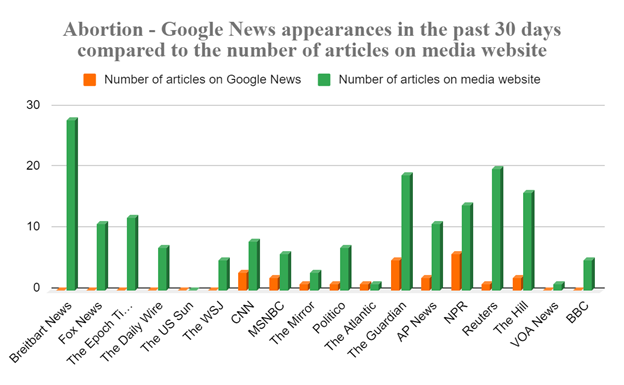
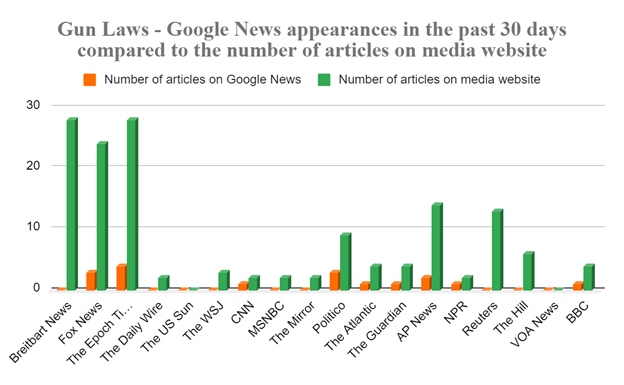
For each search term or topic, Biasly compared the number of articles from a media outlet in the first 2 pages (also called the Top 20) with the number of articles available on that topic on the outlet’s website.
Here is a breakdown of three hot-topic political search terms:
- Search Term: “Affirmative Action”
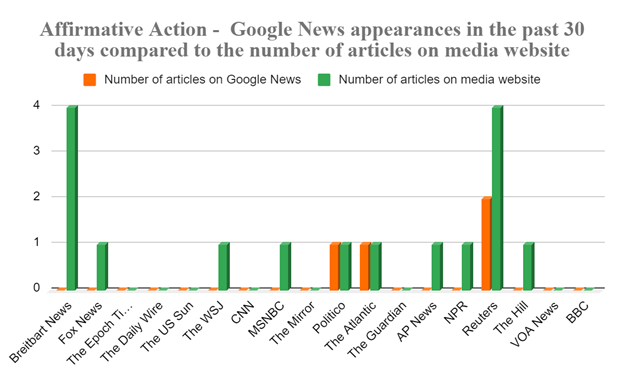
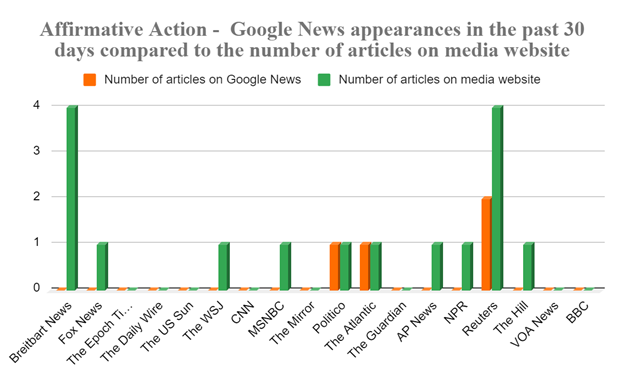
When searching for the term “Affirmative Action” over the last 30 days, 2 of the 4 (50%) articles on Google News were from Liberal sources (Politico and The Atlantic), and the remaining 2 articles were from the Center (Reuters). Notably, no Conservative outlets were present in these search results.

- Search Term: “Abortion”
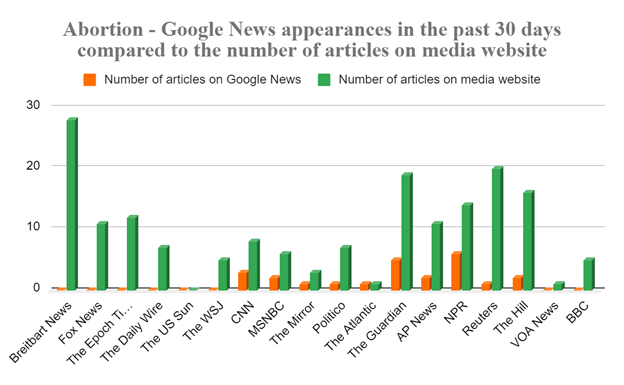
When searching for the term “Abortion” over the last 30 days (often spanning the Top 50-100 results), 13 of the 24 (54%) articles on Google News were from Liberal sources, and the remaining 11 articles (45%) were from the Center. No Conservative sources were represented in the search results.

- Search Term: “Gun Laws”
When searching for the term “Gun Laws” over the last 30 days, 7 of the 17 (41%) articles on Google News were from Conservative sources, 6 of the 17 (35%) were from Liberal sources, and the remaining 4 articles (23.53%) were from the Center. 3 out of 6 Center sources and 4 out of 6 Liberal sources were featured on Google News’ Top 20 compared with just 2 Conservative outlets. The remaining Conservative outlets were shown after the first 2 pages.

News Topics Ranked by Popularity on Google News
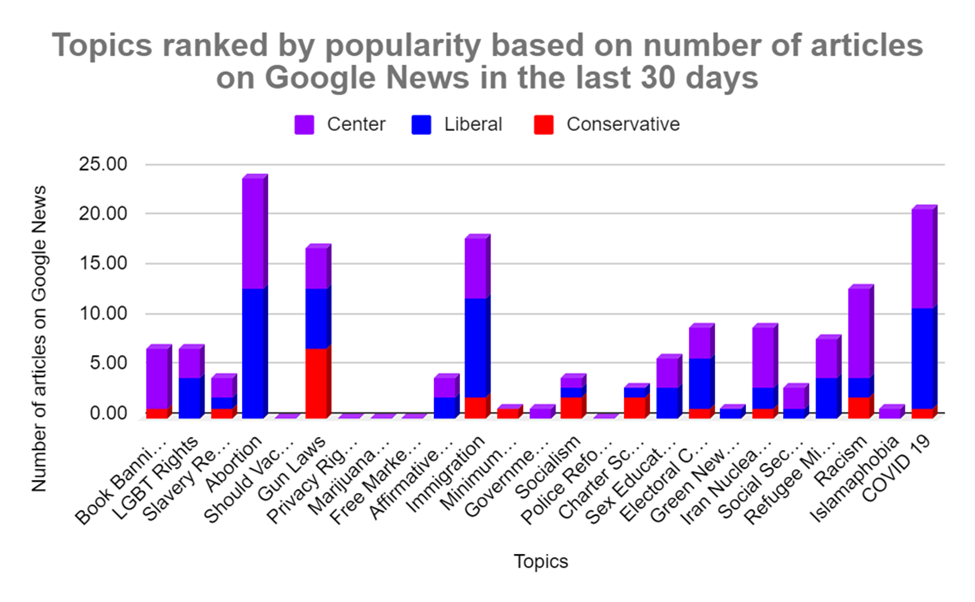
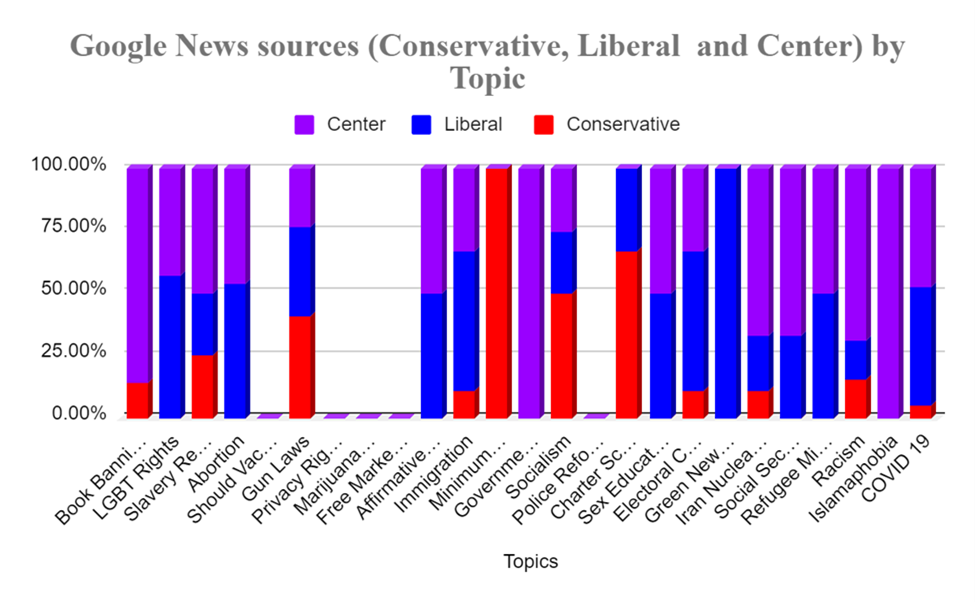
Through another experiment, Biasly analyzed popular topics shown in Google News by counting the number of articles for those topics shown within the last 30 days. Abortion was the most popular topic with 24 articles appearing in Google News search results in December, even though Roe vs Wade was overthrown quite earlier in the year on June 24, 2022. Other popular topics included COVID-19, immigration, and gun laws.

Biasly analyzed the share of Conservative, Liberal, and Center news sources for all topics. On the most popular topics like abortion, immigration, and COVID-19, Conservatives had little to no representation. Out of 20 search terms (5 search terms were excluded due to lack of data), the only topics where Conservative outlets fared better than Liberal and Center sources were gun laws, minimum wage, socialism, and charter schools. Through this, we can see Google News displays bias in favor of gun laws, minimum wage, socialism, and charter schools.

Media Source Appearances in Google News in the Last 30 Days
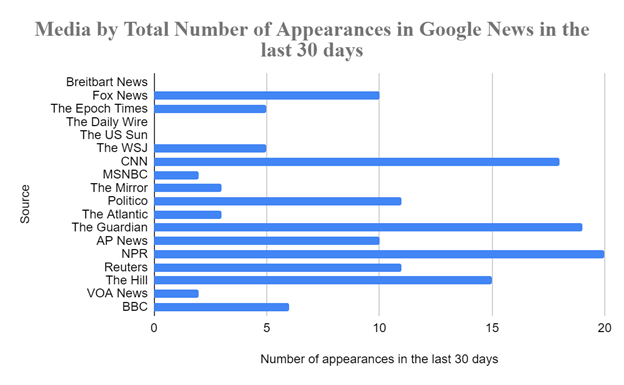
Biasly looked at the number of appearances in Google News over the last 30 days (within the first 10 pages of Google News search results) across all topics for each media outlet. Liberal and Center sources dominated, with only Fox News and WSJ making an appearance from Conservative outlets (2 out of 6), in contrast to all Liberal and Center outlets being featured on Google News in the last 30 days.

Media Source Appearances in Google News Top 20
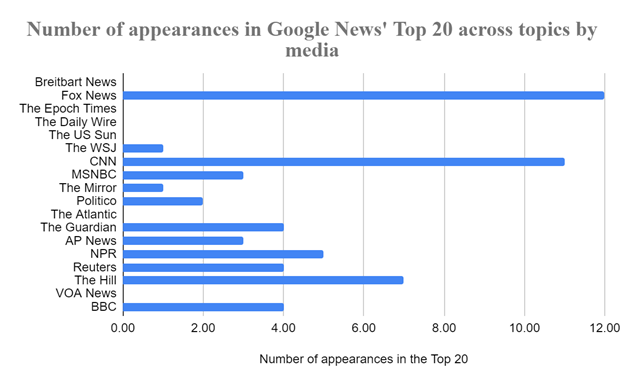
Finally, Biasly evaluated the number of appearances in Google News’ Top 20 across all topics for each media outlet. Liberal and Center sources dominated the rankings with only Fox News and WSJ making an appearance from Conservative outlets (2 out of 6) in contrast to 5 out 6 Liberal (the Atlantic was the only Liberal source to not feature in the Top 20) and 5 out of 6 Center outlets making an appearance (VOA News was the only Center source to not be featured in the Top 20).

When searching for the term “Affirmative Action” over the last 30 days, 2 of the 4 (50%) articles on Google News were from liberal sources (Politico and The Atlantic), and the remaining 2 articles were from the Center (Reuters). Notably, no conservative outlets were present in these search results.

- Search Term: “Abortion”
When searching for the term “Abortion” over the last 30 days (often spanning to the Top 50-100 results), 13 of the 24 (54%) articles on Google News were from Liberal sources, and the remaining 11 articles (45%) were from the Center. No Conservative sources were represented in the search results.

Google News Bias Overview

Source: Pew Research Center
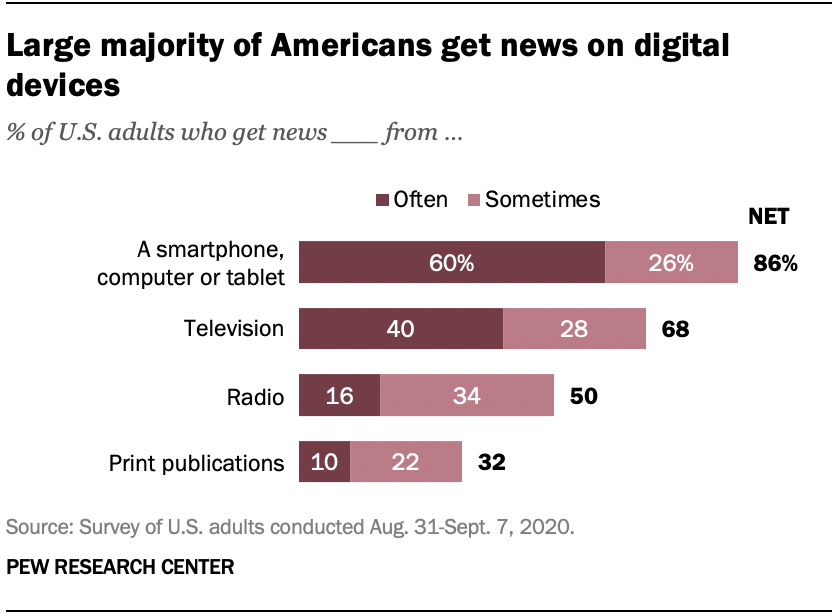
According to the Pew Research Center, 86% of U.S. adults say they get news from a smartphone, computer, or tablet “often” or “sometimes,” including 60% who say they do so often. Google developed Google News, a news aggregator service, in 2006. It displays links to news articles organized by publishers and magazines. According to Google, the ranking of articles in Google News is determined algorithmically by the relevance of content, prominence, authoritativeness, freshness, location, and language. However, are the search results displayed on important political topics truly free of bias and impartial?
In 2020, Ahrefs conducted a study on organic search performance between Liberal and Conservative news sites and found that Liberal news sites got more traffic. Northwestern researchers Nicholas Diakopoulos and Daniel Trielli found Google’s “Top Stories” section, which appears at the top of search results, favors a small number of media sources leaning left. This article delves into Google News’s editorial tendencies to explore whether political bias is present and, if so, to what degree.
Is Google News Biased?
Based on Biasly’s evaluations, Google News is rated as Somewhat Left.
By examining content patterns and the broader context of media influence, we aim to offer a balanced perspective on Google News’s political bias—and contribute to the ongoing discussion about bias in the news.
How Does Biasly Rate News Sources?
Biasly uses proprietary algorithms and a team of analysts to provide comprehensive bias evaluations across thousands of news outlets. Over 200,000 articles from more than 3,200 sources have been analyzed to identify the most accurate and unbiased stories.
Biasly assigns each outlet three key scores:
- Reliability Score – Reflects factual accuracy
- AI Bias Score – Generated via natural language processing
- Analyst Bias Score – Assessed by human political analysts
These scores are based on seven core metrics: Tone, Tendency, Diction, Author Check, Selection/Omission, Expediency Bias, and Accuracy. These elements help analysts and algorithms evaluate the political attitude conveyed by each article.
Biasly’s Bias Meter ranges from -100% (most left) to +100% (most right), with 0% indicating neutrality. The system evaluates individual articles based on political terms, policies, figures, and sentiment to calculate precise bias ratings.
Is Google News Politically Biased?
Google News earns a Somewhat Left rating for its AI Bias Score and a Somewhat Left for its Analyst Bias Score. The Analyst Bias Score is generated by reviewers from liberal, moderate, and conservative backgrounds. Analysts reviewed 15 Google News articles and noted preferences in areas like coverage of liberal politicians and policy topics such as abortion rights and affirmative action. However, the paper maintained objectivity on topics like education and national security.
How to Evaluate Bias
Although Biasly rates Google News as Somewhat Left, it’s important to remember that bias can vary from article to article. So, let’s learn how to evaluate media bias.
Recognizing media bias requires awareness and critical thinking. Often, readers trust news sources that affirm their existing beliefs—a psychological tendency known as confirmation bias. This makes it harder to identify slanted narratives or one-sided reporting.
To combat this, it’s essential to challenge your assumptions by consulting multiple viewpoints and verifying news through third-party analysis. Tools like Biasly’s media bias ratings allow readers to compare the same news story across the political spectrum.
Ultimately, bias isn’t always a matter of what is said—it’s also about what is left out, how topics are framed, and which stories are chosen for coverage. Learning to recognize these patterns can help readers make more informed decisions and develop greater media literacy.
To start comparing news outlets and gain a better understanding of bias, sign up for Biasly’s Media Bias & News Analytics Platform to see how stories vary between sources.
Google News Reliability Overview
Is Google News Reliable?
Google News can appear reliable because it links to established news outlets. However, to understand reliability, the reader can only discern this through analyzing each of the articles that Google News provides individually, as editorial reliability cannot necessarily be attributed to Google News due to the fact that they do not write the articles themselves. Thus, depending on which article is suggested by Google News as well as the news outlet it is from, the reliability of Google News can vary widely.
How to Evaluate Reliability?
Reliability refers to how trustworthy or accurate a news source is. If we can’t trust what we read, then continuing to consume content from that outlet serves little purpose. So how do we evaluate a news outlet’s reliability?
There are several potential measures of reliability to look out for when trying to determine whether a media source is reliable or not. Red flags for an unreliable article can include the presence of wild, unsubstantiated claims, facts dependent on other unreliable sources, heavy use of opinionated language, and more. In contrast, hallmarks of a reliable source include:
- Absence of subjective language
- Citing credible sources (e.g., .gov, .edu, academic references)
- Verifiable facts and statistics from multiple outlets
- Use of primary sources, like interviews or transcripts
- Consistency with coverage across other platforms
Biasly’s reliability scores incorporate these elements in evaluating media outlets.
So How Does Google News Fare in Its Reliability?
The political reliability index developed by Biasly assesses both accuracy and trustworthiness. Google News currently holds N/A Reliability Score, which is calculated as a weighted average of:
- Fact Analysis Score – Evaluates the accuracy of claims, facts, and evidence.
- Source Analysis Score – Assesses the number, diversity, and credibility of sources and quotes used.
Google News’s Source Analysis Score is Limited at 0% Reliable. This suggests moderate trustworthiness in the sourcing practices of the articles it recommends. The score is AI-generated and considers quote length, frequency, diversity, and quality.
The Fact Analysis Score of Google News is Pending at N/A. This further shows how well Google News supports its claims, addresses selection and omission bias, and presents verifiable evidence.
While Google News leans toward factual reporting, occasional lapses—such as unbalanced viewpoints or incomplete data—can affect its reliability rating. These nuances emphasize the importance of analyzing individual articles.
Google News’s Accuracy and Reliability
According to Biasly’s analysis, Google News maintains N/A Reliability Score, but individual articles may vary significantly. Let’s dive into the details.
Two common types of bias that affect factuality include:
- Selection Bias – Highlighting or omitting stories to fit a particular narrative.
- Omission Bias – Leaving out differing perspectives or relevant details to skew perception.
Biasly’s accuracy ratings use a scale from 1% (least accurate) to 100% (most accurate). Factors include the presence of supporting evidence, internal and external reliable sources, and balanced viewpoints.
So, is Google News Reliable?
Overall, Google News can be considered to be an outlet that is N/A reliable. It demonstrates a consistent goal of journalistic integrity and typically supports claims with sources and quotes. Occasional omissions and framing bias do appear, particularly on culturally sensitive or partisan issues.
As media literacy improves, readers can more easily detect issues with selection bias, omission bias, and factuality. To strengthen your ability to assess reliability across the political spectrum, use Biasly’s News Bias Checker to compare how multiple outlets report the same story.
This empowers you to consume more accurate, balanced, and dependable news.
Google News Editorial Patterns
Google News’s selected articles’ coverage of political topics often reflects a Somewhat Left bias, with consistent patterns in phrasing, source selection, and thematic focus that are Slightly Liberal. While Google News often selects stories that are reliable, the choice of issues, framing, and word usage within some of their selected articles can indicate a political slant. This content analysis examines how Google News’s selected articles handle liberal and conservative issues and evaluates their language choices and editorial tendencies.
Coverage of Liberal vs. Conservative Topics
Google News’s articles include causes such as government regulation policy and climate policy, which tend to adopt sympathetic and supportive coverage towards liberal perspectives. For instance, its coverage of topics related to abortion rights, clean energy, and anti-discrimination laws frequently aligns with liberal viewpoints, using inclusive and affirmative language to frame these policies as necessary reforms.
On the other hand, Google News conveys articles covering conservative figures or Republican-led initiatives that often employ a more critical tone. Biasly’s analysis of recent articles provided by Google News reveals a tendency to highlight controversies or opposition surrounding Republican policies, while downplaying positive aspects or conservative rationale. For example, in political campaign coverage, Republican candidates may receive more scrutiny, with an emphasis on potential missteps or public backlash. Furthermore, articles that portray conservative politicians or policies in a positive light are given less coverage.
Policy and Issue Framing
When covering the environment, Google News often includes articles that describe Trump’s policies as “rollbacks,” “stripping federal protection,” and focus on the effects these policies have on endangered and marginalized species. This focus reflects a liberal framing.
Issues such as Trump’s foreign policy are often framed in a more critical tone, focusing on drawbacks or perceived oversights rather than offering a neutral or balanced perspective on his policies.
Coverage and Relevance
Google News’s reporting often touches on key issues central to the political bias discussion — including elections and foreign military policy. As such, it serves as a compelling case study for examining source bias and news media bias in state-focused reporting.
Readers who wish to further explore how Google News compares with other publications can visit Biasly’s Media Bias Chart to analyze tone and word choice in real time.
Google News Funding and Ownership
Who Owns Google News?

Larry Page, Co-Founder, Google News – Source: Wikimedia
Google News is owned by Alphabet Inc., whose CEO is Sundar Pichai. Alphabet Inc. is a for-profit company with Google as its main subsidiary. Google itself is involved with internet search, advertising, news, e-commerce, information technology, and countless other functions. It, along with Apple and Amazon, is one of the world’s leading technology companies.
Who Funds Google News?
Google News is funded by its parent company, Google. Google’s main source of revenue stems from advertising. This reliance on a for-profit and advertising structure may influence how Google News selects the articles it chooses to present. The need for views and a steady flow of consumers may suggest that their algorithms may emphasize appealing to a reader’s biases, rather than providing the reader with neutral and fact-based news.
Additional Insights
News Source Comparison
Google News is not a news source in itself, but rather provides multiple articles on certain perspectives based on the user’s search. Thus, Google News does not necessarily compare to other news outlets themselves, but rather includes a wide range of articles from different news outlets. Another well-known news aggregator that Google News can be compared to is Yahoo News.
Notable Contributors and Authors
Google News does not have any authors of its own, as it is not a news outlet. They include a wide range of news outlets that have their own reporters and their own ideological biases. The reader then must analyze these articles and their authors on their own terms.
Related Tools and Resource Pages
To better understand how Google News fits into the broader media landscape, we recommend exploring these helpful resources:
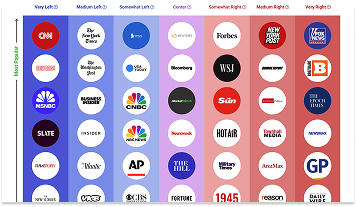
- Media Bias Chart: See where Google News ranks among hundreds of media outlets across the political spectrum.
- Political Bias Chart: Visualize political slants of news sources across various policy areas.
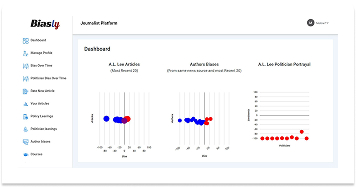
- Journalist Bias Analytics Platform: Explore how individual journalists contribute to bias within their publications.
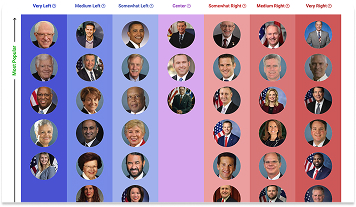
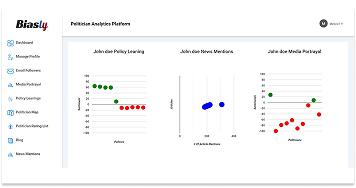
- Politician Bias Analytics Platform: Compare how politicians are framed differently by Google News and other outlets.
- Media Literacy Education Platform: Learn how to critically assess media sources, bias techniques, and news reliability.
Frequently Asked Questions
Google News is rated as Somewhat Left based on Biasly’s media bias algorithm, which assesses sentiment, article framing, and policy favorability.
While Google News is not widely known for directly promoting fake news, it operates as a news aggregator, meaning it curates content from other sources using algorithm-driven systems. As a result, it can influence what information users see, or do not see, through ranking and filtering mechanisms. Some articles have shown selection and omission bias, particularly in political reporting. For example, reports have noted Google’s algorithm suggesting AI-generated news articles. Additionally, a court in France ordered the website News Day Fr, which had been surfaced to users through Google News, to be blocked after it was found to be plagiarizing. However, its factual reporting is generally sound.
Biasly uses a combination of AI sentiment analysis and human analyst review to assess tone, fact accuracy, source quality, and media bias indicators. Learn more on our Bias Meter page.
Generally, yes, though partisan framing and selective reporting can affect perceived reliability.
Military Spending
| Date | Sentiment | Associated Article | Snippet |
|---|---|---|---|
| 08/25/2019 | 75% For | Trump Family Detentions Flores Agreement (link) | So, of course, the Trump administration is doing the opposite in a baldfaced |