




-10% Center
Bias Meter
Extremely
Liberal
Very
Liberal
Somewhat Liberal
Center
Somewhat Conservative
Very
Conservative
Extremely
Conservative
-100%
Liberal
100%
Conservative

Biasly determines media bias ratings through a dual-layered approach combining artificial intelligence and analyst review. The platform’s proprietary bias detection engine, Bias Meter, evaluates sentiment, policy position alignment, and language framing across thousands of data points in news articles. Analysts then verify and interpret the AI’s findings, providing additional context where needed. Learn more about ratings
- Profile
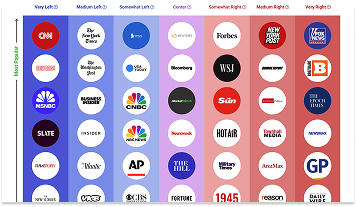
Bloomberg News on the media bias chart
- Bias Rating
-10% Center
- Reliability78% Reliable GoodPolicy Leanings
-8% Center
Extremely
LiberalVery
LiberalModerately
LiberalSomewhat Liberal
Center
Somewhat Conservative
Moderately
ConservativeVery
ConservativeExtremely
Conservative-100%
Liberal100%
Conservative
Average Reliability
*Our bias meter rating uses data science including sentiment analysis, machine learning and our proprietary algorithm for determining biases in news articles. Bias scores are on a scale of -100% to 100% with higher negative scores being more liberal and higher positive scores being more conservative and 0% being neutral. The rating is an independent analysis and is not affiliated nor sponsored by the news source or any other organization.
Politician Portrayal85% negative
Continue For Free
Create your free account to see the in-depth bias analytics and more.
By creating an account, you agree to our Terms and Privacy Policy, and subscribe to email updates.
Log In
Log in to your account to see the in-depth bias analytics and more.
Analysis of Bloomberg News Articles
Analysis of Bias in Bloomberg News Online Articles
To evaluate bias, we can analyze select Bloomberg News articles through several of Biasly’s bias rating criteria: Tone, Tendency, Author, Diction, and Expediency Bias.
- Tone: The overall attitude conveyed by the article
- Diction: Specific word choices made by the writer
- Author: The background and social presence of the journalist
- Tendency: Patterns of bias in the writer’s broader body of work
- Expediency Bias: Quick visual or textual indicators like headlines and photos that imply bias
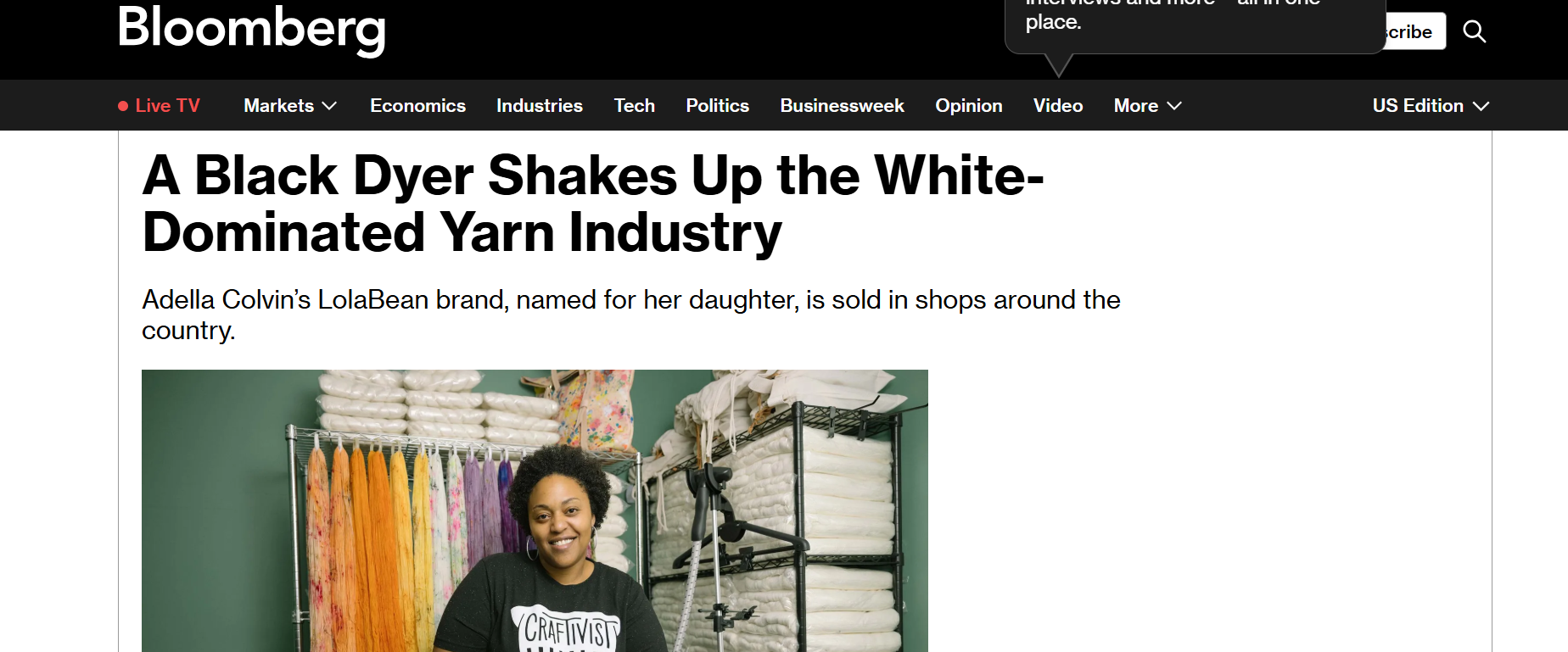
The first article we will examine is titled “A Black Dyer Shakes up the White-Dominated Yarn Industry.” Biasly rates this article as Very Liberal because it echoes progressive orthodoxy on discrimination within the small business space. The tone of the article is clear and insistent, as the author claims that the yarn industry has become an “unlikely cultural battleground… divided by charges of racism and cultural appropriation.” The image shows a very positive image of the “Black Dyer”, focusing on social policies such as Black Lives Matters.
This article’s sources also reflect the author’s tendency to favor viewpoints that endorse typical progressive positions on the effects of racism in society.
“People say, ‘I had no idea there was so much racism in knitting.’ Colvin says. “Of course. Racism is built into the fabric of our country.”
The diction of the article is harsh and generally aligns with said progressive views:
“The woman who once tried to hide her Black face says she has lost the little bit of filter she had left. “Sometimes I’m brutal… If that makes you not want to buy my yarn, don’t… I’m not going to make middle-aged White women comfortable about where they buy their yarn.”
Due to the selection of such quotes as these, even though the author may not have intended it this way, the diction of the article and its tone read as very harsh; the language is adversarial and blunt, which may have been the result of the author’s choice of sources. The article was therefore found to be generally left-leaning, as the quotes the author chose paint a particular picture.
For similar reasons, we would rate the article as Very Liberal when it comes to Tendency because it maintains its progressive tone consistently throughout the piece; all of its sources focus on this one particular perspective of a “Black Dyer” in the “White-Dominated Yarn industry” and the tension that arises from the interactions between the two groups.
“The industry’s cultural battles peaked in 2019 when Ravelry, long knitting’s dominant social platform… ignited a skirmish by banning all pro-Trump content… “We cannot provide a space that is inclusive of all and also allow support for open white supremacy,” the owners announced in a written statement.”
“The crossfire prompted many knitters of color to share their stories of racism in the industry for the first time.”
“The cries of White privilege were immediate, no doubt influenced by the location of Berg’s store just blocks from where George Floyd was murdered…The video came down, and Berg apologized… ‘I’ve changed from being the loudmouthed leader to listening and learning,’ he says.”
As for the author’s history, Loren Feldman’s X, formerly known as Twitter, does not reveal much about the author’s personal opinions. He seems to focus exclusively on reporting on small businesses, having also published in Forbes, Time, and on the 21 Hats blog and podcast. The biases in this article may be outliers and not representative of Mr. Feldman’s general views. However, he has occasionally promoted content on the intersection between small business and social issues.
My business exists because I couldn’t find a trash enclosure that I liked in the mass market. So I created my own. It’s a niche product for a customer who is willing to pay for quality and design. It’s not the type of mass market product that does well on Shark Tank. https://t.co/9CPqSjPiX0
— Loren Feldman (@lfeldman) June 19, 2021
For a contrasting example, consider this article from Bloomberg News Opinion, which demonstrates little to no bias: “Blue Collars have Outpaced White Collars in Pay- at First Glance”.This article elaborates on a chart in a Bureau of Labor Statistics report that claims the average wage has risen faster among blue-collar, lower-wage workers than among white-collar workers. In the author’s view, the chart misses out on some critical information, which he then supplies:
“In a sense, both the EPI (Economic Policy Institute) and Yardeni (Edward Yardeni, founder of Yardeni Research Inc.) are correct…”
“Although the numbers in (the chart) are derived from Bureau of Labor Statistics data, you won’t find them on the BLS website. The BLS doesn’t report average hourly wages for higher-wage workers.”
The article uses accurate and reliable sources, namely the Economic Policy Institute and the federal Bureau of Labor Statistics; the language is neutral and sticks to quibbles with individual data points.
The language employed shows that the author is striving to be diplomatic and to apply their analysis to improve upon an already existing piece of information. The language is not adversarial or antagonistic. This is about as neutral an article as you will find.
To sum it up, Bloomberg News shows inconsistent bias across its reporting. Despite attempts at balance in some reporting, Bloomberg News’s sometimes highlight progressive initiatives and frame stories through a social justice lens, indicating an occasional left-leaning orientation.
Analysis of Bloomberg News Opinion Articles
To fully understand political bias in media, it’s important to distinguish between factual reporting and opinion pieces. While reporting aims to present facts and let readers form their own conclusions, opinion articles express personal viewpoints on current issues. Although the previous section examined factual reporting, this section turns to how bias surfaces through Bloomberg News’s selection and tone of opinion content.
Consider the piece “DeSantis’ Immigration Stunt Didn’t Go Entirely as Planned.” Right away, we can see that the title’s language is loaded with bias, calling Gov. DeSantis’ actions a “stunt,” a kind of acerbic language designed to prime the reader’s opinion before they even consider the body of the article. The attentive reader can see that the author does not intend to provide a balanced viewpoint. Further on in the article, one finds choice items like the claim that:
“(Gov. Desantis) consumed so much media attention that even communities far from the border now irrationally consider illegal immigration as a critical threat to their well-being… instead of the governing failure that it is”.
The author provides no evidence to support their assertion that illegal immigration is the result of a failure of governance or arguments against the idea that illegal immigration is not a critical threat. The important thing to remember is that, like anyone who writes an opinion piece, the author comes to the writing process with a host of their own biases and preconceived notions, which can affect the content.
However, there are ways to produce opinion pieces that mask their biases or produce more objective content. Such pieces can contain suggestions or policy prescriptions that can cloak themselves in relatively neutral language. For an example of this in Bloomberg News, see the article “America is a House Divided. Public Service Can Fix It.” This article’s slant and language are pretty diplomatic. It argues that the divisions in American civil society are due in no small part to the lack of proper role models in office.
“Both sides of the political spectrum are at fault (for) hyper-partisan screaming matches.”
The author stresses that a more vital civic spirit and political unity are crucial for America to face the challenges ahead, including foreign and domestic security threats. To achieve this, both citizens and political leaders must do their part. He notes that increasing numbers of Americans do not identify with either party, claiming that a recent poll (which he unfortunately does not cite) shows that 43% consider themselves independents. The author explicitly seeks ways to represent this data in the political process and concludes with a call for unity.
“We should collectively discuss ways to realign the political process in a way that encourages compromise, bipartisanship, and rational discussion.”
Even looking at tone and diction alone, this article is more balanced than the other example.
This tendency underscores the importance of distinguishing subjective viewpoints from straight reporting, especially when interpreting the political leanings of any news organization.
Analysis of Reliability in Bloomberg News’s Online News Articles
Bloomberg News aims to serve its readers with objective, fact-based reporting. Its staff includes writers from varying ideological backgrounds, which can help balance coverage. However, readers should distinguish between news reporting and opinion pieces to evaluate credibility effectively.
One example is “Vale Mine Overflow in Brazil Sends Water Into Competitor’s Site.” This article does a good job of using quotes to emphasize its points. They also use multiple sources in the article. However, the sources they use are somewhat limited in terms of differences of opinion. This leads the article to only having average reliability.
Another article called “Starmer Blocks Burnham but Rivals Say He’s Only Put Off His Fate.” This article shares similar strengths and weaknesses in terms of reliability. We see good use of quotes and multiple sources, but only one side of the issue is given a true representation.
Quality of Sources and Facts Used
Bloomberg News often uses credible sources from across the political spectrum. However, some articles skew in how comprehensively they present opposing viewpoints.
For an example of how unreliability can manifest itself even in otherwise meticulously reliable publications like Bloomberg News News, consider this article: “Desantis Orders Florida Schools to Teach Evils of Communism” by Anna J. Kaiser. An outstanding example of the difficulties that arise from selection and omission biases, this piece (which somehow wasn’t part of the Opinion section) is rated at a staggeringly low 15% source analysis rating by Biasly. The article contains only three different sources and two short quotes from the same source. More extended quotes generally (though not always) point towards more reputable sources.
In this article, the author uses the following sources:
- Statement from Office of Florida Gov. Ron DeSantis
- An uncited factoid from PEN America claiming that “over 3,100 books were removed across 11 school districts between July and December last year” (Liberal Leaning)
- A data point from the 2022 gubernatorial election in Florida showing that DeSantis won 69% of voters of Cuban descent (links to an NBC News report) (Liberal Leaning)
The major problem with this article is that it lacks sufficient sources to provide a balanced perspective. It is presented as fact-based reporting, simply notifying the reader that Gov. Ron DeSantis signed a bill in April 2024 requiring schools to “teach the dangers and evils of communism.”
The author cites this and other statements from the Governor’s office, including DeSantis’ resolution to prevent supposed Communist influence in Florida’s schools. The statement from the Governor’s office is supposedly quoted in support:
“We will not allow our students to live in ignorance nor be indoctrinated by Communist apologists in schools.”
Unfortunately, the author does not provide a link to the Governor’s statement or the text of the supposed bill, leaving the reader in the dark about what the text contains, or indeed whether there is such a bill.
Furthermore, the article contains almost no quotations or sources. Besides the two quotes from the Governor’s office, one uncited fact from PEN America claims that censorship in Florida schools is well underway.
“…over 3,100 books were removed across 11 school districts between July and December last year”.
Unfortunately, there is little to go on for readers interested in learning more about this bill, such as why it is being implemented in the first place or where the initiative originated. This does not stop Kaiser from offering her speculation. She claims that this initiative is part of a broader stunt by DeSantis to appeal to conservative voters who support such efforts.
“Schools across the country have become a battleground for conservatives, heightening tensions in colleges and leading to book bannings in public schools.”
However, she doesn’t provide any direct sourcing for this claim, only listing the PEN America statistic. This seems to indicate the author’s bias, as it primes the reader to associate the bannings with the efforts of conservatives; the author does not provide any direct evidence that conservatives are responsible for heightening tensions or that the book bannings are genuinely the result of their efforts.
Without any context or supporting statements surrounding the origins of or reasons for this bill, the author seems to be inviting the reader to fill in the gaps, priming the reader to interpret the text in such a way that they could be made to feel unfavorable towards DeSantis and the bill, as well as any conservatives who may have fair reasons for supporting the bill. A reader interested in learning about the bill’s contents or Governor DeSantis’ plans should look elsewhere. The article presents a non-holistic view without any counterpoints that might prompt the reader to think differently. Unsurprisingly, Biasly gave this piece a Somewhat Liberal rating.
In “Canada, India Pledge to Grow Oil, Petroleum Trade In Energy Reset.” We can see bias that is less obvious but still important to discuss. The article provides a factually sound description of the trade situation. Most of the sources used are neutral. However, a few feel like they’re directly attacking the United States’ recent trade policy. Although these don’t undermine the article’s overall reliability, the use of some anti-Trump sources for quotes is worth noting.
Selection and Omission Bias
Bloomberg News provides extensive coverage of finance and world issues, which is reasonable given the company’s history. However, bias may still emerge through framing and story selection.
In “America’s Values Must Guide White House Diplomacy,” we see founder Michael Bloomberg write about a meeting between President Trump and Russian President Vladimir Putin in 2018. Although Bloomberg mostly offers his opinion, he backs most of it with stats or statements from primary sources. However, at the end of the article, he claims “Americans overwhelmingly support these values.” This claim is not backed up by any surveys or exit polls. Not being able to hear the perspectives of American citizens, one way or the other, is omission bias. This article would’ve been stronger with such a sweeping generalization at the end.
Another article, called “Kavanaugh and Partisanship on the Supreme Court,” shows both selection and omission bias. This article attempts to paint the narrative that the Supreme Court is being partisan. The writers select specific cases that help paint this narrative. However, only naming cases like Citizens United paints a biased picture. Not to mention, Kavanaugh wasn’t even on the Supreme Court for two of the cases they mentioned. The article does state that Kavanaugh is an experienced, well-qualified judge. However, it doesn’t state what those experiences and qualifications are. Stating his experience as White House Staff Secretary and Circuit Judge for 18 years before becoming a Supreme Court justice is vital information, and omitting it is clear bias.
Bloomberg News Bias Overview
Founded in 1981 by Michael Bloomberg, Bloomberg L.P. was established to provide financial data and analytics to businesses and financial professionals. The idea came from Michael Bloomberg’s experience in the financial industry and his vision of creating a company that could provide real-time market data and insights. Initially starting with the Bloomberg Terminal, the company expanded into media with the launch of Bloomberg News in 1990. Today, Bloomberg L.P. is privately owned, with Michael Bloomberg as the majority owner. Bloomberg News covers a wide range of topics, including business, finance, technology, politics, and entertainment. The organization aims to keep its audience informed about global economic trends, market developments, and important news events.
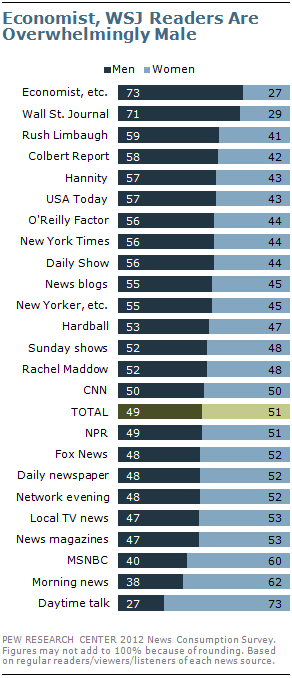
Source: Pew Research
With its headquarters in New York City, Bloomberg News serves a global audience, providing in-depth analysis and reporting on issues that impact the world economy. A unique aspect of Bloomberg News is its Bloomberg Terminal, a computer software system that has revolutionized how financial professionals access market data and news. This innovation has become a staple in the finance industry, used by investment professionals worldwide to make informed decisions.
Is Bloomberg News Biased?
Based on Biasly’s evaluations, Bloomberg News is rated as Center.
By examining content patterns and the broader context of media influence, we aim to offer a balanced perspective on Bloomberg News’s political bias—and contribute to the ongoing discussion about bias in the news.
How Does Biasly Rate News Sources?
Biasly uses proprietary algorithms and a team of analysts to provide comprehensive bias evaluations across thousands of news outlets. Over 200,000 articles from more than 3,200 sources have been analyzed to identify the most accurate and unbiased stories.
Biasly assigns each outlet three key scores:
- Reliability Score – Reflects factual accuracy
- AI Bias Score – Generated via natural language processing
- Analyst Bias Score – Assessed by human political analysts
These scores are based on seven core metrics: Tone, Tendency, Diction, Author Check, Selection/Omission, Expediency Bias, and Accuracy. These elements help analysts and algorithms evaluate the political attitude conveyed by each article.
Biasly’s Bias Meter ranges from -100% (most left) to +100% (most right), with 0% indicating neutrality. The system evaluates individual articles based on political terms, policies, figures, and sentiment to calculate precise bias ratings.
Is Bloomberg News Politically Biased?
Bloomberg News earns a Center rating for its AI Bias Score and a Center for its Analyst Bias Score. The Analyst Bias Score is generated by reviewers from liberal, moderate, and conservative backgrounds. Analysts reviewed Bloomberg News articles and noted no strong preference in most articles.
The site’s founder, Michael Bloomberg, has been registered as both a Republican and a Democrat. He was a Republican during his time as New York City Mayor, but was a candidate in the 2020 Democratic presidential primaries. Bloomberg’s political shifts are indirectly represented in the paper’s neutral coverage of most major issues.
This Bias score is determined through natural language processing that evaluates the tone, word choice, and opinion embedded in the reporting.
How to Evaluate Bias
Although Biasly rates Bloomberg News as Center, it’s important to remember that bias can vary by article. Bloomberg News also covers a liberal-leaning state with objectivity on many issues, from state legislation to social developments. This complexity underscores the importance of examining each article individually. So, let’s learn how to evaluate media bias.
Recognizing media bias requires awareness and critical thinking. Often, readers trust news sources that affirm their existing beliefs, a psychological tendency known as confirmation bias. This makes it harder to identify slanted narratives or one-sided reporting.
To combat this, it’s essential to challenge your assumptions by consulting multiple viewpoints and verifying news through third-party analysis. Tools like Biasly’s media bias ratings allow readers to compare the same news story across the political spectrum.
Ultimately, bias isn’t always a matter of what is said; it’s also about what is left out, how topics are framed, and which stories are chosen for coverage. Learning to recognize these patterns can help readers make more informed decisions and develop greater media literacy.
To start comparing news outlets and gain a better understanding of bias, sign up for Biasly’s Media Bias & News Analytics Platform to see how stories vary between sources.
Bloomberg News Reliability Overview
Is Bloomberg News Reliable?
Bloomberg News generally sticks to the facts when talking about topics. Their strong suit is in business and finance news. However, they have reporters who are knowledgeable on a wide range of issues. These reporters tend to adhere to the same high journalistic standards as the rest of the company.
How to Evaluate Reliability?
Reliability refers to how trustworthy or accurate a news source is. If we can’t trust what we read, then continuing to consume content from that outlet serves little purpose. So how do we evaluate a news outlet’s reliability?
There are several potential measures of reliability to look out for when determining whether a media source is reliable. Red flags for an unreliable article can include wild, unsubstantiated claims, facts that depend on other unreliable sources, heavy use of opinionated language, and more. In contrast, hallmarks of a reliable source include:
- Absence of subjective language
- Citing credible sources (e.g., .gov, .edu, academic references)
- Verifiable facts and statistics from multiple outlets
- Use of primary sources, like interviews or transcripts
- Consistency with coverage across other platforms
Biasly’s reliability scores incorporate these elements in evaluating media outlets.
So How Does Bloomberg News Fare in Its Reliability?
The political reliability index developed by Biasly assesses both accuracy and trustworthiness. Bloomberg News currently holds Good Reliability Score, which is calculated as a weighted average of:
- Fact Analysis Score – Evaluates the accuracy of claims, facts, and evidence.
- Source Analysis Score – Assesses the number, diversity, and credibility of sources and quotes used.
Bloomberg News’s Source Analysis Score is Average at 33% Reliable. This suggests trustworthiness in its sourcing practices. The score is AI-generated and considers quote length, frequency, diversity, and quality.
The Fact Analysis Score of Bloomberg News is Excellent at 90% Reliable. This further shows how well Bloomberg News supports its claims, addresses selection and omission bias, and presents verifiable evidence.
While Bloomberg News leans toward factual reporting, occasional lapses—such as unbalanced viewpoints or incomplete data—can affect its reliability rating. These nuances emphasize the importance of analyzing individual articles.
Bloomberg News’s Accuracy and Reliability
According to Biasly’s analysis, Bloomberg News maintains Good Reliability Score, but individual articles may vary significantly. Let’s dive into the details.
Political orientation plays a crucial role in how audiences perceive reliability. Bloomberg News has been accused of favoring a liberal narrative, potentially at the expense of factual reporting. To validate such claims, it’s essential to analyze whether the publication backs its assertions with sufficient evidence and diverse viewpoints.
Two common types of bias that affect factuality include:
- Selection Bias – Highlighting or omitting stories to fit a particular narrative.
- Omission Bias – Leaving out differing perspectives or relevant details to skew perception.
Biasly’s accuracy ratings use a scale from 1% (least accurate) to 100% (most accurate). Factors include supporting evidence, reliable internal and external sources, and balanced viewpoints.
For instance, Biasly gave ABC7 New York a Center bias rating with a Bias Score of –2% and an Average reliability score (54% Reliable) based on its overall article analysis and language framing. One hypothetical ABC7 article that leaned into sensational framing without sufficiently balancing perspectives might be critiqued for using loaded language around a political controversy and for not including diverse viewpoints in its sourcing, contributing to that moderate reliability outcome and center bias characterization. In contrast, a different ABC7 New York news story that presented legal or policy developments with balanced quotes from multiple sides and careful sourcing could be rated as Center with stronger marks for accuracy. Across the outlet’s coverage sampled by Biasly, political reporting overall aligns with the middle of the spectrum, with moderate reliability, indicating an effort toward balanced reporting, even if occasional framing issues arise.
We will take a closer look at more examples like this below to provide a further investigation into the reliability of Bloomberg News’s articles. This will include its use of selection bias and omission bias, as well as the quality of its sources and the facts it uses.
So, is Bloomberg News Reliable?
Overall, Bloomberg News can be considered an outlet with very reliability. The site regularly publishes fact-based reporting and demonstrates a commitment to credible sourcing across most of its content. While some opinion or editorial framing may appear, particularly in commentary sections, the majority of its coverage maintains journalistic integrity and a balanced presentation of perspectives. Occasional gaps in attribution or depth may occur, but they do not significantly undermine the outlet’s overall trustworthiness.
Bloomberg News Editorial Patterns
Bloomberg News’s coverage of political topics often reflects a neutral tone. The publication demonstrates journalistic standards in many of its reports. This content analysis examines how Bloomberg News handles liberal and conservative issues and evaluates its language choices and editorial tendencies.
Coverage of Liberal vs. Conservative Topics
Bloomberg News’s articles include progressive causes, such as fair taxation, racial justice, and social spending, which tend to adopt neutral language. For instance, its coverage of abortion rights, clean energy, and anti-discrimination laws often aligns with neutral viewpoints.
Articles covering conservative figures or Republican-led initiatives employ the same neutral tone. For example, in political campaign coverage, Republican candidates receive equal scrutiny, with an emphasis on both sides’ potential missteps or public backlash.
Policy and Issue Framing
Bloomberg News covers many topics with an impartial lens. They look at the facts rather than making up their minds beforehand. Abortion, affirmative action, and anti-discrimination laws are just some of the issues where Bloomberg News is a neutral and impartial source.
On select issues, Bloomberg News can lean slightly left. The border wall, Brexit, and charter schools are some of the issues where Bloomberg News is slightly in favor of the Democratic narrative. Border control is the issue they cover the most from a slightly liberal lean.
Coverage and Relevance
Bloomberg News’s reporting often touches on key issues central to modern political discussion, like immigration, foreign policy, and schooling. As such, it serves as a compelling case study for examining source bias and news media bias in state-focused reporting.
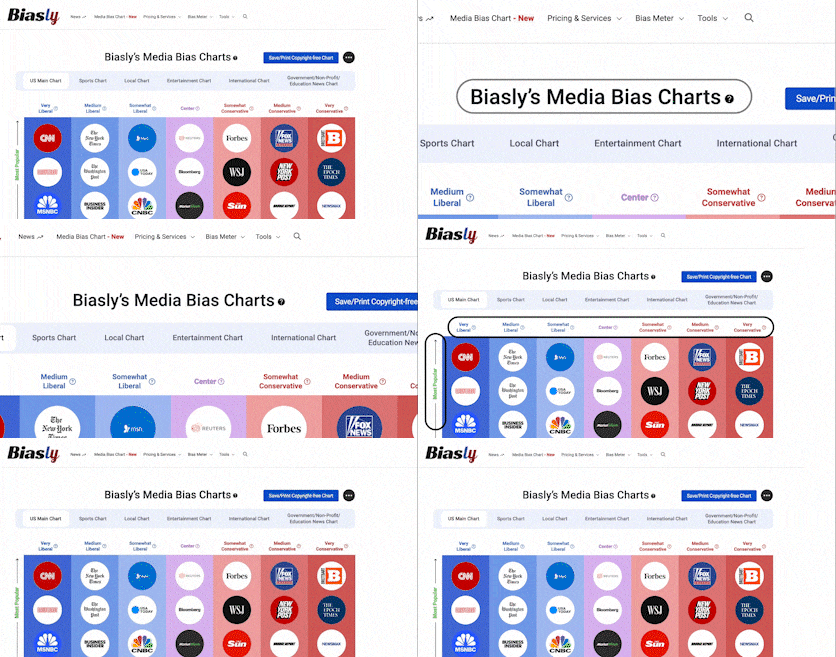
Readers who wish to further explore how Bloomberg News compares with other publications can visit Biasly’s Media Bias Chart to analyze tone and word choice in real time.
Funding and Ownership
Who Owns Bloomberg News?

Michael Bloomberg, Founder, Bloomberg News – Source: Wikimedia Commons
Founder Michael Bloomberg remains the majority owner of Bloomberg News, with an estimated 88 percent stake. Despite this, he’s taken a more hands-off approach to Bloomberg News’s leadership since he became the Mayor of New York City in 2001. Upon his death, he intends to give his share of the company to his philanthropic organization.
Who Funds Bloomberg News?
Bloomberg News is a privately owned company. Almost all of their profits come from subscriptions. A vast majority of their content is paywalled. They also sell their work to other media companies. Since Bloomberg News is part of the larger Bloomberg L.P., it can rely on Bloomberg L.P.’s finances, data, and technology.
Additional Insights
News Source Comparison
When it comes to news source comparison, Bloomberg News is often evaluated alongside other regional and national outlets that lean center. Sources like Reuters, The Hill, and C-SPAN often present similar tones and editorial philosophies. While Bloomberg News maintains a Center media bias, it differs from strongly partisan sources in that it includes opposing viewpoints and strives for a balanced regional coverage.
This puts it in contrast to more biased media outlets that consistently present one-sided narratives without factual counterpoints. Readers seeking balanced political coverage may compare Bloomberg News’s framing of issues with outlets rated as Center or Lean Right on our Media Bias Chart, or explore other regional papers on our Similar Sources page.
Notable Contributors and Authors
Matt Levine writes one of Bloomberg News’s most widely read sections, called “Money Stuff.” He started writing about economics and finance in 2011 for “Dealbreaker.” He joined Bloomberg News in 2013 after receiving recognition from Columbia Journalism Review for his work with Dealbreaker. He’s also made contributions to CNN and the Wall Street Journal.
Adrian Wooldridge covers global economics for Bloomberg News. He wrote for the British newspaper “The Economist” for more than 20 years. He joined Bloomberg News in 2021. He has written several books about economics since the 1990s.
Related Tools and Resource Pages
To better understand how Bloomberg News fits into the broader media landscape, we recommend exploring these helpful resources:
- Media Bias Chart: See where Bloomberg News ranks among hundreds of media outlets across the political spectrum.
- Political Bias Chart: Visualize political slants of news sources across various policy areas.
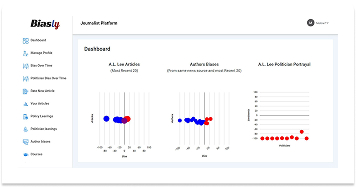
- Journalist Bias Analytics Platform: Explore how individual journalists contribute to bias within their publications.
- Politician Bias Analytics Platform: Compare how politicians are framed differently by Bloomberg News and other outlets.
- Media Literacy Education Platform: Learn how to critically assess media sources, bias techniques, and news reliability.
Frequently Asked Questions
Bloomberg News is rated as Center based on Biasly’s media bias algorithm, which assesses sentiment, article framing, and policy favorability.
Bloomberg News was fined five million Euros by the French financial markets regulator, the Autorité des Marchés Financiers (AMF), in 2016 for a fabricated story about a French construction company named Vinci. This company suffered “significant” financial losses as a result of this article. During Michael Bloomberg’s presidential campaign in 2020, the site admitted it would not investigate Bloomberg. Mike Bloomberg was accused of making sexist comments during the 2020 campaign, which was covered by most other media outlets. The Russian government has accused Bloomberg News of misinformation, but these claims are disputed amongst fact-checkers.
Biasly uses a combination of AI sentiment analysis and human analyst review to assess tone, factual accuracy, source quality, and media-bias indicators. Learn more on our Bias Meter page.
Generally, yes. Bloomberg News is considered one of the most reliable news sources, particularly on finance issues.
Military Spending
| Date | Sentiment | Associated Article | Snippet |
|---|---|---|---|
| 08/25/2019 | 75% For | Trump Family Detentions Flores Agreement (link) | So, of course, the Trump administration is doing the opposite in a baldfaced |