




16% Somewhat Right
Bias Meter
Extremely
Liberal
Very
Liberal
Somewhat Liberal
Center
Somewhat Conservative
Very
Conservative
Extremely
Conservative
-100%
Liberal
100%
Conservative
Biasly determines media bias ratings through a dual-layered approach combining artificial intelligence and analyst review. The platform’s proprietary bias detection engine, Bias Meter, evaluates sentiment, policy position alignment, and language framing across thousands of data points in news articles. Analysts then verify and interpret the AI’s findings, providing additional context where needed. Learn more about ratings
- Profile
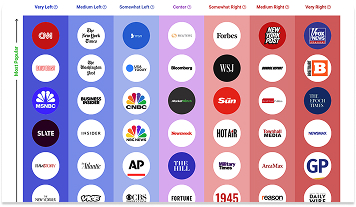
Breaking911 on the media bias chart
- Bias Rating
16% Somewhat Right
- Reliability28% Reliable LimitedPolicy Leanings
-4% Center
Extremely
LiberalVery
LiberalModerately
LiberalSomewhat Liberal
Center
Somewhat Conservative
Moderately
ConservativeVery
ConservativeExtremely
Conservative-100%
Liberal100%
Conservative
Limited Reliability
*Our bias meter rating uses data science including sentiment analysis, machine learning and our proprietary algorithm for determining biases in news articles. Bias scores are on a scale of -100% to 100% with higher negative scores being more liberal and higher positive scores being more conservative and 0% being neutral. The rating is an independent analysis and is not affiliated nor sponsored by the news source or any other organization.
Politician Portrayal31% negative
Continue For Free
Create your free account to see the in-depth bias analytics and more.
By creating an account, you agree to our Terms and Privacy Policy, and subscribe to email updates.
Log In
Log in to your account to see the in-depth bias analytics and more.
Analysis of Breaking911 Articles
Analysis of Bias in Breaking911 Online Articles
To evaluate this, we can analyze select Breaking911 articles through several of Biasly’s bias rating criteria: Tone, Tendency, Author, Diction, and Expediency Bias.
- Tone: The overall attitude conveyed by the article
- Diction: Specific word choices made by the writer
- Author: The background and social presence of the journalist
- Tendency: Patterns of bias in the writer’s broader body of work
- Expediency Bias: Quick visual or textual indicators like headlines and photos that imply bias
Source: Breaking911
Breaking911 was founded in 2011 with the stated goal of delivering real-time breaking news faster than traditional outlets could manage. Today, the outlet describes itself as an “alternative” news source, and its content mixes straight wire reporting with crime stories, political news, and viral social content.
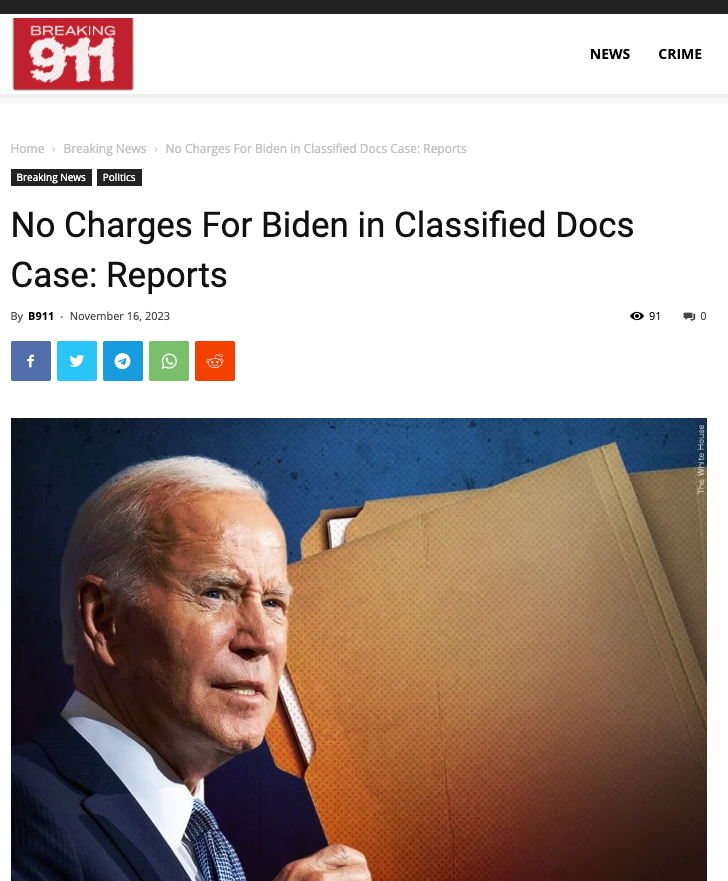
A clear example of expediency bias is the article “No Charges For Biden in Classified Docs Case: Reports.” The headline uses the word “Reports” to hedge the claim, citing the Wall Street Journal as the underlying source rather than direct confirmation. The accompanying photo shows Biden looking tense alongside an oversized folder, an image choice that can be read as framing the story around scandal and concealment rather than legal resolution, even though the article itself reports that no charges are expected:
“Special Counsel Robert Hur will not file charges related to the mishandling of classified documents at two locations associated with President Joe Biden, the Wall Street Journal reported Thursday, citing sources.”
The visual presentation may conflict with the article’s actual content, the kind of expediency bias Biasly’s metrics are designed to flag. A single image isn’t enough to show a pattern; you’d need to compare how Breaking911 illustrates similar stories about figures from both parties.
A different pattern shows up in the article “Jan. 6 ‘Qanon Shaman’ is Running for Congress.” The piece reports factually on Jacob Chansley’s congressional bid and recounts his role in the January 6 Capitol riot, his guilty plea, and his prison sentence in a relatively neutral, fact-forward tone in the passages examined. The article summarizes:
“Jacob Chansley has formally submitted documents to run as a libertarian in Arizona’s 8th Congressional District.”
The article does not editorialize about Chansley’s politics or his fitness for office, instead presenting the facts of his case and his current candidacy without framing in either direction. This is a good example of Breaking911 functioning as a straightforward aggregator rather than an opinion-driven outlet.
By contrast, “North Dakota Politician Charged With Traveling to Czech Republic for Sex With Minor” shows how Breaking911 handles a politically sensitive crime story. The article identifies Raymon Holmberg as a “former Republican North Dakota State Senator,” bracketing his party affiliation directly in the text. Identifying a politician’s party is standard journalistic practice. Here, however, the article reproduces the Department of Justice release almost word for word and inserts “[Republican]” in brackets into the official text, which can be read as added emphasis rather than an incidental detail. Whether Breaking911 applies this same consistent practice across politicians of both parties in similar stories is worth tracking over time.
Talarico Exposed Courting CAIR-Linked Islamic Groups in Texas https://t.co/8dRZiNdxBO
— Breaking911 (@Breaking911) October 19, 2026
Trump appears to have changed his nickname for ‘Laffin” Kamala Harris, it’s now ‘Dumb as a Rock’ Kamala Harris pic.twitter.com/OciZCuZG2H
— Breaking911 (@Breaking911) July 22, 2024
Because Breaking911 articles carry the house byline “B911” rather than a named reporter, the outlet’s own X account serves as its institutional voice rather than an individual author profile. Its posts push breaking headlines to followers within minutes, often as raw statements with little context. In posts like the July 2024 one above, which repeats Donald Trump’s “Dumb as a Rock” nickname for Kamala Harris with a laughing emoji, the account’s own voice is mocking toward Democratic figures. The October 2026 post above uses the word “Exposed” in its headline about Texas Democrat James Talarico, presenting the claim as revealed wrongdoing rather than an allegation. That tone matches the right-leaning framing in some headlines, even though articles such as the QAnon Shaman report stay neutral.
Overall, Breaking911’s news coverage shows an inconsistent pattern rather than a single ideological direction: straightforward reporting on some politically charged stories, more loaded visual and headline framing on others, and added emphasis on party affiliation in at least one crime story. Readers who are aware of these patterns will be better equipped to read individual Breaking911 articles critically.
Analysis of Breaking911 Opinion Articles
Breaking911 does not have a clearly labeled opinion section in the way that many traditional sources do. Nearly all of its content is presented as straightforward news, including stories that carry no individual byline beyond “B911.”
The closest the outlet comes to an editorial voice is its own self-branding. On its website and social media, Breaking911 describes itself as “America’s #1 Alternative News Source,” a tagline that frames its mission as opposing mainstream media rather than as a neutral wire service. That self-positioning is a form of bias signal; before anyone reads an article, it signals that the outlet will push back against the establishment narrative, regardless of which direction that pushback comes from on any given story.
This distinguishes Breaking911 from outlets where opinion bias is concentrated with consistent ideological track records. This means its bias operates at the level of branding, story selection, and headline writing, rather than through individual columnist viewpoints, since the outlet does not maintain named opinion writers.
Analysis of Reliability in Breaking911’s Online News Articles
Breaking911 aims to deliver breaking news as quickly as possible, so much of its political content is a lightly edited official press release, a wire summary, or a short update. Reliability therefore varies by story: it depends heavily on whatever source the outlet is republishing. Readers can check individual articles with Biasly’s Bias Check Chrome Extension.
The Breaking911 article “North Dakota Politician Charged With Traveling to Czech Republic for Sex With Minor” is presented as a brief breaking-news report rather than an opinion piece. The article summarizes the federal indictment of former North Dakota State Senator Raymon Everett Holmberg and reproduces, almost word for word, a news release from the U.S. Department of Justice, credited in the dateline as “(DOJ)”. There is very little commentary or interpretation added. The tone remains factual and straightforward, although the headline emphasizes the seriousness of the allegations to capture readers’ attention. Overall, the article demonstrates a mostly neutral reporting style while focusing on a criminal case involving a former Republican state senator.
Quality of Sources and Facts Used
The article contains no direct quotes from any individuals. Instead, the article republishes the Department of Justice’s announcement of the federal indictment. Because there are no verbatim quotations from investigators, prosecutors, defense attorneys, or the defendant, readers must rely on the government’s own summary of the charges.
Rather than direct quotations, this article depends on publicly available legal records. Since the information comes directly from the federal indictment and official Department of Justice materials, the article’s core facts are verifiable despite not including any direct quotations. However, including statements from prosecutors or defense attorneys would have provided readers with additional context.
On linked sourcing, the article uses very few identifiable sources. There are no external hyperlinks within the article itself, and nearly all of the information comes from the official Department of Justice announcement describing the federal indictment. By political classification, the article links to no external sources (0 Left, 0 Center, 0 Right); its single underlying source, the Department of Justice, is an institutional reference. Rather than presenting multiple viewpoints, the article simply summarizes publicly available court allegations and procedural facts.
- U.S. Department of Justice, federal agency whose news release is reproduced (institutional reference)
- Federal grand jury, charging body that returned the indictment (institutional reference)
- U.S. District Court for the District of North Dakota, federal court handling the case (institutional reference)
- Raymon Everett Holmberg, former Republican North Dakota State Senator and defendant (Right)
The sourcing is limited but appropriate for the type of story being reported. Nearly every factual claim originates from official government documents rather than political commentators or advocacy organizations. There are no competing political viewpoints because the article is reporting the filing of criminal charges rather than debating a political issue. Since the Department of Justice provides nearly all of the factual information, institutional sources dominate both the prominence of the article and the total amount of information presented.
In terms of source usage, the article presents the government’s allegations while also noting that Holmberg entered a not guilty plea and that a trial date was scheduled. This helps distinguish accusations from convictions and provides readers with important legal context. The article does not speculate about guilt, criticize either side, or introduce partisan commentary. Because the reporting relies almost entirely on official court records and avoids editorial language beyond the headline, the author’s overall bias is best classified as Center. Although Breaking911 is generally considered a right-leaning publication, this specific article remains largely factual and avoids ideological framing.
On factual accuracy, the article is consistent with reporting from other major news organizations, including the Associated Press and North Dakota broadcasters such as KFGO and KVRR. These outlets similarly reported that a federal grand jury indicted Raymon Everett Holmberg on charges of child sex tourism and receipt of child pornography, that the alleged conduct occurred between 2011 and 2016, and that Holmberg entered a not guilty plea during his initial court appearance. Holmberg later pleaded guilty to the travel charge, according to the AP.
While Breaking911 provides fewer details than larger news organizations, the factual information presented aligns closely with publicly available court records and other independent reporting. The article is therefore factually accurate, although its brevity leaves out additional background that readers might find in more comprehensive coverage.
In contrast, “Arizona’s Dem Attorney General Announces Election Charges Against Two Republican Officials” (November 29, 2023) republishes a news release from Arizona Attorney General Kris Mayes and contains one quoted statement, split into two passages of 9 and 36 words (average 22.5). Like the North Dakota story, it has no external links (0 Left, 0 Center, 0 Right), and the only voice quoted is the official announcing the charges. The headline adds the “Dem” label to the attorney general, while the body is the official release. A day later, the outlet republished a Texas Attorney General Ken Paxton release on a lawsuit against Pfizer in the same way, which suggests the press-release format is typical of its political coverage.
“The repeated attempts to undermine our democracy are unacceptable,”
- Kris Mayes, Arizona Attorney General (Democrat) quoted announcing the charges (Left)
- Arizona Attorney General’s Office, investigating agency and source of the release (institutional reference)
- Arizona State Grand Jury, body that returned the indictment (institutional reference)
- Maricopa County Superior Court, court where the indictment was filed (institutional reference)
- Arizona Secretary of State’s Office, office whose canvass was allegedly delayed (institutional reference)
- Peggy Judd and Tom Crosby, Republican Cochise County Supervisors and defendants (Right)
Selection and Omission Bias
Selection and omission bias at Breaking911 shows up most clearly in how political identifiers are added to stories, though the articles reviewed label both parties: the Arizona headline adds “Dem” to the attorney general, while the North Dakota story adds “[Republican].” The North Dakota Senator article clearly brackets Raymon Holmberg’s party affiliation as “Republican” directly within the quoted DOJ summary, inserting an editorial detail into what is otherwise a direct government document excerpt.
Whether Breaking911 applies this same bracketed-party-identification practice consistently to politicians of both parties facing comparable allegations is something readers should watch for across the outlet’s broader coverage; selective emphasis on party affiliation, even when factually accurate, can shape how readers perceive stories.
A different kind of selection bias shows up in the Biden classified documents story. The headline’s “Reports” correctly attributes the news to the Wall Street Journal, but the accompanying photo of a tense Biden beside oversized folders creates tension between the visual presentation and the outcome described in the text. In the articles reviewed, this kind of image-and-substance mismatch is worth watching across Breaking911’s political coverage.
Breaking911 Bias Overview
Breaking911 was founded in September 2011, with co-founder Grant Benson identified in radio coverage, to provide real-time news updates that could keep pace with the rapid speed of digital information. The outlet, now based in Nashville, Tennessee, built its early reputation on a Twitter account that broke news faster than many traditional newsrooms, eventually expanding into a standalone website with a social media following that BNO News put at nearly 1 million on X and more than 770,000 across Instagram and Facebook in 2022.
According to SimilarWeb, the site averages about 491,000 monthly visits (as shown on Biasly’s profile, October 2026).
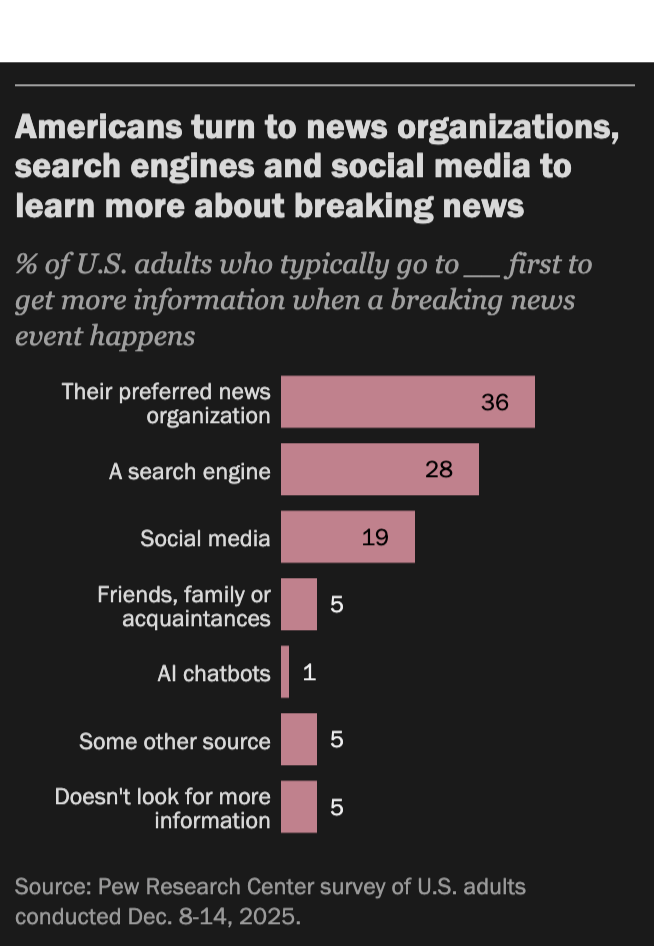
Source: Pew Research
Understanding why an outlet like Breaking911 exists and who it serves requires understanding how Americans actually consume breaking news. According to a Pew Research Center survey conducted in December 2025, 36% of U.S. adults say they turn to their preferred news organization first when a breaking news event happens. Another 28% go to a search engine, and 19% turn to social media. Only 1% turn to AI chatbots.
Breaking911 is aimed at readers who want to know what happened right now, often before context or verification has caught up. Pew’s data show that social media, where Breaking911 has most of its reach, is the first stop for about one in five adults during breaking news. The data do not show who reads Breaking911, but its speed-first model helps explain the reliability concerns documented below.
Breaking911 is an outlet optimized for breaking news at maximum speed, which can come at the cost of sourcing rigor, as the Chattanooga case below shows. As one of the more widely followed social-media-native news aggregators in the country, Breaking911 can shape what its followers believe they know in the critical first hours after a major news event. This article examines Breaking911’s editorial tendencies to explore whether, and how bias shows up in an outlet built around speed, virality, and an explicitly “alternative” brand identity.
Is Breaking911 Biased?
Based on Biasly’s evaluations, Breaking911 is rated as Somewhat Right.
By examining content patterns and the broader context of media influence, we aim to offer a balanced perspective on Breaking911’s political bias—and contribute to the ongoing discussion about bias in the news.
How Does Biasly Rate News Sources?
Biasly uses proprietary algorithms and a team of analysts to provide comprehensive bias evaluations across thousands of news outlets. Over 200,000 articles from more than 3,200 sources have been analyzed to identify the most accurate and unbiased stories.
Biasly assigns each outlet three key scores:
- Reliability Score – Reflects factual accuracy
- AI Bias Score – Generated via natural language processing
- Analyst Bias Score – Assessed by human political analysts
These scores are based on seven core metrics: Tone, Tendency, Diction, Author Check, Selection/Omission, Expediency Bias, and Accuracy. These elements help analysts and algorithms evaluate the political attitude conveyed by each article.
Biasly’s Bias Meter ranges from -100% (most left) to +100% (most right), with 0% indicating neutrality. The system evaluates individual articles based on political terms, policies, figures, and sentiment to calculate precise bias ratings.
Is Breaking911 Politically Biased?
Breaking911 earns a Somewhat Right rating for its AI Bias Score and a Somewhat Right for its Analyst Bias Score. The Analyst Bias Score is generated by reviewers from liberal, moderate, and conservative backgrounds.
Breaking911 presents an unusual case for analysts since much of its content is republished or lightly edited rather than originally written, and its self-branding as an “alternative” outlet doesn’t map cleanly onto a left-right axis. Much of its political coverage consists of republished press releases from officials of both parties, such as Democratic and Republican state attorneys general, while its social media posts and headline choices carry more of its own voice.
In the articles reviewed here, that lean is most visible in the outlet’s own social media posts and in editorial choices such as the party label inserted into the North Dakota Senator story, rather than in sustained commentary.
How to Evaluate Bias
Although Biasly rates Breaking911 as Somewhat Right, it’s important to remember that bias can vary from article to article. Breaking911 also covers a wide range of topics with objectivity on many issues. This complexity underscores the importance of examining each article individually. So, let’s learn how to evaluate media bias.
Recognizing media bias requires awareness and critical thinking. Often, readers trust news sources that affirm their existing beliefs—a psychological tendency known as confirmation bias. This makes it harder to identify slanted narratives or one-sided reporting.
To address this, it’s essential to challenge your assumptions by consulting multiple perspectives and verifying information through third-party analysis. Tools like Biasly’s media bias ratings allow readers to compare the same news story across the political spectrum.
Ultimately, bias isn’t always a matter of what is said—it’s also about what is left out, how topics are framed, and which stories are chosen for coverage. Learning to recognize these patterns can help readers make more informed decisions and develop greater media literacy.
To start comparing news outlets and gain a better understanding of bias, sign up for Biasly’s Media Bias & News Analytics Platform to see how stories vary between sources.
Breaking911 Reliability Overview
Is Breaking911 Reliable?
Breaking911 presents a mixed reliability picture. Its articles are often accurate when they republish official documents, but errors are most likely in fast-moving breaking news. There are also concerns about sourcing transparency and a documented instance of republishing an unverified claim.
Breaking911’s Limited reliability rating reflects its core editorial model. Because the outlet functions primarily as an aggregator rather than an original reporting outlet, its reliability on any given story depends almost entirely on the credibility of whatever source it happens to be republishing. When that source is a federal indictment, a government press release, or a vetted wire service report, the content tends to be accurate and well-grounded. When that source is a secondary claim from an unverified commentator, the outlet has at times republished first and verified later.
One documented example came during the July 2015 Chattanooga shooting, when Breaking911 posted the claim that an ISIS supporter had tweeted about the attack 15 minutes before it began. PolitiFact rated the claim False: the tweet’s timestamp was in Pacific time, so it was posted after the shooting began. PolitiFact lists Breaking911’s July 16, 2015 tweet among the accounts that spread it. A single documented case shows the risk in a republish-first model, but it does not by itself establish how often such errors occur.
How to Evaluate Reliability?
Reliability refers to how trustworthy or accurate a news source is. If we can’t trust what we read, then continuing to consume content from that outlet serves little purpose. So how do we evaluate a news outlet’s reliability?
There are several key indicators of reliability to consider when assessing a media source. Red flags of an unreliable article can include wild, unsubstantiated claims, facts that depend on other unreliable sources, heavy use of opinionated language, and more. In contrast, hallmarks of a reliable source include:
- Absence of subjective language
- Citing credible sources (e.g., .gov, .edu, academic references)
- Verifiable facts and statistics from multiple outlets
- Use of primary sources, like interviews or transcripts
- Consistency with coverage across other platforms
Biasly’s reliability scores incorporate these elements in evaluating media outlets.
So How Does Breaking911 Fare in Its Reliability?
The political reliability index developed by Biasly assesses both accuracy and trustworthiness. Breaking911 currently holds Limited Reliability Score, which is calculated as a weighted average of:
- Fact Analysis Score – Evaluates the accuracy of claims, facts, and evidence.
- Source Analysis Score – Assesses the number, diversity, and credibility of sources and quotes used.
Breaking911’s Source Analysis Score is Limited at 28% Reliable. This suggests moderate trustworthiness in its sourcing practices. The score is AI-generated and considers quote length, frequency, diversity, and quality.
The Fact Analysis Score of Breaking911 is Pending at N/A. This further shows how well Breaking911 supports its claims, addresses selection and omission bias, and presents verifiable evidence.
While Breaking911 leans toward factual reporting, occasional lapses—such as unbalanced viewpoints or incomplete data—can affect its reliability rating. These nuances emphasize the importance of analyzing individual articles.
Breaking911’s Accuracy and Reliability
According to Biasly’s analysis, Breaking911 maintains Limited Reliability Score, but individual articles may vary significantly. Let’s dive into the details.
The two most common reliability concerns in Breaking911’s coverage are:
- Selection Bias – choosing which details, like party affiliation or a photo, to highlight within otherwise factual reporting
- Source Verification Gaps – republishing claims from secondary or unverified sources without independent fact-checking, as in the Chattanooga shooting case described above.
The Biden classified documents article and the North Dakota Senator story show possible selection bias in different forms, one through an image that clashes with the outcome reported, the other through bracketed emphasis on party affiliation inserted into a republished government release. The Chattanooga case is a clear example of the second concern: it wasn’t fabrication, but a failure to verify a questionable secondary source before republishing it as fact.
By contrast, the Jan. 6 “QAnon Shaman” article and the North Dakota indictment story both report well-documented facts (court records and a federal indictment) with minimal added framing.
Its reliability is strongest when it draws on primary government and legal documents, and most at risk when it relies on unverified outside claims, as in the Chattanooga case. Readers who use Biasly’s News Bias Checker to compare how Breaking911 covers a story against other outlets will get a clearer sense of when the outlet is functioning as a reliable aggregator versus when it’s adding its own framing.
So, is Breaking911 Reliable?
Overall, Breaking911 can be considered to be an outlet that is minimally reliable. It demonstrates a consistent goal of journalistic integrity and typically supports claims with sources and quotes. Occasional omissions and framing bias do appear, particularly on culturally sensitive or partisan issues.
As media literacy improves, readers can more easily detect issues with selection bias, omission bias, and factuality. To strengthen your ability to assess reliability across the political spectrum, use Biasly’s News Bias Checker to compare how multiple outlets report the same story.
This empowers you to consume more accurate, balanced, and dependable news.
Breaking911 Editorial Patterns
Breaking911’s coverage of political topics often reflects a Somewhat Right bias, with consistent patterns in phrasing, source selection, and thematic focus that are Slightly Conservative. Patterns show up less in phrasing crafted by Breaking911 writers and more in which details get emphasized, how headlines and images are paired with story substance, and the outlet’s explicit self-branding as an “alternative” news source. This section examines how that selection process plays out across political topics.
Coverage of Liberal vs. Conservative Topics
Breaking911’s coverage of politically sensitive stories doesn’t follow a single consistent ideological direction. The Jan. 6 “QAnon Shaman” congressional run was covered with minimal editorializing despite the subject’s connection to one of the most politically charged events in recent American history. The North Dakota Republican former senator’s indictment, by contrast, flagged his party affiliation with a bracket inserted into the official release, a detail that, while accurate, represents an editorial choice about what to emphasize.
The pattern that emerges most consistently isn’t left-versus-right framing, but rather headline and visual choices designed to maximize engagement; in the articles reviewed, labels like “BREAKING” and dramatic photo selection appear regardless of which party or political figure is involved.
Policy and Issue Framing
Breaking911’s framing on specific policy issues tends to follow whichever government source or wire report it’s drawing from in a given story, rather than reflecting a consistent editorial position of its own. This pattern is visible in its republished releases from both Democratic and Republican state attorneys general, which keep the language of the office making the announcement.
This matters for readers because it means Breaking911’s apparent “lean” on any given story often says more about which official source it’s summarizing than about a fixed editorial philosophy at the outlet itself.
Coverage and Relevance
Breaking911’s model of rapid aggregation paired with explicit “alternative news” branding represents a distinct category of media bias worth understanding: bias that emerges from self-positioning, headline choices, and selective emphasis rather than from sustained ideological commentary. As more readers get news through social-media-native outlets like Breaking911 rather than traditional newsrooms, understanding this kind of structural bias is increasingly relevant to media literacy.
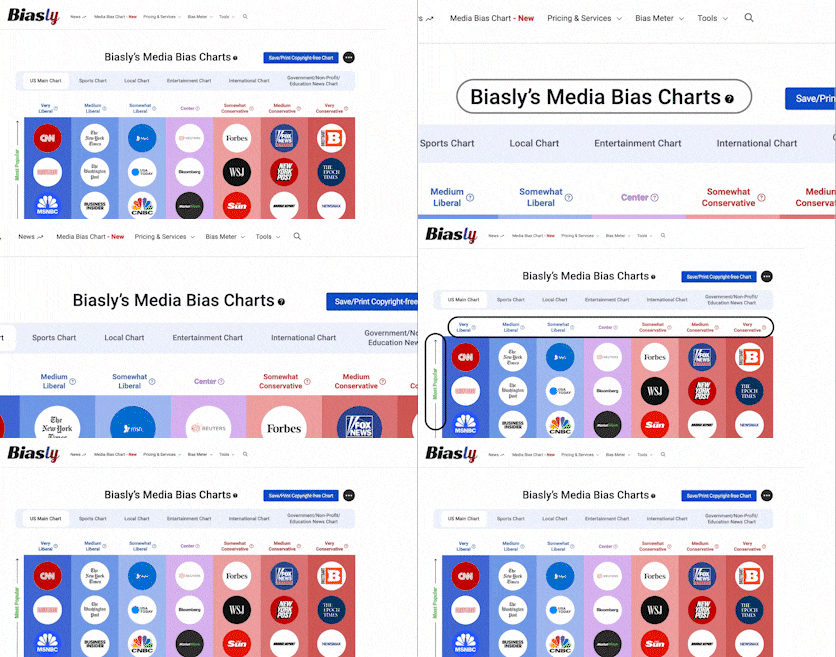
Readers who want to see how Breaking911’s framing compares to other outlets can visit Biasly’s Media Bias Chart to analyze tone and word choice in real time.
Funding and Ownership
Who Owns Breaking911?
Breaking911 lists Nashville, Tennessee as its location and does not publish an ownership statement. Grant Benson has been identified as the outlet’s co-founder in radio coverage, and Breaking911’s website today is a single landing page that does not list owners or editors. Beyond Benson, the outlet does not maintain a public about page or disclose a full ownership structure, making it impossible to confirm who else founded or currently runs the publication. Its website describes it simply as:
“America’s #1 Alternative News Source”
Source: Breaking911
That lack of transparency around leadership is itself notable. Many established news organizations, large and small, maintain some form of public-facing information about who is responsible for their editorial decisions. Breaking911 provides none of that, which makes it harder for readers to assess who is shaping the outlet’s content choices.
Who Funds Breaking911?
Breaking911 does not publish information about its finances, so its revenue mix cannot be independently assessed. Its reach is built mainly on social media: BNO News reported in 2022 that the X account had nearly 1 million followers, with more than 770,000 more across Instagram and Facebook. Like other social-media-native outlets, it has a commercial incentive to prioritize speed and engagement.
Additional Insights
News Source Comparison
Breaking911 operates primarily as a social-media-native breaking-news aggregator, prioritizing speed, virality, and its self-described “alternative news” brand identity over original investigative reporting. Readers seeking original investigative or analytical journalism, regardless of political orientation, will generally find more substantive content at outlets that produce their own reporting rather than primarily republishing wire content and press releases.
Notable Contributors and Authors
Breaking911 does not maintain a roster of named columnists or bylined political commentators. Articles are typically attributed simply to “B911,” with no individual reporter byline. This absence of identifiable, accountable authorship is itself a notable feature of the outlet’s editorial model.
Related Tools and Resource Pages
To better understand how Breaking911 fits into the broader media landscape, we recommend exploring these helpful resources:
- Media Bias Chart: See where Breaking911 ranks among hundreds of media outlets across the political spectrum.
- Political Bias Chart: Visualize political slants of news sources across various policy areas.
- Journalist Bias Analytics Platform: Explore how individual journalists contribute to bias within their publications.
- Politician Bias Analytics Platform: Compare how politicians are framed differently by Breaking911 and other outlets.
- Media Literacy Education Platform: Learn how to critically assess media sources, bias techniques, and news reliability.
Frequently Asked Questions
Breaking911 is rated as Somewhat Right based on Biasly’s media bias algorithm, which assesses sentiment, article framing, and policy favorability.
Breaking911 has spread at least one claim later rated false: during the 2015 Chattanooga shooting, it posted a claim that an ISIS supporter had tweeted about the attack beforehand, which was later reported to be a False claim. In the articles reviewed here, which republish official documents, the factual content matched independent reporting.
Biasly uses a combination of AI sentiment analysis and human analyst review to assess tone, fact accuracy, source quality, and media bias indicators. Learn more on our Bias Meter page.
Generally, yes, though partisan framing and selective reporting can affect perceived reliability.
Military Spending
| Date | Sentiment | Associated Article | Snippet |
|---|---|---|---|
| 08/25/2019 | 75% For | Trump Family Detentions Flores Agreement (link) | So, of course, the Trump administration is doing the opposite in a baldfaced |