




6% Center
Bias Meter
Extremely
Liberal
Very
Liberal
Somewhat Liberal
Center
Somewhat Conservative
Very
Conservative
Extremely
Conservative
-100%
Liberal
100%
Conservative

Biasly determines media bias ratings through a dual-layered approach combining artificial intelligence and analyst review. The platform’s proprietary bias detection engine, Bias Meter, evaluates sentiment, policy position alignment, and language framing across thousands of data points in news articles. Analysts then verify and interpret the AI’s findings, providing additional context where needed. Learn more about ratings
- Profile
Movieweb on the media bias chart
- Bias Rating
6% Center
- Reliability53% Reliable AveragePolicy Leanings
8% Center
Extremely
LiberalVery
LiberalModerately
LiberalSomewhat Liberal
Center
Somewhat Conservative
Moderately
ConservativeVery
ConservativeExtremely
Conservative-100%
Liberal100%
Conservative
Average Reliability
*Our bias meter rating uses data science including sentiment analysis, machine learning and our proprietary algorithm for determining biases in news articles. Bias scores are on a scale of -100% to 100% with higher negative scores being more liberal and higher positive scores being more conservative and 0% being neutral. The rating is an independent analysis and is not affiliated nor sponsored by the news source or any other organization.
Politician Portrayal24% negative
Continue For Free
Create your free account to see the in-depth bias analytics and more.
By creating an account, you agree to our Terms and Privacy Policy, and subscribe to email updates.
Log In
Log in to your account to see the in-depth bias analytics and more.
Analysis of Movieweb Articles
Analysis of Bias in Movieweb Online Articles
To evaluate this, we can analyze select Movieweb articles through several of Biasly’s bias rating criteria: Tone, Tendency, Author, Diction, and Expediency Bias.
- Tone: The overall attitude conveyed by the article
- Diction: Specific word choices made by the writer
- Author: The background and social presence of the journalist
- Tendency: Patterns of bias in the writer’s broader body of work
- Expediency Bias: Quick visual or textual indicators like headlines and photos that imply bias
Source: Movieweb
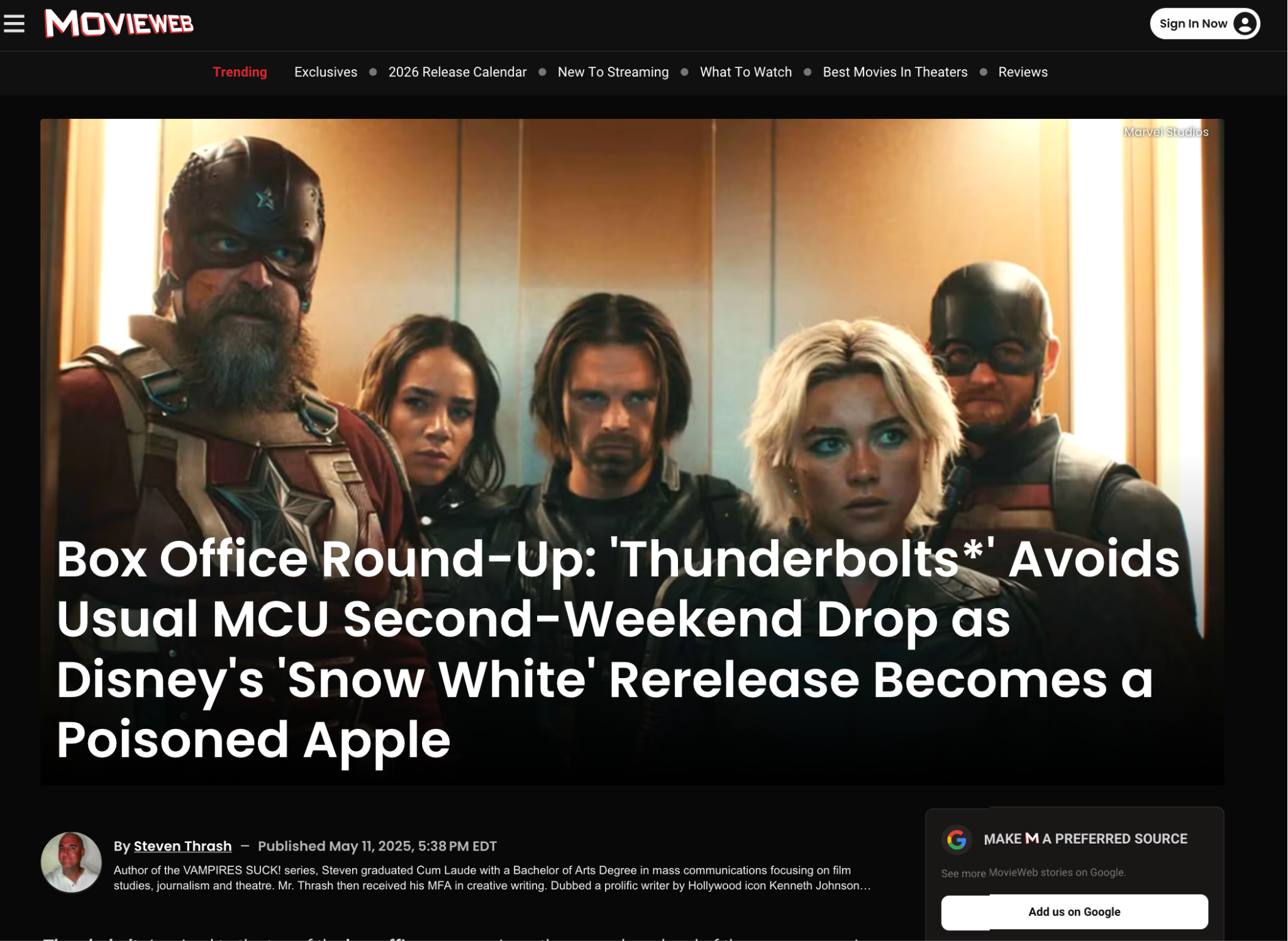
One such article, “Box Office Round-Up: ‘Thunderbolts*’ Avoids Usual MCU Second-Weekend Drop as Disney’s ‘Snow White Rerelease’ Becomes a Poisoned Apple“, features a headline that itself utilizes wordplay, talking about how the live-action Snow White adaptation’s box office performance is akin to the very poison apple within the original story, contrasting it with Thunderbolts’ better overall box office performance.
Writer Steven Thrash continues the headline’s tone with phrases such as the subheading “Disney Embarrasses Itself by Rereleasing Its Controversial Live-Action ‘Snow White’” and “the ploy didn’t work… only managed to average a minuscule, weekend-low of $252 per venue.” The diction emphasizes embarrassment, controversy, and commercial failure while giving limited space to alternative explanations for the underperformance. This framing reads as a commercial critique of Disney’s handling of the project rather than a partisan political argument.
“However, while Disney was reveling in the success of Thunderbolts*, courtesy of Marvel Studios, the Mouse House went above and beyond in embarrassing itself by trying to rerelease Rachel Zegler and Gal Gadot’s controversial Snow White in over 1,000 more theaters than it played in last week. The ploy didn’t work, though, as the critically maligned film only managed to average a minuscule, weekend-low of $252 per venue just days before its digital release on all the usual VOD platforms.”
However, Movieweb showcases more nuance on this topic than leaning purely right, as can be seen in the article “Why ‘Snow White’ Was Doomed To Fail From the Start”. The title alone signals a deterministic, critical stance. The piece highlights casting backlash, release delays, and “current controversies,” presenting these factors as the primary reasons for failure while condemning the racist comments aimed at Zegler.
“Perhaps people think Snow White is someone real that we learned about in history books. Maybe that’s why they’re so offended that a Latina could be cast as the character. That is the keyword here: character. Snow White isn’t real and can be reimagined by any race, but that isn’t the world we live in, and, unfortunately, Zegler had to deal with an onslaught of racist comments that continued through the film’s opening weekend. This is negativity that Zegler nor the film asked for, but it became a reality once she was announced.”
While it references real events, the selective emphasis on controversy and “doomed” framing over other commercial variables (marketing, competition, or quality of the final product) gives readers a mostly production-focused explanation, alongside a clear defense of Zegler’s casting. The tone is more evaluative rather than neutral, while still emphasizing nuance and restraint in criticism.
The reporter, Gaius Bolling, does not shy away from using emotional or judgmental language, clearly framing certain critiques against Zegler as being unacceptable in nature. His social media presence is mostly about film and rarely partisan. A September 2021 post on Gaius Bolling’s X profile celebrating on-screen representation is consistent with the article’s criticism of the racist backlash against Zegler, while a July 2021 post criticizing Los Angeles County for reinstating its indoor mask rule without giving restaurants and bars proper guidance suggests his political views do not fit neatly on one side:
Congrats to @SimuLiu coming in like a boss and just owning this role. Representation matters. Kids will see him as this character & will be inspired. Kudos to you sir. Great performance. Great movie. You should be proud of @shangchi! #SimuLiu #shangchi https://t.co/ZFR9DWIfdG
— Gaius Bolling (@G_Reelz) September 3, 2021
@CountyofLA @lapublichealth Way to screw businesses such as restaurants and bars again by not giving them proper guidance on this. Trying to police this in a crowded bar will be impossible. Do You all think before you act?
— Gaius Bolling (@G_Reelz) July 16, 2021
In summary, Movieweb shows bias that varies by article type. Movieweb’s degree and direction of bias vary considerably by article, with culturally charged entertainment commentary showing more political framing than straightforward industry news. Pure hard-news entertainment coverage remains largely neutral, which is why the overall lean remains mild rather than strongly partisan.
Analysis of Movieweb Opinion Articles
To fully understand political bias in media, it’s important to distinguish between factual reporting and opinion pieces. Reporting aims to present facts and let readers draw their own conclusions, while opinion articles express personal viewpoints on current issues. Although the previous section examined factual reporting, this section examines how bias surfaces through Movieweb’s selection and tone in opinion content.
Movieweb does not publish traditional political op-eds. Instead, its opinion and analysis often appear in ranking pieces, “why it failed” breakdowns, and industry commentary. These still reveal editorial tendencies.
One clear example is the article “Gal Gadot Breaks Silence on Why ‘Snow White’ Flopped Hard at the Box Office”. The news report by Anthony Lund centers on Gadot’s comments attributing part of the film’s commercial failure to “pressure on celebrities to speak against Israel.” The headline’s “Flopped Hard” sets a blunt tone, and the body calls the reaction “catastrophic.” Yet the article does not simply adopt Gadot’s explanation: a subheading states that the film’s stars “Were Not the Problem,” and the writer instead blames changes made to modernize the story, adding a sarcastic aside (“Worked well, didn’t it?”). This blend of news reporting and editorial asides shows how commentary can surface even in Movieweb’s news coverage, though its target is a studio’s creative choices rather than a political side.
In contrast, a more straightforward ranking piece such as “Amazon’s Remake of a 127-Year-Old Sci-Fi Classic Declared the Worst Movie of 2025” focuses on critical scores and Metacritic rankings. While still evaluative, the tone remains closer to neutral industry reporting. It lists films by score, quotes critic consensus, and avoids strong cultural or political framing. The language stays descriptive (“declared the worst,” “bewildering,” “dull”) without tying the failures to broader industry ideology or activism.
These examples show that Movieweb’s commentary is evaluative and sometimes pointed, but its targets are mostly creative and commercial decisions rather than political parties or policies. Readers on different sides of cultural debates may still read some pieces as slanted.
This tendency underscores the importance of distinguishing subjective viewpoints from straight reporting, especially when interpreting the political leanings of any news organization.
Analysis of Reliability in Movieweb’s Online News Articles
Movieweb aims to serve entertainment audiences with timely movie and television news, including casting announcements, trailer coverage, box office updates, and release schedules. Its content is high-volume and SEO-driven. However, readers should distinguish between straightforward factual reporting and more interpretive industry analysis to evaluate credibility effectively.
One notable example is the article “Every Movie Coming to Theaters in August 2026”. The piece functions largely as a release calendar, listing dates, titles, and brief descriptions drawn from studio schedules. It sticks closely to confirmed information and provides a clear, organized overview of the month’s theatrical slate.
Quality of Sources and Facts Used
Movieweb frequently uses studio announcements, official release calendars, box office tracking data, Rotten Tomatoes scores, and CinemaScore results as primary material. While these are generally accurately attributed, the depth and balance of sourcing can vary depending on whether the article is a pure announcement or an analytical piece.
Consider articles focused on box office underperformance. These pieces often cite specific gross figures and percentage drops but may offer limited insight into competing factors such as marketing strategy, release timing, competition from other films, or broader market conditions. They frequently rely on a narrow set of data points and official statements while giving less space to alternative explanations. This absence can create a narrower picture of why a project succeeded or failed, even when the core numbers are accurate.
But can readers find tighter sourcing in other Movieweb pieces? In the article “Every Movie Coming to Theaters in August 2026”, the reporting is structured as a calendar rather than a one-source argument. Author Adam Symchuk lists titles by date and attaches short descriptive blocks to each film. The piece contains no direct quotes; instead, it offers short descriptive entries for roughly 17 films. That format gives readers many small, checkable claims—release dates, casts, directors, studios—instead of one long unchallenged narrative.
On named sources and companies, the calendar article points to institutional entertainment sources rather than partisan media. By left/center/right categorization, every source it references is an institutional reference:
- Warner Bros. Pictures, studio behind several listed releases (institutional reference)
- A24, studio cited in a director’s background (institutional reference)
- Blumhouse, production company of a listed release (institutional reference)
- Ketchup Entertainment, distributor of Coyote vs. Acme (institutional reference)
- Black Bear Pictures, studio credited in the header image (institutional reference)
- Adult Swim, network cited for Casper Kelly’s earlier work (institutional reference)
- Official theatrical calendars and cast lists, basis for release dates and credits (institutional reference)
The article links to no other news outlets, left, center, or right. The sourcing is lopsided by design toward Hollywood production entities, which is appropriate for a release calendar and still more transparent than a single-quote flop explainer.
In contrast, the news report “Gal Gadot Breaks Silence on Why ‘Snow White’ Flopped Hard at the Box Office” does use quotes. It contains four quoted passages: the longest is Gadot’s 126-word answer, the shortest is a one-word quote (“disappointment”), and the average is about 41 words. Its sources are:
- Gal Gadot, actress quoted at length on the film’s performance (institutional reference)
- Parade Magazine, review quoted on the film’s quality (institutional reference)
- Reported box office and budget figures, cited without a named tracker (institutional reference)
In how sources are used, the calendar piece presents studio and talent information as attributed facts: who directs, who stars, when it opens, whether the release is limited. Claims can be verified against studio schedules. The Gadot article leans on one long interview answer and one review quote, and cites a $205 million worldwide gross against a reported $270 million budget without naming the box-office source. That difference in source quality—few named sources plus untracked numbers versus many studio-attributed calendar facts—is why some Movieweb articles support a Average reliability rating, and others drag it down.
On factual accuracy, the calendar’s release dates and credits are generally consistent with public studio information. The Gadot article’s box-office totals are broadly in line with widely reported figures, but because the tracker is not cited, readers cannot audit the claim from the page itself. That is the reliability problem: not invented titles or fake quotes, but missing source trails on the numbers that carry the argument.
Selection and Omission Bias
Movieweb provides extensive coverage of movie and television news, which is expected given its entertainment focus. However, bias may still emerge through framing and story selection on industry topics, even when the core facts presented are accurate.
In coverage of high-profile underperforming films, selection bias surfaces through heavy emphasis on controversy, casting decisions, or cultural pushback while giving less space to purely commercial or logistical explanations. Articles analyzing projects such as the live-action Snow White remake frequently highlight casting backlash, celebrity comments, and external pressures as central factors in the commercial outcome. While the reporting remains rooted in verifiable box office numbers, it often omits or minimizes deeper exploration of competing variables such as marketing strategy, release timing, competition from other films, production quality issues, or broader market conditions. This selective focus creates a narrower picture of why certain projects underperform.
By comparison, the article “Every Movie Coming to Theaters in August 2026” is a release calendar, so it is best judged on completeness and accuracy rather than balance. It lists upcoming releases across multiple genres, draws on official studio schedules, and adds little interpretive framing, with no apparent omission of competing titles or distribution details. Analysis pieces, by contrast, should be judged on the evidence they offer and whether they consider alternative explanations. The difference between the two reflects format rather than a shift toward greater neutrality.
Overall, Movieweb uses a well-rounded approach to delivering hard entertainment news in its stronger pieces, with clear emphasis on verifiable release data and official sources. Its story selection on commercial outcomes can sometimes under-emphasize broader logistical or market factors in favor of more culturally charged explanations. However, the contents of pure announcement and calendar-style articles generally maintain accuracy and cite evidence from industry sources. This mixed pattern appeared across the articles reviewed.
Movieweb Bias Overview
Movieweb launched in 1995 as one of the earliest digital publications dedicated to movie information and entertainment news. It grew into a comprehensive destination for film and television coverage, including news, reviews, trailers, casting updates, and a searchable database of titles. In 2021, it was acquired by Valnet Inc., a Montreal-based digital media company that owns multiple entertainment brands.
Source: Pew Research
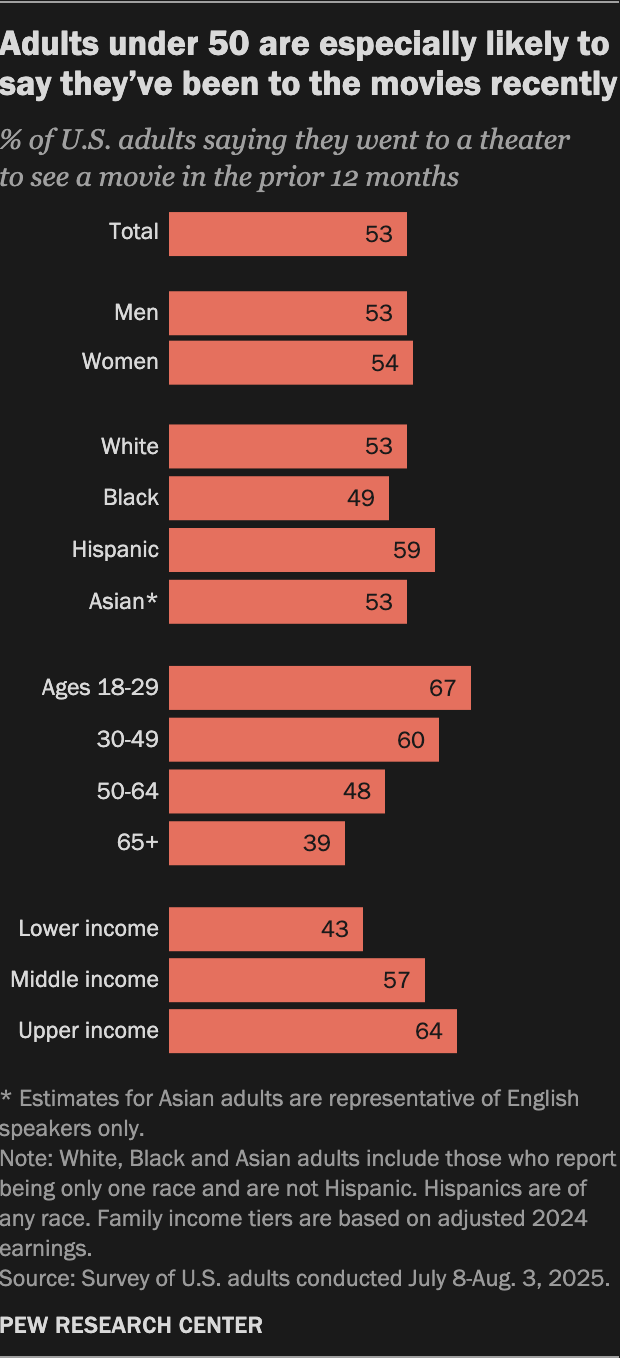
As a media outlet covering film and entertainment, Movieweb plays a significant role in shaping public perception, especially in a period of declining theater attendance. Readers’ trust in the accuracy of news discussing media may mirror the conclusions reached by Biasly’s media bias ratings. This article delves into Movieweb’s editorial tendencies to explore whether political bias is present and, if so, to what degree.
Is Movieweb Biased?
Based on Biasly’s evaluations, Movieweb is rated as Center.
By examining content patterns and the broader context of media influence, we aim to offer a balanced perspective on Movieweb’s political bias—and contribute to the ongoing discussion about bias in the news.
How Does Biasly Rate News Sources?
Biasly uses proprietary algorithms and a team of analysts to provide comprehensive bias evaluations across thousands of news outlets. Over 200,000 articles from more than 3,200 sources have been analyzed to identify the most accurate and unbiased stories.
Biasly assigns each outlet three key scores:
- Reliability Score – Reflects factual accuracy
- AI Bias Score – Generated via natural language processing
- Analyst Bias Score – Assessed by human political analysts
These scores are based on seven core metrics: Tone, Tendency, Diction, Author Check, Selection/Omission, Expediency Bias, and Accuracy. These elements help analysts and algorithms evaluate the political attitude conveyed by each article.
Biasly’s Bias Meter ranges from -100% (most left) to +100% (most right), with 0% indicating neutrality. The system evaluates individual articles based on political terms, policies, figures, and sentiment to calculate precise bias ratings.
Is Movieweb Politically Biased?
Movieweb earns a Center rating for its AI Bias Score and a Center for its Analyst Bias Score. The Analyst Bias Score is generated by reviewers from liberal, moderate, and conservative backgrounds. Analysts reviewed several Movieweb articles and have noted preferences in how Hollywood commercial results and creative decisions are framed, particularly when they intersect with broader cultural debates.
For example, coverage of box office performance and franchise outcomes sometimes touches on cultural debates, while pure casting and trailer reporting remains largely neutral.
American media consumption presents an interesting contrast. Pew Research shows that 83% of U.S. adults use streaming services; far fewer subscribe to cable or satellite TV. With streaming this widespread, many viewers can wait for a film to reach their home screens, which raises the stakes of theatrical box office coverage and makes the release and streaming information Movieweb publishes useful to readers.
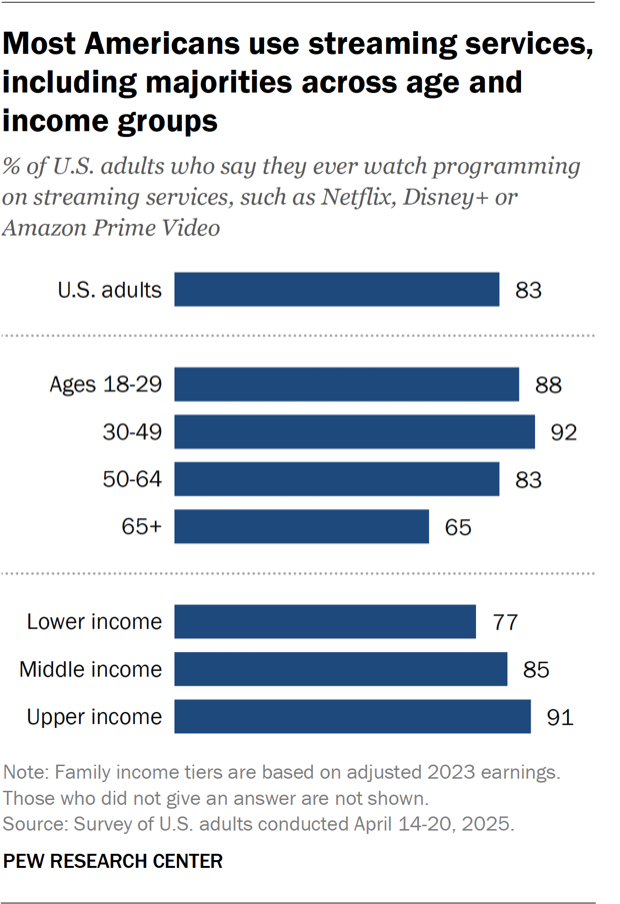
Source: Pew Research
This could explain differing perceptions of Movieweb’s content. The outlet may draw mixed reactions depending on readers’ beliefs as to the content or background relating to certain projects in the entertainment industry.
This Bias score is determined through natural language processing that evaluates the tone, word choice, and opinion embedded in the reporting.
How to Evaluate Bias
Although Biasly rates Movieweb as Center, it’s important to remember that bias can vary from article to article. This complexity underscores the importance of examining each article individually. So, let’s learn how to evaluate media bias.
Recognizing media bias requires awareness and critical thinking. Often, readers trust news sources that affirm their existing beliefs—a psychological tendency known as confirmation bias. This makes it harder to identify slanted narratives or one-sided reporting.
To address this, it’s essential to challenge your assumptions by consulting multiple perspectives and verifying information through third-party analysis. Tools like Biasly’s media bias ratings allow readers to compare the same news story across the political spectrum.
Ultimately, bias isn’t always a matter of what is said—it’s also about what is left out, how topics are framed, and which stories are chosen for coverage. Learning to recognize these patterns can help readers make more informed decisions and develop greater media literacy.
To start comparing news outlets and gain a better understanding of bias, sign up for Biasly’s Media Bias & News Analytics Platform to see how stories vary between sources.
Movieweb Reliability Overview
Is Movieweb Reliable?
Movieweb finds itself toward the middle of the spectrum for entertainment digital media, with a Average reliability rating. Its status as a high-volume entertainment publisher contributes to its reach, but the emphasis on timely, SEO-driven content can affect depth and consistency on analytical pieces.
Further investigation is needed to determine whether bias or other factors are affecting its accuracy. At Biasly, we specialize in evaluating not just bias but also the reliability of media outlets. Let’s explore the accuracy and trustworthiness of Movieweb.
How to Evaluate Reliability?
Reliability refers to how trustworthy or accurate a news source is. If we can’t trust what we read, then continuing to consume content from that outlet serves little purpose. So how do we evaluate a news outlet’s reliability?
There are several key indicators of reliability to consider when assessing a media source. Red flags of an unreliable article can include wild, unsubstantiated claims, facts that depend on other unreliable sources, heavy use of opinionated language, and more. In contrast, hallmarks of a reliable source include:
- Absence of subjective language
- Citing credible sources (e.g., .gov, .edu, academic references)
- Verifiable facts and statistics from multiple outlets
- Use of primary sources, like interviews or transcripts
- Consistency with coverage across other platforms
Biasly’s reliability scores incorporate these elements in evaluating media outlets.
So How Does Movieweb Fare in Its Reliability?
The political reliability index developed by Biasly assesses both accuracy and trustworthiness. Movieweb currently holds Average Reliability Score, which is calculated as a weighted average of:
- Fact Analysis Score – Evaluates the accuracy of claims, facts, and evidence.
- Source Analysis Score – Assesses the number, diversity, and credibility of sources and quotes used.
Movieweb’s Source Analysis Score is Average at 53% Reliable. This suggests moderate trustworthiness in its sourcing practices. The score is AI-generated and considers quote length, frequency, diversity, and quality.
The Fact Analysis Score of Movieweb is Pending at N/A. This further shows how well Movieweb supports its claims, addresses selection and omission bias, and presents verifiable evidence.
While Movieweb leans toward factual reporting, occasional lapses—such as unbalanced viewpoints or incomplete data—can affect its bias rating. These nuances emphasize the importance of analyzing individual articles.
Movieweb’s Accuracy and Reliability
According to Biasly’s analysis, Movieweb maintains Average Reliability Score, but individual articles may vary significantly. Let’s dive into the details.
Political orientation plays a crucial role in how audiences perceive reliability. Entertainment outlets such as Movieweb are sometimes criticized for leaning into culture-war narratives around high-profile releases, potentially at the expense of factual reporting. To validate such claims, it’s essential to analyze whether the publication backs its assertions with sufficient evidence and diverse viewpoints.
Two common types of bias that affect factuality include:
- Selection Bias – Highlighting or omitting stories to fit a particular narrative.
- Omission Bias – Leaving out differing perspectives or relevant details to skew perception.
Biasly’s accuracy ratings use a scale from 1% (least accurate) to 100% (most accurate). Factors include supporting evidence, reliable internal and external sources, and balanced viewpoints.
For instance, Biasly gave OutKick a Center Bias rating and Average reliability. One OutKick article, titled “Donald Trump Shocks Internet With UFO Announcement. Is The Truth Finally Coming Out?” showed average reliability. In contrast, another piece from the outlet, titled “Venezuela Dictator Captured By U.S. Black Ops, Insane Strike Videos Surface: WATCH,” was rated somewhat left for bias and limited in reliability for failing to include reliable data sources.
So, is Movieweb Reliable?
Overall, Movieweb can be considered to be an outlet that is moderately reliable. It demonstrates a consistent goal of journalistic integrity and typically supports claims with sources and quotes. Occasional omissions and framing bias do appear, particularly on culturally sensitive or partisan issues.
As media literacy improves, readers can more easily detect issues with selection bias, omission bias, and factuality. To strengthen your ability to assess reliability across the political spectrum, use Biasly’s News Bias Checker to compare how multiple outlets report the same story.
This empowers you to consume more accurate, balanced, and dependable news.
Movieweb Editorial Patterns
Movieweb’s coverage of political topics often reflects a Center bias, with consistent patterns in phrasing, source selection, and thematic focus that are Neutral. While the publication demonstrates journalistic standards in many of its reports, the choice of issues, framing, and word usage can indicate a political slant. This content analysis examines how Movieweb handles liberal and conservative issues and evaluates its language choices and editorial tendencies.
Coverage of Liberal vs. Conservative Topics
Movieweb’s articles frequently cover Hollywood industry trends, casting decisions, and box office results. Coverage of projects associated with progressive creative or casting strategies often adopts language that emphasizes commercial challenges or audience reception. For instance, articles on underperforming films may highlight cultural or creative choices as contributing factors, using terms that frame certain industry decisions as out of step with broader audiences.
On the other hand, coverage of commercially successful traditional franchises or audience-driven hits tends to employ more positive or neutral framing focused on fan enthusiasm and market performance. Biasly’s analysis of recent Movieweb articles reveals a tendency to highlight commercial outcomes when discussing certain industry practices, while offering more detached language on pure entertainment announcements.
Policy and Issue Framing
When covering industry trends that intersect with cultural debates (such as casting practices or franchise direction), Movieweb often references audience reception and box office data. This can align with a mild Neutral media bias in the entertainment space.
In contrast, pure news of trailers, casting announcements, and release schedules is covered in a more straightforward, enthusiast tone with minimal interpretive framing. Articles may describe certain creative decisions as contributing to commercial results in ways that implicitly critique industry trends, while successful projects are framed more as audience triumphs.
Even in neutral coverage, phrasing choices shape perception. Pieces on high-profile underperformers frequently emphasize controversy and external pressures, while calendar and announcement articles remain largely free of such framing.
Coverage and Relevance
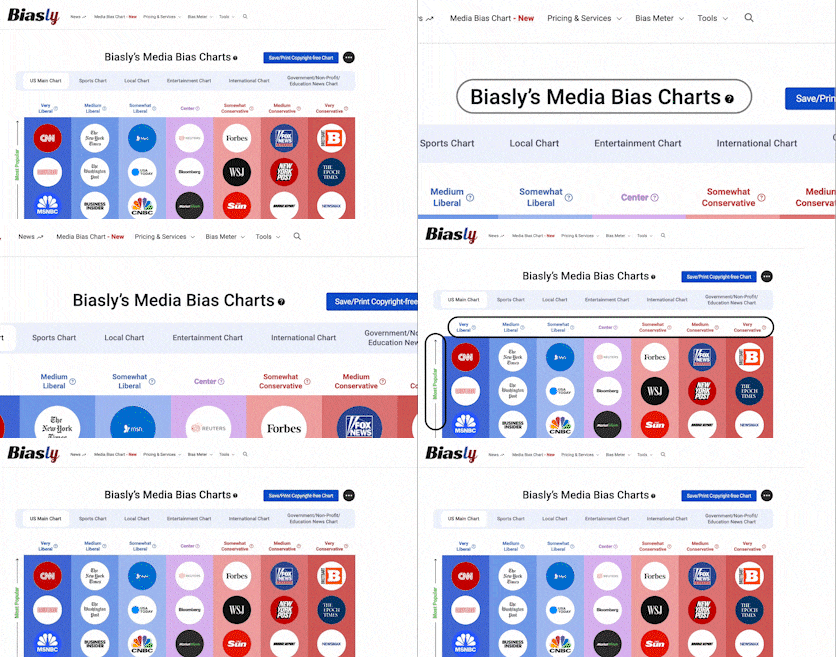
Readers who wish to further explore how Movieweb compares with other publications can visit Biasly’s Media Bias Chart to analyze tone and word choice in real time.
Funding and Ownership
Who Owns Movieweb?
Movieweb has been owned and operated by Valnet Inc., a Montreal-based digital media company, since September 2021, when it acquired the site from WatchR Media, Inc. Valnet is a subsidiary of the Valsef investment group and owns multiple entertainment brands including Screen Rant, Collider, and Comic Book Resources. The company was founded by Sam and Hassan Youssef.
Under Valnet ownership, the editorial teams are stated to operate independently of advertising operations. Valnet’s published editorial standards describe labeling of sponsored content and a ban on paid reviews, though the company has faced criticism and legal challenges related to writer compensation and content volume practices across its portfolio.
Movieweb leadership has asserted on their website that:
“Online since 1995, and acquired and owned by Valnet since 2021, MovieWeb was one of the first digital publications to appear on the web. Over 30 years later, the legacy brand continues to be one of the most trusted movie and TV entertainment destinations for big franchises, streaming releases and box office coverage.”

Source: Movieweb
Who Funds Movieweb?
Movieweb is funded primarily through programmatic advertising platforms. Advertising revenue supports website operations, editorial salaries, and content production.
As with many high-volume digital publishers, the advertising-driven model can incentivize high output and SEO optimization. Readers should remain aware that this structure, common across similar entertainment sites, can influence content volume and framing priorities over time.
Additional Insights
News Source Comparison
When it comes to news source comparison, Movieweb can be compared with other Valnet-owned entertainment sites such as Screen Rant, Collider, and CBR, as well as similar digital entertainment publishers. While Movieweb maintains a Center media bias, it differs from traditional political outlets in that its leanings appear primarily in cultural and industry framing rather than hard partisan politics.
This puts it in contrast with both strongly partisan political media and more neutral traditional film journalism. Readers seeking balanced entertainment coverage may compare Movieweb’s framing with other Center or entertainment-focused outlets on our Media Bias Chart.
Notable Contributors and Authors
Movieweb features a diverse range of reporters and columnists, many of whom are deeply familiar with film culture. Writers like Richard Nebens, who frequently cover film controversies and entertainment matters, exemplify the outlet’s strength in film-related journalism.
Other contributors focus on box office gross or awards—topics central to film and entertainment discussions. While some contributors may be seen as leaning left in tone or topic selection, their work is generally grounded in factual reporting. The presence of recurring bylines helps readers evaluate individual journalists’ bias over time.
Related Tools and Resource Pages
To better understand how Movieweb fits into the broader media landscape, we recommend exploring these helpful resources:
- Media Bias Chart: See where Movieweb ranks among hundreds of media outlets across the political spectrum.
- Political Bias Chart: Visualize political slants of news sources across various policy areas.
- Journalist Bias Analytics Platform: Explore how individual journalists contribute to bias within their publications.
- Politician Bias Analytics Platform: Compare how politicians are framed differently by Movieweb and other outlets.
- Media Literacy Education Platform: Learn how to critically assess media sources, bias techniques, and news reliability.
Frequently Asked Questions
Movieweb is rated as Center based on Biasly’s media bias algorithm, which assesses sentiment, article framing, and policy favorability.
The articles examined do not establish a pattern of misinformation by Movieweb. Some analysis pieces, however, rely on sensational language or thin sourcing for box-office figures. Separately from questions of factual accuracy, former contributors quoted by TheWrap have criticized parent company Valnet’s content-volume practices. One described sister site Collider as “a content mill, borderline like almost sweatshop-level,” and another said Valnet forced contractors to create “junky clickbait.”
Biasly uses a combination of AI sentiment analysis and human analyst review to assess tone, fact accuracy, source quality, and media bias indicators. Learn more on our Bias Meter page.
Generally, yes, for objective facts, though partisan framing and selective reporting can affect perceived reliability in opinion-based articles.
Military Spending
| Date | Sentiment | Associated Article | Snippet |
|---|---|---|---|
| 08/25/2019 | 75% For | Trump Family Detentions Flores Agreement (link) | So, of course, the Trump administration is doing the opposite in a baldfaced |