




-44% Medium Left
Bias Meter
Extremely
Liberal
Very
Liberal
Somewhat Liberal
Center
Somewhat Conservative
Very
Conservative
Extremely
Conservative
-100%
Liberal
100%
Conservative

Biasly determines media bias ratings through a dual-layered approach combining artificial intelligence and analyst review. The platform’s proprietary bias detection engine, Bias Meter, evaluates sentiment, policy position alignment, and language framing across thousands of data points in news articles. Analysts then verify and interpret the AI’s findings, providing additional context where needed. Learn more about ratings
- Profile
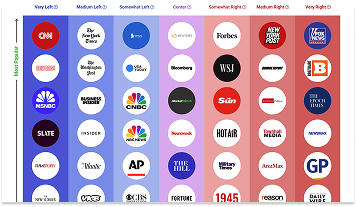
Slate Magazine on the media bias chart

- Bias Rating
-44% Medium Left
- Reliability56% Reliable AveragePolicy Leanings
0% Center
Extremely
LiberalVery
LiberalModerately
LiberalSomewhat Liberal
Center
Somewhat Conservative
Moderately
ConservativeVery
ConservativeExtremely
Conservative-100%
Liberal100%
Conservative
Average Reliability
*Our bias meter rating uses data science including sentiment analysis, machine learning and our proprietary algorithm for determining biases in news articles. Bias scores are on a scale of -100% to 100% with higher negative scores being more liberal and higher positive scores being more conservative and 0% being neutral. The rating is an independent analysis and is not affiliated nor sponsored by the news source or any other organization.
Politician PortrayalN/A
Continue For Free
Create your free account to see the in-depth bias analytics and more.
By creating an account, you agree to our Terms and Privacy Policy, and subscribe to email updates.
Log In
Log in to your account to see the in-depth bias analytics and more.
Analysis of Slate Magazine Articles
Analysis of Bias in Slate Magazine’s Online Articles
Slate Magazine has found that in-depth coverage of abortion is one of the most effective ways to drive subscriptions. Given that much of its readership is liberal leaning, it’s essential to ask: is Slate Magazine truly biased?
To evaluate this, we can analyze Slate Magazine’s articles through several of Biasly’s bias rating criteria: Tone, Tendency, Author, Diction, and Expediency Bias.
- Tone: The overall attitude conveyed by the article
- Diction: Specific word choices made by the writer
- Author: The background and social presence of the journalist
- Tendency: Patterns of bias in the writer’s broader body of work
- Expediency Bias: Quick visual or textual indicators like headlines and photos that imply bias
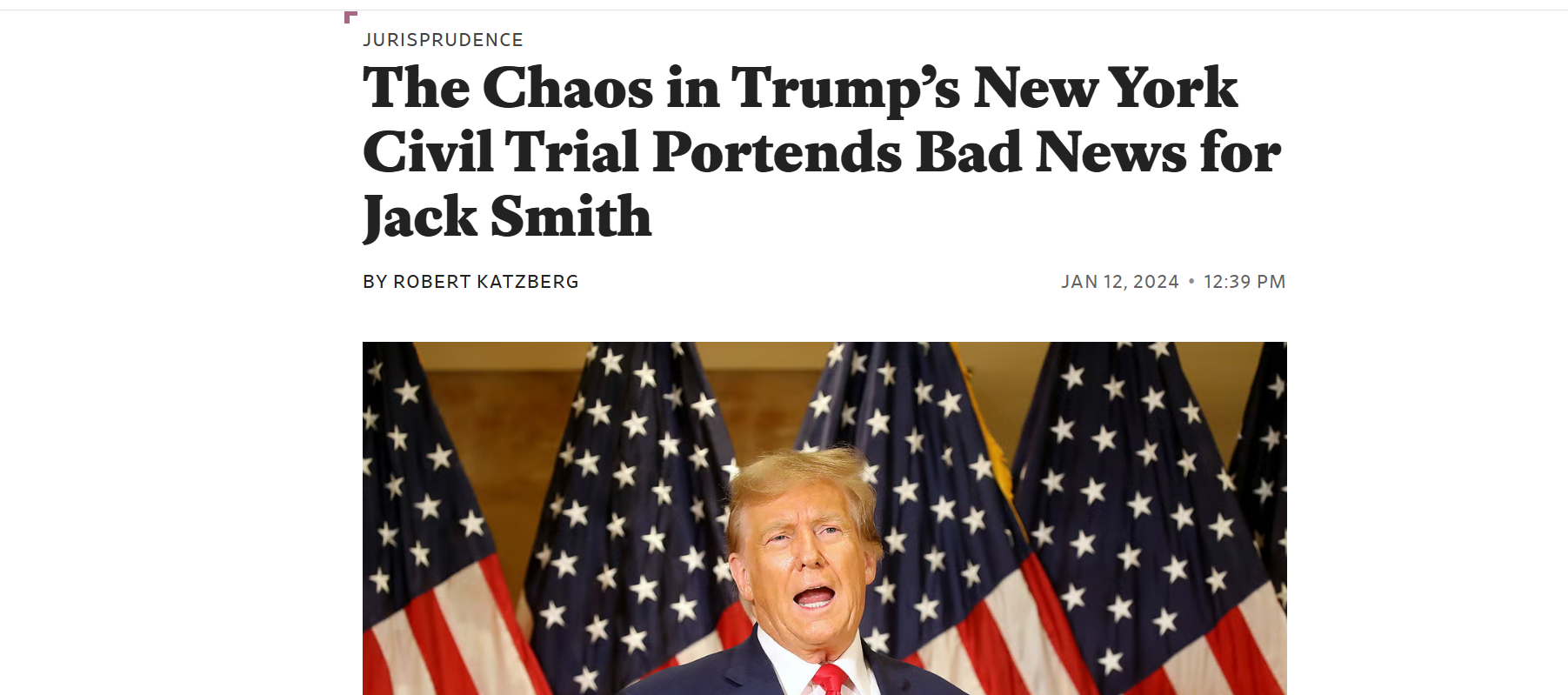
The first article we will examine highlights the diction that inspires an extreme emotional reaction in the reader. The title alone, “The Chaos in Trump’s New York Civil Trial Portends Bad News for Jack Smith,” with its use of “chaos,” also exhibits expediency bias, as the author attempts to sway readers toward having a negative attitude toward the trial before they continue reading. The article begins:
“As with all things in Trump world, just when you think there is no lower behavioral place to go, new depth-defying plunges occur.”
This quote refers to the civil fraud case brought by the New York attorney general against Donald Trump, his sons, and his organization. The “lower behavior place” reached is supposedly Trump’s defense summations, which the author labeled “unprofessional,” “self-defeating,” and “baseless.” Coinciding with words such as “lower,” “shameful,” and “incompetent,” the diction clearly favors a bias against the former president, his attorney, and many of his associates. The author, Robert Katzberg, describes the trial proceedings in an exceedingly negative light to support his opinions, and his liberal tone persists throughout most of the article.
Katzberg does not have social media. However, his past statements on this case show a bias. Katzberg has been covering high-profile white-collar criminal cases for four decades.
“What is new is the decision to have Trump address the court directly and hurl the multifaceted lies straight to the judge’s face.”
This sets a very clear tone that portrays Donald Trump negatively. “Multifaceted lies” is also an instance of strong diction meant to sway readers, making it harder for them to distinguish fact from opinion and creating preconceived notions about Donald Trump without an appropriate background or context. One more example of the strong tone and the tendency that supports liberal ideas reads:
“But, as has been abundantly clear for some time now, decisions made by Team Trump are almost always based primarily on their potential political impact, with little to no regard for the legal result—after all, as he believes, if he is president again, he can undo whatever needs to be undone.”
Another Slate Magazine article that tackles the abortion issue is called “South Carolina Tried to Pass a Bill Jailing Women for Abortion. No Republican Voted Against it.”
The article generally takes an attacking tone towards the proposed bill. The word choices remain relatively neutral. The author, Mary Ziegler, wrote a book on abortion called “After Roe, Beyond Abortion, Abortion and the Law in America, and Dollars for Life.” This is clearly an issue she is knowledgeable about. She is generally a defender of abortion rights and other similar issues like IVF, family, and sexuality. The headline pushes its attack on the Republicans for not voting against this bill. It’s clear the writer believes this proposed law isn’t just.
Despite some pro-choice bias that can be seen in her writing, both journalistically and otherwise, she maintains a more neutral tone on social media. One example of her talking about the abortion issue is a May 15, 2022, tweet where she says, “The question of whether to punish people for having abortions will likely heat up as states struggle to punish out-of-state providers. Especially because the abortion abolition movement, which has contributed to changes in TX law, has become more effective elsewhere.” Although some word choices, like “abortion abolition,” do show some bias, overall this is a pretty neutral tone.
Thread. The question of whether to punish people for having abortions will likely heat up as states struggle to punish out-of-state providers. Especially because the abortion abolition movement, which has contributed to changes in TX law, has become more effective elsewhere. /1 https://t.co/6elDbfT4RM
— Mary Ziegler (@maryrziegler) May 15, 2022
Analysis of Slate Magazine’s Opinion Articles
To fully understand political bias in media, it’s important to distinguish between factual reporting and opinion pieces. While reporting aims to present facts and let readers form their own conclusions, opinion articles express personal viewpoints on current issues. Although the previous section examined factual reporting, this section turns to how bias surfaces through Slate Magazine’s selection and tone of opinion content.
One article that shows Slate’s opinion writing in action is “Trump’s Secretary of Defense has Embraced a Great Idea, but He Seems to be the Worst Person to Implement it.” This article tackles Defense Secretary Pete Hegseth’s attempts to weaken the power of the military-industrial complex.
The article supports the policy but attacks the defense secretary himself. Word choices remain relatively neutral. Kaplan has covered military issues since the Cold War. His main expertise is on the nuclear arms race, but he’s covered a wide range of military issues in his long career. He is generally opposed to the excesses of the military. You can very quickly tell from the title that the author is opposed to excessive military spending and also doesn’t like the current Defense Secretary, Pete Hegseth.
Another article titled “The House is Now Seeing What Kind of Speaker it Elected. Oops.” The expediency bias is evident in the title, which immediately presupposes that a mistake was made regarding the current Speaker of the House, Mike Johnson. The article continues to cast negative viewpoints on several other relevant U.S. politicians while sharing little actual news. The language is almost entirely emotional, encouraging the reader to react strongly to the author’s observations.
That being said, objective articles can still be found on Slate, although they are not common. The objective articles that are present more frequently address world politics than domestic issues. For example, “What Gaza’s Future Might Look Like After the War,” by Amy Mackinnon. Biasly’s AI rating is “Center,” as the article primarily consists of facts and objective reporting. There is no clear emphasis or favoritism toward either side in the Israel-Palestine conflict, and the author addresses issues that will affect both nations in the future. There is no emotional language or overarching tone, allowing the reader to form their own opinion on the content.
“While an Israeli ground invasion is likely to deal a devastating blow to Hamas’ commanders, its foot soldiers, and its arms caches, many analysts noted that the only long-term solution to address Israel’s need for security and Palestinians’ hopes for self-determination is to work toward a political solution to the conflict.”
This quote provides a very neutral overview of the situation without setting a tone that emphasizes a particular political agenda. The remainder of the article suggests several possible political solutions to the conflict, listing the pros and cons of each without stating a clear preference. Objective reporting like this allows the reader to form an informed opinion based on facts.
Analysis of reliability in Slate Magazine’s Online News Article
Slate Magazine aims to offer New Yorkers and liberals nationwide liberal-leaning reporting that still emphasizes the facts. Its staff includes writers from varying ideological backgrounds, which can help balance coverage. However, readers should distinguish between news reporting and opinion pieces to evaluate credibility effectively.
One example is an audio story called “How did Planned Parenthood get Defunded.” This story takes a liberal-leaning frame and frames the defunding of Planned Parenthood as a push towards a total abortion ban, but draws from facts and stats that are neutral.
Some of the evidence it uses includes legislative texts, experts such as reproductive health reporter Shelafi Luthra, and Clinic CEO George Hill. Quoting legislative texts is a primary source, the best you can get sourcing-wise. Meanwhile, expert opinions can help interpret the texts, as they’re sometimes written in complex legal language. Independent fact checkers have supported most of the claims in this audio story, like the fact that Planned Parenthood relies on Medicaid and Title X funding, President Trump cutting budgets for reproductive healthcare services, and that Planned Parenthood also helps with preventative care and family-planning services, not just abortion. Although you can disagree with some of the opinions of the story, it’s clear that the facts come from a place of objectivity.
Quality of Sources and Facts Used
Slate Magazine often uses credible sources from across the political spectrum. However, some articles skew in how comprehensively they present opposing viewpoints.
Slate’s “Why did Democrats cave on the shutdown?” frames the shutdown’s end primarily as a story of Democratic capitulation rather than a messy, two-party bargaining outcome. The tone is commentary-forward and prosecutorial: the lede’s “caved—again,” plus recurring loaded phrasing (“weirder stuff,” “wishy-washy,” “So much for that fight,” “Most Depressing Possibility”) pushes readers toward a clear takeaway before competing explanations are fully stress-tested. That makes the piece highly readable and persuasive, but also meaningfully slanted in how it assigns blame and sets the stakes.
The article uses 12 direct quotes (including partial quotes inside quotation marks). The shortest quote is 2 words, the longest is 62 words, and the average quote length is 15.25 words. Longer quotes—especially the extended excerpt attributed to Sen. Tim Kaine—tend to be more reliable because they preserve reasoning, qualifiers, and context rather than leaving the author to “fill in” intent with surrounding narration. Very short quotes can still be accurate, but they’re easier to frame: without fuller context (and without hearing tone), readers can’t evaluate what the speaker emphasized or conceded. In this piece, the presence of at least one long quote strengthens credibility, but many of the article’s most consequential judgments are delivered primarily through the author’s voice.
On linked sourcing, the piece contains 25 distinct external linked sources (excluding Slate’s own internal links), spread across 33 external hyperlinks. By outlet lean (using a rough left/center/right categorization), the breakdown is 10 left, 11 center, and 2 right, plus 1 platform link (Bluesky) and 1 hard-to-classify/unknown newsletter source. So while the article isn’t sourced from only one ideological “tribe,” it provides relatively limited representation from right-leaning outlets compared with left- and center-leaning outlets.
- Bluesky (bsky.app), social media platform.
- Crooked Timber, political and academic commentary blog.
- Hill Heat, political newsletter.
- The American Prospect, progressive magazine.
- The Hill, U.S. political news outlet.
- Virginia Mercury, nonprofit state politics newsroom.
- Washington Monthly, liberal political magazine.
- Axios, U.S. news outlet.
- Brennan Center for Justice, policy and legal institute.
- Center on Budget and Policy Priorities (CBPP), progressive policy think tank.
- CBS News, U.S. news network.
- CNN, U.S. news network.
- Maine Department of Health and Human Services (Maine.gov), state government agency site.
- MPR News (Minnesota Public Radio), public media news outlet.
- MSNBC, U.S. cable news network.
- NBC News, U.S. news network.
- NPR, U.S. public radio news outlet.
- The New York Times, U.S. newspaper.
- PBS NewsHour (PBS), public media program.
- Politico, U.S. political news outlet.
- The Nation, left-leaning magazine.
- New Hampshire Union Leader, newspaper.
- Vox, explanatory news outlet.
- VPM News (VPM), Virginia public media outlet.
- The Wall Street Journal, newspaper.
Looking at the balance, sourcing is not evenly distributed across left/center/right. Center and left sources dominate by count, while right sources are sparse (2). That imbalance becomes more noticeable when you consider prominence and voice: the most directly quoted or closely paraphrased actors are Democrats (Kaine, Cortez Masto, Hassan, King, plus references to others). Right-of-center presence appears more as background reporting than as an articulated argument from the right that’s developed at comparable length. In effect, the link mix is broad-ish, but the “argument mix” is narrower—and the quoted-word share appears to favor Democratic explanations and intra-party Democratic critique.
The author’s use of sources largely reinforces a pre-set frame: Democrats’ concession is treated as puzzling or self-defeating, even though polling allegedly favored them. Center outlets are used as factual scaffolding (polling, legislative mechanics, negotiation reporting), while left-leaning commentary frequently amplifies themes of Democratic strategic failure or institutional weakness. Skepticism is directed heavily at Democratic leadership decisions and the credibility of Republican “promises” of a future vote; comparatively less space is devoted to steel-manning the GOP rationale for refusing the health-care extension or to presenting the right’s negotiating posture in sympathetic terms. Based on the quantitative sourcing breakdown (left/center heavy, thin right representation) and the consistent rhetorical framing, the author-bias rating is Somewhat Left.
Finally, on factual accuracy: the article’s most concrete, externally verifiable claims are generally supported by the types of sources it links—polling about shutdown blame (NBC News), SNAP numbers and reliance rates (state government and policy sources like Maine.gov and CBPP), and bill-provision reporting (Politico, MPR News). Where the reader should be most cautious is with claims that are either inherently interpretive or require legal/technical substantiation that isn’t fully walked through in-text (for example, assertions framed as definitively “illegal,” or motive-claims like “there was never any strategy”). Those points may still be defensible, but the article sometimes relies on confident framing plus links, rather than laying out competing interpretations and evidentiary limits directly.
Selection and Omission Bias
Slate Magazine provides extensive coverage of US politics. However, bias may still emerge through framing and story selection.
Without hearing from the writers themselves, it can be difficult to tell whether bias is selected or omitted. Regardless, we can tell when sources feel limited. In their article “An Expert on Hamas Explains why the Group isn’t Going Anywhere,” they received a limited grade on opposite sources from Biasly. Although having an expert leads to reliable storytelling, it can also make the story seem biased. Even experts can be biased. Slate Magazine consistently gets a limited grade from opposite sources. They rarely hear from conservative or even neutral thought leaders.
Slate Magazine Bias Overview
Slate Magazine was founded in 1996 by former “New Republic” editor Michael Kinsley. He set out to create an online magazine to capitalize on the booming digital economy. In 2004, Slate Magazine was acquired by the Washington Post. In 2014, it became part of Graham Holding’s digital media company. Based in New York City, Slate Magazine covers a wide range of topics, including politics, news, technology, business, culture, and lifestyle.
Is Slate Magazine Biased?
Based on Biasly’s evaluations, Slate Magazine is rated as Medium Left.
By examining content patterns and the broader context of media influence, we aim to offer a balanced perspective on Slate’s political bias—and contribute to the ongoing discussion about bias in the news.
How Does Biasly Rate News Sources?
Biasly uses proprietary algorithms and a team of analysts to provide comprehensive bias evaluations across thousands of news outlets. Over 200,000 articles from more than 3,200 sources have been analyzed to identify the most accurate and unbiased stories.
Biasly assigns each outlet three key scores:
- Reliability Score – Reflects factual accuracy
- AI Bias Score – Generated via natural language processing
- Analyst Bias Score – Assessed by human political analysts
These scores are based on seven core metrics: Tone, Tendency, Diction, Author Check, Selection/Omission, Expediency Bias, and Accuracy. These elements help analysts and algorithms evaluate the political attitude conveyed by each article.
Biasly’s Bias Meter ranges from -100% (most left) to +100% (most right), with 0% indicating neutrality. The system evaluates individual articles based on political terms, policies, figures, and sentiment to calculate precise bias ratings.
Is Slate Magazine Politically Biased?
Slate Magazine earns a Medium Left rating for its AI Bias Score and a Medium Left rating for its Analyst Bias Score. The Analyst Bias Score is generated by reviewers from liberal, moderate, and conservative backgrounds. Analysts reviewed Slate Magazine’s articles and noted extreme bias in areas such as Senate relations and oil pipelines, and showed less but still notable bias in the Voting Rights Act, racial bias in the policy force, and maternity.
New York is consistently one of the liberal strongholds. The Independent Voter Project says that New York has over 5 million registered Democrats and over 2 million registered Republicans.
This means New York leans more liberal, which could explain differing perceptions of Slate Magazine’s content. The paper may draw mixed reactions depending on readers’ political orientations.
This Bias score is determined through natural language processing that evaluates the tone, word choice, and opinion embedded in the reporting. Recent AI evaluations highlight liberal-leaning narratives in articles discussing the Republican Party and LGBTQ+ issues.
How to Evaluate Bias
Although Biasly rates Slate Magazine as Medium Left, it’s important to remember that bias can vary from article to article. Slate Magazine also covers many issues with objectivity, from legislation to social developments. This complexity underscores the importance of examining each article individually. So, let’s learn how to evaluate media bias.
Recognizing media bias requires awareness and critical thinking. Often, readers trust news sources that affirm their existing beliefs, a psychological tendency known as confirmation bias. This makes it harder to identify slanted narratives or one-sided reporting.
To combat this, it’s essential to challenge your assumptions by consulting multiple viewpoints and verifying news through third-party analysis. Tools like Biasly’s media bias ratings allow readers to compare the same news story across the political spectrum.
Ultimately, bias isn’t always a matter of what is said—it’s also about what is left out, how topics are framed, and which stories are chosen for coverage. Learning to recognize these patterns can help readers make more informed decisions and develop greater media literacy.
To start comparing news outlets and gain a better understanding of bias, sign up for Biasly’s Media Bias & News Analytics Platform to see how stories vary between sources.
Slate Magazine Reliability Overview
Is Slate Magazine Reliable?
Slate Magazine finds itself toward the middle of the spectrum, with neither high nor low accuracy. They are average in sourcing, factual accuracy, showing the other side, and quote length. However, they’re good at finding unique sources. They’re excellent at using multiple quotes and sources. Although some may criticize Slate Magazine as a liberal echo chamber, they do try to get as many voices as possible, even if they often fall into their biases.
How to Evaluate Reliability?
Reliability refers to how trustworthy or accurate a news source is. If we can’t trust what we read, then continuing to consume content from that outlet serves little purpose. So how do we evaluate a news outlet’s reliability?
There are several potential measures of reliability to consider when determining whether a media source is reliable. Red flags for an unreliable article can include wild, unsubstantiated claims, reliance on other unreliable sources, heavy use of opinionated language, and more. In contrast, hallmarks of a reliable source include:
- Absence of subjective language
- Citing credible sources (e.g., .gov, .edu, academic references)
- Verifiable facts and statistics from multiple outlets
- Use of primary sources, like interviews or transcripts
- Consistency with coverage across other platforms
Biasly’s reliability scores incorporate these elements in evaluating media outlets.
So How Does Slate Magazine Fare in Its Reliability?
The political reliability index developed by Biasly assesses both accuracy and trustworthiness. Slate Magazine currently holds a Average Reliability Score, which is calculated as a weighted average of:
- Fact Analysis Score – Evaluates the accuracy of claims, facts, and evidence.
- Source Analysis Score – Assesses the number, diversity, and credibility of sources and quotes used.
Slate Magazine’s Source Analysis Score is Average This suggests moderate trustworthiness in its sourcing practices. The score is AI-generated and considers quote length, frequency, diversity, and quality.
The Fact Analysis Score of Slate Magazine is Average. This further shows how well Slate Magazine sometimes supports its claims, addresses selection and omission bias, and presents verifiable evidence, but at other times doesn’t.
While Slate Magazine leans toward factual reporting, occasional lapses, such as unbalanced viewpoints or incomplete data, can affect its reliability rating. These nuances emphasize the importance of analyzing individual articles.
Slate Magazine’s Accuracy and Reliability
According to Biasly’s analysis, Slate Magazine maintains a Average reliability Score, but individual articles may vary significantly. Let’s dive into the details.
Political orientation plays a crucial role in how audiences perceive reliability. Slate Magazine has been accused of favoring a liberal narrative, potentially at the expense of factual reporting. To validate such claims, it’s essential to analyze whether the publication backs its assertions with sufficient evidence and diverse viewpoints.
Two common types of bias that affect factuality include:
- Selection Bias – Highlighting or omitting stories to fit a particular narrative.
- Omission Bias – Leaving out differing perspectives or relevant details to skew perception.
Biasly’s accuracy ratings range from 1% (least accurate) to 100% (most accurate). Factors include the presence of supporting evidence, internal and external reliable sources, and balanced viewpoints.
For instance, Biasly gave New Jersey 101.5 a Somewhat Right bias with an Average reliability score, reflecting its overall editorial tone and article evaluations. One rated article from the outlet, such as a piece about Murphy lifting NJ’s school mask mandate, exhibited a conservative bias rating and did not score for reliability, suggesting heavy ideological framing without corresponding balanced sourcing. This skewed perspective, which strongly favored conservative positions, was not balanced by the inclusion of opposing views or contextual nuance. In contrast, more neutral content from the source, focused on straightforward local reporting, was associated with the outlet’s Average reliability designation, indicating moments when factual reporting aligned with community-focused coverage rather than overt political framing. Overall, the most prominent language opposing liberal viewpoints tended to come from talk segments or opinion pieces in which political figures and policies were discussed in a highly charged manner, underscoring the impact of commentator tone and source selection on perceived bias.
We will take a closer look at additional examples like this below to further investigate the reliability of Slate Magazine articles. This will include its use of selection bias and omission bias, as well as the quality of its sources and the facts it uses.
So is Slate Magazine Reliable?
Overall, Slate Magazine can be considered an outlet that is moderately reliable. The site often prioritizes opinion-driven content, with variable sourcing and occasional editorial framing on sensitive international topics. While some claims are supported with evidence, consistency in sourcing and balance could be improved to meet stronger journalistic standards.
As media literacy improves, readers can more easily detect issues such as selection bias, omission bias, and factual errors. To strengthen your ability to assess reliability across the political spectrum, use Biasly’s News Bias Checker to compare how multiple outlets report the same story.
This empowers you to consume more accurate, balanced, and dependable news.
Slate Magazine Editorial Patterns
Slate Magazine’s coverage of political topics often reflects a Medium Left bias, with consistent patterns in phrasing, source selection, and thematic focus that are very liberal. While the publication sometimes demonstrates journalistic standards in many of its reports, the choice of issues, framing, and word usage can indicate a political slant. This content analysis examines how Slate Magazine handles liberal and conservative issues and evaluates its language choices and editorial tendencies.
Coverage of Liberal vs. Conservative Topics
When covering conservative issues like the actions of President Donald Trump and Defense Secretary Pete Hegseth, Slate Magazine tends to cover news topics with a center-leaning lean. Their article “Pete Hegseth Has Embraced a Great Idea. Too Bad He’s the Worst Person to Implement It” is rated Center by Biasly’s bias meter. Although the title is an aggressive attack on the defense secretary, the actual article gives his policy a chance. Another one of their articles called “Pete Hegseth Takes On the Military-Industrial Complex. (Guess Who’s Likely to Win?)” also has a Center rank by Biasly’s bias meter. This article’s title is a lot less of an attack on Hegseth and maintains a similar tone to the other one. However, their article on Trump’s decision to cut SNAP funding during the government shutdown, called “Federal Judge Uses Trump’s Own Words To Prove DOJ Was Defying His Court Order,” was extremely biased. The article attacks Trump’s attempt to withhold SNAP benefits.
Articles that cover liberal issues, like the Democrats in Congress and Palestine, tend to be very left-leaning. An article on Hamas called, “An Expert on Hamas Explains Why the Group Isn’t Going Anywhere, has a very left rating. Although the article does speak to an expert source, this source does seem to have an extreme anti-Israel bias. Their article on the Democrats’ performance during the shutdown, called “So Why Exactly Did Democrats Cave on the Shutdown?” is rated Center. This article somewhat attacks the Democrats for ending the shutdown without any real concessions, but it also tries to be fair and rationalize the decision. The use of the word “cave” in the title does show some of the bias in this article.
Policy and Issue Framing
Despite their policy leanings being rated at Medium Left, they are rated as center. This shows their bias generally comes down to matters of framing and opinion biases, not to playing favorites in policy. The issue they leaned left the hardest on is “black lives matter polarization”, which is graded as Medium Left on Biasly’s bias score. Granted, this is not an issue they cover extensively, as Biasly only had one article on the topic in their system. They seem to have a centrist coverage on a variety of issues, including anti-discrimination laws and border control. Biasly has six examples for both of these issues. The issue they seem to cover the most is abortion, which had 72 articles in Biasly’s system. They lean somewhat left on this issue. Many of their articles will criticize extreme abortion bans, but they will hear both sides when the bans are considered reasonable.
Coverage and Relevance
Slate’s reporting often touches on key issues central to the discussion of media’s political bias, including the military, foreign affairs, and government benefit programs. As such, it serves as a compelling case study for examining source bias and news media bias in reporting.
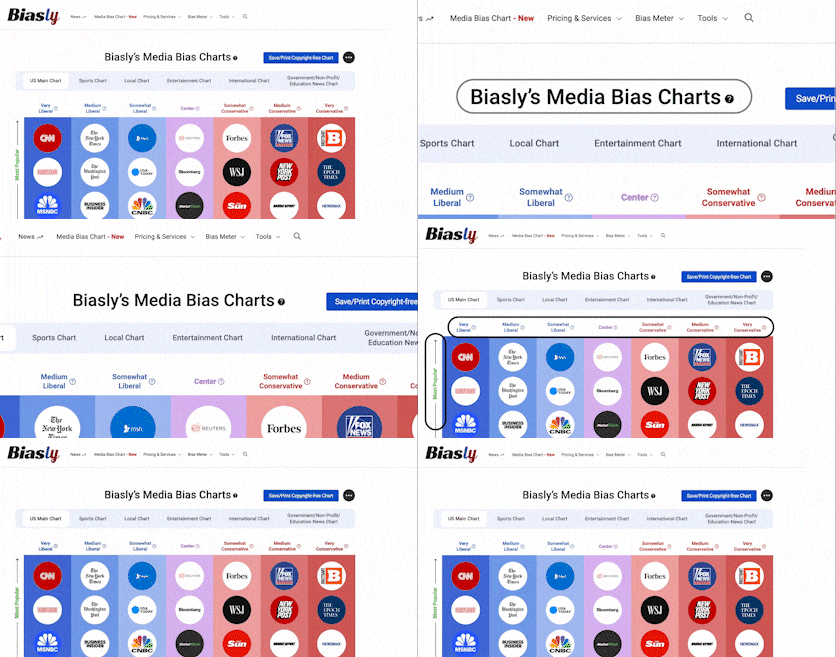
Readers who wish to further explore how Slate Magazine compares with other publications can visit Biasly’s Media Bias Chart to analyze tone and word choice in real time.
Funding and Ownership
Who Owns Slate Magazine?
As stated earlier, Slate Magazine is currently owned by the Graham Holding Company. The Graham Holding Company is a conglomerate that owns several news media outlets, like Newsweek. Slate Magazine is run by the digital marketing branch of the company called Code3. They also hold investments in healthcare, manufacturing, restaurants, automobiles, and education.
The company is run by Chairman Donald E. Graham. He was a publicist at the Washington Post from 1979 to 2000.
According to Semafor.com, Slate Magazine had the most profitable year of its history in 2023. Since 2013, Slate Magazine has made a commitment to maximize its writing for online viewership.
Who Funds Slate Magazine?
According to YouTuber Podglomerate, Slate Magazine gets its funding from ads on the site and subscribers for premium content. Since they are owned by a large conglomerate, they can afford to take occasional losses and still secure funding. In the grand scheme of things, Slate Magazine is generally able to reliably turn a profit. They are one of the few magazines that have grown consistently in recent years.
Additional Insights
News Source Comparison
When it comes to news source comparison, Slate Magazine is often evaluated alongside other regional and national outlets that lean left or center-left. Sources like The New York Times, Washington Post, and Business Insider often present similar tones and editorial philosophies. While Slate Magazine maintains a Medium Left media bias, it differs from strongly partisan sources in that it occasionally includes opposing viewpoints and strives for regional coverage balance.
This puts it in contrast with more biased media outlets that present consistently one-sided narratives without factual counterpoints. Readers seeking balanced political coverage may compare Slate Magazine’s framing of issues with outlets rated as Center or right on our Media Bias Chart, or explore other regional papers on our Similar Sources page.
Notable Contributors and Authors
Dahlia Lithwick is a longtime writer about the American legal system. Covers the Supreme Court for Slate Magazine Phil Plait is an astronomy expert. Has worked on several shows, including “How the Universe Works” and “Crash Course”. Has a newsletter called “bad astronomy”. He is sometimes skeptical of the consensus, but never without reason.
Related Tools and Resource Pages
To better understand how Slate Magazine fits into the broader media landscape, we recommend exploring these helpful resources:
- Media Bias Chart: See where Slate Magazine ranks among hundreds of media outlets across the political spectrum.
- Political Bias Chart: Visualize political slants of news sources across various policy areas.
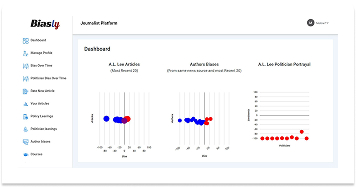
- Journalist Bias Analytics Platform: Explore how individual journalists contribute to bias within their publications.
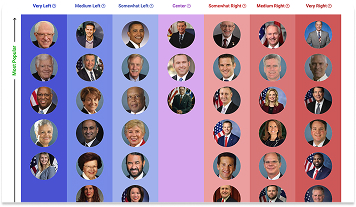
- Politician Bias Analytics Platform: Compare how politicians are framed differently by Slate Magazine and other outlets.
- Media Literacy Education Platform: Learn how to critically assess media sources, bias techniques, and news reliability.
Frequently Asked Questions
Slate Magazine is rated as Medium Left based on Biasly’s media bias algorithm, which assesses sentiment, article framing, and policy favorability.
Slate Magazine was accused of posting fake news in 2001. In June 2001, Slate Magazine published an article by writer Jay Forman describing a practice of fishermen in the Florida Keys using monkeys as bait to catch sharks. The story was later investigated by other news organizations, including The Wall Street Journal and The New York Times, which found the claims to be a hoax. For nearly six years, Slate Magazine largely stood by the story and its author, despite mounting evidence of fabrication. However, in 2007, Forman eventually admitted to his editor, Jack Shafer, that he had fabricated the story. The magazine published a correction and a story about the incident, acknowledging the fabrication. This hoax, known as the “monkeyfishing” hoax, would hurt Slate’s reputation for years. Beyond this, they have been accused of biased reporting. Despite the hoax and bias, Slate Magazine is generally a reliable source, but like with most publications, it’s best to fact-check.
Biasly uses a combination of AI sentiment analysis and human analyst review to assess tone, fact accuracy, source quality, and media bias indicators. Learn more on our Bias Meter page.
Generally, yes, though partisan framing and selective reporting can affect perceived reliability.
Military Spending
| Date | Sentiment | Associated Article | Snippet |
|---|---|---|---|
| 08/25/2019 | 75% For | Trump Family Detentions Flores Agreement (link) | So, of course, the Trump administration is doing the opposite in a baldfaced |