




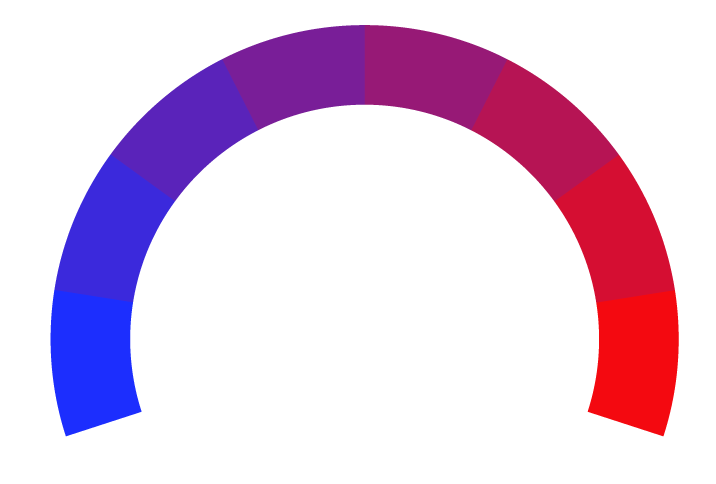
22% Somewhat Right
Bias Meter
Extremely
Liberal
Very
Liberal
Somewhat Liberal
Center
Somewhat Conservative
Very
Conservative
Extremely
Conservative
-100%
Liberal
100%
Conservative
Biasly determines media bias ratings through a dual-layered approach combining artificial intelligence and analyst review. The platform’s proprietary bias detection engine, Bias Meter, evaluates sentiment, policy position alignment, and language framing across thousands of data points in news articles. Analysts then verify and interpret the AI’s findings, providing additional context where needed. Learn more about ratings
- Profile
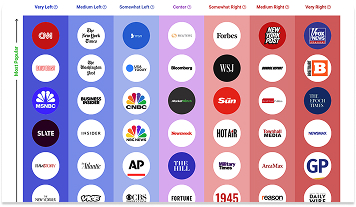
The Dispatch on the media bias chart
- Bias Rating
22% Somewhat Right
- Reliability52% Reliable AveragePolicy Leanings
24% Somewhat Right
Extremely
LiberalVery
LiberalModerately
LiberalSomewhat Liberal
Center
Somewhat Conservative
Moderately
ConservativeVery
ConservativeExtremely
Conservative-100%
Liberal100%
Conservative
Average Reliability
*Our bias meter rating uses data science including sentiment analysis, machine learning and our proprietary algorithm for determining biases in news articles. Bias scores are on a scale of -100% to 100% with higher negative scores being more liberal and higher positive scores being more conservative and 0% being neutral. The rating is an independent analysis and is not affiliated nor sponsored by the news source or any other organization.
Politician Portrayal90% positive
Continue For Free
Create your free account to see the in-depth bias analytics and more.
By creating an account, you agree to our Terms and Privacy Policy, and subscribe to email updates.
Log In
Log in to your account to see the in-depth bias analytics and more.
Analysis of The Dispatch Articles
Analysis of Bias in The Dispatch Online Articles
To evaluate this, we can analyze select The Dispatch articles through several of Biasly’s bias rating criteria: Tone, Tendency, Author, Diction, and Expediency Bias.
- Tone: The overall attitude conveyed by the article
- Diction: Specific word choices made by the writer
- Author: The background and social presence of the journalist
- Tendency: Patterns of bias in the writer’s broader body of work
- Expediency Bias: Quick visual or textual indicators like headlines and photos that imply bias
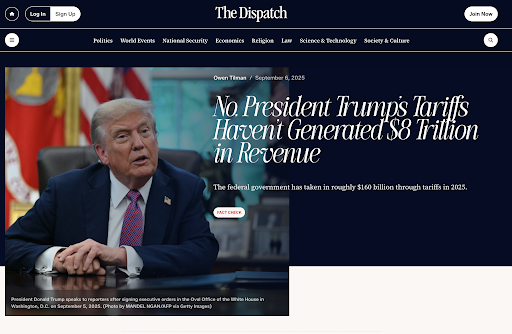
Source: The Dispatch
A useful example is the article “No, President Trump’s Tariffs Haven’t Generated $8 Trillion in Revenue,” written by Owen Tilman and published September 6, 2025. The article examines claims made by President Donald Trump and the White House about the amount of revenue and investment supposedly generated by Trump’s tariff policy. The headline immediately tells readers that the central claim is false, making the article’s position clear before the reader reaches the first paragraph, as seen in the image above.Trump seems to be portrayed as naive in the image as well.
The article begins by reporting that the White House had promoted Trump’s tariff policies and claimed they had produced enormous amounts of investment and revenue:
“protectionist trade policies”
The article then presents Trump’s own claim:
“[T]aken in almost $17 trillion in investment … most of it has come in because of tariffs.”
The author immediately follows this with the statement, “None of the claims is accurate.” This is important from a tone and expediency perspective. Rather than presenting Trump’s statement as one side of a political disagreement, the article treats it as a factual claim that can be tested against available evidence. That approach is appropriate for a fact-checking article. Although the framing is unfavorable to the White House’s claim, that alone does not establish political bias, because the key questions are whether the article represents the claim accurately and supports its conclusion with data.
The author, Owen Tilman, is a Yale student and a former intern at The Dispatch. His earlier bylines include the Washington Free Beacon in June 2024, and he has served as editor-in-chief of the Buckley Beacon at Yale and as a College Fix fellow. These are right-leaning outlets and programs, which suggests a right-leaning author. That background makes the article’s critical treatment of a Trump claim more notable, because it reads as a fact-based correction of a claim from a Republican president rather than a one-sided partisan argument.
A second example of The Dispatch’s political framing can be found in David Drucker’s article “Do Michigan Democrats Want Populism or Pragmatism?” published on July 15, 2026. The article examines the Democratic Senate primary between Abdul El-Sayed and Haley Stevens. Unlike the tariff fact check, this article uses more evaluative language to describe the candidates and their political positions. Its subhead presents the race as one between “progressive Abdul El-Sayed” and “the more traditional Rep. Haley Stevens,” and the opening paragraph calls El-Sayed “the progressive populist” while noting that his signature “Medicare for All” proposal leaves open the question of cost to the average taxpayer.
The article sets up a contrast between a progressive populist and a more conventional Democrat. A focus on cost and electability is a common theme in primary coverage and does not by itself prove a political lean, but the opening line, “Just don’t ask the progressive populist for the cost to the average taxpayer,” is an evaluative aside that fits The Dispatch’s center-right editorial perspective.
Overall, The Dispatch’s online articles show a center-right perspective through framing and story selection more consistently than through extreme diction. Its political perspective is most visible in which questions it chooses to ask, which political movements receive scrutiny, and how conservative and progressive policies are evaluated.
Analysis of The Dispatch Opinion Articles
The Dispatch maintains a clearer distinction between reporting, analysis, and opinion than some highly partisan online outlets, but its opinion writing still provides important evidence of its political orientation.
The publication’s opinion writers generally operate from a conservative or center-right perspective. However, The Dispatch is particularly notable because its writers have often criticized the Republican Party and Donald Trump from the perspective of traditional conservatism.
This distinction matters when evaluating political bias. A conservative publication does not necessarily have to support every Republican politician. In fact, The Dispatch’s willingness to criticize Trump is one reason its editorial identity reads as closer to center-right than that of strongly partisan conservative outlets.
In his opinion column “The Democrats Need a Better Agenda Than ‘Trump Is Bad,’” Jonah Goldberg argues, according to the subhead, that “the messaging rallies supporters and raises money, but it’s not a strategy for long-term success.” The column, published October 22, 2025, is critical of the Democratic Party’s strategy from a conservative perspective, and it opens by observing that “the only thing the parties can agree on is that Donald Trump is the central issue of our time.”
Goldberg’s September 16, 2026 column “Trump’s Scapegoating of Ukraine Is Dishonorable” shows the other side of the outlet’s opinion writing. Its subhead says, “The president would rather point fingers at Kyiv than tell Putin to stop the killing.” Together, the two columns show opinion writing that is critical of both Democratic strategy and Trump’s conduct.
The Dispatch also publishes commentary that criticizes Trump from a conservative perspective. Co-founders Steve Hayes and Goldberg resigned as Fox News contributors in November 2021 in protest of Tucker Carlson’s January 6 documentary series, describing it as “a collection of incoherent conspiracy-mongering, riddled with factual inaccuracies, half-truths, deceptive imagery, and damning omissions.”
This demonstrates that The Dispatch’s political bias should not be understood as simply “pro-Republican.” Its editorial identity is better described as conservative or center-right, with a particular emphasis on traditional conservative principles, institutionalism, and skepticism toward political populism.
The contrast between its reporting and opinion content shows that The Dispatch’s bias is generally strongest in editorial interpretation rather than in basic factual reporting.
Analysis of Reliability in The Dispatch’s Online News Articles
The Dispatch presents a relatively strong reliability picture compared with many partisan political websites, although its Average reliability rating from Biasly means readers should still evaluate individual articles rather than assuming every story is equally reliable.
This is significant because the publication’s political orientation does not automatically mean that every factual claim is presented inaccurately. In fact, The Dispatch frequently relies on primary documents, government statistics, public statements, court records, and established news organizations.
The tariff article provides a strong example. The author uses Congressional Budget Office estimates and Treasury data rather than relying only on political commentary. The article cites the CBO’s August 2025 estimate that the tariffs then in place would reduce federal deficits by about $4 trillion over a decade, and a Bipartisan Policy Center analysis of Treasury statements showing about $158.4 billion in tariff revenue collected since January 21, 2025.
At the same time, the article’s treatment of the White House’s investment figures shows why reliability and bias are separate concepts. A story can use accurate facts while still choosing a particular interpretation of those facts.
Quality of Sources and Facts Used
The Dispatch often uses credible sources and official government data, but its political perspective can still shape how a story is framed. Consider the headline, “No, President Trump’s Tariffs Haven’t Generated $8 Trillion in Revenue.” The article is structured as a fact check and directly challenges claims made by President Trump and the White House.
It relies heavily on government data and outside economic analysis, which gives the article a strong factual foundation. However, the wording and selection of evidence clearly place more scrutiny on Trump’s claims than on arguments supporting his tariff policies.
The article contains 7 direct quotes in quotation marks (counting partial quotes). The shortest quote is 3 words, the longest is 57 words, and the average quote length is about 26 words.
The quotes include “protectionist trade policies” (3 words), Trump’s claim that the U.S. had “taken in almost $17 trillion in investment … most of it has come in because of tariffs” (16 words), and longer statements from Scott Lincicome and White House spokesperson Kush Desai.
The longer quotes provide more context and make it easier for readers to understand what the speaker actually said rather than relying on a short soundbite. This makes the sourcing more reliable because the article gives readers enough of the speakers’ statements to understand their arguments.
However, the article still chooses which portions of those statements to include, so quote selection can influence how readers view each side.
On linked sources, the article uses 12 distinct hyperlinks, one of which points to The Dispatch’s own newsletter. Of the other 11, the linked sources are approximately Left = 1, Center = 3, Right = 1, and six are institutional references.
The strongest part of the sourcing is that the article uses several institutional sources, including the Congressional Budget Office, the Treasury Department, the Bureau of Economic Analysis, and the U.S. Trade Representative.
It also includes sources from both conservative and mainstream organizations, including the Cato Institute, Wall Street Journal, Reuters, and the Bipartisan Policy Center. The article therefore has a broader sourcing base than many politically focused opinion pieces.
- White House, official presidential administration source (Right)
- Donald Trump, U.S. President, whose tariff and investment claims are examined (Right)
- Mediaite, article reporting Trump’s $17 trillion investment claim (Left)
- Bipartisan Policy Center, policy research organization (Center)
- U.S. Treasury Department, federal financial agency (institutional reference)
- Congressional Budget Office (CBO), nonpartisan federal agency (institutional reference)
- Bureau of Economic Analysis (BEA), federal economic statistics agency (institutional reference)
- Office of the U.S. Trade Representative (USTR), federal trade agency (institutional reference)
- Scott Lincicome, Cato Institute vice president and trade-policy analyst (Right/Libertarian)
- Cato Institute, libertarian policy organization (Right)
- The Wall Street Journal, news organization (Center)
- Reuters, international news organization (Center)
The sourcing is relatively balanced in terms of the types of sources used, although the article gives more prominence to sources that challenge the White House’s claims.
There is only one clearly left-leaning linked source, while most of the evidence comes from center or institutional sources. The right-leaning perspective comes mainly from the White House, Trump, Lincicome, and the Cato Institute, with Lincicome and Cato counting as a single libertarian viewpoint.
However, the center and institutional sources make up the majority of the evidence. The article’s quoted-word share is also relatively balanced between the opposing positions because it gives substantial space to both Scott Lincicome’s criticism of the investment claims and Kush Desai’s defense of Trump’s tariff policy.
The author uses sources differently depending on their role. Government agencies and economic organizations are presented as factual evidence, while Trump and the White House are primarily used as the subjects of the fact check.
Lincicome is used to challenge the credibility of Trump’s investment figures, while Desai is given an opportunity to defend the administration’s position.
The author’s framing is established early when he states, “None of the claims is accurate.” This tells readers, before the rest of the evidence is presented, that the central claim has already been judged false.
The White House’s explanation is included, but it is not given the same weight as the government data and outside analysis. Based on the author’s background and the article’s framing, the author is right-leaning, but the article itself is relatively factual and restrained for a political fact check.
On factual accuracy, the article’s central claim is strongly supported by outside evidence. A Bipartisan Policy Center analysis of Treasury statements, cited by the article, found that the federal government had collected about $158.4 billion in tariff revenue since January 21, 2025, rather than anything close to $8 trillion.
The Congressional Budget Office also estimated in August 2025 that the tariffs then in place would reduce federal deficits by about $4 trillion over a decade. The article also notes that the United States imports roughly $3 trillion of goods a year, which makes $8 trillion in tariff revenue in 2025 nearly impossible.
The article is therefore accurate in distinguishing between actual tariff revenue and much larger claims about future investment or deficit reduction.
Its explanation that corporate investment pledges should not automatically be counted as completed investments is also reasonable, particularly because the article identifies specific examples and gives Lincicome’s explanation rather than presenting the claim without support.
Overall, the factual evidence strongly supports the article’s conclusion that the $8 trillion tariff-revenue claim was false.
Selection and Omission Bias
Selection and omission bias at The Dispatch is more subtle than at openly partisan conservative publications.
The Dispatch’s editorial mission gives it a center-right perspective, which affects the issues it emphasizes and the arguments it considers important. However, its coverage does not consistently select stories that make Democrats look bad while ignoring Republicans.
The tariff fact check provides a good example. A Republican administration is the subject of a story that directly challenges an important economic claim.
Other fact checks point the same way. Ashley Dowdney’s “Fact-Checking Trump’s Election Security Speech” (July 18, 2026) says in its subhead that the documents released by the White House “largely failed to support his claims,” and Stephen Richer’s “Trump’s ‘Rigged Election’ Claims Are Short on Evidence, Again” (July 17, 2026) examines what its subhead calls “two of the president’s unsubstantiated voter fraud claims.” David Drucker’s article on the Michigan Senate primary, by contrast, scrutinizes a Democratic candidate’s signature policy proposal.
This means selection bias exists primarily through the outlet’s broader conservative editorial perspective rather than through a simple rule of “positive coverage for Republicans and negative coverage for Democrats.”
The Dispatch is more likely to approach issues through conservative principles involving limited government, constitutional institutions, free markets, national security, and skepticism toward progressive policy. That influences which stories are interpreted.
However, the publication’s willingness to criticize Republican politicians makes its selection bias less one-sided than the selection patterns found in explicitly partisan political outlets.
The Dispatch Bias Overview
The Dispatch was launched in 2019 by Steve Hayes, Jonah Goldberg, and Toby Stock as a conservative publication focused on reporting, commentary, and analysis. Hayes and Goldberg came from established conservative publications, including The Weekly Standard and National Review.
The publication’s conservative identity is openly acknowledged. At the same time, its stated approach differs from media organizations that closely align themselves with a particular political party.
The Dispatch has developed a reputation for being particularly skeptical of populist politics and for criticizing Republicans when they move away from traditional conservative principles. This is especially relevant when evaluating its coverage of Donald Trump.
Its editorial model combines political reporting with commentary, newsletters, podcasts, and fact-checking. The acquisition of SCOTUSblog in April 2025 also expanded its coverage of the Supreme Court and legal issues.
The result is an outlet that occupies a distinct position in conservative media. It is clearly not politically neutral, but its reporting is generally more institutionally focused and fact-based than the most openly partisan conservative outlets.
Is The Dispatch Biased?
Based on Biasly’s evaluations, The Dispatch is rated as Somewhat Right.
By examining content patterns and the broader context of media influence, we aim to offer a balanced perspective on The Dispatch’s political bias—and contribute to the ongoing discussion about bias in the news.
How Does Biasly Rate News Sources?
Biasly uses proprietary algorithms and a team of analysts to provide comprehensive bias evaluations across thousands of news outlets. Over 200,000 articles from more than 3,200 sources have been analyzed to identify the most accurate and unbiased stories.
Biasly assigns each outlet three key scores:
- Reliability Score – Reflects factual accuracy
- AI Bias Score – Generated via natural language processing
- Analyst Bias Score – Assessed by human political analysts
These scores are based on seven core metrics: Tone, Tendency, Diction, Author Check, Selection/Omission, Expediency Bias, and Accuracy. These elements help analysts and algorithms evaluate the political attitude conveyed by each article.
Biasly’s Bias Meter ranges from -100% (most left) to +100% (most right), with 0% indicating neutrality. The system evaluates individual articles based on political terms, policies, figures, and sentiment to calculate precise bias ratings.
Is The Dispatch Politically Biased?
The Dispatch earns a Somewhat Right rating for its AI Bias Score and a Somewhat Right for its Analyst Bias Score. The Analyst Bias Score is generated by reviewers from liberal, moderate, and conservative backgrounds. The publication’s conservative identity is visible in its policy coverage, opinion writing, and selection of topics. However, its political coverage does not consistently favor Republican politicians.
The Dispatch has published reporting critical of Trump and other Republican figures, including fact-checks that directly challenge statements from Republican officials. Its coverage of the Trump administration has therefore included both favorable and unfavorable stories depending on the subject.
The Dispatch’s political bias is therefore best understood as a conservative editorial perspective rather than a straightforward Republican Party advocacy group.
How to Evaluate Bias
Although Biasly rates The Dispatch as Somewhat Right, it’s important to remember that bias can vary from article to article. So, let’s learn how to evaluate media bias.
Recognizing media bias requires awareness and critical thinking. Often, readers trust news sources that affirm their existing beliefs—a psychological tendency known as confirmation bias. This makes it harder to identify slanted narratives or one-sided reporting.
To address this, it’s essential to challenge your assumptions by consulting multiple perspectives and verifying information through third-party analysis. Tools like Biasly’s media bias ratings allow readers to compare the same news story across the political spectrum.
Ultimately, bias isn’t always a matter of what is said—it’s also about what is left out, how topics are framed, and which stories are chosen for coverage. Learning to recognize these patterns can help readers make more informed decisions and develop greater media literacy.
To start comparing news outlets and gain a better understanding of bias, sign up for Biasly’s Media Bias & News Analytics Platform to see how stories vary between sources.
The Dispatch Reliability Overview
Is The Dispatch Reliable?
The Dispatch presents a relatively strong reliability picture compared with many partisan political outlets, despite its clear political orientation.
Biasly currently rates its reliability as Average.
The Dispatch’s strongest reliability comes from its use of government records, primary documents, interviews, and named sources.
The tariff fact check demonstrates this approach. Rather than relying on an ideological argument alone, the article uses Treasury data and CBO estimates to challenge the White House’s claims.
The main reliability concern is not a consistent pattern of fabricated information. Instead, it is the possibility that conservative framing influences which facts receive emphasis and how political arguments are presented.
How to Evaluate Reliability?
Reliability refers to how trustworthy or accurate a news source is. If we can’t trust what we read, then continuing to consume content from that outlet serves little purpose. So how do we evaluate a news outlet’s reliability?
There are several key indicators of reliability to consider when assessing a media source. Red flags of an unreliable article can include wild, unsubstantiated claims, facts that depend on other unreliable sources, heavy use of opinionated language, and more. In contrast, hallmarks of a reliable source include:
- Absence of subjective language
- Citing credible sources (e.g., .gov, .edu, academic references)
- Verifiable facts and statistics from multiple outlets
- Use of primary sources, like interviews or transcripts
- Consistency with coverage across other platforms
Biasly’s reliability scores incorporate these elements in evaluating media outlets.
So, How Does The Dispatch Fare in Its Reliability?
The political reliability index developed by Biasly assesses both accuracy and trustworthiness. The Dispatch currently holds Average Reliability Score, which is calculated as a weighted average of:
- Fact Analysis Score – Evaluates the accuracy of claims, facts, and evidence.
- Source Analysis Score – Assesses the number, diversity, and credibility of sources and quotes used.
The Dispatch’s Source Analysis Score is Average at 52% Reliable. This suggests moderate trustworthiness in its sourcing practices. The score is AI-generated and considers quote length, frequency, diversity, and quality.
The Fact Analysis Score of The Dispatch is Pending at N/A. This further shows how well The Dispatch supports its claims, addresses selection and omission bias, and presents verifiable evidence.
The fact that well-sourced individual articles can sit alongside a Average overall reliability rating shows why it is important to separate factual accuracy from political framing. An article can use reliable evidence while still presenting that evidence from a particular ideological perspective.
The Dispatch’s Accuracy and Reliability
According to Biasly’s analysis, The Dispatch maintains a Average Reliability Score, but individual articles may vary significantly. Let’s dive into the details.
The two most important reliability concerns in The Dispatch’s coverage are:
- Selection Bias – emphasizing issues and stories that fit a conservative editorial perspective
- Framing Issues – using conservative terminology or interpretations when discussing political disputes.
The tariff fact check demonstrates why these concerns should not automatically be equated with factual unreliability.
The article’s headline is strongly corrective, but the underlying evidence is based on government and institutional sources. The author provides a specific revenue figure and explains how that figure was calculated.
The article also gives the White House an opportunity to respond, which provides readers with the administration’s argument rather than simply presenting The Dispatch’s position.
Overall, The Dispatch can be considered moderately reliable, with the important qualification that reliability and political bias are separate measurements.
So, is The Dispatch Reliable?
Overall, The Dispatch can be considered to be an outlet that is moderately reliable. It demonstrates a consistent goal of journalistic integrity and typically supports claims with sources and quotes. Occasional omissions and framing bias do appear, particularly on culturally sensitive or partisan issues.
As media literacy improves, readers can more easily detect issues with selection bias, omission bias, and factuality. To strengthen your ability to assess reliability across the political spectrum, use Biasly’s News Bias Checker to compare how multiple outlets report the same story.
This empowers you to consume more accurate, balanced, and dependable news.
The Dispatch Editorial Patterns
The Dispatch’s coverage of political topics often reflects a Somewhat Right bias, with consistent patterns in phrasing, source selection, and thematic focus that are Slightly Conservative.
The outlet’s conservative philosophy is most visible in its opinion writing and broader policy coverage. Its straight news reporting is generally more restrained. The Dispatch’s editorial pattern is therefore different from that of an outlet whose news coverage and political advocacy are essentially indistinguishable.
Coverage of Liberal vs. Conservative Topics
The Dispatch’s coverage of liberal and Democratic topics is generally critical in framing, though more measured in language than most right-leaning outlets. Its coverage of conservative and Republican topics is more complex, sympathetic to traditional center-right policy positions, but consistently critical of Trump populism and the personalities and institutions that have come to define the modern GOP.
This produces an unusual asymmetry: The Dispatch applies critical scrutiny to both parties, but the nature of that scrutiny differs. Democratic politicians and policies are covered through a conventional center-right critical lens. Republican politicians who represent right-wing populism are covered through a more distinctive lens, one that frames them as having betrayed conservative principles.
Policy and Issue Framing
On fiscal policy, The Dispatch consistently frames government spending and debt as a serious structural problem, positions aligned with traditional conservative economic thought but presented with rigorous data rather than rhetorical inflation. Jessica Riedl’s August 28, 2026 article “Can the U.S. Avoid a Dangerous Debt Spiral?” is a representative example of its fiscal coverage, which centers on Treasury and bond-market data.
On election integrity, The Dispatch has published fact checks that challenge Trump’s election-fraud claims, including Ashley Dowdney’s July 2026 fact check of his election security speech and Stephen Richer’s July 2026 analysis of his “rigged election” claims. Those pieces apply evidence-based scrutiny to a Republican president, while the outlet’s broader election coverage still approaches election administration through a center-right policy lens.
On foreign policy, the outlet reflects a traditional center-right internationalist orientation, skeptical of isolationism, supportive of U.S. alliances, and critical of Trump’s approach to allies. Goldberg’s April 8, 2026 column “Why Trump’s Antics Don’t Work on Our Allies” is one example.
Coverage and Relevance
The Dispatch’s approach to political journalism, center-right in orientation, fact-based in methodology, and openly critical of right-wing populism from a conservative perspective, makes it a distinctive case study in the current conversation about bias in the media. It represents a model of explicitly ideological journalism that nonetheless emphasizes fact-based reporting and has been willing to fact-check its own ideological allies.
Readers who want to see how The Dispatch’s framing compares to other outlets can visit Biasly’s Media Bias Chart to analyze tone and word choice across outlets in real time.
Funding and Ownership
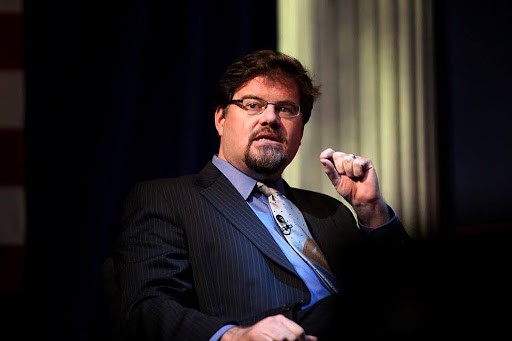
The Dispatch is owned and operated by Dispatch Media, Inc., a privately held company owned by its co-founders together with a broad group of individual investors, and it has avoided venture-capital funding. Jonah Goldberg serves as editor-in-chief, and Steve Hayes serves as CEO and editor. Both are co-founders along with Toby Stock.
The outlet was launched in 2019 with a subscription-based model that has grown significantly since, with paid members rising from about 10,000 in 2020 to more than 40,000 in 2024. Unlike many ideological outlets that rely on wealthy donors or institutional backing, The Dispatch has built its revenue primarily through reader memberships, a funding model that ties its commercial interests to its readers rather than to donor priorities.
Who funds The Dispatch?
The Dispatch is funded primarily through reader memberships, which make up the large majority of its revenue, with sponsorships providing a smaller share. A membership model means the publication’s commercial incentives run largely through its readers rather than through a single donor or advertiser, which can reduce, though not eliminate, the risk of outside financial pressure on editorial direction.
Funding arrangements can also change over time. Semafor reported in May 2026 that the company had been in talks with Axel Springer about a possible acquisition. Because The Dispatch is privately held and primarily membership-funded, its editorial direction largely reflects its founding team’s conservative, anti-populist orientation, but readers should still evaluate individual articles on their evidence.
Additional Insights
News Source Comparison
The Dispatch occupies a distinct niche among conservative and center-right outlets. Among publications with a similar right-leaning bias rating, it stands out for its fact-based reporting, a combination that places it alongside outlets like The Economist and The Wall Street Journal news section rather than alongside more partisan right-leaning outlets like The Daily Caller or Breitbart. Among Never Trump or Trump-skeptical conservative outlets, it is one of the most prominent, having outlasted The Weekly Standard (which closed in 2018) and grown significantly since its 2019 founding.
Its 2025 acquisition of SCOTUSblog adds a respected legal reporting resource, further broadening its appeal beyond its core center-right readership. Readers seeking more partisan conservative coverage may find outlets like The Daily Caller or The Washington Free Beacon more aligned with their preferences, while readers seeking centrist coverage may find outlets rated as Center on Biasly’s Media Bias Chart a better fit.
Notable Contributors and Authors
The Dispatch features a distinctive roster that reflects its unusual position in conservative media. Jonah Goldberg is editor-in-chief and writes the G-File newsletter, focusing on political philosophy, conservative principles, and intra-conservative debate. David French, a former senior editor who wrote the French Press newsletter until early 2023, now writes for The New York Times and remains a special guest on the Advisory Opinions podcast. Sarah Isgur, a former Department of Justice spokesperson, is a senior editor who hosts the Advisory Opinions podcast. Kevin D. Williamson is a national correspondent who contributes political and cultural commentary. Jessica Riedl, a Brookings Institution fellow, is a contributing writer on fiscal policy and analysis. Steve Hayes serves as CEO and editor and hosts the outlet’s flagship podcast, and Michael Warren is politics editor.
The common thread across these contributors is a commitment to center-right principles and fact-based journalism combined with a critical distance from the Trumpist direction of the modern Republican Party, a profile that would have been unremarkable in conservative media before 2016 but has become increasingly rare since.
Related Tools and Resource Pages
To better understand how The Dispatch fits into the broader media landscape, we recommend exploring these helpful resources:
- Media Bias Chart: See where The Dispatch ranks among hundreds of media outlets across the political spectrum.
- Political Bias Chart: Visualize political slants of news sources across various policy areas.
- Journalist Bias Analytics Platform: Explore how individual journalists contribute to bias within their publications.
- Politician Bias Analytics Platform: Compare how politicians are framed differently by The Dispatch and other outlets.
- Media Literacy Education Platform: Learn how to critically assess media sources, bias techniques, and news reliability.
Frequently Asked Questions
The Dispatch is rated as Somewhat Right based on Biasly’s media bias algorithm, which assesses sentiment, article framing, and policy favorability.
While The Dispatch is not widely known for promoting fake news, some articles have shown selection and omission bias, especially in political reporting. Its factual reporting is generally sound.
Biasly uses a combination of AI sentiment analysis and human analyst review to assess tone, fact accuracy, source quality, and media bias indicators. Learn more on our Bias Meter page.
Generally, yes, though partisan framing and selective reporting can affect perceived reliability.
Military Spending
| Date | Sentiment | Associated Article | Snippet |
|---|---|---|---|
| 08/25/2019 | 75% For | Trump Family Detentions Flores Agreement (link) | So, of course, the Trump administration is doing the opposite in a baldfaced |