









How News Sources Portray The Green New Deal Policy
This chart shows how major news sources across the ideological spectrum frame the green new deal policy, from left to right-leaning perspectives.










Whether due to media bias or biased news, many topics are becoming increasingly polarizing and defining political parties in contemporary politics, one of which surrounds the Green New Deal. The GND is a highly partisan topic, with the majority of Democrats supporting it and the majority of Republicans opposing it.
The Green New Deal refers to the provision to curb climate change within ten years while investing in good-paying union jobs, originally inspired by President Roosevelt’s New Deal during the Great Depression. Democratic Representative Alexandria Ocasio-Cortez and Massachusetts Senator Edward Markey originally proposed the GND in 2019, promoting it as a framework for tackling the climate crisis and building a better world. The status of the Green New Deal has remained unchanged since 2019.
What is the Green New Deal?
According to AOC, the Green New Deal is a “framework for tackling our climate crisis and building a better world,” by “creat[ing] new green space, and revers[ing] the effects of environmental racism in the borough.” AOC defines the Green New Deal as a “jobs and justice-centered plan to decarbonize the U.S. economy within ten years.” The GND also aims to benefit working people and marginalized communities, and guarantees a living-wage union job for Americans.
Although not passed into law, the GND has significantly influenced recent climate legislation. Senator Markey claims that since the introduction in 2019, there has been immense progress towards clean energy, climate, and environmental justice. He promotes that the GND would help the low-income and disadvantaged communities and create reliable union jobs for Americans.
The Green New Deal aims to achieve net-zero greenhouse gas emissions, create millions of green jobs, upgrade infrastructure, and promote environmental and social justice while benefiting lower- and working-class Americans. If passed, $34 billion would be allocated towards water infrastructure projects, $150 billion towards broadband infrastructure, and $75 billion for transportation infrastructure.
Republican Stance on the Green New Deal
Republicans often believe that climate change isn’t an issue, or at least shouldn’t be a top priority. President Donald Trump has called climate change a “hoax” and discredits the causation between human activity and global warming. However, more moderate Republicans have sought to address climate change and its causes. 12% of Republicans say dealing with global climate change should be a top priority for the president and Congress in 2024. Another poll shows that just 28% of Republicans support the Green New Deal.
Republicans generally oppose the Green New Deal because they view it as too expensive, too broad, and too dependent on government control. They argue that its climate and social policies would hurt the economy, raise energy costs, reduce consumer choice, and harm workers in fossil fuel and energy-related industries. Republicans also criticize the Green New Deal for combining environmental goals with wider social programs, which they see as unrealistic and beyond the proper role of climate policy.
Instead, Republicans tend to favor market-based climate solutions focused on private-sector innovation, technological development, affordable energy, and energy reliability. Many Republicans support keeping fossil fuels in the energy mix while using cleaner technologies to reduce emissions. Overall, they argue that climate policy should protect jobs, strengthen national security, and reduce emissions without creating massive federal programs or disrupting the economy.
Politicians Who Oppose The Green New Deal
12% of Republicans say dealing with global climate change should be a top priority for the president and Congress in 2024.
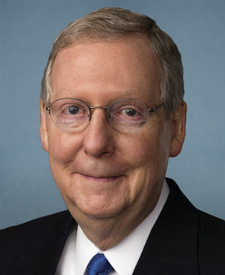
Mitch McConnell
“The Green New Deal is a radical, top-down, socialist makeover of the entire U.S. economy. ... It would cost millions of jobs and sharply drive up energy prices for working families across our country while doing little to solve global emissions.”
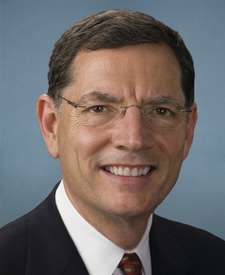
John Barrasso
“Democrats' extreme Green New Deal would send our strong, our healthy and our growing economy careening over a liberal cliff. ... Just last week, Democrats released their Green New Deal proposal – a big-government takeover of the economy masked as an environmental policy. The proposal isn't green and it's not new. It's not a green deal – it's a raw deal.”
Democratic Stance on the Green New Deal
Democrats generally support the Green New Deal and believe that climate change is a serious issue. 59% of Democrats say dealing with global climate change should be a top priority for the president and Congress in 2024. In terms of the Green New Deal, 87% of Democrats support it, compared to just 28% of Republicans. The Biden Administration, for example, has established many programs that sought to benefit and progress environmental justice, but has not worked to implement the Green New Deal and its exact policies.
Democrats tend to view the Green New Deal as a way to address climate change while also creating jobs and strengthening the economy. Many Democrats, especially progressives, support Green New Deal-style policies such as investing in clean energy, moving away from fossil fuels, upgrading infrastructure, and reducing greenhouse gas emissions. Even though not all Democrats support the full Green New Deal proposal, many of its ideas have influenced the party’s broader climate agenda, including plans for renewable energy, union jobs, and economic recovery through green investment.
Democrats also connect the Green New Deal to environmental justice, arguing that pollution and climate change disproportionately harm low-income communities, communities of color, Indigenous communities, and other vulnerable groups. Progressive Democrats and youth climate activists have been the strongest supporters, while some moderate Democrats are more cautious about the cost, political feasibility, and effects on workers in fossil fuel industries. Overall, Democrats tend to see Green New Deal-style policies as a framework for fighting climate change, promoting economic opportunity, and reducing inequality.
Politicians Who Support The Green New Deal
59% of Democrats say dealing with global climate change should be a top priority for the president and Congress in 2024.

Alexandria Ocasio-Cortez
“This is going to be the New Deal, the Great Society, the moon shot, the civil-rights movement of our generation. We don't have time to sit on our hands as our planet burns. For young people, climate change is bigger than election or re-election. It's life or death.”

Edward J. Markey
“A Green New Deal is about jobs, and it is about justice. It would be the greatest blue-collar jobs program in a generation and repair the historic oppression of frontline and vulnerable communities that have borne the worst burdens of our fossil fuel economy, all while saving the planet.”
Green New Deal: Pros and Cons
Benefits of the Green New Deal include combating climate change, creating new jobs, and addressing systemic social and economic inequalities. The GND aims to transition the U.S. to 100% renewable energy, which would reduce anthropogenic greenhouse gas emissions and effectively combat climate change. AOC contends that renewable energy would create several jobs across various sectors, as renewable energy infrastructure and green technology would require assistance to operate. This offers a just transition for those working in the fossil fuel industry, as green energy would require engineers, construction, machine operators, etc.
Furthermore, the GND would address systemic social and economic inequalities by creating a more equitable society and addressing social issues, such as poverty, access to affordable healthcare and housing, and job training opportunities. Job creation helps ensure that more people have access to securing a sustainable career, thus reducing economic inequalities.
Opposition to the Green New Deal includes the cost, economic disruption, and feasibility of the entire process. Critics argue that the GND would be very expensive, with some estimating that it would reach trillions of dollars in cost. Equipment and high-paying jobs, similar to those in fossil fuel industries, would be the main culprits for the high price, and funding for these factors is a concern. The government may need to increase taxes, borrow money from other sectors, or engage in inflationary spending to achieve the goals of the GND.
The GND could disrupt the economy, as transitioning from fossil fuels to clean energy could disturb state and local economies. Texas, for one, heavily relies on the fossil fuel industry to support its state economy. The GND could sink state economies during their transition to clean energy and lead to significant job losses on the local level. Additionally, because of the optimistic 100% transition, the GND would be unlikely to take place within a short timeframe, and would take more than the apparent 10 years to transition fully. Critics contend that the GND is unfeasible because of its sudden transition, and that it would take trillions of dollars and several years to meet its goals.
Why is the Green New Deal Controversial?
The Green New Deal is controversial because it’s a polarizing topic. Democrats and Republicans generally disagree with one another on the GND, as discussed above, but for different reasons. Republicans are concerned with potential restrictions on individual liberties and economic costs. Because Republicans tend to oppose a large government with high government intervention, they dislike the GND as it would expand the powers of the government to intervene in certain sectors. They also discuss the financials of the GND and how it would ultimately punish American citizens. As mentioned earlier, critics worry that the government would increase taxes to fund the GND due to its high cost.
Democrats are deeply concerned with climate change and tend to favor a large government; therefore, they generally support the GND. The issue of climate change by itself is rather controversial, making the GND controversial by nature.
To learn more about biases and party affiliation, visit www.biasly.com. Biasly also offers a Premium Membership for an in-depth analysis of current news and access to bias analytics, discussions, and more.
