




-72% Very Left
Bias Meter
Extremely
Liberal
Very
Liberal
Somewhat Liberal
Center
Somewhat Conservative
Very
Conservative
Extremely
Conservative
-100%
Liberal
100%
Conservative
Biasly determines media bias ratings through a dual-layered approach combining artificial intelligence and analyst review. The platform’s proprietary bias detection engine, Bias Meter, evaluates sentiment, policy position alignment, and language framing across thousands of data points in news articles. Analysts then verify and interpret the AI’s findings, providing additional context where needed. Learn more about ratings
- Profile
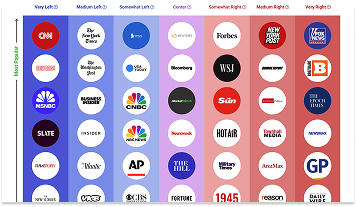
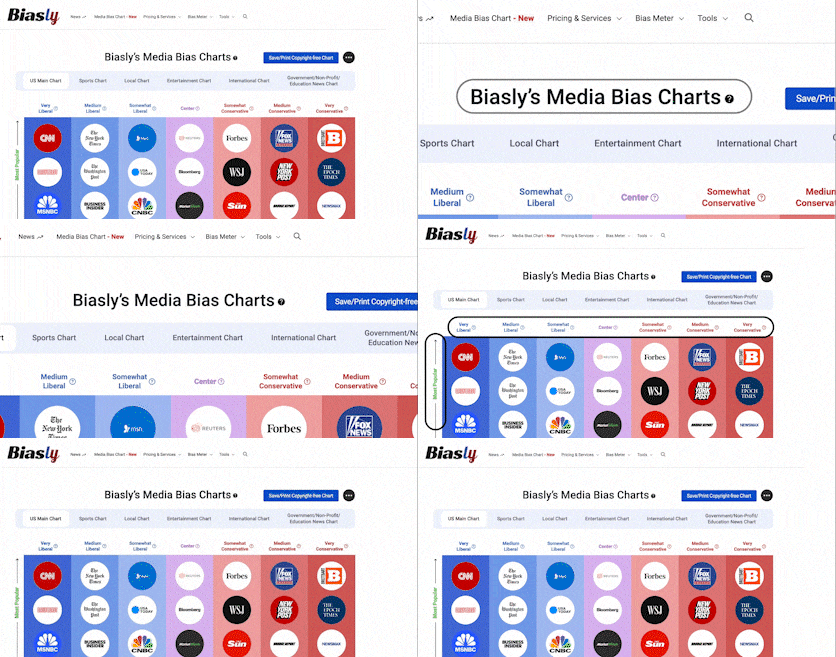
CNN on the media bias chart

- Bias Rating
-72% Very Left
- Reliability73% Reliable GoodPolicy Leanings
-24% Somewhat Left
Extremely
LiberalVery
LiberalModerately
LiberalSomewhat Liberal
Center
Somewhat Conservative
Moderately
ConservativeVery
ConservativeExtremely
Conservative-100%
Liberal100%
Conservative
Average Reliability
*Our bias meter rating uses data science including sentiment analysis, machine learning and our proprietary algorithm for determining biases in news articles. Bias scores are on a scale of -100% to 100% with higher negative scores being more liberal and higher positive scores being more conservative and 0% being neutral. The rating is an independent analysis and is not affiliated nor sponsored by the news source or any other organization.
Politician Portrayal98% negative
Continue For Free
Create your free account to see the in-depth bias analytics and more.
By creating an account, you agree to our Terms and Privacy Policy, and subscribe to email updates.
Log In
Log in to your account to see the in-depth bias analytics and more.
Analysis of CNN Articles
Analysis of Bias in CNN Online Articles
To evaluate bias, we can analyze select CNN articles through several of Biasly’s bias rating criteria: Tone, Tendency, Author, Diction, and Expediency Bias.
- Tone: The overall attitude conveyed by the article
- Diction: Specific word choices made by the writer
- Author: The background and social presence of the journalist
- Tendency: Patterns of bias in the writer’s broader body of work
- Expediency Bias: Quick visual or textual indicators like headlines and photos that imply bias
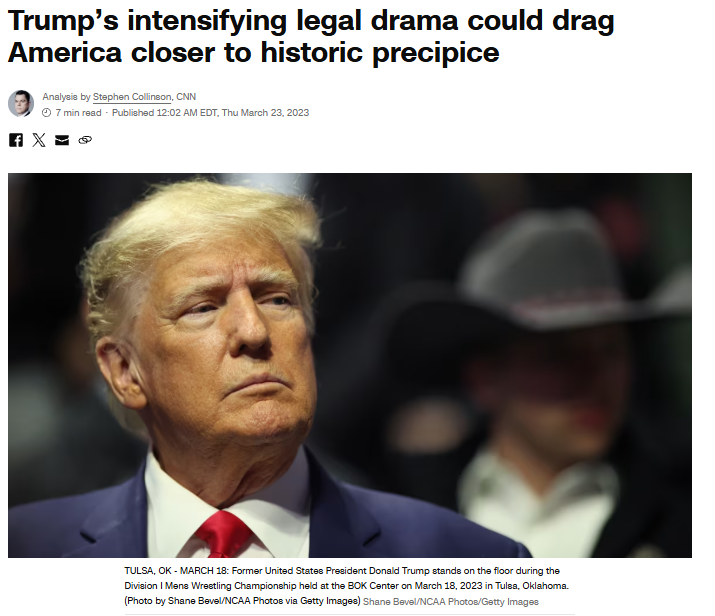
On March 23, 2023, CNN Politics posted this piece: Trump’s intensifying legal drama could drag America closer to historic precipice. The Bias Meter indicates that the article is Very Left and contains a negative portrayal. Upon closer examination of Biasly’s analysis, there appear to be 28 negative sentiments for Donald Trump, with only 2 positive sentiments to balance the negative portrayal. It is also evident from the emotionally charged words used in the title — including “drama” and “drag” — that the author sees Trump in an unfavorable light. Although the photos used are relatively neutral, the article links only to other CNN articles on the same topic with similar bias ratings.
Digging into the language of the article itself, it is evident that the author displays a consistently critical tone toward Republicans, particularly former President Trump. Take, for instance, the following passage:
“… Trump’s legal mire also may remind voters who rejected him in 2020 and some of his favored candidates in last year’s midterms why they were alienated by his chaotic leadership.”
Words like “alienated” and “chaotic” are word choices that reveal how the author feels about Trump and his administration without saying it outright, suggesting a bias against the former president. Using these words in this context may also indicate that Collinson sees the Trump administration as disloyal to its base and in a state of confusion and disorganization.
In another quote, the author states:
“A fateful national moment is brewing amid Trump’s wild rhetoric and predictions of his own arrest, a political storm whipped up by his allies, and anticipation among those who have long chafed at his flair for impunity.”
Using phrases like “wild rhetoric” and “flair for impunity,” the author seems to imply the former president’s guilt before the indictment.
The article further reveals its bias by leaning solely on quotes and analysis from CNN’s staff members, left-leaning political figures like the District Attorney of Fulton County, and liberal analysts from organizations like the Brookings Institution for providing factual information, but with bias-loaded words that favor liberal causes. While Republican Governor Ron DeSantis is quoted, his words are used to portray the former president in a negative light and illustrate Trump’s camp turning against him:
“Florida Gov. Ron DeSantis told a crowd on Monday that he doesn’t ‘know what goes into paying hush money to a porn star’ and later implied in an interview that if he won the Oval Office, he would be far more disciplined than Trump was in his riotous four years as president.”
What this article does not mention, however, is that Ron DeSantis has refused to get involved with Trump’s potential indictment in any way, according to Politico. DeSantis has been quoted as saying:
“I have no interest in getting involved in some type of manufactured circus by some Soros DA … He’s trying to do a political spectacle … I’ve got real issues I’ve got to deal with here in the state of Florida.”
This article pits DeSantis and Trump against each other while leaving out the context that DeSantis is not interested in engaging in the matter and prefers to focus on his state, not a political rivalry. The author appears to have cherry-picked quotes to further political drama and portray Trump in an unflattering light.
Overall, the body of the article makes little attempt to be politically neutral and is very left-leaning. This coincides with the Biasly analysis that CNN, as a network, tends to lean very left in its biases — but remember that this is only one article and does not reflect every piece the company produces. Bias between articles in the same network can vary, underscoring the importance of looking for the signs of bias in every article.
Beyond the tone and diction of this specific article, Stephen Collinson’s broader body of Analysis pieces for CNN also reveals a consistent tendency toward framing Donald Trump and related political developments in critically normative language and narrative arcs. For example, in another CNN analysis by Collinson, “Trump is acting like an authoritarian; California’s crisis now rests on what he does next”, the former president’s actions are described as authoritarian and a threat to political stability — framing that moves beyond simple reporting into interpretive evaluation.
Similarly, in “Trump’s following his campaign promises, but they’re threatening the rule of law”, Collinson situates Trump’s policy decisions within a broader narrative about risks to legal norms, reinforcing a pattern of portraying Trump’s conduct as problematic rather than neutrally contextualized.
Additionally, a January 2026 analysis titled “2026 is a hinge in history that will define Trump’s second term and legacy” places Trump’s second term in dramatic historical terms, suggesting high stakes and potential rupture in U.S. governance — again reflecting a judgment-laden framing.
Taken together, these articles by Collinson show a tendency to emphasize instability, constitutional risk, and negative political outcomes when covering Trump and his political environment. This pattern supports the Biasly rating’s characterization of the outlet and these analyses as leaning toward critical interpretations of conservative political figures.
This tendency is also subtly reflected in Collinson’s social media activity. While his Twitter feed is largely professional and restrained, it occasionally reinforces the same institutional and normative concerns that appear in his analysis writing. For example, Collinson reposted a Reuters statement condemning what it described as an “outrageous attack on press freedom” in Myanmar, highlighting solidarity with journalists facing state punishment for their reporting:
.@Reuters statement responding to the outrageous attack on press freedom in Myanmar that has left two esteemed colleagues sentenced to seven years in prison for doing their jobs. pic.twitter.com/4NA8roc5cB
— Jeff Mason (@jeffmason1) September 3, 2018
This repost aligns with a broader pattern in Collinson’s work of emphasizing democratic norms, press freedom, and institutional accountability—values that also underpin his critical framing of Donald Trump’s legal and political actions.
Similarly, Collinson has shared commentary from major legacy outlets like The New York Times, including a remark comparing then–UK Prime Minister Theresa May to “a really old Jeep,” a metaphor that reflects a willingness to circulate sharp political characterizations rather than purely descriptive assessments:
Theresa May is like “a really old Jeep” — @anandMenon1 in NYT pic.twitter.com/7pVNCjswfw
— Stephen Collinson (@StCollinson) October 4, 2018
While these posts do not amount to overt partisan advocacy, they complement the interpretive and judgment-laden tone seen across Collinson’s CNN analysis pieces. Taken together with his repeated framing of Trump-related developments as threats to democratic stability, Collinson’s reporting and social media presence reinforce a consistent tendency toward critical, institution-defensive narratives that align more closely with liberal or center-left political perspectives.
An example of bias being present through tone can be seen in the article “The double standard with Hunter Biden’s laptop is worse than you think.” The article states that because there was not yet an investigation into Trump’s attempts to overturn the 2020 election, the Department of Justice had a double standard, due to their ongoing investigations of liberal figures like Hunter Biden and Hillary Clinton.
Furthermore, the article focuses on emphasizing Trump’s attempts to overturn the election, while downplaying and minimizing the cases and evidence against Biden and Clinton. This suggests that the article has a left-leaning bias, as it does not aim to present a neutral or objective portrayal of the Hunter Biden case. Rather, it uses the lack of an investigation against Trump as a way to criticize the Department of Justice and thus uses this to fit a predetermined narrative of criticism.
Analysis of CNN Opinion Articles
Opinion pieces are a type of reporting that is not meant to be objective. Rather, they are designed to serve as an outlet for those who wish to present a specific viewpoint and persuade readers to their side of an issue. These types of articles, due to their subjective nature, tend to be less reliable. Still, they can often be worth reading for the sake of broadening one’s understanding of various viewpoints across the political spectrum.
A good example of reliability problems with CNN opinions is their tendency to amplify disputed or later-corrected narratives that aligned with left-leaning causes and individuals; over the years, CNN opinions have spread the Jussie Smollett false hate crime narrative, mischaracterized Joe Rogan’s use of Ivermectin, and pushed the debunked Russia Hoax. CNN’s devotion to these narratives and others has cost its reporters, anchors, pundits, and the network as a whole its reliability and ratings.
Analysis of Reliability in CNN’s Online News Articles
CNN aims to serve Americans with objective, fact-based reporting. Some CNN authors are good at being neutral by providing factual reporting, while others fall short, and as you continue to consume online articles and see how they’re rated using Biasly, you will start to see reliability indicators and become more media literate.
In the meantime, it’s essential to have a bias and reliability gauge like Biasly’s Chrome extension that can help you determine the reliability of any article and seek out the most credible and accurate news.
Quality of Sources and Facts Used
CNN frequently relies on direct quotations from lawmakers and official statements, which can strengthen factual grounding. However, reliability varies depending on how comprehensively opposing viewpoints and contextual details are presented.
In the article “Senate Democratic leaders want members to hold firm against ‘lethal’ GOP amendments on relief bill,” sourcing is narrow and ideologically concentrated, which limits the article’s overall balance and reliability. The piece contains five direct quotations, all attributed to a single Democratic lawmaker, Senate Majority Whip Dick Durbin. Each quote is medium-length and used to frame Republican amendments as procedurally dangerous or substantively harmful, without offering countervailing explanations.
The article references four distinct source categories, none of which provide a conservative or oppositional perspective. All quoted material comes from Democratic leadership, while Republicans are discussed only indirectly through characterizations made by Democratic officials. No Republican senators are quoted explaining, defending, or even identifying the amendments being described as “lethal.” Additionally, the article does not link to amendment text, reconciliation rule documents, or any external primary sources that would allow readers to independently assess the claims.
Sources cited in the article include:
- Dick Durbin, Senate Majority Whip (Democrat – Illinois) — primary source
- Unnamed Democratic Senate leadership — secondary attribution
- CNN congressional reporting and internal analysis
- References to the White House position (no direct quotations or linked documents)
From an ideological standpoint, 100% of named and quoted sources are liberal, with no conservative or neutral primary voices included. While Republican actions are central to the article’s premise, they are framed exclusively through Democratic language, such as “disruptive,” “lethal,” and “derailing,” without clarification or substantiation from opposing lawmakers. This approach places Republican proposals in a negative light while denying readers the opportunity to evaluate those proposals on their merits.
All primary sources used are valid in terms of institutional authority, but the lack of ideological diversity and absence of opposing primary sources weakens the article’s balance. By relying on Democratic leadership commentary to define Republican actions, the authors present an interpretation rather than verification. This sourcing structure contrasts sharply with more balanced reporting that allows readers to compare competing claims side by side.
Overall, while the article accurately describes the procedural mechanics of budget reconciliation, its one-sided sourcing and absence of conservative voices or primary documentation reduce its reliability and limit its usefulness for readers seeking a comprehensive understanding of the legislative dispute.
By contrast, the article “Colorado state Democrats introduce three new gun measures in response to Boulder shooting” demonstrates broader sourcing and stronger factual grounding than more narrowly framed political coverage. While the article leans left in its policy framing, it incorporates multiple perspectives and relies on a mix of political, institutional, and documentary sources to contextualize the proposed legislation.
The article contains approximately 14 direct quotations, including eight long-form quotes and six medium-length quotes. These quotations are distributed across both Democratic and Republican officials, allowing readers to compare competing interpretations of the legislation. Democratic lawmakers are quoted most frequently to explain the intent and structure of the bills, while Republican officials are given space to criticize the proposals and present alternative policy priorities.
In total, the article draws from at least eight distinct source categories. These include elected officials from both parties, executive branch statements, court rulings, law enforcement records, and state agencies. Democratic sources slightly outnumber Republican ones, reflecting the fact that Democrats authored the legislation, but conservative perspectives are clearly identified and presented without editorial dismissal. Republican critiques are quoted directly rather than paraphrased, allowing their objections to stand on their own.
Sources cited in the article include:
- Stephen Fenberg, Colorado Senate Majority Leader (Democrat) — primary source
- Rhonda Fields, Colorado State Senator (Democrat) — primary source
- Hugh McKean, Colorado House Minority Leader (Republican) — primary source
- Sage Naumann, Senate Republican spokesperson — primary source
- Colorado Bureau of Investigation — institutional source
- Colorado Department of Public Health and Environment — institutional source
- Court rulings and arrest warrant affidavits — primary documentary sources
- Statements from Governor Jared Polis (Democrat) — executive branch source
- Law enforcement sources cited by CNN
From an ideological perspective, the article features both liberal and conservative viewpoints, with Democratic sources explaining policy goals and Republican sources challenging the effectiveness and focus of the measures. While the article’s narrative structure foregrounds Democratic arguments, conservative responses are not framed negatively or dismissed. Instead, Republican concerns about mental health funding, government overreach, and resource allocation are presented as legitimate counterarguments.
Importantly, many of the article’s most consequential factual claims are supported by nonpartisan primary documentation, including court decisions, arrest records, and data from state agencies. These sources reduce reliance on political rhetoric and strengthen the article’s overall reliability.
The article relies heavily on primary and institutional sources, presents opposing political viewpoints, and avoids evaluative language when quoting critics of the legislation. Although the framing reflects a policy direction favored by Democrats, the inclusion and neutral portrayal of conservative sources contribute to a more balanced and substantiated account, supporting its higher reliability assessment.
Overall, these two examples illustrate how CNN’s reliability depends less on ideological lean and more on sourcing practices. Articles that rely heavily on a single political perspective and lack external or primary documentation tend to score lower on reliability, while those that incorporate diverse viewpoints and verifiable sources provide readers with a more complete and trustworthy picture of the issue.
Selection and Omission Bias
We can see reliability issues exemplified in the piece, “The majority of women feel relief, not regret, after an abortion, study says,” which skews facts and demonstrates one-sidedness, or selection and omission bias, negatively affecting the reliability of the article. This article is based on a study in the Journal of Social Science & Medicine, which reports that five years post-abortion, only 6% of participants expressed negative emotions. The most significant issue lies in the following excerpt:
“Researchers came to this conclusion after surveying nearly 1,000 women and following up with them 11 times over a period of five years. They surveyed women who lived in 21 states a week after they had an abortion and then again every six months thereafter.”
The article implies the study followed nearly 1,000 women for five years. In reality, about 28% dropped out by year three, meaning the long-term conclusions rely on roughly 667 participants. And because those who withdrew are no longer represented, it’s possible the dropouts included women who had more negative feelings about the experience.
There’s also a bigger representativeness issue: out of about 3,000 eligible women, researchers consistently interviewed 667 over five years, roughly 22%. That makes selection bias likely, because the women willing to participate long-term may differ meaningfully from those who declined or stopped responding.
The article also leaves out key context, including how many women dropped out and why. It focuses on participants who reported feeling okay about their decision, but does not address women who may have regretted it or experienced more negative outcomes. By excluding these limitations, the piece presents a more one-sided conclusion than the study design can fully support.
As an opinion-driven argument, this kind of selective framing can weaken reliability, especially on ideologically sensitive issues where outlet incentives may favor supportive sourcing over full context.
CNN Bias Overview
CNN claims to distribute news stories more widely than any media company in the world, with 2 billion people having access to its networks in over 200 countries. As of 2022, CNN was the United States’ third most-viewed news network behind Fox and MSNBC, and in late 2019, Pew Research found that CNN and Fox were the two most significant sources of political news among U.S. adults.
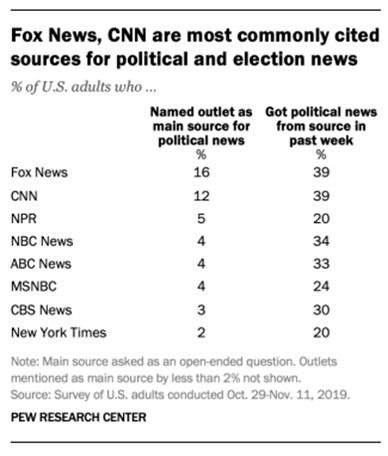
Source: Pew Research Center
Despite its staggering reach and a long-standing reputation for being a respectable media company, studies have shown that CNN’s bias has shifted over time from a more centrist position toward a consistently liberal orientation, bringing the network’s reliability into question. But how valid is this concern, and has bias weakened the strength of CNN’s reporting?
Note: The bias ratings and analyses provided in this blog post focus on the CNN website and not its TV or radio programming unless mentioned explicitly.
Is CNN Biased?
Based on Biasly’s evaluations, CNN is rated as Very Left.
By examining content patterns and the broader context of media influence, we aim to offer a balanced perspective on CNN’s political bias—and contribute to the ongoing discussion about bias in the news.
How Does Biasly Rate News Sources?
Biasly uses proprietary algorithms and a team of analysts to provide comprehensive bias evaluations across thousands of news outlets. Over 200,000 articles from more than 3,200 sources have been analyzed to identify the most accurate and unbiased stories.
Biasly assigns each outlet three key scores:
- Reliability Score – Reflects factual accuracy
- AI Bias Score – Generated via natural language processing
- Analyst Bias Score – Assessed by human political analysts
These scores are based on seven core metrics: Tone, Tendency, Diction, Author Check, Selection/Omission, Expediency Bias, and Accuracy. These elements help analysts and algorithms evaluate the political attitude conveyed by each article.
Biasly’s Bias Meter ranges from -100% (most left) to +100% (most right), with 0% indicating neutrality. The system evaluates individual articles based on political terms, policies, figures, and sentiment to calculate precise bias ratings.
Is CNN Politically Biased?
Many political conservatives tend to view CNN unfavorably, feeling that the network has a left-leaning bias and does not represent conservative viewpoints accurately or give fair coverage to conservative issues or politicians. They see CNN as prioritizing the left-leaning agenda over objective news coverage. On the other hand, most liberals feel that CNN is a reliable news source that conducts fact-checks and prioritizes progressive social issues, including racial justice, climate change, and LGBTQ rights. From an objective standpoint, is CNN biased? And if so, which side of the political spectrum does it favor?
Biasly’s A.I. Bias Score for CNN is Very Left. Biasly also gave CNN an Analyst Bias Score of Somewhat Left. Although CNN covers U.S. and world news, it tends to approach political topics from an American liberal political perspective. Praise for progressive politicians and more critical treatment of Republican figures and policies are contributing factors to these ratings. Please note that these ratings only reflect news articles published on CNN’s website; segments, live news coverage, and talk shows have not yet been considered in this analysis, but some will be covered below independently of Biasly’s bias meter scores.
According to a 2022 survey by Statista, Americans have strong feelings about CNN, with 23% of survey respondents finding the media company “very credible” and 20% feeling it to be “not at all credible.” As we continue our discussion of CNN’s news bias, we will explain why this might be the case and how it may be determined whether CNN’s website contains bias.
Before we begin, we need to discuss bias. Bias is a natural human tendency, and we can express it both consciously and unconsciously. Bias is one of the most fundamental forms of pattern recognition in humans. This is not to suggest that all reporting is equally biased, but to explain how we may come to trust certain news organizations that exhibit patterns of coverage.
The media is strongly motivated to maintain and grow its audience, gain new subscriptions, and achieve high ratings. Being unbiased is an important part of appealing to a broader audience. However, many viewers are also interested in news that aligns with their interests. This creates a reinforcement cycle that influences the selection and presentation of news stories and partly explains the behavior of more left-leaning news outlets, including CNN.
How to Evaluate Bias
Although Biasly rates CNN as Very Left, it’s important to remember that bias can vary from article to article. So, let’s learn how to evaluate media bias.
Recognizing media bias requires awareness and critical thinking. Often, readers trust news sources that affirm their existing beliefs—a psychological tendency known as confirmation bias. This makes it harder to identify slanted narratives or one-sided reporting.
To combat this, it’s essential to challenge your assumptions by consulting multiple viewpoints and verifying news through third-party analysis. Tools like Biasly’s media bias ratings allow readers to compare the same news story across the political spectrum.
Ultimately, bias isn’t always a matter of what is said; it’s also about what is left out, how topics are framed, and which stories are chosen for coverage. Learning to recognize these patterns can help readers make more informed decisions and develop greater media literacy.
To start comparing news outlets and gain a better understanding of bias, sign up for Biasly’s Media Bias & News Analytics Platform to see how stories vary between sources.
CNN Reliability Overview
Is CNN Reliable?
In 2014, CNN was the most trusted political news source over ABC, NBC, CBS, and Fox News among four in every ten adult online adults who had heard of these companies.
However, under the leadership of the previous leader, Jeff Zucker, the network’s reliability came into question as commentators started to put forth more opinions than ever before during the Trump Administration. Anderson Cooper, for example, is one of the network’s popular broadcasters and is known to have compared Trump to “an obese turtle on its back, flailing in the hot sun, realizing its time is over.” Amid this rather recent shift in tone, has CNN remained a reliable source of news, or has its opinion-style approach to the news reduced the accuracy of its reporting? Let’s find out.
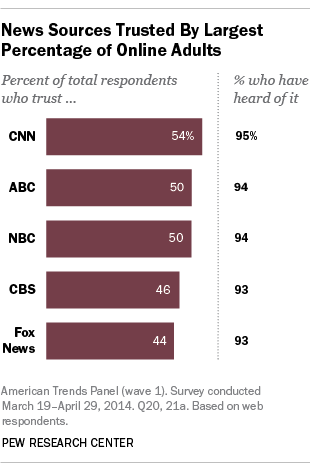
Source: Pew Research
How to Evaluate Reliability?
Reliability refers to how trustworthy or accurate a news source is. If we can’t trust what we read, then continuing to consume content from that outlet serves little purpose. So how do we evaluate a news outlet’s reliability?
There are several potential measures of reliability to look out for when trying to determine whether a media source is reliable or not. Red flags for an unreliable article can include the presence of wild, unsubstantiated claims, facts dependent on other unreliable sources, heavy use of opinionated language, and more. In contrast, hallmarks of a reliable source include:
- Absence of subjective language
- Citing credible sources (e.g., .gov, .edu, academic references)
- Verifiable facts and statistics from multiple outlets
- Use of primary sources, like interviews or transcripts
- Consistency with coverage across other platforms
Biasly’s reliability scores incorporate these elements in evaluating media outlets.
So How Does CNN Fare in Its Reliability?
The political reliability index developed by Biasly assesses both accuracy and trustworthiness. CNN currently holds Good Reliability Score, which is calculated as a weighted average of:
- Fact Analysis Score – Evaluates the accuracy of claims, facts, and evidence.
- Source Analysis Score – Assesses the number, diversity, and credibility of sources and quotes used.
CNN’s Source Analysis Score is Average at 50% Reliable. This suggests moderate trustworthiness in its sourcing practices. The score is AI-generated and considers quote length, frequency, diversity, and quality.
The Fact Analysis Score of CNN is Good at 79% Reliable. This further shows how well CNN supports its claims, addresses selection and omission bias, and presents verifiable evidence.
While CNN leans toward factual reporting, occasional lapses—such as unbalanced viewpoints or incomplete data—can affect its reliability rating. These nuances emphasize the importance of analyzing individual articles.
CNN’s Accuracy and Reliability
According to Biasly’s analysis, CNN maintains Good Reliability Score, but individual articles may vary significantly. Let’s dive into the details.
Political orientation plays a crucial role in how audiences perceive reliability. CNN has been accused of favoring a liberal narrative, potentially at the expense of factual reporting. To validate such claims, it’s essential to analyze whether the publication backs its assertions with sufficient evidence and diverse viewpoints.
Two common types of bias that affect factuality include:
- Selection Bias – Highlighting or omitting stories to fit a particular narrative.
- Omission Bias – Leaving out differing perspectives or relevant details to skew perception.
Biasly’s accuracy ratings use a scale from 1% (least accurate) to 100% (most accurate). Factors include the presence of supporting evidence, internal and external reliable sources, and balanced viewpoints.
For instance, let’s review a transcript of a CNN talk show for reliability. One of CNN’s popular primetime shows is The Lead with Jake Tapper. As of the time of writing, the most recent transcript available for this show discusses the TikTok congressional hearing, the Afghanistan withdrawal, the Supreme Court, and responses to recent commentary from political figures like Donald Trump and Kyrsten Sinema.
In the first half of the transcript, Tapper interviews the commissioner of the FCC, a Republican, about the TikTok ban. Tapper remains reasonably neutral throughout, facilitating a question/answer format without offering up much personal interpretation. He sticks to the facts as he poses his questions:
“So, in order to ban the app from the United States, Congress or President Biden would need to prove TikTok is a national security threat. Did you see any hard evidence presented that it is?”
Once his guest has answered the question, he moves on to the next question without injecting personal opinion.
However, once the subject changes to a more partisan topic, Tapper becomes more engaged and changes his approach. In the second half of his show, he interviews the National Investigative Correspondent from Politico — which has a Somewhat Left rating on Biasly — about Donald Trump’s potential impending indictment for paying hush money to an adult film actress amid the 2016 election. Here, we see Tapper become critical of Speaker Kevin McCarthy for giving the former president the benefit of the doubt after being asked about one of Trump’s social media posts. McCarthy is shown in a video clip saying,
“I mean, I think the thing that you may misinterpret… when President Trump talks, when someone says that they can protest, he would probably be referring to my tweet, to educate people about what’s going on. He’s not talking in a harmful way.”
Tapper reveals a more left-leaning approach in the tone of his response, which could be interpreted as sarcastic:
“Golly. Speaker McCarthy always takes the bright side of things when it comes to Donald Trump and interpreting. It’s really quite remarkable.”
He then starts to speculate and infuse personal analysis:
“Kevin, how did you interpret that our country is being destroyed as they tell us to be peaceful? It sounded to me, and I showed it to a law enforcement officer who was there on January 6, and he couldn’t — he wasn’t surprised, but again, shocked. He considered it to be an incitement to violence.”
As the show goes on, Tapper’s comments demonstrate selection and omission bias in that he is rushing to judgment without fully considering all the facts on both sides of the issue; according to MSN, Trump’s lawyer asserts,
“You can’t bring a case, cobble two misdemeanors together to try and make a felony and meet the statute limitations when not one misdemeanor exists. There is no crime here. There’s not even a bad act.”
Tapper’s show could reduce its bias by weighing legal insights like these from the other side of the political spectrum in addition to those from his left-leaning guests. On partisan and bipartisan issues, such as the TikTok congressional hearing, having input from multiple viewpoints is equally important.
So, is CNN Reliable?
Overall, CNN can be considered to be an outlet that is very reliable. It demonstrates a consistent goal of journalistic integrity and typically supports claims with sources and quotes. Occasional omissions and framing bias do appear, particularly on culturally sensitive or partisan issues.
As media literacy improves, readers can more easily detect issues with selection bias, omission bias, and factuality. To strengthen your ability to assess reliability across the political spectrum, use Biasly’s News Bias Checker to compare how multiple outlets report the same story.
This empowers you to consume more accurate, balanced, and dependable news.
CNN Editorial Patterns
CNN’s coverage of political topics often reflects a Very Left bias, with consistent patterns in phrasing, source selection, and thematic focus that are Very Liberal. While the publication demonstrates journalistic standards in many of its reports, the choice of issues, framing, and word usage can indicate a political slant. This content analysis examines how CNN handles liberal and conservative issues and evaluates its language choices and editorial tendencies.
Coverage of Liberal vs. Conservative Topics
CNN’s articles include political topics such as elections, government spending, and climate policy, which tend to adopt sympathetic and supportive language toward liberal perspectives. For example, their coverage of Zohran Mamdani’s election win is often framed within positive or affirmative language, suggesting a liberal bias.
On the other hand, articles covering conservative figures or Republican-led initiatives often employ a more critical tone. For example, CNN has articles dedicated to debunking and fact-checking Trump’s speeches. While fact-checking is a standard journalistic practice, the frequency and framing of such coverage may differ across outlets with different ideological leanings.
Policy and Issue Framing
When covering gender rights, specifically same-sex marriage, CNN often references inclusivity and representation, supporting movements for expanded legal protections. Similarly, coverage of environmental issues reflects an urgency consistent with climate advocacy narratives — often featuring voices from scientists, community leaders, and activists in favor of green legislation.
In contrast, when covering Trump’s foreign policy, CNN tends to take a more critical tone. These stories are often contextualized through the lens of the domestic criticisms and pushback surrounding Trump’s policies.
Even in neutral coverage, phrasing choices shape perception. Articles will describe liberal proposals as “expanding access” or “strengthening protections,” while conservative legislation may be described as “imposing limits” or “rolling back rights.” This consistent choice of words reflects an editorial direction that, even unintentionally, can contribute to bias in news media.
Coverage and Relevance
CNN’s reporting often touches on broader discussions of political media bias, including the economy, technological developments, and military conflicts. As such, it serves as a compelling case study for examining source bias and news media bias in state-focused reporting.
Readers who wish to further explore how CNN compares with other publications can visit Biasly’s Media Bias Chart to analyze tone and word choice in real time.
Funding and Ownership
Who Owns CNN?

Mark Thompson, CEO, CNN – Source: Wikimedia
CNN’s CEO is now Mark Thompson, who oversees the entirety of CNN’s business apparatus, while also serving as the editor-in-chief of CNN.
Additionally, one of the primary investors has a new vision for the media company. John Malone, CEO of Warner Bros. Discovery and CNN board member, is calling for a reinvention of the company with the goal of steering it away from its liberal bias that he says “muddles opinion and news.” He wants anchors and hosts to take a more centrist, “just the facts” standpoint.
According to Malone, “I would like to see CNN evolve back to the kind of journalism that it started with and actually have journalists, which would be unique and refreshing … Fox News, in my opinion, has followed an interesting trajectory of trying to have ‘news’ news, I mean some actual journalism, embedded in a program schedule of all opinions.”
Malone is considered a conservative/libertarian who sat on the board of the Cato Institute and is known to have donated several hundred thousand dollars to Donald Trump’s 2017 inaugural committee. Given Malone’s newly acquired influence over CNN, there may soon be a shift in the company’s bias that could significantly influence the network’s future editorial direction.
Who Funds CNN?
CNN is primarily funded through its parent company, Warner Bros. Discovery, which owns and operates the network as part of its broader portfolio of television, streaming, and digital media assets. As a subsidiary, CNN’s financial resources, budgeting, and long-term investments are ultimately tied to the parent company’s corporate strategy and performance.
The network generates revenue largely through advertising, distribution fees paid by cable and satellite providers, and digital revenue streams, including online advertising and content licensing. Like other major cable news networks, advertising remains a central funding source, meaning audience size, demographics, and advertiser preferences can indirectly influence programming priorities.
While individual executives and board members, such as John Malone, do not directly fund CNN’s day-to-day operations, their influence within Warner Bros. Discovery can shape high-level strategic decisions. These decisions may affect leadership direction, editorial emphasis, and the balance between opinion-driven programming and straight news coverage.
Overall, CNN’s funding structure aligns with that of other major corporate-owned news organizations, where commercial revenue and parent-company oversight play a significant role in shaping operational and editorial priorities.
Additional Insights
News Source Comparison
When it comes to news source comparison, CNN is often evaluated alongside other regional and national outlets that lean left or center-left. Sources like The Guardian, Los Angeles Times, or The Seattle Times often present similar tones and editorial philosophies. While CNN maintains a Very Left media bias, it differs from strongly partisan sources in that it occasionally includes opposing viewpoints and strives for regional coverage balance.
This puts it in contrast with more biased media outlets that present consistently one-sided narratives without factual counterpoints. Readers seeking balanced political coverage may compare CNN’s framing of issues with outlets rated as Center or Lean Right on our Media Bias Chart, or explore other regional papers on our Similar Sources page.
Notable Contributors and Authors
CNN features a diverse range of reporters and columnists, many of whom are deeply familiar with America’s political and social climate. Reporters like Aaron Blake frequently cover domestic and foreign political controversies and have come to symbolize CNN’s significant impact on investigative journalism.
While some contributors may be seen as leaning left in tone or topic selection, their work is generally grounded in factual reporting. The presence of recurring bylines helps readers evaluate individual journalists’ bias over time.
Related Tools and Resource Pages
To better understand how CNN fits into the broader media landscape, we recommend exploring these helpful resources:
- Media Bias Chart: See where CNN ranks among hundreds of media outlets across the political spectrum.
- Political Bias Chart: Visualize political slants of news sources across various policy areas.
- Journalist Bias Analytics Platform: Explore how individual journalists contribute to bias within their publications.
- Politician Bias Analytics Platform: Compare how politicians are framed differently by CNN and other outlets.
- Media Literacy Education Platform: Learn how to critically assess media sources, bias techniques, and news reliability.
Frequently Asked Questions
CNN is rated as Very Left based on Biasly’s media bias algorithm, which assesses sentiment, article framing, and policy favorability.
While CNN is not widely known for promoting fake news, some articles have shown selection and omission bias, especially in political reporting. Its factual reporting is generally sound. For example, CNN has received criticism of severe bias against Trump in their coverage of the 2016 and 2020 elections.
Biasly uses a combination of AI sentiment analysis and human analyst review to assess tone, fact accuracy, source quality, and media bias indicators. Learn more on our Bias Meter page.
Generally, yes, though partisan framing and selective reporting can affect perceived reliability.
Military Spending
| Date | Sentiment | Associated Article | Snippet |
|---|---|---|---|
| 08/25/2019 | 75% For | Trump Family Detentions Flores Agreement (link) | So, of course, the Trump administration is doing the opposite in a baldfaced |