




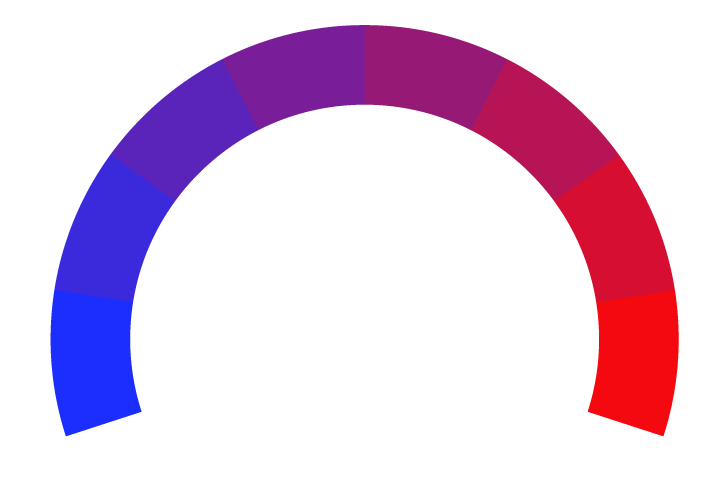
-6% Center
Bias Meter
Extremely
Liberal
Very
Liberal
Somewhat Liberal
Center
Somewhat Conservative
Very
Conservative
Extremely
Conservative
-100%
Liberal
100%
Conservative
Biasly determines media bias ratings through a dual-layered approach combining artificial intelligence and analyst review. The platform’s proprietary bias detection engine, Bias Meter, evaluates sentiment, policy position alignment, and language framing across thousands of data points in news articles. Analysts then verify and interpret the AI’s findings, providing additional context where needed. Learn more about ratings
- Profile
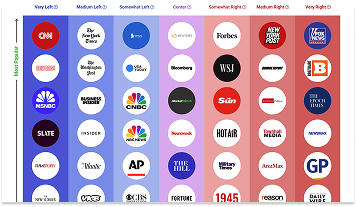
CTV News on the media bias chart
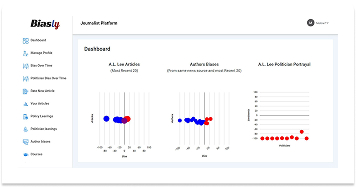
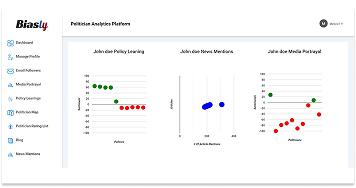

- Bias Rating
-6% Center
- Reliability39% Reliable AveragePolicy Leanings
4% Center
Extremely
LiberalVery
LiberalModerately
LiberalSomewhat Liberal
Center
Somewhat Conservative
Moderately
ConservativeVery
ConservativeExtremely
Conservative-100%
Liberal100%
Conservative
Average Reliability
*Our bias meter rating uses data science including sentiment analysis, machine learning and our proprietary algorithm for determining biases in news articles. Bias scores are on a scale of -100% to 100% with higher negative scores being more liberal and higher positive scores being more conservative and 0% being neutral. The rating is an independent analysis and is not affiliated nor sponsored by the news source or any other organization.
Politician Portrayal52% negative
Continue For Free
Create your free account to see the in-depth bias analytics and more.
By creating an account, you agree to our Terms and Privacy Policy, and subscribe to email updates.
Log In
Log in to your account to see the in-depth bias analytics and more.
Analysis of CTV News Articles
Analysis of Bias in CTV News Online Articles
CTV News uses in-depth coverage of Canada to drive subscriptions. Given that much of its readership is Canada-based, where regional issues often take precedence, it’s essential to ask: is CTV News truly biased?
To evaluate this, we can analyze select CTV News articles through several of Biasly’s bias rating criteria: Tone, Tendency, Author, Diction, and Expediency Bias.
- Tone: The overall attitude conveyed by the article
- Diction: Specific word choices made by the writer
- Author: The background and social presence of the journalist
- Tendency: Patterns of bias in the writer’s broader body of work
- Expediency Bias: Quick visual or textual indicators like headlines and photos that imply bias

In “Half of Americans Against Canadian Tariffs, Preferring to Keep CUSMA Intact: Survey Finds,” the article presents a largely balanced, low-bias account of public opinion on tariffs between the United States and Canada, with a title and image above that convey neutral positioning and low expediency bias. Its neutrality is achieved through careful reliance on data, restrained language, and the inclusion of broader context rather than opinion-driven framing.
One of the clearest indicators of low bias is the article’s foundation in survey data rather than commentary. By centering its claims on polling results such as the finding that roughly half of Americans oppose Canadian tariffs, the article avoids speculation and instead grounds its narrative in measurable public opinion. This approach limits the influence of the writer’s personal perspective and allows readers to interpret the findings independently. Similar polling from other organizations suggests that Americans are divided or skeptical about tariff policies, reinforcing that this is a data-driven issue rather than a selectively framed one.
“More than half of Americans disapprove of Trump’s tariff policies (57 per cent), nearly double the rate of approval (30 per cent).”
The language used throughout is also notably neutral. The article does not rely on emotionally charged or persuasive wording when describing policies associated with Donald Trump or the Canadian response. Instead of portraying tariffs as inherently good or bad, it presents them as a subject of public debate. This restraint helps prevent the article from leaning toward either a pro- or anti-tariff stance.
Another sign of minimal bias is the inclusion of a broader geopolitical and economic context. The article situates the survey within ongoing trade tensions and the framework of CUSMA, helping readers understand why the issue matters without pushing a specific conclusion. External reporting shows that these tensions have had measurable impacts on public opinion and international relations, including declining perceptions of the U.S. in Canada and shifting views on trade partnerships. By aligning with these wider trends, the article reinforces its credibility.
Importantly, the article avoids presenting only one side of the issue. While it highlights opposition to tariffs, it does not ignore the differences of views or the complexity of trade policy. This balanced presentation ensures that readers are informed about the issue without being steered toward a particular judgment.
The author, Anam Khan, shows little bias on social media. Most of her posts are articles she or her peers wrote.
Trade agreements come with rules. Here’s what Canada can and cannot do https://t.co/kvC2nnAPax
— anam khan (@17anam) February 9, 2026
Overall, the article demonstrates a lack of bias through its reliance on empirical evidence, neutral tone, and contextual framing. Rather than advocating for a position, it informs readers about public sentiment and the state of U.S.–Canada trade relations, allowing them to form their own conclusions based on the information provided.
However, not all of the CTV News articles are unbiased. In “With Trudeau’s Liberals in trouble, is Mark Carney the answer?,” We see some conservative bias creep in. The article frames former Prime Minister Justin Trudeau’s policy as a failure. On top of that, he also paints Mark Carney as the possible answer. Although Trudeau and Carney are both Liberals, Carney is more fiscally conservative than Trudeau. The author, Brennan MacDonald, tends to show conservative bias. MacDonald has a private X, formerly known as Twitter.
In summary, CTV News shows inconsistent bias in its reporting.
Analysis of CTV News Opinion Articles
To fully understand political bias in media, it’s important to distinguish between factual reporting and opinion pieces. While reporting aims to present facts and let readers form their own conclusions, opinion articles express personal viewpoints on current issues. Although the previous section examined factual reporting, this section turns to how bias surfaces through CTV News’s selection and tone of opinion content.
In “Only God can make a tree, but a bad budget can destroy it”, written by Tom Mulcair, we see a clear Left-leaning bias, largely due to its authorship, framing, and argumentative style. While published on a mainstream news platform, it is important to recognize that this piece is an opinion column rather than a neutral news report.
One of the strongest indicators of left-wing bias is the author’s perspective. Mulcair is a former leader of Canada’s New Democratic Party (NDP), a political party generally associated with progressive and social-democratic policies. Tom Mulcair has historically supported policies such as stronger social programs and limits on corporate tax cuts, reflecting a left-of-center economic philosophy. This ideological background shapes the article’s interpretation of government budgeting decisions.
The article’s framing of the federal budget is another key sign of bias. It characterizes the budget in strongly negative terms, arguing that it fails future generations and undermines sustainable development. For example, the budget is described as the “exact opposite” of what was promised, signaling a clear evaluative stance rather than a neutral assessment. This kind of language is persuasive and opinion-driven, guiding readers toward a critical view rather than presenting multiple interpretations.
Additionally, the column emphasizes themes commonly associated with left-wing critique, such as long-term environmental responsibility, intergenerational equity, and skepticism of economic decisions that may prioritize fiscal goals over social outcomes. By focusing on how policy affects future generations and public welfare, the article aligns with progressive priorities while giving less attention to potential conservative arguments, such as fiscal restraint, economic growth, or deficit reduction.
Another sign of bias is the lack of counterbalancing viewpoints. The article does not meaningfully engage with perspectives that might defend the budget or explain the government’s rationale. Instead, it presents a largely one-sided critique, reinforcing the author’s position without offering readers a full spectrum of debate.
Finally, the rhetorical style, which is illustrated by the metaphor in the title, adds an emotional and moral dimension to the argument. Comparing a budget’s impact to the destruction of something as natural and valuable as a tree frames the issue in a way that appeals to readers’ values rather than strictly to empirical analysis. This technique is effective for persuasion but contributes to ideological slant.
The article exhibits left-wing bias through its authorship, its critical framing of economic policy, its focus on progressive themes, and its absence of opposing viewpoints. While this does not diminish its value as commentary, it does mean the piece is best understood as an opinion reflecting a particular political perspective rather than an objective news report.
In “Carney’s major projects come with major opportunities and risks”, the CTV News opinion article by James Moore displays a noticeable conservative bias through its framing, priorities, and underlying assumptions about economic policy and government action. While it presents itself as a balanced discussion of risks and opportunities, the perspective is rooted in traditionally conservative viewpoints on development, regulation, and economic growth.
A key indicator of conservative bias is the author’s background. Moore is a former Conservative cabinet minister, and his political history shapes the lens through which he evaluates Prime Minister Mark Carney’s policies. His commentary tends to emphasize market-driven growth, private investment, and the importance of large-scale infrastructure, which are positions commonly associated with conservative economic ideology.
The article’s framing of “major projects” reflects this orientation. It highlights the economic potential of resource extraction, infrastructure expansion, and nation-building projects, aligning with a pro-development stance often favored by conservatives. Broader policy discussions around such projects in Canada frequently emphasize competitiveness, reducing reliance on foreign markets, and accelerating approvals.
Although the article acknowledges “risks,” these are largely framed in terms of execution challenges such as regulatory delays, investor uncertainty, or government inefficiency rather than environmental or social concerns. This selective emphasis suggests a bias toward viewing economic growth as the primary objective, with less attention given to critiques commonly raised by more progressive perspectives, such as environmental protection or Indigenous rights.
Another sign of conservative bias is the implicit critique of government processes. The article suggests that bureaucratic hurdles and unclear policy frameworks could undermine the success of major projects, echoing a common conservative argument that government overreach can stifle economic development. By focusing on the need for efficiency, clarity, and investment-friendly conditions, it reinforces a preference for streamlined regulation and reduced state intervention.
Additionally, the article gives limited space to opposing viewpoints. While it briefly acknowledges potential downsides, it does not engage in depth with arguments against large-scale development, such as environmental risks or long-term sustainability concerns. This imbalance contributes to a one-sided narrative that favors economic expansion over a more holistic policy debate.
The tone of the piece is also pragmatic and business-oriented, emphasizing opportunity, competitiveness, and national economic strength. This reflects a conservative rhetorical style that prioritizes growth and strategic advantage rather than social critique or redistributive concerns.
In conclusion, the article demonstrates conservative bias through its pro-development framing, emphasis on economic growth and efficiency, limited engagement with opposing perspectives, and the author’s ideological background. While it includes some acknowledgment of risks, its overall perspective aligns closely with conservative economic principles and policy priorities.
These examples show that while not all CTV News opinion pieces are overtly biased, the platform frequently publishes opinion content that allows contributors to present perspective-driven viewpoints.
Analysis of Reliability in CTV News’s Online News Articles
CTV News aims to serve Canadians with objective, fact-based reporting. Its staff includes writers from varying ideological backgrounds, which can help balance coverage. However, readers should distinguish between news reporting and opinion pieces to evaluate credibility effectively.
One article that has good reliability is “Truth Tracker: No, Justin Trudeau isn’t converting from Christianity to Islam.” This story debunked a misinformation campaign that Prime Minister Justin Trudeau was converting from Christianity to Islam. The article explains the context of the story, such as how it originated on a website that intentionally publishes satirical fake news stories. It also explains how supporters of President Trump helped spread the story. Overall, readers are left with a clear explanation of why this story is fake and how it spread.
Another article with good reliability is “Doug Ford’s chief of staff resigns one day after appointment controversy.” The article uses original reporting, along with reporting from other publications like The Globe, The Daily Mail, and The Canadian Press, to tell the full story of why the Chief of Staff resigned. The article also directly quotes Ontario Premier (the American equivalent of a governor) Doug Ford and a member of the Ontario Parliament named Matt Stiles. The combination of original reporting by their own reporters and other reliable publications, along with original quotes from major political figures in Ontario, makes the article reliable.
Quality of Sources and Facts Used
CTV News often uses credible sources from across the political spectrum. However, some articles lean too heavily toward how comprehensively they present opposing viewpoints.
The article “As World Cup Nears, Toronto Mayor Moves To Block U.S. ICE Presence” is structured as a local policy report centered on Toronto Mayor Olivia Chow’s motion opposing any role for U.S. Immigration and Customs Enforcement during the 2026 FIFA World Cup. The piece is not written as an argument-driven opinion article, but the framing does place Chow’s concerns about fear, safety, and immigrant communities near the top. This gives the article a slightly sympathetic tone toward the mayor’s position, though it also includes jurisdictional context from Global Affairs Canada and notes the Vancouver precedent, which helps moderate the framing.
The article contains 5 direct quotes in quotation marks: “create fear” (2 words), “Toronto should be a place where everyone feels welcome and safe” (11 words), “Residents and visitors should be able to enjoy our city without fear” (11 words), “Any presence of U.S. Immigration and Customs Enforcement in Toronto is liable to create fear during a time when we want to welcome the world and ensure that everyone feels safe” (29 words), and “City Council should be clear… No ICE in Toronto” (8 words). The shortest quote is 2 words, the longest is 29 words, and the average quote length is about 12.2 words. Most quotes come from Chow’s motion, meaning the quoted material is heavily weighted toward one side of the debate. Longer quotes help preserve her reasoning and reduce the risk of cherry-picked phrasing, but because there are no direct quotes from ICE, federal public safety officials, Toronto police, or critics of the motion, the article’s quoted-word share is clearly dominated by Chow’s framing.
On linked sources, the article appears to use 1 distinct linked source in the body: a related article about the Vancouver council motion being ruled out of order. By left/center/right: Left = 0, Center = 1, Right = 0. The linked-source footprint is small and mainly provides procedural background rather than ideological contrast. There are references to Global Affairs Canada and ICE’s Toronto office, but based on the pasted text, these are not clearly presented as separate hyperlinks. As a result, the article relies more on official statements and local political framing than on a broad, linked evidence base.
Sources referenced in the article include:
- Jermaine Wilson, article author/reporter
- Toronto Mayor Olivia Chow
- Paul Ainslie
- Toronto City Council
- S. Immigration and Customs Enforcement
- Global Affairs Canada
- Canadian federal authorities
- Federal minister of public safety
- Federal minister of foreign affairs
- Ontario solicitor general
- Toronto Police Service Board
- Vancouver City Council / Vancouver council chair
The sourcing is somewhat lopsided in terms of direct voice. Olivia Chow’s position dominates the article through multiple direct quotes and the story’s central framing. Other institutional sources, such as Global Affairs Canada and the Vancouver council precedent, provide useful legal and procedural context but do not serve as direct counterarguments. ICE is discussed as the subject of the motion, but is not quoted, and no opposing city councilor, law enforcement representative, federal official, or event security planner is given space to respond. This makes the article source-balanced in a basic institutional sense, but not fully viewpoint-balanced.
In how sources are used, Chow sets the moral and emotional frame through language about safety, fear, and welcoming the world. Global Affairs Canada is used more neutrally to explain jurisdictional limits and sovereignty rules, which helps prevent the article from becoming purely advocacy-oriented. However, skepticism is mostly directed toward ICE’s potential presence, not toward the assumptions behind the motion itself. Because the article gives limited scrutiny to whether ICE involvement is likely, necessary, or legally possible, the operating bias reads closest to Somewhat Left: the article is factual and restrained, but its quoted material and framing lean toward immigrant-protection and anti-ICE concerns.
On factual accuracy, the broad context appears generally sound: Toronto is a 2026 World Cup host city, Olivia Chow is Toronto’s mayor, ICE has international offices, and foreign law enforcement activity in Canada would be subject to Canadian approval. The article also accurately uses the Vancouver precedent to show that similar motions may face procedural or jurisdictional limits. Where the article is less complete is in clarifying whether ICE had actually sought an operational role in Toronto or whether the motion is preemptive. Without that detail, the factual reporting is mostly reliable, but the framing may make the threat of ICE involvement feel more immediate than the evidence provided clearly establishes.
In “7-year-old Canadian, mom detained by ICE last weekend: stepfather.” The story incorporates multiple types of sources, which strengthens its credibility. This includes family members, a legal expert, and a Global Affairs Canada spokesperson. The use of Kurland, the legal expert, is particularly important. Unlike family members, he is not directly involved in the case, so his commentary functions as a form of independent verification/context.
The article explicitly notes that reporters reached out to ICE but did not receive a response. In journalism, attempted contact is often the best possible outcome when officials decline to comment. This actually strengthens the article’s neutrality rather than weakening it.
The father is only indirectly quoted. The lack of direct quotes can make the article feel detached. In a human interest story, it’s common practice to directly quote most of the important figures in the story.
Even with better sourcing, there are still some constraints. The family still dominates the narrative. Compared to the earlier article, this one demonstrates stronger journalistic sourcing practices. Because of that, it reads as more credible and responsibly reported, even if it still leans slightly toward the family’s perspective due to the nature of the story.
Selection and Omission Bias
CTV News provides extensive coverage of Canada’s leaders. However, bias may still emerge through framing and story selection.
In “Ontario premier says electric vehicle mandates putting jobs at risk, urges Quebec, B.C. to scrap policies,” The article demonstrates clear examples of both selection bias and omission bias, which together shape how readers interpret the issue.
The most noticeable feature of the article is its heavy reliance on Ontario Premier Doug Ford’s viewpoint. This creates a narrative centered on one political actor. While this is common in political reporting, the selection of sources appears narrow. Based on coverage of the same announcement, Ford emphasizes that EV mandates “threaten the livelihoods of tens of thousands of workers” and harm competitiveness.
When this perspective dominates the article, it elevates one interpretation of the issue, economic risk, over others. There is limited indication that equally strong opposing voices are included. As a result, the article’s sourcing leans toward reinforcing Ford’s argument rather than testing it.
Equally important is what the article leaves out. EV mandates are a complex policy issue involving climate goals, economic transitions, and technological change. However, the article appears to omit arguments in favor of EV mandates.
Other reporting on the same issue notes that EV policies are tied to national targets for zero-emission vehicles and broader climate strategies. By not including this context, the article narrows the debate to jobs vs. mandates, rather than presenting the full policy trade-offs. This omission limits the reader’s ability to critically evaluate the central claim.
Together, these biases shape the article into a single-frame narrative. While the article is not necessarily inaccurate, the combination of selective sourcing and missing perspectives reduces its neutrality. A more balanced piece would include a wider range of voices and explicitly address competing evidence, allowing readers to see the full scope of the debate rather than one dominant viewpoint.
In “New Canada-Mexico deal creates new market for P.E.I. potato growers,” the article shows relatively strong sourcing compared to more political pieces, but it still reflects selection and omission bias in how the story is framed.
The article primarily selects sources that highlight the benefits of the new trade deal. All of these sources share a common perspective: they stand to benefit from expanded access to the Mexican market. This creates a consistently optimistic narrative, where the deal is framed as an opportunity for growth and expansion. Even when this is factually accurate, the selection of mostly pro-industry voices limits the range of interpretation. As a result, the article leans toward a promotional tone, even if unintentionally.
What’s missing is just as important as what’s included. The deal is described mainly as “creating a potential new market” for Canadian potatoes, but without discussion of trade-offs, risks, or opposing stakeholders. This narrows the issue to a single dimension, which is economic opportunity, while excluding other relevant considerations. Another form of omission is the lack of scrutiny toward the deal itself. Without this, the article functions more as an announcement than an analysis.
The combination of selecting mainly supportive, industry-aligned sources and omitting broader or critical perspectives results in a story that feels one-sided, even if it is factually correct. Readers come away with the impression that the deal is clearly beneficial, without being exposed to the complexities that typically accompany international trade agreements.
CTV News Bias Overview
Founded in 1961 by John Bassett and Joel Aldred, CTV News emerged as part of the newly created CTV Television Network. The idea was to create a private, commercial alternative to the public Canadian Broadcasting Corporation (CBC). CTV News is headquartered in Toronto, Ontario, and covers a wide range of topics, including national and international news, politics, business, entertainment, sports, and lifestyle content.
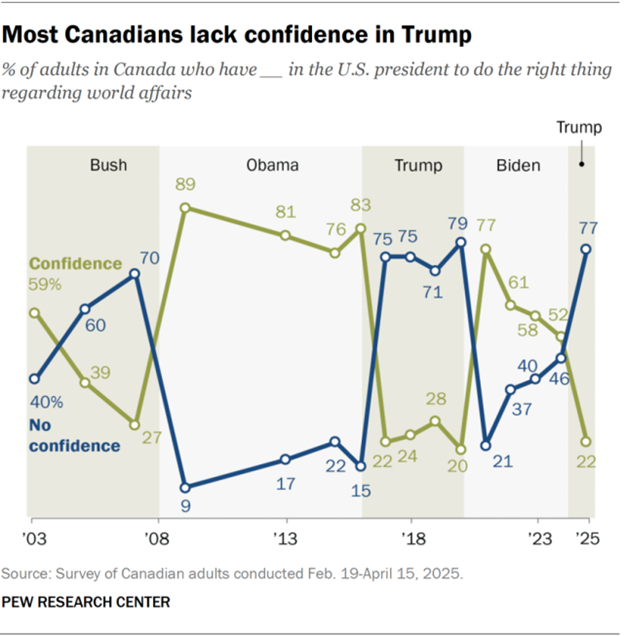
Source: Pew Research
CTV News made history in 1962 when it became the first North American broadcaster to use a communications satellite for a live TV broadcast, transmitting a program from London, England to Andover, Maine, which was then sent to Canadian viewers.
Is CTV News Biased?
Based on Biasly’s evaluations, CTV News is rated as Center.
By examining content patterns and the broader context of media influence, we aim to offer a balanced perspective on CTV News’s political bias—and contribute to the ongoing discussion about bias in the news.
How Does Biasly Rate News Sources?
Biasly uses proprietary algorithms and a team of analysts to provide comprehensive bias evaluations across thousands of news outlets. Over 200,000 articles from more than 3,200 sources have been analyzed to identify the most accurate and unbiased stories.
Biasly assigns each outlet three key scores:
- Reliability Score – Reflects factual accuracy
- AI Bias Score – Generated via natural language processing
- Analyst Bias Score – Assessed by human political analysts
These scores are based on seven core metrics: Tone, Tendency, Diction, Author Check, Selection/Omission, Expediency Bias, and Accuracy. These elements help analysts and algorithms evaluate the political attitude conveyed by each article.
Biasly’s Bias Meter ranges from -100% (most left) to +100% (most right), with 0% indicating neutrality. The system evaluates individual articles based on political terms, policies, figures, and sentiment to calculate precise bias ratings.
Is CTV News Politically Biased?
CTV News earns a Center rating for its AI Bias Score and a Center for its Analyst Bias Score. The Analyst Bias Score is generated by reviewers from liberal, moderate, and conservative backgrounds. Analysts reviewed CTV News articles and noted no preferences in areas like coverage.
This Bias score is determined through natural language processing that evaluates the tone, word choice, and opinion embedded in the reporting.
How to Evaluate Bias
Although Biasly rates CTV News as Center, it’s important to remember that bias can vary from article to article. This complexity underscores the importance of examining each article individually. So, let’s learn how to evaluate media bias.
Recognizing media bias requires awareness and critical thinking. Often, readers trust news sources that affirm their existing beliefs, which is a psychological tendency known as confirmation bias. This makes it harder to identify slanted narratives or one-sided reporting.
To address this, it’s essential to challenge your assumptions by consulting multiple perspectives and verifying information through third-party analysis. Tools like Biasly’s media bias ratings allow readers to compare the same news story across the political spectrum.
Ultimately, bias isn’t always a matter of what is said; it’s also about what is left out, how topics are framed, and which stories are chosen for coverage. Learning to recognize these patterns can help readers make more informed decisions and develop greater media literacy.
To start comparing news outlets and gain a better understanding of bias, sign up for Biasly’s Media Bias & News Analytics Platform to see how stories vary between sources.
CTV News Reliability Overview
Is CTV News Reliable?
CTV News finds itself toward the middle of the spectrum, with neither high nor low accuracy. Its status as a local news outlet contributes to its moderate reputation for reliability.
This suggests that CTV News’s popularity among Canadians may not stem from the reliability of its political news coverage. Further investigation is needed to determine whether bias or other factors are affecting its accuracy. At Biasly, we specialize in evaluating not just bias but also the reliability of media outlets. Let’s explore the accuracy and trustworthiness of CTV News.
How to Evaluate Reliability?
Reliability refers to how trustworthy or accurate a news source is. If we can’t trust what we read, then continuing to consume content from that outlet serves little purpose. So how do we evaluate a news outlet’s reliability?
There are several key indicators of reliability to consider when assessing a media source. Red flags of an unreliable article can include wild, unsubstantiated claims, facts that depend on other unreliable sources, heavy use of opinionated language, and more. In contrast, hallmarks of a reliable source include:
- Absence of subjective language
- Citing credible sources (e.g., .gov, .edu, academic references)
- Verifiable facts and statistics from multiple outlets
- Use of primary sources, like interviews or transcripts
- Consistency with coverage across other platforms
Biasly’s reliability scores incorporate these elements in evaluating media outlets.
So How Does CTV News Fare in Its Reliability?
The political reliability index developed by Biasly assesses both accuracy and trustworthiness. CTV News currently holds Average Reliability Score, which is calculated as a weighted average of:
- Fact Analysis Score – Evaluates the accuracy of claims, facts, and evidence.
- Source Analysis Score – Assesses the number, diversity, and credibility of sources and quotes used.
CTV News’s Source Analysis Score is Average at 39% Reliable. This suggests moderate trustworthiness in its sourcing practices. The score is AI-generated and considers quote length, frequency, diversity, and quality.
The Fact Analysis Score of CTV News is Pending at N/A. This further shows how well CTV News supports its claims, addresses selection and omission bias, and presents verifiable evidence.
While CTV News leans toward factual reporting, occasional lapses such as unbalanced viewpoints or incomplete data can affect its reliability rating. These nuances emphasize the importance of analyzing individual articles.
CTV News’s Accuracy and Reliability
According to Biasly’s analysis, CTV News maintains Average Reliability Score, but individual articles may vary significantly. Let’s dive into the details.
Political orientation plays a crucial role in how audiences perceive reliability. CTV News has been accused of favoring a liberal narrative, potentially at the expense of factual reporting. To validate such claims, it’s essential to analyze whether the publication backs its assertions with sufficient evidence and diverse viewpoints.
Two common types of bias that affect factuality include:
- Selection Bias – Highlighting or omitting stories to fit a particular narrative.
- Omission Bias – Leaving out differing perspectives or relevant details to skew perception.
Biasly’s accuracy ratings use a scale from 1% (least accurate) to 100% (most accurate). Factors include supporting evidence, reliable internal and external sources, and balanced viewpoints.
For example, according to Biasly, Military Times receives an “average” reliability rating, meaning it is moderately trustworthy but not consistently fully reliable. This rating suggests that readers can generally trust the outlet’s reporting, but should still approach some articles with caution. One reason for this middle-level reliability is the quality of sourcing.
Biasly notes that Military Times often uses credible sources, quotes, and factual information, which are key indicators of a reliable publication. However, the reliability score also reflects that sourcing is not always consistent across all articles, and some pieces may rely on less diverse or less balanced sources.
We will take a closer look at more examples like this below to provide a further investigation into the reliability of CTV News’s articles. This will include its use of selection bias, omission bias, and the quality of its sources and the facts it uses.
So, is CTV News Reliable?
Overall, CTV News can be considered an outlet with moderately reliability. The site often prioritizes opinion-driven content, with variable sourcing and occasional editorial framing on sensitive international topics. While some claims are supported with evidence, consistency in sourcing and balance could be improved to meet stronger journalistic standards.
As media literacy improves, readers can more easily detect issues with selection bias, omission bias, and factuality. To strengthen your ability to assess reliability across the political spectrum, use Biasly’s News Bias Checker to compare how multiple outlets report the same story.
This empowers you to consume more accurate, balanced, and dependable news.
CTV News Editorial Patterns
CTV News’s coverage of political topics often reflects a Center bias, with consistent patterns in phrasing, source selection, and thematic focus that are Neutral. The choice of issues, framing, and word usage doesn’t indicate a political slant. This content analysis examines how CTV News handles liberal and conservative issues and evaluates its language choices and editorial tendencies.
Coverage of Liberal vs. Conservative Topics
CTV News offers extensive coverage of Canada. They cover many issues that are at the forefront of Canadian political discussion.
Toronto is their main focus. They have a specialized channel called CP24 that covers breaking news in Toronto. They have a partnership with Bloomberg News in which the two publications work together to create business-centered news for Canadians. According to Biasly, Bloomberg is generally considered more of a centrist source.
Policy and Issue Framing
CTV News covers almost every mainstream political issue with no bias. Abortion, criminal justice, and the European Union are some of CTV News’s most covered topics. Although CTV News focuses on Canada, they covered the United States and European nations extensively as well.
Coverage and Relevance
CTV News’s reporting often touches on key issues central to Canadian political discussion, such as abortion, criminal justice, and foreign policy. As such, it serves as a compelling case study for examining source bias and news media bias in state-focused reporting.
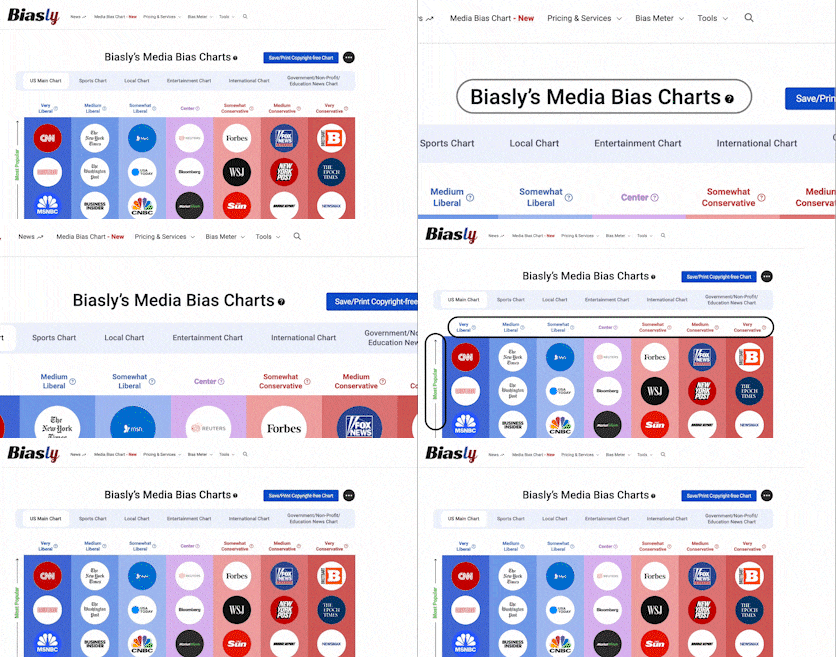
Readers who wish to further explore how CTV News compares with other publications can visit Biasly’s Media Bias Chart to analyze tone and word choice in real time.
Funding and Ownership
Who Owns CTV News?

Bell Media, Source: Wikimedia Commons
Before 2000, CTV News was independently owned. In 2000, CTV News was partially acquired by Bell Canada Enterprises. In 2011, a subsidiary of BCE called Bell Media was formed. This company took 100% control of CTV News.
Who Funds CTV News?
CTV News primarily makes money through TV ads. They also make money from cable and satellite providers who pay to broadcast CTV News. Online, they put ads before their videos. Although traditional pop-up ads are uncommon for CTV News, they are occasionally used.
Additional Insights
News Source Comparison
When comparing news sources, CTV News is often evaluated alongside other regional outlets. Sources like ABC 7 New York, News Channel 8, and Mass Live often present similar tones and editorial philosophies. While CTV News maintains a Center media bias, it differs from strongly partisan sources in that it occasionally includes opposing viewpoints and strives for a balanced regional coverage.
This contrasts with more biased media outlets that consistently present one-sided narratives without factual counterpoints. Readers seeking balanced political coverage may compare CTV News’s framing of issues with outlets rated as Center or Lean Right on our Media Bias Chart, or explore other regional papers on our Similar Sources page.
Notable Contributors and Authors
CTV News features a diverse range of reporters and columnists, many of whom are deeply familiar with Canada’s political and social climate.
Omar Sachedina is currently a news anchor and senior editor for CTV News. He went to McGill University in Montreal, Canada, before attending Columbia University in New York City for his master’s degree. CTV News hired him right out of college as a parliamentary correspondent. In 2022, he was promoted to his current role.
Avery Haines is currently a host and managing editor for CTV News. She attended Ryerson University in Toronto, Canada. She got her career started in 1989 as a News Anchor and Reporter for CFRB 1010 AM. She was hired by CTV News in 2017. She is one of the top investigative reporters for CTV News.
Related Tools and Resource Pages
To better understand how CTV News fits into the broader media landscape, we recommend exploring these helpful resources:
- Media Bias Chart: See where CTV News ranks among hundreds of media outlets across the political spectrum.
- Political Bias Chart: Visualize political slants of news sources across various policy areas.
- Journalist Bias Analytics Platform: Explore how individual journalists contribute to bias within their publications.
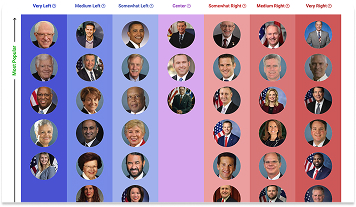
- Politician Bias Analytics Platform: Compare how politicians are framed differently by CTV News and other outlets.
- Media Literacy Education Platform: Learn how to critically assess media sources, bias techniques, and news reliability.
Frequently Asked Questions
CTV News is rated as Center based on Biasly’s media bias algorithm, which assesses sentiment, article framing, and policy favorability.
In 2024, CTV News aired a fake video of Conservative leader Pierre Poilievre. This video used audio splicing, the practice of combining several real clips to create a fake clip that sounds authentic. The audio made it sound as though he was discussing the Liberals’ dental plan, but he never gave a public speech on the topic. CTV News apologized for this video and fired the two editors responsible.
Biasly uses a combination of AI sentiment analysis and human analyst review to assess tone, fact accuracy, source quality, and media bias indicators. Learn more on our Bias Meter page.
Generally, yes, though partisan framing and selective reporting can affect perceived reliability.
Military Spending
| Date | Sentiment | Associated Article | Snippet |
|---|---|---|---|
| 08/25/2019 | 75% For | Trump Family Detentions Flores Agreement (link) | So, of course, the Trump administration is doing the opposite in a baldfaced |