




10% Center
Bias Meter
Extremely
Liberal
Very
Liberal
Somewhat Liberal
Center
Somewhat Conservative
Very
Conservative
Extremely
Conservative
-100%
Liberal
100%
Conservative
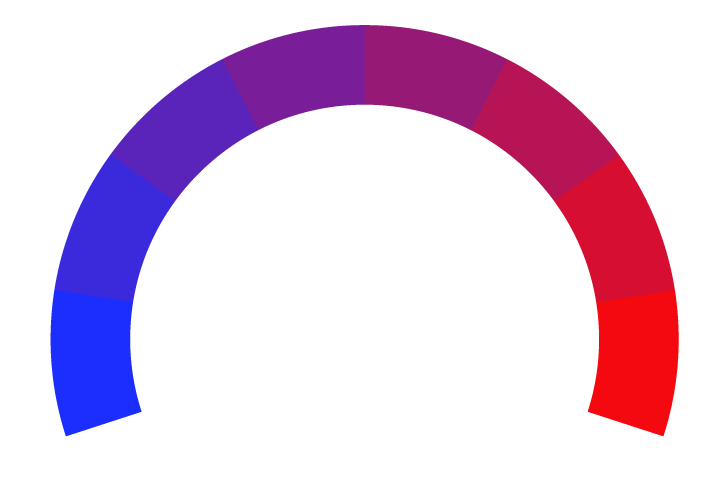
Biasly determines media bias ratings through a dual-layered approach combining artificial intelligence and analyst review. The platform’s proprietary bias detection engine, Bias Meter, evaluates sentiment, policy position alignment, and language framing across thousands of data points in news articles. Analysts then verify and interpret the AI’s findings, providing additional context where needed. Learn more about ratings
- Profile
RealClearPolitics on the media bias chart

- Bias Rating
10% Center
- Reliability53% Reliable AveragePolicy Leanings
14% Somewhat Right
Extremely
LiberalVery
LiberalModerately
LiberalSomewhat Liberal
Center
Somewhat Conservative
Moderately
ConservativeVery
ConservativeExtremely
Conservative-100%
Liberal100%
Conservative
Average Reliability
*Our bias meter rating uses data science including sentiment analysis, machine learning and our proprietary algorithm for determining biases in news articles. Bias scores are on a scale of -100% to 100% with higher negative scores being more liberal and higher positive scores being more conservative and 0% being neutral. The rating is an independent analysis and is not affiliated nor sponsored by the news source or any other organization.
Politician Portrayal25% negative
Continue For Free
Create your free account to see the in-depth bias analytics and more.
By creating an account, you agree to our Terms and Privacy Policy, and subscribe to email updates.
Log In
Log in to your account to see the in-depth bias analytics and more.
Analysis of RealClearPolitics Articles
Analysis of Bias in RealClearPolitics Online Articles
Earlier, we noted limited data on RealClearPolitics demographics, but this allows us to test whether its audience shows conservative bias.
Common bias metrics include tone, author background, diction, tendency, and expediency bias, which we will analyze below.
- Tone reflects the writer’s attitude
- Diction refers to the writer’s word choice
- Author evaluates the writer’s stance based on past articles and social media posts
- Tendency: Established patterns of bias in an author’s writing
- Expediency Bias: Bias shown in sections like headlines or photographs that skew the story

The first article we’ll examine is entitled “Photos of Migrant Detention Highlights Biden’s Border Secrecy”. Biasly has rated this article 14% on the Bias Meter, or “Somewhat Conservative”. This rating reflects a tone suggesting frustration with Joe Biden’s administration and its perceived lack of transparency. Before we discuss the article’s tone, the headline exemplifies expediency bias. Because the headline uses the keyword “secrecy,” the story is framed from a right-leaning perspective rather than as a fact-based one. The image also shows that the immigrants are sleeping with blankets, as what appears outside.
The tone of the article is made clear from the first sentence when the author states:
“President Joe Biden’s administration has tried for weeks to keep the public from seeing images like those released Monday of immigrant children in U.S. custody at the border sleeping on mats under foil blankets, separated in groups by plastic partitions.”
The opening tone criticizes the Biden administration’s border handling, though the author remains neutral and lets sources speak. For example:
“The newly published photos released by Cuellar’s office show groups of children crowded together inside the partitions. Some appear to be watching television while others are lying on floor mats, some side by side. Children are shown wearing surgical masks, but are close to each other.”
The article’s diction is anything but extreme. Throughout the article, the authors present facts objectively without inserting their own opinions. The strongest diction used is:
“Several of those visits revealed troubling conditions inside, including the detention of large numbers of children as young as 5 separated from their parents.”
Overall, the authors remain objective, suggesting the bias mainly reflects a centered article framing.
Authors Nomaan Merchant, Jonathan Lemire, and Josh Boak show little bias and maintain strong records of journalistic integrity. Furthermore, their Twitter profiles (linked above) display an array of ideological viewpoints and minimal partisanship. Examples of tweets are shown below.
The White House press corps in Nantucket saved a seat and our thoughts for @evangershkovich at our Thanksgiving table tonight. #IStandWithEvan https://t.co/LhDoH900Ak pic.twitter.com/bYJBtmDGa7
— Seung Min Kim (@seungminkim) November 24, 2023
Nearly 21 million children in the U.S. and its territories are expected to receive food benefits this summer through a newly permanent federal program, the United States Department of Agriculture announced Wednesday. https://t.co/DblaTA9xtT
— Josh Boak (@joshboak) January 10, 2024
Overall, the authors convey frustration with the Biden administration’s handling of the border and its perceived lack of transparency with the press. However, the article maintains strong journalistic standards and remains objective by drawing on multiple sources and viewpoints. This shows that although RealClearPolitics has a conservative bias, many articles follow journalistic standards and qualify as quality reporting.
Although this article shows little bias, bias can vary between articles and authors within the same organization. This highlights the importance of identifying bias indicators such as tone, tendency, diction, and author background.
Here is another analysis article from RealClearPolitics that displays little bias, “Will Rioting Sway the Election Picture”. Bialsy rated the article Medium Right. The article compares the 2020 election with historical examples, including the 1948 race between Harry Truman and Thomas E. Dewey. The article also discusses various election theories, such as:
“an old theory that political scientists call “retrospective voting.” The idea is pretty straightforward: When voters go into the voting booth, they aren’t making a choice between two candidates. Instead, they’re mostly passing judgment on the incumbent candidate’s performance.”
The Medium Right rating reflects focus on changes benefiting Donald Trump, though the analysis remains grounded in historical examples. RealClearPolitics publishes diverse political coverage, so article quality can vary across its website.
Analysis of RealClearPolitics Opinion Articles
Before we jump into opinion articles, it is important to distinguish between opinion and reporting. Reporting aims to present facts and primary-source quotes, while opinion pieces allow columnists to express personal views. Although earlier analysis included factual reporting, RealClearPolitics opinion pieces often prioritize advancing the author’s argument over presenting facts.
Consider the opinion article, “Biden Border Policy: Criminals Welcome.” The title uses strong, biased diction implying Biden welcomes criminals to cross the southern border. Throughout the article, the author omits sources or viewpoints that would support Biden’s border policy while attacking the potential ramifications. One example states,
“Immigration advocacy had moved from shielding otherwise law-abiding undocumented immigrants to protecting undocumented immigrants with criminal records. It’s happening again under Biden. That’s not policy; it’s recklessness.”
Framing the position with this language and using an emotionally provocative word like reckless proves this piece is demonstrably bias. Omission bias, strong tone, and the title suggest the author does not aim for balanced reporting.
In contrast, “The Problem With Ideological Purity in Congress” uses a neutral title that signals discussion rather than provoking partisanship. Reliable articles, like this one, are marked by neutral language and facts from credible sources. Based on the title alone, it is safe to assume that this article is less biased than the previous one.
One quote that demonstrates the neutrality of this article states,
“In sum, for both parties, purity is fatal for solving problems and sustaining majorities.”
This statement highlights the points in the article, which are not aimed at one party but at both of them equally. The author’s supporting arguments are not framed from a biased stance, and the reporting covers the story thoroughly. These examples represent limited content but show the outlet mixes opinion and reporting, highlighting the need to distinguish subjective writing.
Analysis of Reliability in RealClearPolitics’s Online News Articles
Opinion-style journalism is a vehicle for reporters to express their beliefs, even if excessive opinion should be avoided. Although opinion pieces are less trustworthy because they are subjective, they can still be worthwhile to read to increase one’s understanding of various political viewpoints.
RealClearPolitics opinion articles have caused issues in the past with their reliability because they tended to promote conservative ideologies and individuals. For example, RealClearPolitics was embroiled in controversy after the 2020 election because of their resistance to admitting Trump’s electoral defeat.
The article “New Peer-Reviewed Research Finds Evidence of 2020 Voter Fraud” is advertised as ‘commentary’ but looks more like an opinion piece with an intense conservative bias. RealClearPolitics’s commitment to pro-Trump coverage superseded their desire to accurately and objectively report the news, likely in an attempt to appeal to their majority conservative viewership.
Quality of Sources and Facts Used
RealClearPolitics can be good at using reliable sources from both sides of the ideological divide and citing facts as evidence; however, the quality of journalism varies from article to article. Consider, “Dems in Tough Elections Ignore Pelosi’s Push to Tout BBB.” In this article by Susan Crabtree, there are only six quotes. Of the six quotes, two are short, three are medium-length, and one is long.
In addition, the author’s four sources for the article are:
- Leaked phone call between Representative Pelosi and Democratic donors
- CNBC/Change Research Survey
- Quote from former White House Press Secretary Jen Psaki
- Selected tweets from Democratic politicians
The quality of sources used is average. The leaked phone call and survey are high-quality sources; however, the tweets from Democratic representatives (some of which are almost a decade old) and out-of-context quotes from the press secretary are not as reliable.
Furthermore, most of the quotes used are not statistical facts but rather opinions from Democratic politicians, which allow the author to further her argument. The article does address Democrats’ strategy to sell the Build Back Better bill to the American people, but with the underlying assumption that the legislation is flawed. The article’s opening sentence demonstrates the author’s combative tone:
“As congressional Democrats struggle to breathe new life into their stalled legislative agenda…”
The article does use some quality sources; however, the author shows a conservative bias from the first sentence to the last. Therefore, the article relies on average-quality sources and lacks evidence-based reporting.
The author, Susan Crabtree, could have improved the quality of her article by using more original sources and grappling with the effects of the proposed (now-passed) Build Back Better Bill. However, despite its conservative undertones, most of the article’s sources are from CNBC, which Biasly considers somewhat liberal.
The only conservative reference the author cites is from the Daily Mail. The latter discusses Nancy Pelosi’s calls for the Democratic Party to brag more to donors about President Biden’s achievements while avoiding the word “transformative” when describing Build Back Better. Specifically, in Pelosi’s words:
“So, this is transformative. But people tell me not to use the word ‘transformative.’ Just say it lowers costs. It lowers costs for health care — costs for families across America; it lowers the cost of child care; it enables so much more to happen. So, we’re very, very proud of the legislation. Now we just have to get it passed.”
The author’s language implies that Pelosi is refraining from overselling the accomplishments of Biden due to rising inflation and economic troubles among the American people:
“The new CNBC poll, which showed Biden with a 56% disapproval rating — the worst of his presidency — also revealed deep concerns over the spike in inflation since he took office. Nearly three-fourths of those polled disapprove of his handling of “kitchen table issues,” and 89% of voters labeled the price of everyday goods as “poor” or “not so good,” the survey found.
Independents, who delivered the election for Biden, gave him a “D” across the board on economic issues, with most voters blaming the rising prices of goods on his policies and government spending.” As for its other sources, the article links to mailchimp.com, but it no longer works. Additionally, this link from rev.com doesn’t take a partisan approach in its content. Instead, it’s merely a transcript from a 2022 press conference with White House Press Secretary Jen Psaki.
Another RealClearPolitics article, “New Peer-Reviewed Research Finds Evidence of 2020 Voter Fraud,” relies on claims later rejected in federal court. The author cites polling showing 52% believe cheating affected the 2020 election, thereby presenting opinion as evidence of wrongdoing.
A Hoover Institution review argues that many statistical claims of voter fraud rely on inaccurate facts or on unsurprising patterns. The U.S. judicial system reached the same conclusion, declaring in over 60 court cases, some of which were presided over by Republican judges, that the 2020 election was legitimate and that Joe Biden was the true winner of the race.
Furthermore, the Harvard Kennedy School’s Misinformation Review highlights a significant partisan divide in beliefs about the election outcome. Their study found that most Trump voters believed it was more likely that Trump would win than Biden, despite a lack of evidence of voter fraud and Biden securing an electoral vote victory.
On top of all of this, Ken Block, a voter data expert hired by the Trump campaign to find voter fraud in the election, penned an op-ed stating unequivocally that the 2020 presidential election was not fraudulent and that there was no evidence of voter fraud sufficient to change its outcomeof the election.
The author posits the result of his “forthcoming [research] in a peer-reviewed economics journal” before its publication, which flies in the face of the scientific method. Specifically, this research originates from a study by John Lott Jr., an economist and president of the Crime Prevention Research Center. According to his findings, there were approximately 255,000 “excess votes” for President Joe Biden in six key battleground states during the 2020 election, possibly as many as 368,000.
Lott’s research focused on ballot counts in states where former Trump alleged voter fraud. The study’s fundamental assertion is that these excess votes may explain Biden’s margin of victory over Trump. The states in question are Arizona, Georgia, Michigan, Nevada, Pennsylvania, and Wisconsin, with Biden’s total margin being 313,253 votes. Excluding Michigan, the gap was supposedly 159,065 votes.
Lott used three primary methods in his study:
- He compared precincts in a county with alleged fraud to adjacent precincts in neighboring counties with no fraud allegations. For example, he found a significant unexplained gap in absentee ballot counts in Fulton County, Georgia, compared to 2016.
- He analyzed provisional ballots in Allegheny County, Pennsylvania, where voters were allegedly allowed to correct defects in absentee ballots by submitting provisional ballots on Election Day. This method suggested an additional 6,700 votes for Biden in Allegheny County alone.
- He examined areas with unusually high turnouts, noting that Democratic-leaning counties had lower turnouts in 2020, except for counties with alleged vote fraud. In these counties, there was a significant increase in turnout.
Nevertheless, Lott clarified that he did not intend his report to contest the 2020 election. Instead, he wanted to highlight issues that need attention to enhance public confidence in future elections (e.g., changes to voter identification, absentee voting, and provisional ballots).
It’s important to note that while this study raises questions and presents findings that suggest discrepancies, it does not conclusively prove widespread voter fraud. The legitimacy of the study’s methodology and conclusions can be subject to further scrutiny and debate among the academic community and election experts. As with any single study, it’s critical to consider it within the broader context of electoral research and analysis.
Selection and Omission Bias
In another example from RealClearPolitics, we can see the author’s disdain for the Build Back Better Bill (which was being considered by Congress at the time). This article, “The Progressive Logic of Build Back Better — and Its Dangers,” by Charles Lipson, focuses on what he perceives as the negative impacts of the bill and the dangers associated with progressivism. The author does not use quotes from either side of the political spectrum; instead, he conveys the progressive movement’s history since FDR and the New Deal.
The article exhibits selection and omission biases in its discussion of the Build Back Better plan and broader progressive politics. Lipson primarily focuses on the perceived risks and drawbacks of the plan, emphasizing its potential to transform the United States into a social welfare state akin to those in Europe. This perspective is underscored by a significant critique of progressive politics, tracing its history and arguing that it tends to override traditional governing procedures. For instance, Lipson states:
“Enacting these massive, new entitlements is one reason the House bill is rightly called ‘progressive.’ The second, equally important reason is that nearly all Democrats, except Manchin and his Arizona colleague Kyrsten Sinema, are willing to break the Senate’s longstanding rules and procedures to achieve their desired outcome.”
This quote exemplifies the selection bias in the article, highlighting certain aspects of the legislation and the Democratic Party’s approach, potentially at the expense of discussing its benefits or the reasons behind its support. Furthermore, the article presents a limited range of perspectives, mainly critiquing the progressive movement and its methods.
More broadly, there must be better counter-arguments or defenses of the Build Back Better plan or progressive politics. This omission creates an unbalanced view, leaning towards a critique of the progressive agenda. Historical examples and discussions on constitutional interpretations further support this viewpoint, possibly omitting other perspectives or interpretations that might offer a different understanding. Thus, while providing a detailed analysis of the progressive elements of the Build Back Better plan, the article does so with a noticeable selection and omission bias.
In the article we discussed earlier, “Dems in Tough Elections Ignore Pelosi’s Push to Tout BBB,” the author selects quotes from Democratic leaders that she can use as fodder to disagree with and further her argument against the Build Back Better bill.
The selection of quotes does not imply a liberal bias – it simply gives the author something to disagree with. On the other hand, the author omits any information/opinion(s) that would indicate a positive effect of the Build Back Better Bill. The use of the CNBC Change Research survey is a reputable source backed by the scientific process.
Nevertheless, the author selectively emphasizes aspects of the bill and related political maneuvers that align with a critical or opposing viewpoint. This approach is evident in the choice of quotes and data. For instance, the article highlights House Speaker Nancy Pelosi’s strategy on the bill, as illustrated by this quote:
“As congressional Democrats struggle to breathe new life into their stalled legislative agenda, House Speaker Nancy Pelosi earlier this week told “VIP” donors on a leaked private phone call that all party members need to brag about the House-passed version of the Build Back Better bill even as she cautioned her colleagues not to describe the multitrillion-dollar spending measure’s impact as too sweeping.”
This focus on Pelosi’s cautious promotion strategy, combined with the selective presentation of poll data emphasizing public concerns about the economy and inflation, paints a picture of internal party disagreements and public skepticism.
In addition, the article spotlights the reluctance of some Democrats in competitive races to publicly endorse the bill, further supporting a narrative of uncertainty and lack of confidence in the bill’s merits. The selective use of quotes and data, particularly from reputable sources like the CNBC Change Research survey, reinforces an argument critical of the BBB bill while omitting more positive aspects or supportive opinions. The overall reliability of this article is poor because of the omission of contradictory viewpoints and the calculated selection of quotes and statistics.
In opinion pieces, issues with factuality, sources, selection, and omission are frequently present. The articles we’ve covered are biased and exclude adequate, relevant background information that may contradict the author’s position. As a news organization with a conservative slant and funding, RealClearPolitics has minimal incentive to stop appealing to its majority conservative readership. Now that we have enumerated typical trustworthiness indications, you may stay current by informing yourself on the most accurate news.
RealClearPolitics Bias Overview
In 2000, John McIntyre and Tom Bevan founded RealClearPolitics with the vision, “to create an online clearinghouse tailored to consumers of news and information on U.S. politics, policy, and elections.”
Today, RealClearPolitics is renowned for its polling averages, which are frequently cited by trusted cable and digital news organizations. Because there is no information about RealClearPolitics’s viewers’ partisanship, we will rely on Similarweb’s audience demographic data.
RealClearPolitics’s audience is about 70% male, and 50% are older than fifty-five. Pew Research Center’s ‘Trends in Party Affiliation’ demonstrates a 12-point gender gap and a widening generational divide between registered voters, which insinuates RealClearPolitics audience has a slight conservative lean. Supporting our hypothesis is Similarweb’s data that ‘other visited websites’ by RealClearPolitics viewers include Breitbart, Fox News, Politico, the Drudge Report, and FiveThirtyEight – most of which have a conservative bias or appeal to political enthusiasts.
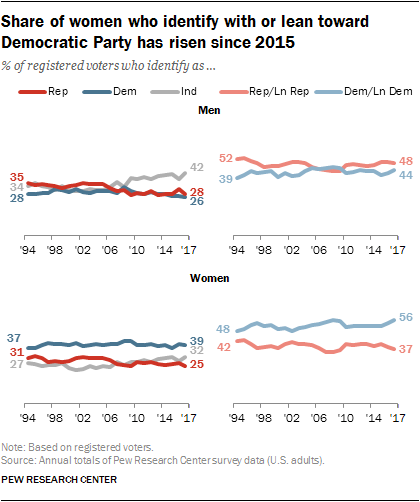
Source: Pew Research
Throughout the rest of this article, we will analyze RealClearPolitics coverage and editorial decisions to determine if there is a discernible political bias in their reporting. Through our analysis, we hope to provide a comprehensive answer to whether RealClearPolitics is biased and shed light on the factors that contribute to media bias.
Is RealClearPolitics Biased?
Based on Biasly’s evaluations, RealClearPolitics is rated as Center.
By examining content patterns and the broader context of media influence, we aim to offer a balanced perspective on RealClearPolitics’s political bias—and contribute to the ongoing discussion about bias in the news.
How Does Biasly Rate News Sources?
Biasly uses proprietary algorithms and a team of analysts to provide comprehensive bias evaluations across thousands of news outlets. Over 200,000 articles from more than 3,200 sources have been analyzed to identify the most accurate and unbiased stories.
Biasly assigns each outlet three key scores:
- Reliability Score – Reflects factual accuracy
- AI Bias Score – Generated via natural language processing
- Analyst Bias Score – Assessed by human political analysts
These scores are based on seven core metrics: Tone, Tendency, Diction, Author Check, Selection/Omission, Expediency Bias, and Accuracy. These elements help analysts and algorithms evaluate the political attitude conveyed by each article.
Biasly’s Bias Meter ranges from -100% (most left) to +100% (most right), with 0% indicating neutrality. The system evaluates individual articles based on political terms, policies, figures, and sentiment to calculate precise bias ratings.
Is RealClearPolitics Politically Biased?
RealClearPolitics earns a Center rating for its AI Bias Score and a Medium Right for its Analyst Bias Score. The Analyst Bias Score is generated by reviewers from liberal, moderate, and conservative backgrounds. Biasly’s rating is based on two scores: an AI-generated score and a human analyst score. Biasly rated RealClearPolitics with a source bias score of ‘Center’ and an analyst bias score of %_SOURCE_ANST_BIAS_RATING_%, which means, overall, it provides political coverage from a rather conservative political perspective.
Analyst scores use about 15 articles, each reviewed by liberal, moderate, and conservative analysts. The more articles rated by Biasly’s analyst team for a particular source, the more accurate the analyst score. Praise for conservative politicians and policies, as well as disdain toward Democratic policies and politicians, contribute to this rating. Biasly’s scores mostly align with determinations by other third-party bias research agencies.
Since the 2016 election, RealClearPolitics has faced criticism for being biased in favor of conservative causes. The source faced criticism for its election coverage and editorial decisions following the 2020 presidential election. Furthermore, RealClearPolitics published an article in 2019 that identified the whistleblower who led to Trump’s impeachment. The case pertained to a secret call between Trump and the Ukrainian president that the whistleblower reported. Facebook, Fox News, and others refused to publish an article naming the whistleblower for concerns about their safety.
Readers may have strong opinions of RealClearPolitics because it tends to favor conservative causes and figures. This is represented by Biasly’s “Somewhat Conservative” rating. This article explains how to identify bias so you can separate opinions from facts and become a more informed reader.
Before we begin, we need to discuss bias. Bias is a natural function of humans, and we can express it both consciously and subconsciously. Bias is one of the most fundamental forms of pattern recognition in humans. This does not claim everything is biased, but it explains why we may trust news organizations showing consistent coverage patterns.
On the media’s part, there is an incentive to retain audiences, encourage them to purchase subscriptions, and rate products positively. Bias works both ways: audiences want preferred stories, and media organizations need viewers to sustain operations. This creates a positive feedback loop that influences what stories are covered and from what perspective. This explains the actions of many news organizations.
How to Evaluate Bias
Although Biasly rates RealClearPolitics as Center, it’s important to remember that bias can vary from article to article. RealClearPolitics also covers a conservative-leaning state with objectivity on many issues, from state legislation to social developments. This complexity underscores the importance of examining each article individually. So, let’s learn how to evaluate media bias.
Recognizing media bias requires awareness and critical thinking. Often, readers trust news sources that affirm their existing beliefs—a psychological tendency known as confirmation bias. This makes it harder to identify slanted narratives or one-sided reporting.
To combat this, it’s essential to challenge your assumptions by consulting multiple viewpoints and verifying news through third-party analysis. Tools like Biasly’s media bias ratings allow readers to compare the same news story across the political spectrum.
Ultimately, bias isn’t always a matter of what is said—it’s also about what is left out, how topics are framed, and which stories are chosen for coverage. Learning to recognize these patterns can help readers make more informed decisions and develop greater media literacy.
To start comparing news outlets and gain a better understanding of bias, sign up for Biasly’s Media Bias & News Analytics Platform to see how stories vary between sources.
RealClearPolitics Reliability Overview
Is RealClearPolitics Reliable?
Biasly labels RealClearPolitics’s reliability as Average, with good scores for citing multiple quotes and sources in its articles. This source occasionally lapses in reliability and must be examined on a per-article basis, as some articles tend to sympathize with conservative viewpoints. Although this right-leaning slant became more prevalent after 2016, the source can still produce articles that use fact-based reporting. It is important to analyze the reliability of each article independently for this source and use Biasly’s techniques to identify reliability.
How to Evaluate Reliability?
Reliability refers to how trustworthy or accurate a news source is. If we can’t trust what we read, then continuing to consume content from that outlet serves little purpose. So how do we evaluate a news outlet’s reliability?
There are several potential measures of reliability to look out for when trying to determine whether a media source is reliable or not. Red flags for an unreliable article can include the presence of wild, unsubstantiated claims, facts dependent on other unreliable sources, heavy use of opinionated language, and more. In contrast, hallmarks of a reliable source include:
- Absence of subjective language
- Citing credible sources (e.g., .gov, .edu, academic references)
- Verifiable facts and statistics from multiple outlets
- Use of primary sources, like interviews or transcripts
- Consistency with coverage across other platforms
Biasly’s reliability scores incorporate these elements in evaluating media outlets.
So, How Does RealClearPolitics Fare in Its Reliability?
The political reliability index developed by Biasly assesses both accuracy and trustworthiness. RealClearPolitics currently holds Average Reliability Score, which is calculated as a weighted average of:
- Fact Analysis Score – Evaluates the accuracy of claims, facts, and evidence.
- Source Analysis Score – Assesses the number, diversity, and credibility of sources and quotes used.
RealClearPolitics’s Source Analysis Score is Average at 40% Reliable. This suggests readers can trust some of the sources, links, and quotes provided by the news source. This score, which is based on A.I., focuses on assessing the quality of sources and quotes used, including their number, length, uniqueness, and diversity.
The Fact Analysis Score of RealClearPolitics is Average at 57% Reliable. The Fact Analysis score focuses more on the accuracy of claims, facts, and sources presented in the article and any hints of selection and omission bias, which we will discuss further in the article.
The political reliability index developed by Biasly objectively assesses news organizations’ accuracy and trustworthiness. RealClearPolitics’s overall Reliability Score has been rated as ‘Average’ by Biasly. This rating is a weighted average of two distinct scores: the Fact Analysis Score and the Source Analysis Score, each evaluating separate components of RealClearPolitics’s Reliability. When computing the Average Reliability of the article, the Fact Analysis score is given greater weight.
However, since these scores are based on percentages and averages, individual articles could be more or less trustworthy depending on the context, author, and other factors. Our findings show that RealClearPolitics’s reliability is mostly but not all factual because they have retracted several stories in the past or had pieces that were not factual.
Let us analyze the supporting data for RealClearPolitics’s rankings and discuss what to watch out for while searching for trustworthy news sources.
RealClearPolitics’s Accuracy and Reliability
According to Biasly’s analysis, RealClearPolitics maintains Average Reliability Score, but individual articles may vary significantly. Let’s dive into the details.
The credibility of news organizations is impacted significantly by bias and political orientation. Like numerous other media organizations, RealClearPolitics has occasionally received accusations of prioritizing the conservative agenda over facts. We can evaluate the integrity of RealClearPolitics news stories and deduce how well the publication supports assertions with evidence. We will check for selection and omission bias as we assess the articles’ correctness and factuality.
Selection bias occurs when stories or facts are chosen or ignored to support a source’s ideology. Omission bias occurs when opposing opinions are excluded, exposing readers only to the ideological perspective favored by the author. It’s essential to keep in mind these two types of biases when trying to assess an article’s level of accuracy.
Biasly assigns a percentage score for accuracy, with 1 being the least accurate and 100 the most accurate. Ratings consider supporting evidence, reliable internal sources, and credible external sources. A full page at Biasly’s website includes dependability and accuracy ratings for newly released RealClearPolitics news stories. As we previously stated, Biasly’s analysts generally rate RealClearPolitics as 57% reliable.
Reliability scores vary across articles, often due to bias, particularly omission and selection bias. Consider ABC News, which has a somewhat liberal bias and is 78% reliable, according to Biasly. For example, one article scored 85% reliability, while another on Georgia voting laws scored only 42%. With this in mind, readers must carefully examine sources for reliability since it is not uniform from article to article.
For example, the RealClearPolitics article “RCP Takeaway; Weaponized Filibuster? Omicron Onslaught” is rated Somewhat Right. Regarding selection and omission bias, the author relies on summaries instead of primary-source quotes in this briefing article. The author links to outside sources, but their selection and reliability are notably weak. To demonstrate:
“Are adults who’ve received their booster shots at far less risk of hospitalization or death? Everyone from medical policy experts to frontline healthcare workers insists that this is so, and the early data apparently backs it up. All I can say is that we should all pray that this is true and that this trend holds.”
The author cites Alex Berenson to support vaccine skepticism, though Berenson has been criticized for spreading questionable information. The author also cites a bitterly partisan Fox News article about AOC testing positive for COVID-19. Using fewer partisan sources or including balanced perspectives would have made the article less biased and more reliable. Therefore, this article is less reliable than it could be.
So, is RealClearPolitics Reliable?
Overall, RealClearPolitics can be considered to be an outlet that is moderately reliable. RealClearPolitics is a semi-reliable news source/aggregator with a mediocre reputation for journalistic integrity. Critically, reliability fluctuates from article to article, so it is essential to consider each article’s reliability independently of others. The more you research media reliability and accuracy, the simpler it will be for you to spot problems with sources, selection, omission, and factuality. To help with this, you can use Biasly’s News Bias Checker to uncover reliability problems and assist you in finding the most accurate.
As media literacy improves, readers can more easily detect issues with selection bias, omission bias, and factuality. To strengthen your ability to assess reliability across the political spectrum, use Biasly’s News Bias Checker to compare how multiple outlets report the same story.
This empowers you to consume more accurate, balanced, and dependable news.
RealClearPolitics Editorial Patterns
RealClearPolitics’s coverage of political topics often reflects a Center bias, with consistent patterns in phrasing, source selection, and thematic focus that are Neutral. This source occasionally uses emotionally charged language with a rightward slant and is not always considered reliable. This content analysis will cover the specifics of RealClearPolitics’s articles and how they interpret topics across the political spectrum.
Coverage of Liberal vs. Conservative Topics
As discussed, this source is often sympathetic to right-leaning viewpoints, meaning conservative topics are supported more than liberal ones. For example, RealClearPolitics’s articles are more likely to support Donald Trump over Joe Biden. One commentary by Bruce Abramson proclaimed Trump would “restore traditions” to the benefit of our allies, while another article is titled, “Biden Border Policy: Criminals Welcome.”
This platform discusses various topics, including science, history, energy, and breaking political stories. Many of these topics do not contain the same level of bias found in political news stories from this organization. When discussing political topics, the conservative bias is more present, although some subjects are rated as being center-leaning.
Media bias can present itself in different ways, as mentioned above; slight language preferences can reveal certain agendas. Using emotive language in headlines presents the story in one way and thus declares the article’s bias, diminishing its credibility.
Policy and Issue Framing
When covering the border and immigration, this source slants right, as shown in “Despite Trump’s Success, Immigration Isn’t ‘Solved.'” The article labels Donald Trump’s immigration policy as corrective and the previous Democratic administration’s as “brazenly” breaking the law. This refers to specific executive measures taken by Donald Trump to remove undocumented residents from the country. Articles of this nature by RealClearPolitics appear dissatisfied with the Democrats’ recent handling of immigration. Trump’s policies, on the other hand, even though occasionally critiqued by the publication, are presented more positively.
This source also occasionally discusses climate change with a disdainful tone, referencing the “climate industrial complex.” Although this is cited in a source, the label aligns with right-leaning beliefs about climate change. Conversely, liberal viewpoints tend to affirm climate change policies, which do not often occur in RealClearPolitics’s articles.
Using polls and public opinion data to argue against liberal perspectives, this source sometimes equates liberal views with fringe perspectives. Some publications prefer sources supporting right-leaning interpretations of institutions, especially when covering climate change and immigration policies.
Coverage and Relevance
RealClearPolitics’s articles cover a vast array of topics and global interest stories, even including a “Books and Culture” section. Within the sphere of politics, this source covers nearly every area from elections to active political investigations. The articles do not shy away from any topic, including discussions from social justice to finance.
Readers who wish to further explore how RealClearPolitics compares with other publications can visit Biasly’s Media Bias Chart to analyze tone and word choice in real time.
Funding and Ownership

Ted Bevan, Co-founder and Executive Editor, Source: Wikimedia Commons
RealClearPolitics is owned by RealClearInvestors and Crest Media since they bought out Forbes Media LLC’s 51% equity interest in May 2015. The founders, John McIntyre and Tom Bevan, still play important roles at RealClearPolitics, as CEO and chief publisher, respectively.
RealClearPolitics struggled financially after Donald Trump’s election in 2016, leading to layoffs that raised questions about the publication’s future. Additionally, RealClearPolitics could be more transparent about its funding; however, the publication is still held in high regard for its polling averages and in-depth election coverage.
RealClearPolitics’s mission statement is, “To present our audience with informed viewpoints spanning the ideological spectrum in ways that help facilitate meaningful discourse on governance, campaigns, elections, and public policy.”
Who Funds RealClearPolitics?
RealClearPolitics has no requirement to share its funders, but IRS filings have disclosed a few. Notwithstanding all funding from subscriptions and online advertising, some of the largest contributors include DonorsTrust, the Charles Koch Foundation, and the Allegheny Foundation. They have also been funded by notoriously conservative donor foundations like the Sarah Scaife and Thomas W. Smith Foundations.
Additional Insights
News Source Comparison
Some news sources that likely consider RealClearPolitics to be a competitor include FiveThirtyEight, Politico, The National Review, and Pollster.com. FiveThirtyEight and Pollster compare to the source because all have their roots in public opinion data and present polls in their publications.
Politico and The National Review are considered contemporaries of the source in terms of covering large political stories. Additionally, the National Review is a closer peer to RealClearPolitics because both slant to the right, according to Biasly, and therefore share a similar audience.
The National Review and other right-leaning competitors of RealClearPolitics share some similar editorial tendencies. One example is that they often openly critique leftward viewpoints or include charged language in their article headlines.
Notable Contributors and Authors
Some notable figures at RealClearPolitics include founders John McIntyre, who leads poll data for the platform, and Tom Bevan, who oversees the organization’s content. The publisher of the source is named David DesRosiers, who also writes for the news source. Two popular writers at RealClearPolitics are White House reporters and ex-Washington Examiner journalists named Phillip Wegmann and Susan Crabtree.
The most noteworthy contributors to this platform primarily cover political topics and sometimes lean right in their language choices. Readers can compare RealClearPolitics’s framing of topics with other sources rated Center or Lean Left on Biasly’s Media Bias Chart.
Related Tools and Resource Pages
To better understand how RealClearPolitics fits into the broader media landscape, we recommend exploring these helpful resources:
- Media Bias Chart: See where RealClearPolitics ranks among hundreds of media outlets across the political spectrum.
- Political Bias Chart: Visualize political slants of news sources across various policy areas.
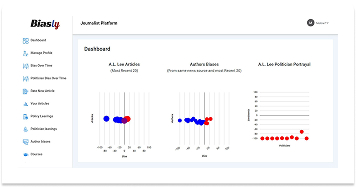
- Journalist Bias Analytics Platform: Explore how individual journalists contribute to bias within their publications.
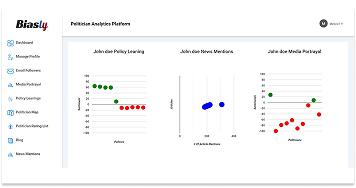
- Politician Bias Analytics Platform: Compare how politicians are framed differently by RealClearPolitics and other outlets.
- Media Literacy Education Platform: Learn how to critically assess media sources, bias techniques, and news reliability.
Frequently Asked Questions
RealClearPolitics is rated as Center based on Biasly’s media bias algorithm, which assesses sentiment, article framing, and policy favorability.
Left-leaning critics of RealClearPolitics have accused the source of spreading misinformation in the past, specifically concerning the 2020 election results. The New York Times identified its language choices as right-leaning in 2020 and found an instance of misidentifying sources in one article. The article then goes on to discuss, as this source page did, specific funding sources that may have influenced these editorial decisions.
Biasly uses a combination of AI sentiment analysis and human analyst review to assess tone, fact accuracy, source quality, and media bias indicators. Learn more on our Bias Meter page.
Generally, this source can be considered reliable when examining polling data. Apart from this, opinion pieces and sources selected to support its publications indicate an overall moderate right-leaning bias.
Military Spending
| Date | Sentiment | Associated Article | Snippet |
|---|---|---|---|
| 08/25/2019 | 75% For | Trump Family Detentions Flores Agreement (link) | So, of course, the Trump administration is doing the opposite in a baldfaced |