Analysis of Bias in The Atlantic’s Online Articles
To evaluate the bias present in The Atlantic’s articles, Biasly analysts utilized these criteria:
- Tone: The overall attitude conveyed by the article’s rhetoric
- Diction: Specific word choices made by the author
- Author: The background and social presence of the journalist
- Tendency: Patterns of bias in the writer’s other works
- Expediency Bias: Quick visual or textual indicators like headlines and photos that imply bias

Source: The Atlantic
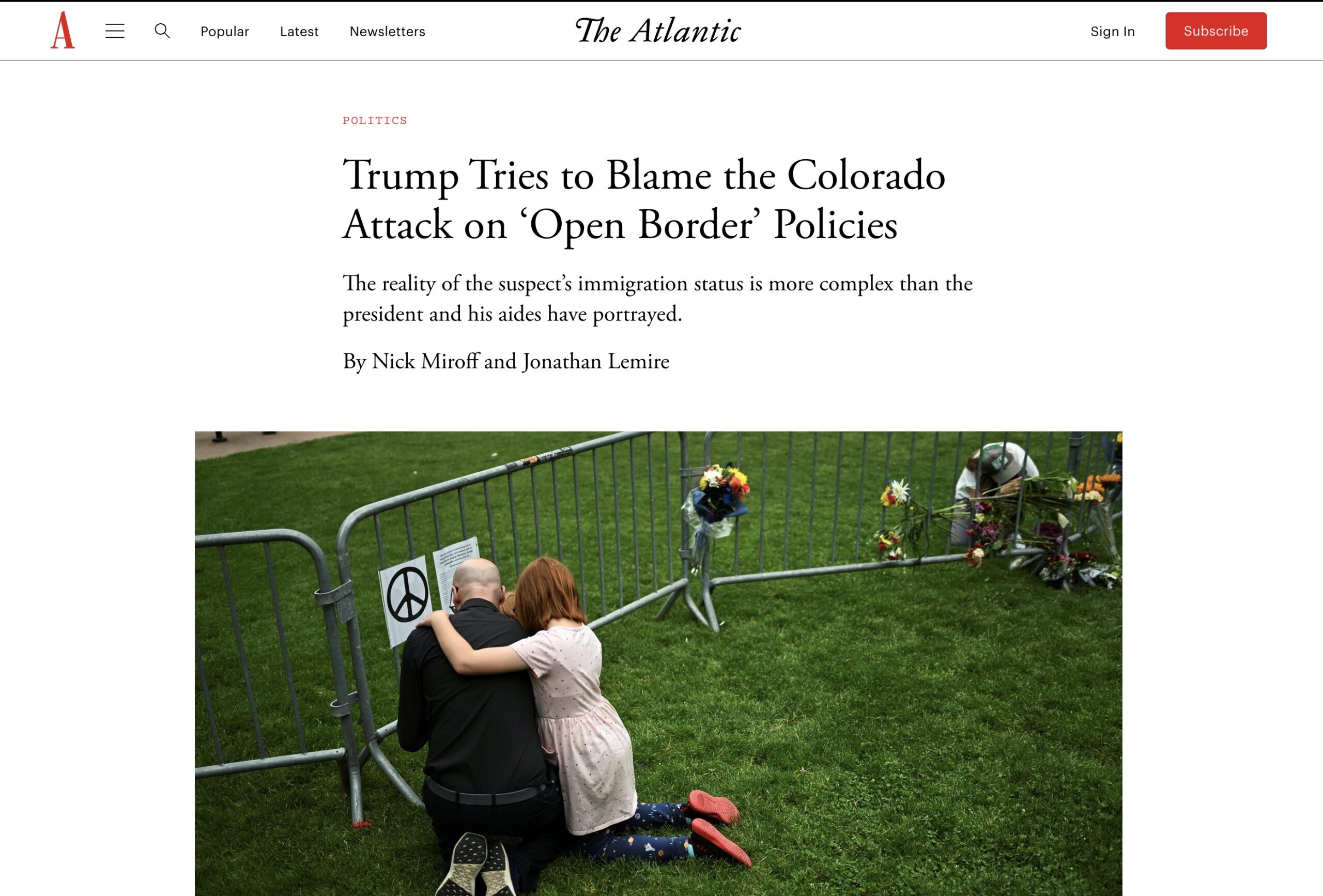
An example of bias evident in tone appears in The Atlantic’s article “Trump Tries to Blame the Colorado Attack on ‘Open Border’ Policies”. The article, at the first glance, does not seem explicitly politically charged or biased. However, the general tone of the article conveys a sense that this article is biased towards a liberal perspective. The article utilizes the Colorado attack to criticize Trump’s response to the event, as well as Trump’s broader immigration goals. The article does not just report on the event itself, but instead situates it within a broader critique of Trump. This portrays a liberal bias as the article presents a one-sided narrative regarding the issue of immigration. It merely tries to demean the conservative perspective on this issue.
An example of diction that portrays bias is in The Atlantic’s article “Trump Keeps Defending Russia”. Here are some quotes from this article that show how diction can be analyzed to convey bias:
“Donald Trump loves to speak extemporaneously, and usually, he makes very little sense.”
“Trying to turn his ramblings into a coherent message is like trying, as an old European saying goes, to turn fish soup back into an aquarium.”
“The setting, as it so often is when Trump piles into a car with his thoughts and then goes full Thelma & Louise off a rhetorical cliff, was Fox & Friends.”
“A Trump interview on conservative media is something like a liturgy, with its predictable chants, its call-and-response moments, and its paternosters.”
The article’s usage of similes and other vivid descriptions conveys an explicit usage of language to demean Trump. These lines add little information and instead reflect liberal bias.
A good example of how an author’s background and analysis of their previous works can signal bias can be seen with Tom Nichols, a writer for The Atlantic. Here is a tweet that can give us an insight into Nichols’ own political bias:
Nichols explicitly attacks Trump’s character and mode of speaking. This signals Nichols’ antagonism towards Trump, and therefore, it is likely that Nichols is personally more liberally biased.
When taking a look at some of Nichols’ previous article titles, this liberal bias can also be noticed: “Trump Is Using the National Guard as Bait”, “A Witch Hunt at the State Department”, and “Trump’s Plan to Sell Out Ukraine to Russia” all convey a liberal bias towards Nichols’ articles. Nichols seems to be solely focused on critiquing Trump rather than providing an objective perspective for readers to view multiple political perspectives.

Source: The Atlantic
A great example of expediency bias can be seen in the just-mentioned article “A Witch Hunt at the State Department”. The image above is the cover photo for this article. Just based off the image, the article does not seem to be conveying any specific messages to the reader. However, the usage of the term “witch hunt” in the headline is provocative and implies the author’s ideological bias before actually reading the article. This type of bias prevents the reader from coming to their own conclusions regarding the issue, as the author signals their intent to present their own subjective account of the issue.
Another good example of expediency bias can be seen in the article “The Government Wants to See Your Papers”. Here are the first lines of the article:
“You there. Stop what you’re doing. Take off that tool belt and hard hat—let’s see some ID. Why? Because we don’t think you’re a citizen. Now show us your papers. This kind of behavior by government officials is now legal in the United States.”’
These first lines are shocking and vivid, drawing the reader in with this contrasted image of what America is really like to the author, compared to how we view America (as the land of the free, democratic, etc.). Before any information is given to us, the author frames the United States as oppressive and authoritarian. This indicates a liberal slant to the article, as these terms are often used by liberal perspectives in response to Trump’s policies.
Analysis of The Atlantic Opinion Articles
Most news outlets distinguish their factual news reports and opinion pieces. Interestingly, The Atlantic does not provide a clear distinction between these two types of reporting. Instead, it uses broad news categories that only distinguish only by topic, not by news vs. opinion. What this means is that readers should be cautious when reading The Atlantic’s articles. While their articles have an average reliability, this lack of a distinction between news and opinion pieces means it is much easier to confuse factual and opinion reporting. Regardless of whether an article is an opinion piece or not, Biasly’s five criteria are still a good source to refer to when analyzing bias.
Analysis of Reliability in The Atlantic’s Online News Articles
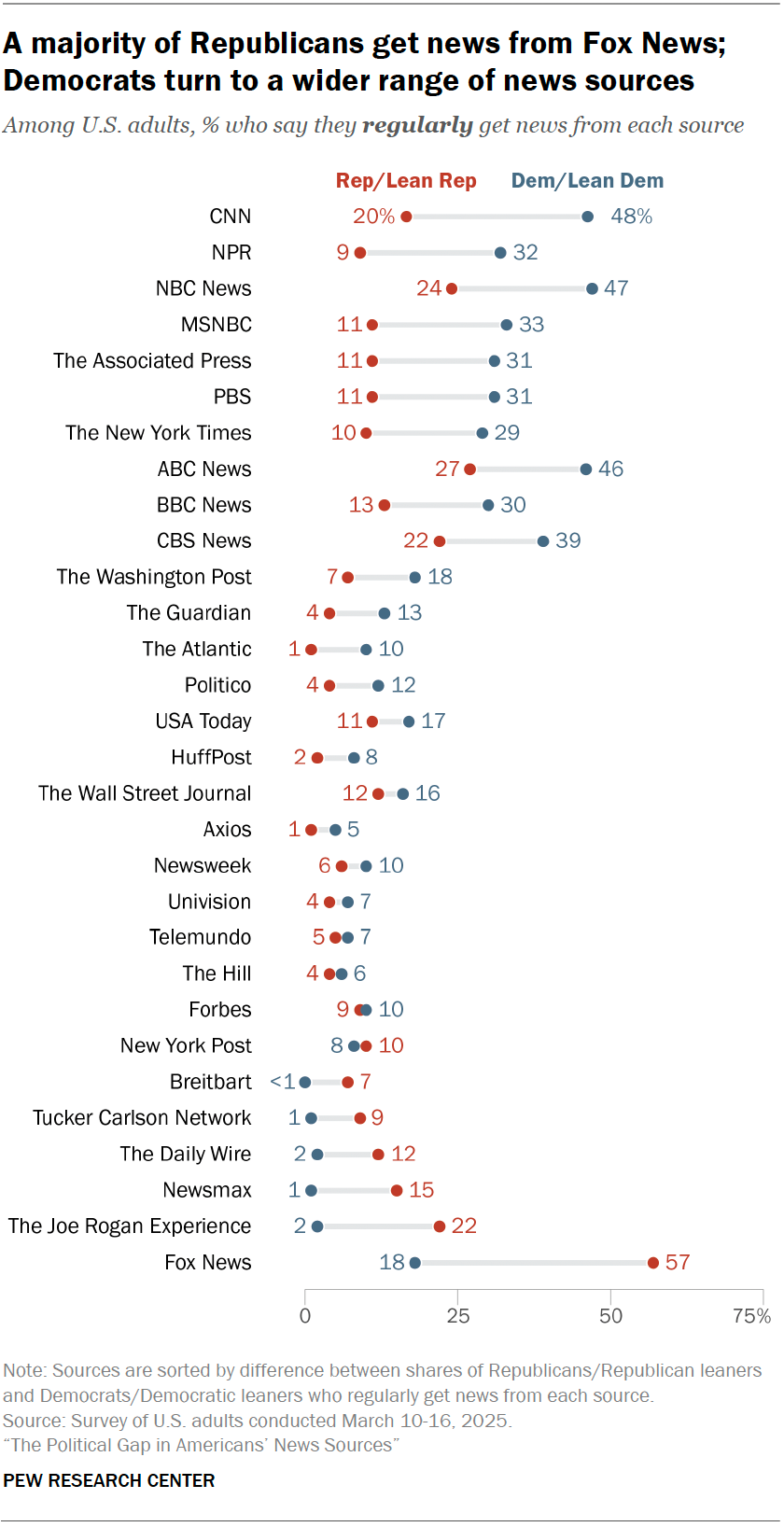
The Atlantic’s for-profit status indicates a need to boost sales and readership. Because most of the readers are liberal-leaning, this is reflected in the editorial decisions surrounding their reporting, as well as how they select authors themselves. Most authors for The Atlantic are liberally-leaning, meaning their articles tend to come from this perspective.
Quality of Sources and Facts Used
While The Atlantic often cites credible sources in their articles, there are ways in which their usage of sources conveys an ideological bias.
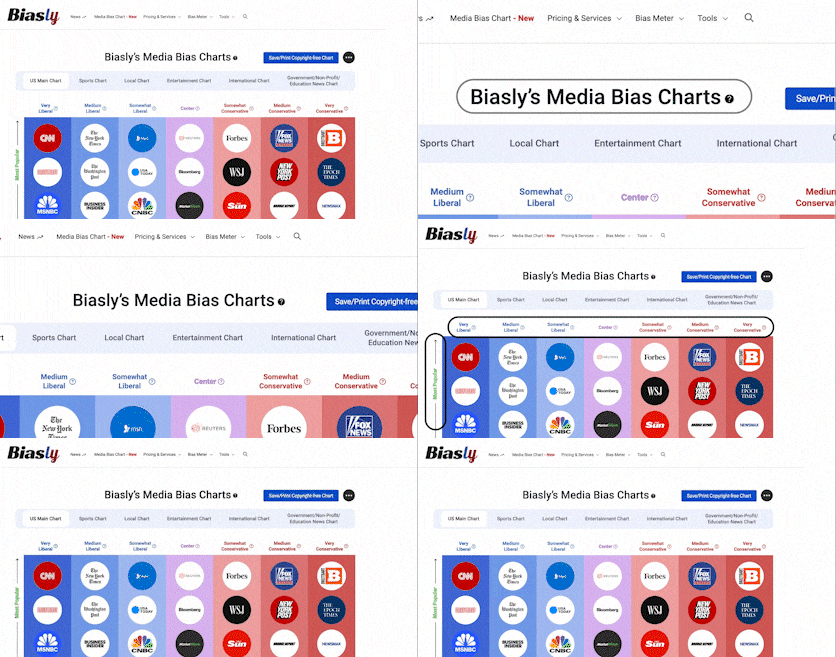
The Atlantic’s article “What We Lose by Distorting the Mission of the National Guard” is an example of how the lack of sources, as well as diverse sources, hurts the reliability of an article. The article only uses two sources, NPR and WNYW– Fox 5 New York. NPR is rated as “somewhat left” by Biasly, while Fox 5 New York is towards the center of the political spectrum. This lack of sources hurts the factuality of this article because, without referencing facts from multiple sources, it is hard for an article to establish objectivity. This article only cites three news articles: “New Mexico asks National Guard to work as substitute teachers to keep classrooms open”, “Massachusetts Calls On The National Guard To Mitigate A School Bus Driver Shortage”, and “Cuomo ready to send National Guard to collect NYC garbage” which all establish the point that the National Guard has been used in the past for civilian purposes. However, the author does not use any sources to support his main argument that the National Guard should not be used for these purposes. The article in this respect turns into an opinion piece rather than objective, factual reporting. Furthermore, a lack of diverse sources insinuates that the article may be cherry-picking sources to fit its narrative. Articles with high reliability reference many different sources that represent different political backgrounds.
A good example of an article that uses a variety of sources is The Atlantic’s article “The MAGA Influencers Rehabilitating Hitler”. Here are some of the sources cited in the article:
- David Collum, a chemistry professor at Cornell
- Tucker Carlson, former commentator on Fox News, now the host of The Tucker Carlson Show
- Darryl Cooper, a right-wing American podcaster and Nazi sympathizer
- Candace Owens, a right-wing political commentator
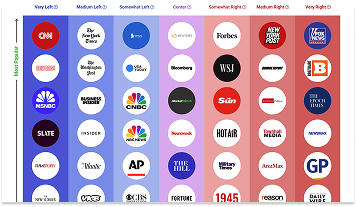
- The New York Times, an American news outlet, rated “medium-left” by Biasly
- CNN, an American news outlet, rated “very left” by Biasly
- Gallup, a reputed opinion polling company, rated “center” by Biasly
- United States Holocaust Memorial Museum, the official United States memorial to the Holocaust
- Smithsonian Magazine, an American magazine that focuses on history, art, and science
- Echoes and Reflections, a website dedicated to Holocaust history
- CBS News, an American news outlet, rated “somewhat left” by Biasly
- USC Shoah Foundation, provides educational programs focused on the Holocaust
- Breaking Points, a political podcast
- PBS News, an American news outlet, rated “left-leaning”
- Ian Carroll, host of The Ian Carroll Show
- Charles Lindbergh’s Website, recounts different speeches and writings from Charles Lindbergh
- Jake Shields, former martial artist
- Myron Gaines, host of the Fresh and Fit Podcast, known as part of the “manosphere.”
- David Shor, a data scientist for the Democratic Party
This diverse and large sample of sources exponentially increases the credibility of this article. Another indicator of credibility is the number of quotes in an article, as well as their length. This article has 28 quotes, with nine of them being long quotes. This high number of quotes further supports the credibility of this article. Furthermore, there is a balance between left-leaning, center, and right-leaning perspectives in this article. David Collum, Tucker Carlson, Darryl Cooper, Candace Owens, Breaking Points, Ian Carroll, Jake Shields, and Myron Gaines are all right-leaning sources. Gallup, the United States Holocaust Memorial Museum, the Smithsonian Magazine, Echoes and Reflections, the USC Shoah Foundation, and Charles Lindbergh’s website are all sources in the center of the political bias spectrum. The New York Times, CNN, CBS News, PBS News, and David Shor are all left-leaning sources.
Selection and Omission Bias
A good example of omission bias can be seen in The Atlantic’s article “So Much for the ‘Best Health-Care System in the World’”. The article focuses only on critiquing Trump’s policies on healthcare. This insinuates that it is only Trump’s policies that have influenced the lack of access and funding to healthcare in the United States. The issue of healthcare and its decline in the United States is extremely complex. This means that it is more likely that there have been multiple causes for the decline of healthcare in the United States. However, by omitting any other perspective that may shed light on a different facet of the healthcare problem, this article makes healthcare seem one-dimensional. By making this issue one-dimensional, the article restricts itself to its liberal bias.
An example of selection bias can be seen in The Atlantic’s article “Donald Trump Shoots the Messenger”. The author focuses on a particular story in which Trump fired Erika McEntarfer, the commissioner of the Bureau of Labor Statistics. Based on this singular story, the author goes on to claim that Trump is a bully and only wants loyalists in his administration. Even if true, it is unreliable to base such a broad argument on a single instance. Large claims such as this require multiple perspectives and stories to provide credible support. However, by selecting this particular story, the article is able to curate its narrative to fit a left-leaning bias.
A The Atlantic article which shows how selection and omission bias can be avoided is “Will Trump Get His Potemkin Statistics?”. This article references scholars and politicians from both sides of the political spectrum. By doing so, the article makes itself credible, as it conveys multiple perspectives for the reader to digest. Instead of selecting or omitting stories to fit a narrative, the article provides a broad range of facts for the reader to construct their own narrative.