









How News Sources Portray Slavery Reparations Policy
This chart shows how major news sources across the ideological spectrum frame slavery reparations policy, from left to right-leaning perspectives.
















Slavery, or the ownership of a human being as property, was commonplace around the world throughout the 15th through the 19th centuries. In that time period, at least 12.5 million Africans were forcibly kidnapped and distributed throughout Europe and America. Slavery existed in modern-day America prior to the United States’ establishment as a nation, and the practice continued for many decades afterward. However, growing discontent between The North and The South eventually led to the American Civil War and the end of slavery.
Slavery reparations are a form of compensation to victims of slavery and/or their descendants. Reparations may take different forms, such as public apologies, pledges that similar policies will never again be enacted, or even monetary payment.
Some form of reparations have been pursued by Africa beginning in 1999, many Caribbean islands throughout the 2000s and 2010s, the United Kingdom beginning in 2007, the Netherlands in 2022, and Portugal in 2023. However, most countries have stopped short of providing financial compensation to slavery descendants. Meanwhile, in the United States, the debate on slavery reparations remains contentious.
In a 2022 Pew Research poll examining opinion on reparations, over two-thirds of Americans, 68 percent, opposed the policy. Only 30 percent were in support. Black Americans were the only demographic group in agreement with reparations, with 77 percent in support. Meanwhile, 80 percent of White Americans opposed the policy.
History of Slavery Reparations in Europe
Portugal trafficked nearly 6 million Africans, more than any other European nation. In the nation’s curriculum, the subject of slavery is often brushed over. While Portugal’s president expressed remorse for their involvement in the practice in 2023, he stopped short of issuing a formal apology, and the government has not indicated plans to provide a policy of reparations.
The United Kingdom trafficked approximately 3.2 million people, second only to Portugal. While King Charles expressed sorrow at the practice, and while former Labour Party Tony Blair apologized for their involvement to the Ghana president in 2007, multiple governments have shied away from a reparations program, instead stating they would prefer to focus on the future instead of the past.
France trafficked around 1.3 million people to the Americas. The country’s government ruled out reparations, but in 2001, it officially recognized slavery as a crime against humanity.
In bordering Belgium, the nation’s king expressed regret at their past involvement in slavery in 2022. According to Reuters, Belgium’s prior rule over the Democratic Republic of Congo may have resulted in the deaths of at least 10 million people. Nevertheless, Belgium’s curriculum does not cover slavery in depth, and there are no current plans for reparations.
In the Netherlands, which trafficked about 0.5 million people, the former prime minister apologized for their involvement in slavery and acknowledged that the country directly benefited from the practice. While the Netherlands has not pursued a direct reparations program, it created a 200 million Euro fund to assist descendants of slavery.
History of Slavery Reparations in the United States
The history of reparations in the United States is a contentious subject. In 2008, the United States House of Representatives formally apologized for American slavery. At the state level, nine states have also apologized: Alabama, Connecticut, Delaware, Florida, Maryland, New Jersey, North Carolina, Tennessee, and Virginia. However, some advocates have pushed for financial compensation to the descendants of slavery, which some estimates suggest could cost the U.S. government upwards of $12 trillion.
Supporters point to the significant wealth gap between White Americans and Black Americans as justification for reparations, arguing that such inequality would not have existed without slavery. In addition, some have argued that reparations represent a way to remedy the centuries of discrimination that Black Americans have faced.
Opposition to reparations takes a few different forms. One argument is that former slave proponents are dead, so reparations are unnecessary and would be discriminatory against people who were not involved. The practicality of providing reparations is also uncertain in terms of who would qualify versus who would not. Finally, many states have statutes of limitations, so the constitutionality of such a program would be in question, too.
The Democratic Stance on Reparations
Democrats are divided on the subject of reparations. In a 2022 Pew Research poll, 49 percent of Democrats opposed providing reparations, while 48 percent were in support. This comes even as 82 percent of Democratic voters agree that the legacy of slavery affects Black Americans a fair amount or a great deal.
The policy of reparations was a contentious subject during the 2020 Democratic primaries, which occurred amid increased racial tensions following the death of a citizen, George Floyd, at the hands of police. Several Democratic candidates for president, including Andrew Yang, Marianne Williamson, Elizabeth Warren, Cory Booker, Tulsi Gabbard, Bernie Sanders, Kamala Harris, Beto O’Rourke, and Tom Steyer, expressed support for providing reparations of some kind.
In June 2019, 173 Democrats cosponsored H.R.40, the only Congressional legislation to study and develop reparation proposals. In the Senate, 20 Democratic or Democratic-aligned senators supported equivalent legislation.
Politicians Who Support Slavery Reparations Rights

49% of Democrats opposed providing reparations, while 48 percent were in support.

Kamala Harris
“I think that the word, the term reparations, it means different things to different people. But what I mean by it is that we need to study the effects of generations of discrimination and institutional racism and determine what can be done, in terms of intervention, to correct course.”
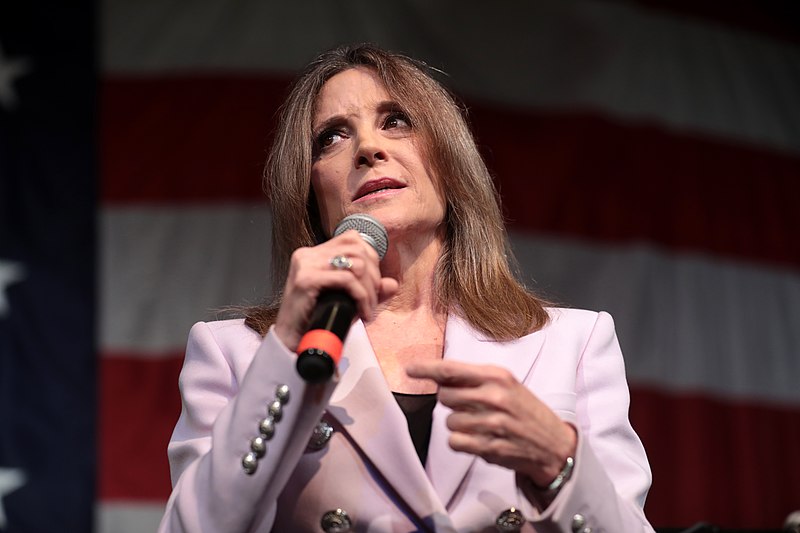
Marianne Williamson
“When this is over, a major new era of American investment in scientific research is critical. It used to be something we did and were proud of, then diminished as we put short term private profit over long-term public good. #repairamerica”
The Republican Stance on Reparations
The Republican stance on reparations is strongly against the policy. In a 2022 Pew Research poll, opposition to reparations was nearly universal among Republicans and Republican-aligned voters, at 91 percent. Only 8 percent of those voters supported the policy. In addition, 69 percent of Republican voters responded that the legacy of slavery has little, if any, impact on Black Americans today.
In March 2025, a group of House Republicans moved to revoke federal funds to any state or local area that enacts slavery reparations. Republicans commonly argue that focusing on slavery reparations diverts attention from more important policy issues and divides Americans on the subject of race.
Politicians Who Oppose Slavery Reparations Rights

Opposition to reparations was nearly universal among Republicans and Republican-aligned voters, at 91%.
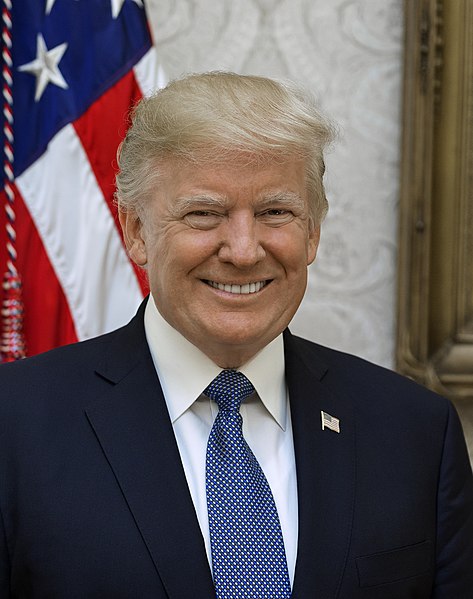
Donald Trump
“I think its a very unusual thing. Its been a very interesting debate. I dont see it happening, no.”

Joe Biden
“I dont feel responsible for the sins of my father and grandfather. I feel responsible for what the situation is today, for the sins of my own generation. And Ill be damned if I feel responsible to pay for what happened 300 years ago.”
The Future on Reparations
Given strong opposition to reparations among Republicans and divided support for reparations among Democrats, it is unclear if this will ever be pursued as a national policy in the United States. This is especially true given a lack of enthusiasm to pursue reparations across many European countries as well. However, reparations policies at the state and local level remain an option moving forward, specifically in very progressive circles.
In 2020, reparations were a forefront issue in the Democratic Party primary, but they received comparatively less attention in 2024. With a highly competitive primary looming in 2028, one or more candidates could pursue a reparations policy as a way to win the support of Black voters who make up the base of the Democratic Party. However, given the unpopularity of this policy nationwide, it is unclear whether there will be an appetite to do so.
