




10% Center
Bias Meter
Extremely
Liberal
Very
Liberal
Somewhat Liberal
Center
Somewhat Conservative
Very
Conservative
Extremely
Conservative
-100%
Liberal
100%
Conservative

Biasly determines media bias ratings through a dual-layered approach combining artificial intelligence and analyst review. The platform’s proprietary bias detection engine, Bias Meter, evaluates sentiment, policy position alignment, and language framing across thousands of data points in news articles. Analysts then verify and interpret the AI’s findings, providing additional context where needed. Learn more about ratings
- Profile
Access WDUN on the media bias chart
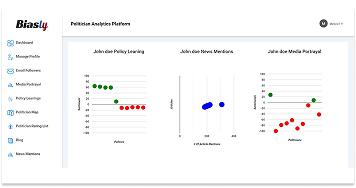
Access WDUN has a Bias Score of 10% Center which is based on a variety of factors including its policy and politician leanings, article ratings, and the use of biased language. Its Reliability is rated as Average, and additional analytical insights are available in the other tabs.
- Bias Rating
10% Center
- Reliability66% Reliable AveragePolicy Leanings
16% Somewhat Right
Extremely
LiberalVery
LiberalModerately
LiberalSomewhat Liberal
Center
Somewhat Conservative
Moderately
ConservativeVery
ConservativeExtremely
Conservative-100%
Liberal100%
Conservative
Average Reliability
*Our bias meter rating uses data science including sentiment analysis, machine learning and our proprietary algorithm for determining biases in news articles. Bias scores are on a scale of -100% to 100% with higher negative scores being more liberal and higher positive scores being more conservative and 0% being neutral. The rating is an independent analysis and is not affiliated nor sponsored by the news source or any other organization.
Politician Portrayal38% negative
Continue For Free
Create your free account to see the in-depth bias analytics and more.
By creating an account, you agree to our Terms and Privacy Policy, and subscribe to email updates.
Log In
Log in to your account to see the in-depth bias analytics and more.
Policy Leanings Analysis
Policy | Bias score |
|---|
Access WDUN Editorial Patterns
Access WDUN’s coverage of political topics often reflects a Center bias, with consistent patterns in phrasing, source selection, and thematic focus that are Neutral. While Access WDUN maintains journalistic standards in many of its reports, the choice of language, issues, and framing indicates a political slant. This analysis examines how Access WDUN covers liberal and conservative issues and evaluates the language choices and editorial tendencies.
Coverage of Liberal vs. Conservative Topics
Access WDUN’s articles include conservative social causes such as immigration and abortion, which tend to embrace sympathetic and supportive language. For instance, Access WDUN portrays conservative figures in a positive light. Access WDUN, however, tends to aggregate articles from other sources such as AP News, which leans liberal in its political reporting.
By contrast, Access WDUN’s articles tend to cover liberal figures or Democratic led initiatives in a critical light. Articles are often framed to cast blame on Democratic legislators or initiatives. For example, in election coverage, Democratic candidates may receive more backlash or criticism.
Policy and Issue Framing
When covering abortion, Access WDUN often references banning the operation or limiting abortion services. This aligns with Center. Similarly, coverage on government spending promotes reduced waste and a balanced budget.
Other policies like clean energy and the death penalty are framed more liberally, while topics such as affirmative action and gun control remain centered.
Coverage and Relevance
Access WDUN mostly has its original news focus on local Georgia politics. Access WDUN aggregates from AP News for reports on national and political news. It serves as an interesting case study for examining source bias and news media bias in both its local and national reporting.
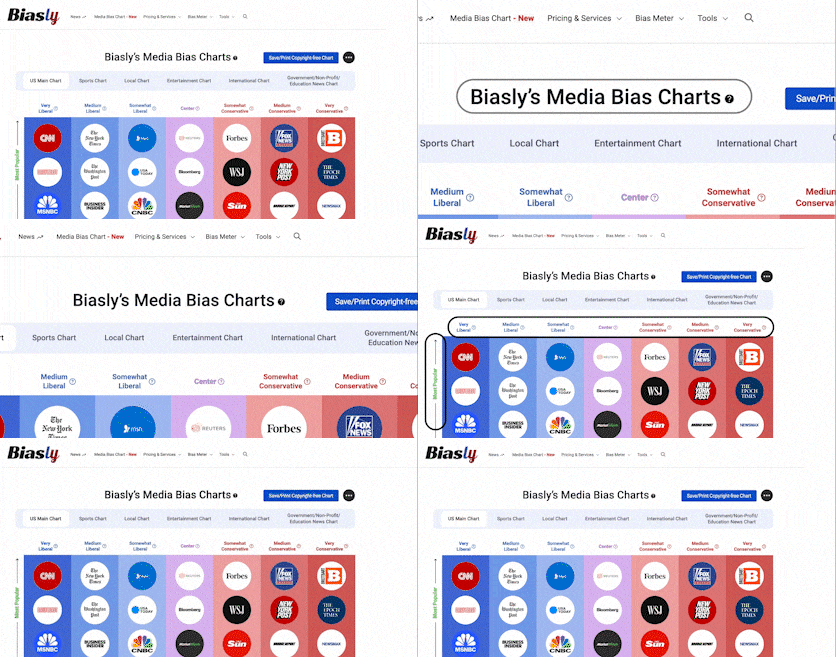
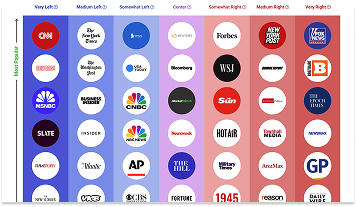
Readers can compare Access WDUN with other outlets using Biasly’s Media Bias Chart, which analyzes diction and tone in near real time.
Access WDUN Bias Analysis
Access WDUN was founded by John Jacobs Sr in 1950. Access WDUN was a radio station in Gainesville that was founded to create a local platform to engage and inform the community. Today, Access WDUN averages over 2.25 million visitors a month and 2 million page views per week.
Is Access WDUN Biased?
Based on Biasly’s evaluations, Access WDUN is rated as Center.
By examining content patterns and the broader context of media influence, we aim to offer a balanced perspective on Access WDUN’s political bias and to contribute to the ongoing discussion of bias in the news.
How Does Biasly Rate News Sources?
Biasly uses proprietary algorithms and a team of analysts to provide comprehensive bias evaluations across thousands of news outlets. Over 200,000 articles from more than 3,200 sources have been analyzed to identify the most accurate and unbiased stories.
Biasly assigns each outlet three key scores:
- Reliability Score – Reflects factual accuracy
- AI Bias Score – Generated via natural language processing
- Analyst Bias Score – Assessed by human political analysts
These scores are based on seven core metrics: Tone, Tendency, Diction, Author Check, Selection/Omission, Expediency Bias, and Accuracy. These elements help analysts and algorithms evaluate the political attitude conveyed by each article.
Biasly’s Bias Meter ranges from -100% (most left) to +100% (most right), with 0% indicating neutrality. The system evaluates individual articles based on political terms, policies, figures, and sentiment to calculate precise bias ratings.
Is Access WDUN Politically Biased?
Access WDUN earns a Center rating for its AI Bias Score and a Center for its Analyst Bias Score. The Analyst Bias Score is generated by reviewers from liberal, moderate, and conservative backgrounds. Analysts reviewed 15 Access WDUN articles and noted preferences in areas like coverage of conservative politicians and policy topics such as abortion rights and government interference. However, the paper maintained objectivity regarding topics such as affirmative action and gun control.
For example, coverage on the Jefferson mayoral race mostly focused on race winner Dawn Maddox and her goals for the city. The article presents little to no information about the current mayor, Jon Howell, who lost the race.
Analysis of Bias in Access WDUN Online Articles
To evaluate the bias of online articles, we can analyze select Access WDUN articles through several of Biasly’s bias rating criteria: Tone, Tendency, Author, Diction, and Expediency Bias.
- Tone: The overall attitude conveyed by the article
- Diction: Specific word choices made by the writer
- Author: The background and social presence of the journalist
- Tendency: Patterns of bias in the writer’s broader body of work
- Expediency Bias: Quick visual or textual indicators like headlines and photos that imply bias

In an aggregated piece titled, Trump says US to boycott G20 in South Africa, repeating allegations about treatment of white farmers, the author remains centered in tone and reporting the situation, but has negative sentiments against Republican leaders, including President Trump, Vice President J.D. Vance, and Secretary of State Marco Rubio. The article also includes no opposing sources, leaving readers with only one side of the story. This article is low in information. Readers would need to do their own further research to understand the situation.
This is a tendency in Access WDUN’s articles. Pieces have little to no evidence or opposing sources. Readers must assume that Access WDUN is providing accurate and reliable information. Articles are short and sometimes only rely on AP News. Now, AP News is a reliable source, but Access WDUN needs to add variety and opposing viewpoints to give readers more information and not shield them from opposing perspectives.
One of the reporters, Seung Min Kim, spends time on her social media debunking claims made by President Trump. An example of one of those tweets is available down below:
Obama and Biden did not leave behind all those judicial vacancies, despite what Trump says. McConnell did.
— Seung Min Kim (@seungminkim) September 30, 2020
Trump has other tariff options after Supreme Court strikes down his worldwide import taxes https://t.co/GM8GTlDE1j
— Seung Min Kim (@seungminkim) February 20, 2026
In another article titled Letitia James calls mortgage fraud case against her vindictive and asks judge to dismiss it differs from the article above. This article uses more critical language to describe measures by President Trump to get Letitia James convicted. Word choices and diction used, such as “hastily” and “vindictive prosecution,” highlight an emotive bias against Republican legislators. Additionally, the article expresses negative sentiment toward Republican leaders, including President Trump and Attorney General Pam Bondi. The word choices and the suggestion that the new interim New York Attorney General may not have sufficient experience for the job suggest an editorial slant in the reporting.
Analysis of Access WDUN Opinion Articles
To fully understand political bias in the media, it is important to differentiate between factual reporting and opinion pieces. Although the goal of reporting is to present facts and let readers form their own conclusions, opinion articles express personal perspectives on current issues. While the previous section examined factual reporting, this section examines how bias surfaces in Access WDUN’s selection and tone of opinion content.
In an op-ed titled, Our Right to Free Speech is Almost Absolute, reporter Bill Crane condemns President Trump for deeming negative criticism of him as unlawful. The article further states that freedom of speech is essential and not intended solely for praise. The critical tone toward President Trump suggests bias, but the author attempts to remain centered by noting that Republican presidents aren’t the only presidents to face criticism. Crane uses the example of former President Lyndon B. Johnson, who received many criticisms during the Vietnam War, so much so that Johnson didn’t pursue reelection. Johnson replied to a variety show that apologized for their frequent targets:
“It is part of the price of leadership of this great and free nation to be the target of clever satirists. You have given the gift of laughter to our people. May we never grow so somber or self-important that we fail to appreciate the humor in our lives.” President Lyndon Baines Johnson, November 9, 1968.”
In contrast, The Conservative Case for the Big Beautiful Law, claims that the Big Beautiful Law will bring prosperity, equality, and better living standards to all. The article employs a laudatory and persuasive tone to argue that this bill benefits everyone. The article presents the bill only in a positive light. It does not address any of the criticisms or potential harms the bill may cause. This suggests a conservative bias, as the article is framed to highlight the potential benefits of the Big Beautiful bill.
How to Evaluate Bias
Although Biasly rates Access WDUN as Center, it’s important to note that bias can vary across articles. Access WDUN also covers conservative-leaning policies with objectivity on many issues, from national legislation to social developments. This complexity underscores the importance of examining each article individually. So, let’s learn how to evaluate media bias.
Recognizing media bias requires awareness and critical thinking. Often, readers trust news sources that affirm their existing beliefs—a psychological tendency known as confirmation bias. This makes it harder to identify slanted narratives or one-sided reporting.
To combat this, it’s essential to challenge your assumptions by consulting multiple viewpoints and verifying news through third-party analysis. Tools like Biasly’s media bias ratings allow readers to compare the same news story across the political spectrum.
Ultimately, bias isn’t always a matter of what is said—it’s also about what is left out, how topics are framed, and which stories are chosen for coverage. Learning to recognize these patterns can help readers make more informed decisions and develop greater media literacy.
To start comparing news outlets and gain a better understanding of bias, sign up for Biasly’s Media Bias & News Analytics Platform to see how stories vary between sources.
Access WDUN Reliability Analysis
Is Access WDUN Reliable?
Access WDUN finds itself in the middle of the spectrum, with neither high nor low accuracy. Since Access WDUN primarily aggregates national news sources, it provides greater coverage of local news. Further investigation is needed to determine whether bias or other factors are affecting its accuracy. At Biasly, we specialize in evaluating not just bias but also the reliability of media outlets. Let’s explore the accuracy and trustworthiness of Access WDUN.
How to Evaluate Reliability?
Reliability refers to how trustworthy or accurate a news source is. If we can’t trust what we read, then continuing to consume content from that outlet serves little purpose. So how do we evaluate a news outlet’s reliability?
There are several potential measures of reliability to consider when assessing whether a media source is reliable. Red flags of an unreliable article can include unsubstantiated claims, reliance on other unreliable sources, frequent use of opinionated language, and more. In contrast, hallmarks of a reliable source include:
- Absence of subjective language
- Citing credible sources (e.g., .gov, .edu, academic references)
- Verifiable facts and statistics from multiple outlets
- Use of primary sources, like interviews or transcripts
- Consistency with coverage across other platforms
Biasly’s reliability scores incorporate these elements in evaluating media outlets.
So How Does Access WDUN Fare in Its Reliability?
The political reliability index developed by Biasly assesses both accuracy and trustworthiness. Access WDUN currently holds Average Reliability Score, which is calculated as a weighted average of:
- Fact Analysis Score – Evaluates the accuracy of claims, facts, and evidence.
- Source Analysis Score – Assesses the number, diversity, and credibility of sources and quotes used.
Access WDUN’s Source Analysis Score is Average at 66% Reliable. This suggests moderate trustworthiness in its sourcing practices. The score is AI-generated and considers quote length, frequency, diversity, and quality.
The Fact Analysis Score of Access WDUN is Pending at N/A. This further shows how well Access WDUN supports its claims, addresses selection and omission bias, and presents verifiable evidence.
While Access WDUN leans toward factual reporting, occasional lapses, such as unbalanced viewpoints or incomplete context, can affect its reliability rating. These nuances emphasize the importance of analyzing individual articles.
Access WDUN’s Accuracy and Reliability
According to Biasly’s analysis, Access WDUN maintains Average Reliability Score, but individual articles may vary significantly. Let’s dive into the details.
Political orientation plays a crucial role in how audiences perceive reliability. Access WDUN has been accused of favoring a conservative policy narrative, potentially at the expense of even-handed reporting. To confirm, it’s important to analyze the evidence and viewpoints provided by Access WDUN.
Two common types of bias that affect factuality include:
- Selection Bias – Highlighting or omitting stories to fit a particular narrative.
- Omission Bias – Leaving out differing perspectives or relevant details to skew perception.
Biasly’s accuracy ratings use a scale from 1% (least accurate) to 100% (most accurate). Factors include the presence of supporting evidence, internal and external reliable sources, and balanced viewpoints.
For instance, Biasly gave The New York Times a Somewhat Left Bias and an Average Analyst Reliability Score. One New York Times article titled As Hours Dwindled Before Flight Cuts, the Government Was Publicly Mum showed an average reliability rating for failing to include opposing sources and inferring that Republicans are fully blaming the government shutdown on Democrats. Reporters Karoun Demirjian, Christine Chung, and Niraj Chokshi give in-depth explanations for how the government shutdown is affecting flights and F.A.A. workers.
We will take a closer look at more examples like this below to provide a further investigation into the reliability of Access WDUN’s articles. This will include its use of selection bias, omission bias, and the quality of its sources and the facts it uses.
Analysis of Reliability in Access WDUN’s Online News Articles
Access WDUN aims to provide Georgia citizens with comprehensive coverage and analysis of a range of topics. Its staff includes writers who cover a range of topics, providing diverse perspectives that can help balance coverage. Readers, however, should distinguish between opinion-based and news reporting when evaluating source credibility.
One notable example is an article titled, Pendergrass police chief resigns, investigation leads to no charges. Reporter Will Daughtry covered the resignation of the Pendergrass police chief. The article refrains from editorial commentary, relying on quotations, an impartial tone, and fact-based language. This piece illustrates factual neutrality despite Access WDUN’s Center rating.
Quality of Sources and Facts Used
In local reporting, Access WDUN tends to rely on a limited number of sources. An article warning residents about a cryptocurrency scam only had one source: the Banks County Sheriff’s Office. Another article, titled “Gas prices slightly rise at the pump ahead of Labor Day,” reports price increases and cites prior prices. The article, however, does not indicate the source of this information. The only evidence in the article is an AAA spokesperson’s opinion regarding the price increase. The limited amount of sources used in articles about local news can decrease the reliability of Access WDUN because readers won’t know where the information is coming from or if it is factual.
In contrast, the article “Hegseth says he wants the Pentagon to prioritize speed over cost when buying weapons” reads like a straight news account of a Pentagon policy push, built around a major speech by Defense Secretary Pete Hegseth and reaction from a defense-acquisition expert and a Republican senator. The tone is largely explanatory and institutional: it gives Hegseth significant space to define the problem and the proposed fix, while adding measured caution regarding trade-offs such as transparency and performance risk. Overall, the article’s tone aligns closest with Center, presenting mild skepticism as practical concerns rather than a partisan critique.
The article contains 12 direct quotes (including partial quotes in quotation marks). Measured in words, the shortest quote is 5 words, the longest quote is 28 words, and the average quote length is about 17.8 words. The quotations are fairly reliable in that several are sufficiently long to preserve meaning and reduce the risk of misleading excerpting—especially where Hegseth lays out his rationale and where the expert explains downside risk. Longer quotes also tend to carry less “reporter tone” because they let readers encounter the speaker’s full thought directly (even though tone and intent still require context that print quotes can’t fully capture). The downside is that heavy quoting of the main official can still tilt the framing toward the official’s priorities if countervailing voices aren’t quoted at similar depth.
In the linked sources section, the article includes 7 distinct hyperlinks (counting the AP hub page, prior AP stories, topic hubs, an external PDF memo on defense.gov, and other AP explainer/reporting links). By left/center/right classification of those linked sources: Left = 0, Center = 7, Right = 0. These are primarily institutional or informational links (AP internal reporting and a U.S. government document), so the link structure supports background and verification more than ideological variety.
- Pete Hegseth, U.S. Defense Secretary in the Trump administration (Right / Republican administration official)
- S. Department of Defense / Pentagon acquisition system, subject-matter institution discussed (Center / institutional)
- National War College, venue where Hegseth delivered remarks (Center / institutional)
- Todd Harrison, defense budget and acquisition expert at the American Enterprise Institute (Right-leaning / conservative-leaning think tank)
- American Enterprise Institute (AEI), policy think tank cited via Harrison’s role (Right-leaning)
- Roger Wicker, Republican U.S. Senator and chair of the Senate Armed Services Committee (Right / Republican)
- Robert Gates, former U.S. Defense Secretary referenced for MRAP precedent (Center-right / establishment)
- President Donald Trump, referenced regarding arms deals and manufacturing (Right / Republican)
- Associated Press (AP), reporting outlet and institutional narrator (Center / mainstream wire service)
- Konstantin Toropin, AP reporter/author (Center / journalist)
- David Klepper, AP contributing writer (Center / journalist)
- Stephen Groves, AP contributing writer (Center / journalist)
- S. government memo hosted on media.defense.gov (“Unleashing U.S. Military Drone Dominance”), referenced as evidence of policy direction (Center / official document)
Across the political spectrum, the balance of speaking and cited sources is not symmetrical: the story is dominated by right-of-center governing voices (Hegseth, Trump, Wicker), plus one key outside expert voice from AEI, which is also generally right-leaning. There are no left-leaning elected officials or left- or center-left policy organizations represented to advocate for procurement transparency, contracting oversight, or alternative priorities. By volume and prominence, Hegseth clearly dominates: he is quoted repeatedly and sets the central narrative (“speed over cost,” “85% solution,” “drone urgency”), while other voices serve as reactions or contexts rather than competing frames.
In how sources are used, the right-leaning political sources are used in a mostly positive-to-neutral way in terms of placement and emphasis: Hegseth’s claims lead paragraphs and are given extended quotations, and Wicker is included chiefly to praise the plan. The skepticism is directed mainly through Harrison, but it is process-focused (the risk of systems not functioning as intended, opacity in newer firms, potential for fraud/abuse) rather than ideologically framed.
That combination—official framing plus limited, technocratic caution—suggests that the author is operating from a Center bias overall (institutional, explanatory, and not overtly partisan), though the source mix leans Somewhat Right simply because the included non-government validator is from a right-leaning think tank and there are no left-leaning counterweights. Grounded in the numbers: 12 quotes with heavy share from Hegseth, and a source list centered on Republican officials plus AEI, the article’s perspective is best described as Center in tone with a center-right sourcing footprint.
On factual accuracy, the article’s core claims align with widely reported realities about U.S. defense acquisition debates: faster fielding versus perfect requirements has long been a central tension; rapid acquisition examples such as MRAPs are commonly cited; and the war in Ukraine has highlighted the battlefield impact of relatively inexpensive drones. The piece also appropriately flags tradeoffs (transparency, incentives, performance risk, fraud/abuse) that defense acquisition experts frequently raise.
To be fully confident on a few specific assertions (for example, the exact magnitude of drones accounting for “most” casualties in Ukraine, or the implied speed gains in procurement timelines), it would be best to cross-check with independent reporting and defense-analysis sources; however, nothing in the article stands out as clearly inconsistent with general knowledge, and the inclusion of an expert cautioning about downsides strengthens its credibility as more than pure amplification of an official speech.
Selection and Omission Bias
Access WDUN provides extensive coverage of Georgia politics and national coverage, which is reasonable given that the goal of Access WDUN is to provide necessary information to everyone. However, bias may still emerge through framing and story selection.
In OPINION: Children in Foster Care in NE Georgia are at Risk, Reporter Martha Zoller states that children in Northeast Georgia are at risk if UnitedHealthcare and the Northeast Georgia Health System (NGHS) do not come to an agreement. In the article, Zoller explains that NGHS has concerns about United regarding claim denials and underpayment. Zoller, however, does not provide a reason for United’s inability to reach a deal with NGHS. Here, selection bias arises through framing, as only one side of the story is presented.
Another article titled, A Vote FOR the Electoral College claims that the electoral college is needed for an election and that people only want to get rid of it when their prospective side loses. Stating this downplays the concerns of the electoral college. This highlights omission bias. Stating that voters want to get rid of the Electoral College because their side lost is to exclude the real reasons for a potential abolition of the Electoral College. It gives readers a false narrative and frames the article in favor of one side of the story.
In opinion pieces, it is important for readers to recognize that issues with factuality, sources, selection, and omission can arise frequently. The articles covered so far reflect Access WDUN’s Center views. However, this is not necessarily detrimental to Access WDUN’s overall reliability. Its evidence may favor issues more to the right, suggesting it neglects issues in the United States that concern the left. Nonetheless, Access WDUN maintains accuracy and tends to cite evidence directly from political leaders.
So, Is Access WDUN Reliable?
Overall, Access WDUN can be considered to be an outlet that is moderately reliable. It demonstrates a consistent goal of journalistic integrity and typically supports claims with sources and quotes. Occasional omissions and framing bias do appear, particularly on culturally sensitive or partisan issues.
As media literacy improves, readers can more easily detect issues with selection bias, omission bias, and factuality. To strengthen your ability to assess reliability across the political spectrum, use Biasly’s News Bias Checker to compare how multiple outlets report the same story.
This empowers you to consume more accurate, balanced, and dependable news.
Funding and Ownership
Who Owns Access WDUN?
Access WDUN is a division of Jacobs Media, a family-owned company based in Gainesville, Georgia. Jacobs Media manages several other media outlets, including Access WDUN, Access WDUN+, WDUN 102.9 FM/550 AM, and The Lake 94.5 FM/1240 AM. The current CEO and president is John W. Jacobs III, who joined the family business immediately after graduating from college.
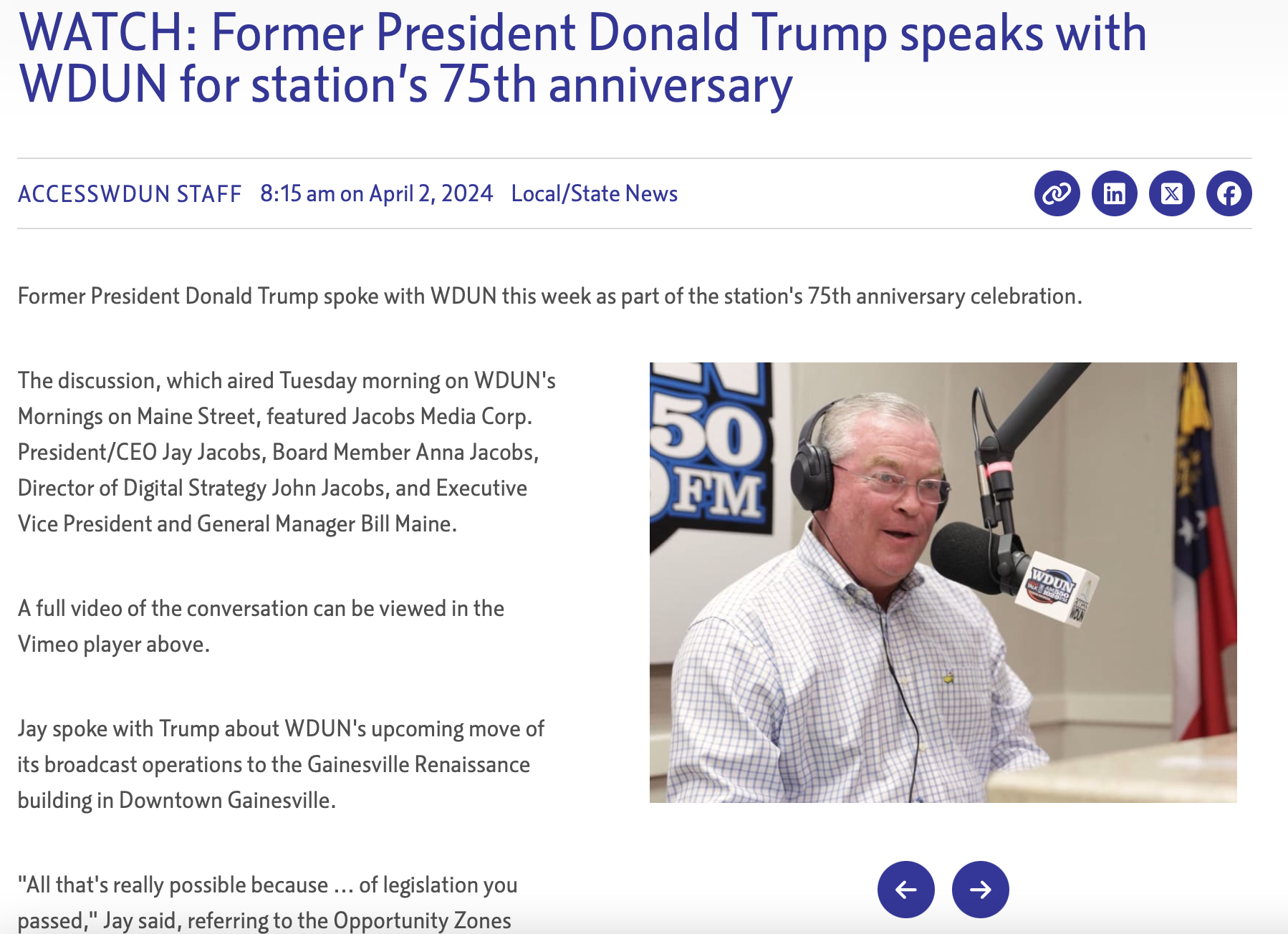
Source: Access WDUN
Access WDUN’s current CEO and President isn’t always behind the scenes. For the 75th anniversary of Access WDUN, President/CEO Jay Jacobs spoke with Donald Trump about the upcoming 2024 election and thanked him for passing legislation that helped benefit Access WDUN.
Who Funds Access WDUN?
Access WDUN is funded by its parent company, Jacobs Media. Funding is generated through advertising sales on their website and radio stations. Since Access WDUN is owned privately, it does not receive federal funding from sources such as the Corporation for Public Broadcasting (CPB). As a major news source in Northern Georgia, Access WDUN reaches a broad portion of its audience through advertisements and commercials.
Additional Insights
News Source Comparison
Access WDUN is often compared with center-to-center-right national outlets. Sources like Forbes, the Wall Street Journal, or The Sun often present similar tones and editorial philosophies. While Access WDUN exhibits a Center media bias, it differs from other sources in that it occasionally includes opposing viewpoints and strives to achieve a balanced national coverage.
This contrasts with outlets that present consistently one-sided narratives with few factual counterpoints. Readers seeking balanced political coverage may compare Access WDUN’s framing of issues with outlets rated as Center, somewhat left, or Lean Left on our Media Bias Chart, or explore other national papers on our Similar Sources page.
Notable Contributors and Authors
Access WDUN mostly aggregates news from AP News. For local news, Access WDUN employs an array of reporters to double as anchors. Some of these reporters include Hamilton Kenner, Logan Landers, Bryan Pirkle, Lawson Smith, and Steve Winslow.
Related Tools and Resource Pages
To better understand how Access WDUN fits into the broader media landscape, we recommend exploring these helpful resources:
- Media Bias Chart: See where Access WDUN ranks among hundreds of media outlets across the political spectrum.
- Political Bias Chart: Visualize political slants of news sources across various policy areas.
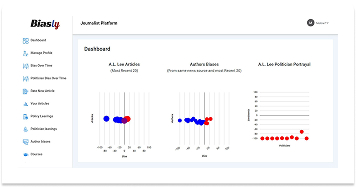
- Journalist Bias Analytics Platform: Explore how individual journalists contribute to bias within their publications.
- Politician Bias Analytics Platform: Compare how politicians are framed differently by Access WDUN and other outlets.
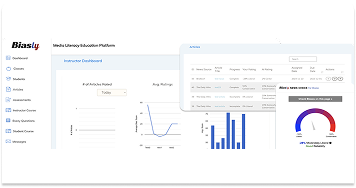
- Media Literacy Education Platform: Learn how to critically assess media sources, bias techniques, and news reliability.
Frequently Asked Questions
Access WDUN is rated as Center based on Biasly’s media bias algorithm, which assesses sentiment, article framing, and policy favorability.
While Access WDUN is not widely known for promoting misinformation, some articles exhibit selection and omission bias, particularly in political reporting. Its factual reporting is generally sound.
Biasly uses a combination of AI sentiment analysis and human analyst review to assess tone, fact accuracy, source quality, and media bias indicators. Learn more on our Bias Meter page.
Generally, yes, though partisan framing and selective reporting can affect perceived reliability.
Ratings are based on recent news using data science and A.I. technology.
Military Spending
| Date | Sentiment | Associated Article | Snippet |
|---|---|---|---|
| 08/25/2019 | 75% For | Trump Family Detentions Flores Agreement (link) | So, of course, the Trump administration is doing the opposite in a baldfaced |