




-28% Somewhat Left
Bias Meter
Extremely
Liberal
Very
Liberal
Somewhat Liberal
Center
Somewhat Conservative
Very
Conservative
Extremely
Conservative
-100%
Liberal
100%
Conservative

Biasly determines media bias ratings through a dual-layered approach combining artificial intelligence and analyst review. The platform’s proprietary bias detection engine, Bias Meter, evaluates sentiment, policy position alignment, and language framing across thousands of data points in news articles. Analysts then verify and interpret the AI’s findings, providing additional context where needed. Learn more about ratings
- Profile
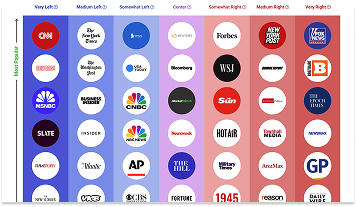
HuffPost on the media bias chart
HuffPost has a Bias Score of -28% Somewhat Left which is based on a variety of factors including its policy and politician leanings, article ratings, and the use of biased language. Its Reliability is rated as Average, and additional analytical insights are available in the other tabs.
- Bias Rating
-28% Somewhat Left
- Reliability64% Reliable AveragePolicy Leanings
-4% Center
Extremely
LiberalVery
LiberalModerately
LiberalSomewhat Liberal
Center
Somewhat Conservative
Moderately
ConservativeVery
ConservativeExtremely
Conservative-100%
Liberal100%
Conservative
Average Reliability
*Our bias meter rating uses data science including sentiment analysis, machine learning and our proprietary algorithm for determining biases in news articles. Bias scores are on a scale of -100% to 100% with higher negative scores being more liberal and higher positive scores being more conservative and 0% being neutral. The rating is an independent analysis and is not affiliated nor sponsored by the news source or any other organization.
Politician PortrayalN/A
Continue For Free
Create your free account to see the in-depth bias analytics and more.
By creating an account, you agree to our Terms and Privacy Policy, and subscribe to email updates.
Log In
Log in to your account to see the in-depth bias analytics and more.
Policy Leanings Analysis
Policy | Bias score |
|---|
HuffPost Editorial Patterns
HuffPost’s coverage of political topics often reflects a Somewhat Left bias, with consistent patterns in phrasing, source selection, and thematic focus that are Lean Left. HuffPost has been accused of using its headlines to cause a stir and promote a specific political ideology. This report will look at how HuffPost evaluates and publishes articles to determine its political bias and reliability.
Coverage of Liberal vs. Conservative Topics
HuffPost’s articles include many progressive and social causes. Something interesting about HuffPost is that these progressive and social topics, such as the border wall and affirmative action, are covered in a sympathetic tone, but with critical language toward conservative figures who oppose the legislation or cause.
Additionally, HuffPost criticizes Republican legislators and Republican-led initiatives, with a critical tone and framing. Articles focusing on Republican legislation or decisions sometimes lack a Republican lawmaker’s perspective. These articles may include only responses from Democratic legislators.
Policy and Issue Framing
When covering abortion, HuffPost often frames increased access to reproductive healthcare favorably, aligning with pro-choice positions. This aligns with a somewhat left media bias. Similarly, border control coverage often adopts a sympathetic framing towards migrants and urges lawmakers to make policy changes.
Certain policies covered by HuffPost are framed more conservatively, such as affirmative action. However, HuffPost mainly remains centered in reporting on policies like civil rights.
Coverage and Relevance
HuffPost focuses heavily on U.S. politics, with additional coverage on international affairs. HuffPost also delves into topics such as business, wellness, and economics. With its broad range of reporting, HuffPost serves as a compelling case study for examining bias and news media bias in reporting.
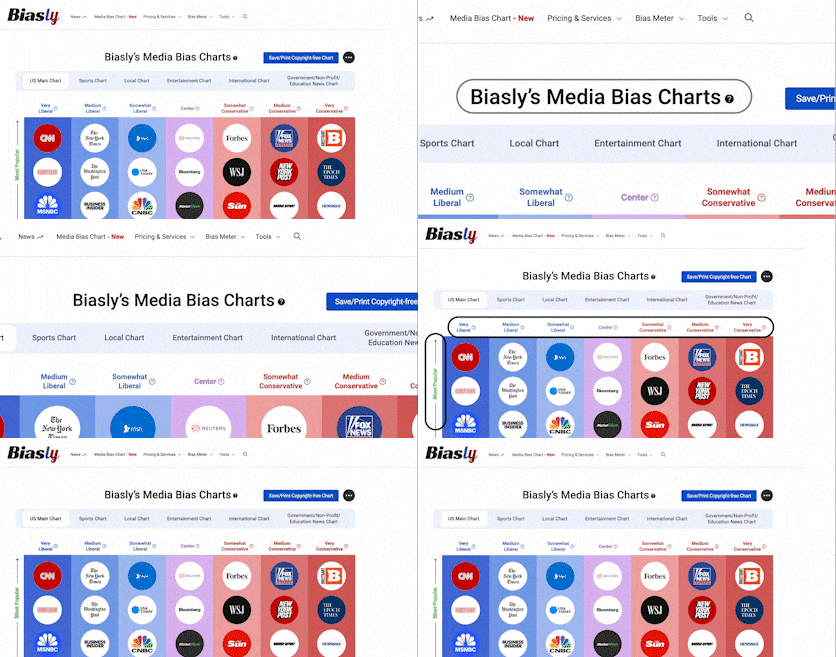
Readers can compare HuffPost with other outlets using Biasly’s Media Bias Chart, which analyzes diction and tone in near real time.
HuffPost Bias Analysis
HuffPost began as The Huffington Post in 2005. The goal was to provide readers with aggregated sources and original content. Today, HuffPost has become a heavily viewed media news source, with 126 million monthly viewers. It is owned by BuzzFeed Inc. and has committed to recounting lesser-reported stories to readers. Like many other media sources, HuffPost has been accused of bias and framing in political coverage. According to the Knight Foundation, 46% of Americans believe that HuffPost is extremely biased.
With a high average of monthly viewers and extensive coverage of topics, HuffPost is a well-known source. Readers’ knowledge of HuffPost may mirror the conclusions reached by Biasly’s media bias ratings. This article delves into HuffPost’s editorial tendencies to explore whether political bias is present and, if so, to what degree.
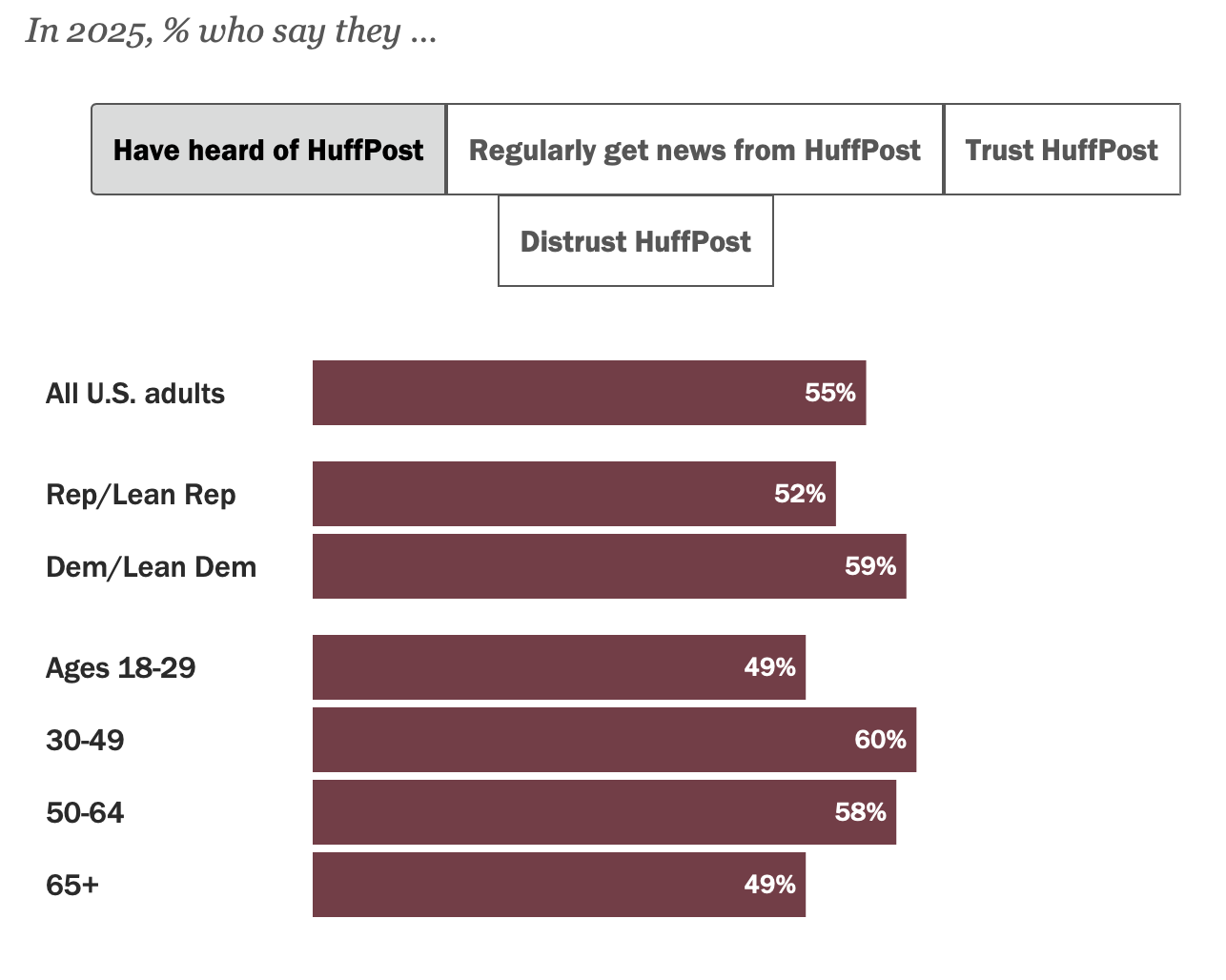
Source: Pew Research
Is HuffPost Biased?
Based on Biasly’s evaluations, HuffPost is rated as Somewhat Left.
By examining content patterns and the broader context of media influence, we aim to offer a balanced perspective on HuffPost’s political bias—and contribute to the ongoing discussion about bias in the news.
How Does Biasly Rate News Sources?
Biasly uses proprietary algorithms and a team of analysts to provide comprehensive bias evaluations across thousands of news outlets. Over 200,000 articles from more than 3,200 sources have been analyzed to identify the most accurate and unbiased stories.
Biasly assigns each outlet three key scores:
- Reliability Score – Reflects factual accuracy
- AI Bias Score – Generated via natural language processing
- Analyst Bias Score – Assessed by human political analysts
These scores are based on seven core metrics: Tone, Tendency, Diction, Author Check, Selection/Omission, Expediency Bias, and Accuracy. These elements help analysts and algorithms evaluate the political attitude conveyed by each article.
Biasly’s Bias Meter ranges from -100% (most left) to +100% (most right), with 0% indicating neutrality. The system evaluates individual articles based on political terms, policies, figures, and sentiment to calculate precise bias ratings.
Is HuffPost Politically Biased?
HuffPost earns a Somewhat Left rating for its AI Bias Score and a Medium Left for its Analyst Bias Score. The Analyst Bias Score is generated by reviewers from liberal, moderate, and conservative backgrounds. Analysts reviewed and evaluated several HuffPost articles and noted preferences regarding abortion, elections, anti-terrorism spending, and border control.
When it comes to bias, it is impossible to avoid. HuffPost has received a Somewhat Left rating for its preferences in perspectives, framing, and evidence that aligns with progressive values. As stated earlier, HuffPost has been praised for brave commentary and reporting. HuffPost Handled the bias conversation head-on in an article titled, “A Reporter’s Take On ‘Liberal Media Bias'”, downplaying the effects of political bias in reporting.
“Yes, the news is biased. Reporters have opinions, and quite often, a reporter’s opinion might creep into her story even if she doesn’t intend it to. But that doesn’t mean the news is wrong or invaluable simply because it is influenced by bias. … But even if a reporter does her due diligence, and tries to report a story honestly and fairly to the best of her ability, she’s still biased because human beings are biased by nature. “
“The real question is not a matter of whether our news is biased or not. It’s more about the degree to which reporters make an effort to present an educated, well-researched account of what’s going on. And as we know from our history books, while the facts are indisputable, they can look differently to different people.”
The article suggests that human nature does not allow the avoidance of bias. While humans are inherently prone to bias, dismissing its potential harm to readers can lead to the omission of important information and influence viewers’ opinions. By claiming that facts can look different to different people, the author presupposes that truth is subjective and dismisses the importance of factual reporting. Reporters should present readers with accurate, well-researched, evidence-backed information. HuffPost claims to provide accurate reporting, transparency, and fair and independent analysis. This article and stance by HuffPost suggest an imbalance in reporting that might be noticeable to readers.
In Addition to the omission stated above, a study by the Pew Research Center shows that HuffPost is not a source that Republicans trust. With the critical articles of Republican leaders and the ignoring of conservative topics or initiatives, HuffPost may be playing into its audience, undaunted by the associated costs and risks of media bias.
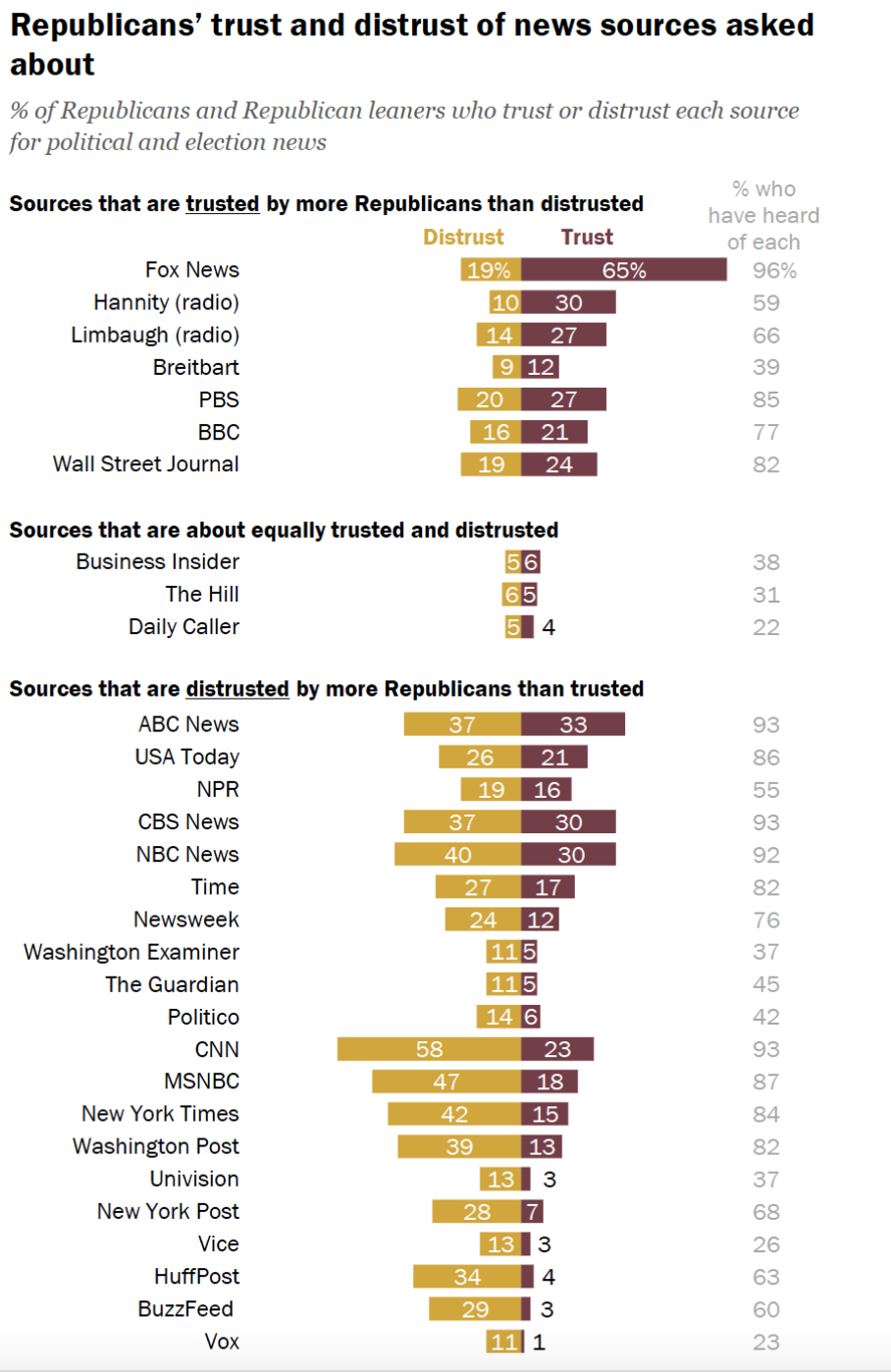
Source: Pew Research Center
Analysis of Bias in HuffPost Online Articles
To evaluate the bias of online articles, we can analyze select HuffPost articles through several of Biasly’s bias rating criteria: Tone, Tendency, Author, Diction, and Expediency Bias.
- Tone: The overall attitude conveyed by the article
- Diction: Specific word choices made by the writer
- Author: The background and social presence of the journalist
- Tendency: Patterns of bias in the writer’s broader body of work
- Expediency Bias: Quick visual or textual indicators like headlines and photos that imply bias
Let’s look at an example of HuffPost’s bias in action. An article titled, Liz Cheney Slaps Down Trump’s Attempt To Redefine 2020 Election As ‘THE BIG LIE’ serves as a good example.
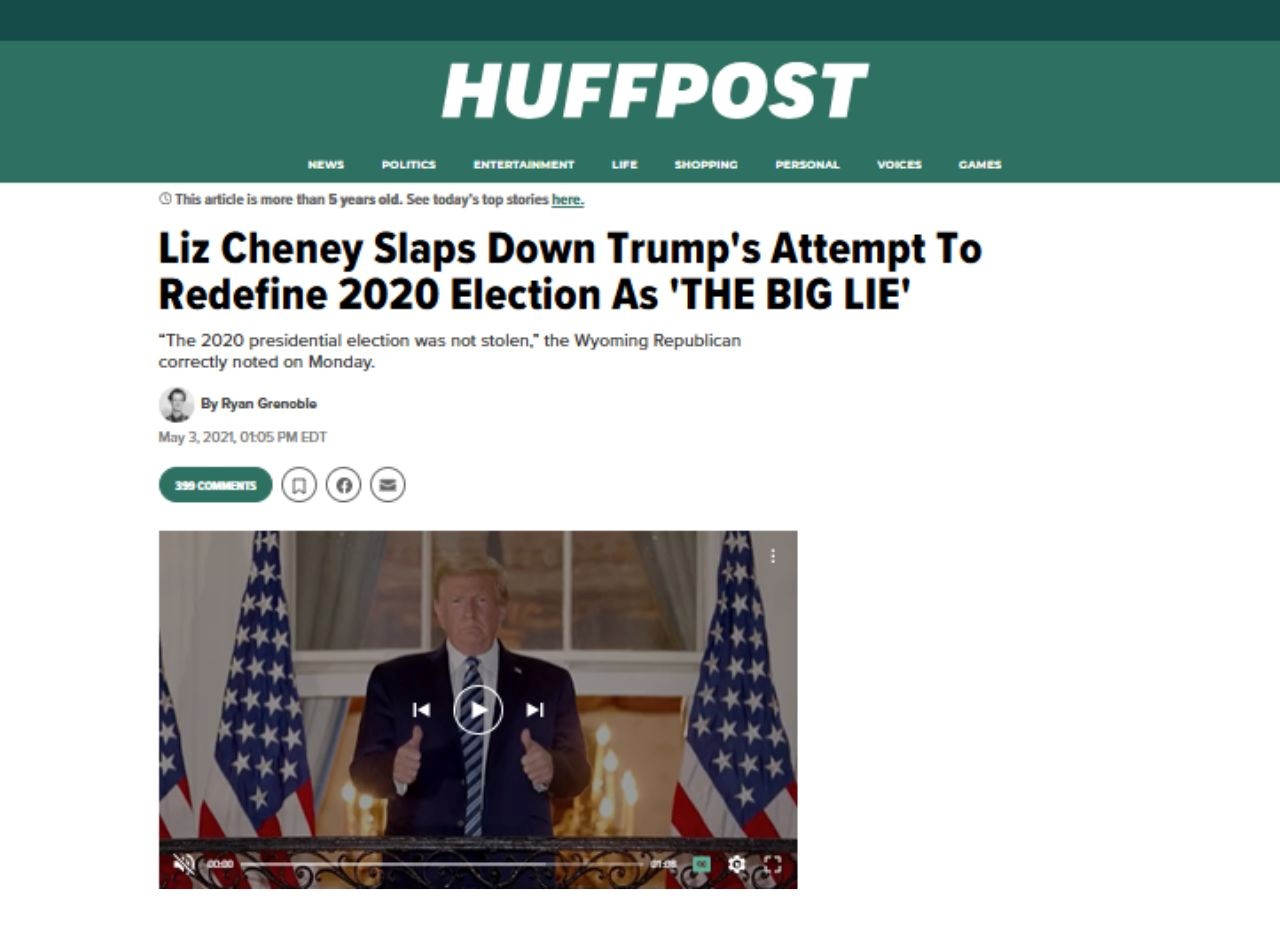
When readers view this article, a clear bias is evident in the headline, subheading, and featured video. The author frames the issue as having a right or wrong stance. The title itself, ‘Liz Cheney Slaps Down Trump’s Attempt To Redefine 2020 Election As ‘THE BIG LIE,’” implies that Cheney is doing the right thing by taking a stance against Trump, and the subheading reinforces her position as the right one. The video beneath the headline features negative coverage of Trump and a CNN clip that dismisses opposing viewpoints. These elements, appearing at the beginning of the article, not only set the tone but also influence the reader’s opinion toward Cheney, Trump, and the Republican Party before the reader begins reading.
Author Ryan Grenoble states his feelings about Donald Trump in the opening of the article:
“His refusal to acknowledge that fact, buttressed by his ― and his enablers’ ― endless lying about it and baseless attempts to overturn it, culminated in the deadly Jan. 6 insurrection at the U.S. Capitol, and Trump’s subsequent second impeachment.”
As the article continues, Grenoble paints Trump as a liar with a following of people just like him. He employs a critical tone meant to invoke contempt for Trump and the Republican Party. Throughout the article, there are approximately 7 instances of negative tone toward Donald Trump and 4 instances of positive tone toward Liz Cheney.
Additionally, the article tends to focus on the positives of Liz Cheney’s character and the negatives of Trump’s. While praising Cheney, the author disses Trump and the Republican Party.
“Cheney’s comment is noteworthy given her leadership role in the GOP and her sustained efforts to steer other Republicans away from Trump’s lie about the election results, which have made her an outlier in the party.”
This implies that Cheney is seen as an outsider by the Republican Party, which may not entirely reflect the views of the GOP. The framing of this quote and others in the article highlights a tendency to portray Cheney in a positive light while critically speaking about Trump and the Republican Party.
Furthermore, Grenoble displays his political views on social media. This can affect his ability to remain neutral in reporting. For instance, it can erode public perception and trust. Readers may view his articles with skepticism. It may also lead readers to avoid future articles by Grenoble out of concern that they are biased. An example of Grenoble’s social media presence is shown below. His tweets and retweets of anti-Republican-themed posts suggest a strong ideological perspective that may influence his reporting.
Pissing your pants to own the libs https://t.co/ehZPrOIl3d
— Ryan Grenoble (@G_nobes) March 24, 2022
Additionally, Grenoble reposted this about President Donald Trump:
“Our president will start a war with Iran because he has absolutely no ability to negotiate. He’s weak and he’s ineffective. So the only way he figures that he’s going to get reelected and is sure as you’re sitting there is to start a war with Iran.” pic.twitter.com/Ad6IPLhOWg
— Angelo Carusone (@GoAngelo) January 3, 2020
To continue, the author’s use of emotionally charged diction highlights a bias against Trump and a preference for Liz Cheney. For example, words and phrases used to describe Cheney are positive and display strength. This includes “civility,” “leadership,” “effective,” and “sustained efforts.” This is a stark contrast compared to Trump. Grenoble uses phrases such as “endless lying,” “baseless attempts,” and “lashed out” to describe Trump and his base and paint them in a negative light.
HuffPost shows a consistency of bias through political reporting. To be perceived as more reliable and credible by viewers, HuffPost needs to strive for factual reporting and objectivity.
Analysis of HuffPost Opinion Articles
To fully understand political bias in the media, it is important to differentiate between factual reporting and opinion pieces. While the previous section examined factual reporting, this section examines how bias surfaces in HuffPost’s selection and tone of opinion content.
HuffPost has a section dedicated to the opinions of journalists, experts, and everyday people. Opinion pieces are meant to express personal perspectives and viewpoints, and persuade the reader about a particular issue. HuffPost’s opinion section tends to lean left and promote progressive values. At a glance, the titles of the articles highlight the author’s personal political bias:
- All The Stupid Laws That Have Passed Instead Of An Assault Rifle Ban
- Can You Hear That Noise? It’s The Sound of The GOP Falling From Grace
- In Plain Sight, Donald Trump Continues His Takeover Of The U.S. Military
- The Party of Reagan Becomes The Party Of Putin
Let’s dive further. The op-ed titled, In Plain Sight, Donald Trump Continues His Takeover Of The U.S. Military raises concern of President Trump sending the National Guard to Los Angeles, California. Although the article refrains from harsh language, its tone is worrisome and critical. The article gives an example of when the National Guard shot at college students in Kent, Ohio, who were protesting the Vietnam War. The reporter expresses concern that a similar situation may occur if the National Guard is deployed to major cities in the United States.
In the article about the GOP becoming the “Party of Putin”, author S.V. Date criticizes Trump’s praise of Vladimir Putin. The tone against Trump is harsh, and the language includes phrases such as “appalling”, “siding with a murderous dictator,” and “playing with fire”. Additionally, the article tends to praise former President Ronald Regan and condemn President Trump. This article demonstrates bias through its editorial slant against President Trump. The author agrees with Regean’s view of Russia and speaks highly of him. It’s President Trump’s policy handling of the Ukraine-Russian War that is facing heavy criticism.
In “All The Stupid Laws That Have Passed Instead Of An Assault Rifle Ban,” the authors criticize lawmakers for not passing more restrictions on guns, but passing laws such as anti-LGBTQ+, anti-abortion legislation, and fewer restrictions on guns. The harsh tone is consistent among all legislators, Democrats and Republicans alike. The article, however, examines only the national level. Many states have made restrictions on the state level to create protections against gun violence. HuffPost, which is based in New York City, has some of the strongest gun laws in the country.
It is important to seek multiple perspectives when seeking information to develop a well-rounded understanding of an issue. Bias can influence and create misinformation around important issues.
How to Evaluate Bias
Although Biasly rates HuffPost as Somewhat Left, it’s important to note that bias can vary across articles. HuffPost also covers liberal-leaning policies with objectivity on many issues, from national legislation to social developments. This complexity underscores the importance of examining each article individually. So, let’s learn how to evaluate media bias.
Recognizing media bias requires awareness and critical thinking. Often, readers trust news sources that affirm their existing beliefs—a psychological tendency known as confirmation bias. This makes it harder to identify slanted narratives or one-sided reporting.
To combat this, it’s essential to challenge your assumptions by consulting multiple viewpoints and verifying news through third-party analysis. Tools like Biasly’s media bias ratings allow readers to compare the same news story across the political spectrum.
Ultimately, bias isn’t always a matter of what is said—it’s also about what is left out, how topics are framed, and which stories are chosen for coverage. Learning to recognize these patterns can help readers make more informed decisions and develop greater media literacy.
To start comparing news outlets and gain a better understanding of bias, sign up for Biasly’s Media Bias & News Analytics Platform to see how stories vary between sources.
HuffPost Reliability Analysis
Is HuffPost Reliable?
HuffPost finds itself toward the middle of the spectrum, with neither high nor low accuracy. Its status as a known media agency contributes to its average reliability. HuffPost has an average of 126 million readers. Given its high average monthly readership, further investigation is needed to determine whether bias or other factors affect its accuracy. At Biasly, we specialize in evaluating not just bias but also the reliability of media outlets. Let’s explore the accuracy and trustworthiness of HuffPost.
How to Evaluate Reliability?
Reliability refers to how trustworthy or accurate a news source is. If we can’t trust what we read, then continuing to consume content from that outlet serves little purpose. So how do we evaluate a news outlet’s reliability?
There are several potential measures of reliability to consider when assessing whether a media source is reliable. Red flags of an unreliable article can include unsubstantiated claims, reliance on other unreliable sources, frequent use of opinionated language, and more. In contrast, hallmarks of a reliable source include:
- Absence of subjective language
- Citing credible sources (e.g., .gov, .edu, academic references)
- Verifiable facts and statistics from multiple outlets
- Use of primary sources, like interviews or transcripts
- Consistency with coverage across other platforms
Biasly’s reliability scores incorporate these elements in evaluating media outlets.
So How Does HuffPost Fare in Its Reliability?
The political reliability index developed by Biasly assesses both accuracy and trustworthiness. HuffPost currently holds Average Reliability Score, which is calculated as a weighted average of:
- Fact Analysis Score – Evaluates the accuracy of claims, facts, and evidence.
- Source Analysis Score – Assesses the number, diversity, and credibility of sources and quotes used.
HuffPost’s Source Analysis Score is Average at 54% Reliable. This suggests moderate trustworthiness in its sourcing practices. The score is AI-generated and considers quote length, frequency, diversity, and quality.
The Fact Analysis Score of HuffPost is Average at 67% Reliable. This further shows how well HuffPost supports its claims, addresses selection and omission bias, and presents verifiable evidence.
While HuffPost leans toward factual reporting, occasional lapses, such as unbalanced viewpoints or incomplete context, can affect its reliability rating. These nuances emphasize the importance of analyzing individual articles.
HuffPost’s Accuracy and Reliability
According to Biasly’s analysis, HuffPost maintains Average Reliability Score, but individual articles may vary significantly. Let’s dive into the details.
Political orientation plays a crucial role in how audiences perceive reliability. HuffPost has been accused of favoring a liberal policy narrative, potentially at the expense of even-handed reporting. To confirm, it’s important to analyze the evidence and viewpoints provided by HuffPost.
Two common types of bias that affect factuality include:
- Selection Bias – Highlighting or omitting stories to fit a particular narrative.
- Omission Bias – Leaving out differing perspectives or relevant details to skew perception.
Biasly’s accuracy ratings use a scale from 1% (least accurate) to 100% (most accurate). Factors include the presence of supporting evidence, internal and external reliable sources, and balanced viewpoints.
For example, Biasly gave The Hill a Center Bias rating and a high reliability score. One article titled, “GOP senator calls to ban, deport ‘Islam’ immigrants over National Guard Shooting,” showed a good reliability score for multiple sources and quotes. Reporter Ryan Manchini discussed the National Guard Shooting in Washington and the response by Republican senators.
We will take a closer look at more examples like this below to provide a further investigation into the reliability of HuffPost’s articles. This will include its use of selection bias, omission bias, and the quality of its sources and the facts it uses.
Analysis of Reliability in HuffPost’s Online News Articles
HuffPost aims to give everyone objective, transparent news and information. HuffPost employs a staff with unique perspectives and different backgrounds who can balance the conversation. Readers, however, should distinguish between opinion-based and news reporting when evaluating source credibility.
One notable example is an article titled, “Alexandria Ocasio-Cortez Slashes Lauren Boebert For Call To End Government Benefits,” where bias is shown through opinionated language. One subheading in the article is titled, “The woman who has talked about her days on welfare NOW wants benefits to end.” The main reason, however, that this article has low reliability is its poor choice of evidence. The article’s links point to other articles by HuffPost. All of the other sources used in the article, which are NPR, The Washington Post, and Brookings Institution, are known for having a liberal slant in reporting.
The inconsistent evidence contributes to the low accuracy of HuffPost. For example, the article references the Conservative Political Action Conference (CPAC), where Boebert called for an end to benefits. However, the link in the article directs readers to another article by HuffPost about CPAC, rather than to the original footage of Boebert’s speech. This doesn’t allow readers to hear or understand Boebert’s speech in full context.
Another article titled, “Scott Bessent Clumsily Responds To Report He Privately Confronted Trump Over DOJ Probe Into Jerome Powell,” discusses the Treasury Secretary distancing himself from a report that alleged he confronted President Trump about the Justice Department investigating Federal Reserve Chair Jerome Powell. The article mostly relies on an interview Secretary Bessent gave to NBC News. The article notes that Bessent distances himself from the allegation and declines to comment on private conversations with President Trump. This article is more credible than the one above because of its direct quotations and sources. The interview with NBC News is also available as a video, and HuffPost links to the Axios report that initiated this situation.
Having more sources is preferable to having all the links in the article link back to HuffPost. Multiple sources allow readers to form their own opinions and reduce the risk of misinformation and biased perspectives.
Quality of Sources and Facts Used
HuffPost often links information back to other articles published by HuffPost. An article titled, “Marjorie Taylor Greene Seems To Warn Trump About Deportation Promise” displays this. Out of the 12 links seen in the article, 11 of them lead readers to another article written by HuffPost. The one link not linked back to HuffPost is an X tweet. Because the article does not cite different sources, HuffPost loses credibility. HuffPost can easily frame a story to fit its narrative and generate misinformation. To gain a comprehensive and consistent understanding of an issue, readers should consult multiple sources.
The HuffPost piece, “Stephen Miller Stirs Outrage With Wild Claim As ICE Protests Escalate In Minneapolis”, is structured as a quick-turn political news hit: it spotlights a provocative Stephen Miller statement, places it in the context of ongoing Minneapolis ICE protests, and then widens out to related claims from the Trump administration and responses from local officials. The overall tone is strongly skeptical and adversarial toward Miller and the administration, using loaded descriptors (“stirs outrage,” “wild claim,” “bizarre”) that clearly signal the article’s stance before readers reach the supporting evidence.
The article contains 9 direct quotes (counting every phrase in quotation marks, including partial quotes). The longest quote is 38 words, the shortest quote is 3 words, and the average quote length is about 12.7 words. In terms of reliability, the quotations are a mix: several short, punchy snippets are rhetorically effective but easy to frame within the surrounding narration. The longer quotes (especially the extended Miller and Frey remarks) provide more verifiable context because readers can judge wording and intent for themselves; in general, longer, more complete quotations reduce the writer’s ability to “steer” tone, while short fragments tend to amplify whichever interpretation the article is already pushing.
Regarding sourcing, the article cites 10 distinct sources. By outlet/lean, the mix skews heavily left because most links point back to HuffPost’s prior reporting, with a small number of center links for primary/reference material and essentially no right-leaning journalism links. In breakdown terms: Left: 5, Center: 5, Right: 0. That link profile matters because hyperlinks are the article’s “evidence trail,” and here that trail relies a lot on the same publication’s framing and previous narrative arcs, rather than a broad spread of outside reporting across the spectrum.
Every linked source (as a bullet list):
- Stephen Miller, White House deputy chief of staff, X (Twitter) post.
- S. Constitution (Congress.gov), 10th Amendment explainer/reference page.
- HuffPost, prior report on the Renee Good shooting and related details.
- HuffPost, prior report on Trump/Noem and allegations around the ICE shooting narrative.
- HuffPost, FBI topic page (internal navigation/topic hub).
- The Hill, news report referencing Miller accusing Minnesota officials of “insurgency.”
- HuffPost, prior report on Minneapolis mayor comments about ICE agents.
- HuffPost, prior report on the Pentagon preparing troops for possible deployment.
- HuffPost, CNN topic page (internal navigation/topic hub).
- YouTube, clip/link to CNN’s “State of the Union.”
Sourcing is not balanced across the left, center, and right. By raw count, left + internal HuffPost links dominate (and several of the “center” links are reference/navigation rather than independent reporting). There are no right-leaning news links, and the only meaningful “cross-outlet” reporting link is The Hill (often considered broadly center tocenter-right, depending on the story and framing). In terms of prominence, the most central “proof” is Miller’s own post (primary), followed by HuffPost’s background reporting, which keeps the story anchored within HuffPost’s established narrative. In the quoted-word section, the article devotes significant space to Miller and Frey’s quotations, but the surrounding descriptive language consistently cues readers toward a single interpretation of those quotations.
The author uses sources in a way that reinforces a pre-set frame: Miller’s claim is introduced with dismissive labeling, then paired with a constitutional point (the 10th Amendment) that undermines his implication, and then supported by prior coverage that emphasizes administrative overreach and disputed claims about the underlying shooting. Local Democratic officials (Frey, Ellison, Walz) are presented largely as respondents/foils to federal escalation, while federal claims (especially from Noem) are treated with explicit skepticism (“vilified,” “rhetoric,” and the note that circulated footage doesn’t back up her description). Skepticism is directed primarily at the Trump administration’s characterization of events, while the article does less to stress-test or interrogate local officials’ rhetoric beyond quoting it. Based on the tone plus the sourcing mix, an appropriate author-bias rating here is Medium Left.
On factual accuracy, the article’s core “hard checkable” points appear mostly consistent with other coverage: Miller did post the “stand down and surrender” line, and it’s correct that the federal government generally cannot command local law enforcement in the way the claim implies (the anti-commandeering doctrine tied to the 10th Amendment is a real constraint). External reporting also complicates Miller’s claim: for example, coverage republished from The Independent notes that the Minneapolis Police Department denied Miller’s assertion, calling it false, and CBS News’ Minnesota live updates similarly report that local/state officials continue to manage public safety rather than “standing down.” Where certainty is harder is in the article’s broader narrative assertions about the shooting and who is/was validated by “circulated footage,” since that depends on what footage exists, what it shows, and whether it’s complete—areas where readers typically need fuller primary materials (full video, investigative reports, charging documents) to reach firm conclusions.
Selection and Omission Bias
HuffPost provides extensive coverage of U.S. politics. Bias, however, can still emerge through story selection and framing. The article stated above, titled “Alexandria Ocasio-Cortez Slashes Lauren Boebert For Call To End Government Benefits,” is the perfect example. The author distorts the interpretation of Boebert’s tweet regarding her speech.
I’m living the American dream. I came up from welfare, standing in line waiting for government cheese, to now running for Congress.
Let’s keep radical socialists out of government so that people can be empowered to lift themselves out of poverty, rather than wait on government!
— Lauren Boebert (@laurenboebert) September 16, 2020
The author prefaces this tweet with, “Ironically, Boebert has talked about her own days on welfare, which eventually led her to ‘living the American dream.’ Now she’s ready to turn off aid to others.”
The problem is that the author implies that Boebert did not state that government welfare was the factor that led her to achieve the American dream. In the tweet, Boebert directly credits herself by implying that her hard work lifted her out of poverty and into office. While the author’s interpretation may be correct, the failure to clarify constitutes an example of omission bias and framing. Additionally, the exclusion of facts that could help the author’s argument, such as government welfare, welfare statistics, and any other information that may give validity to Boebert’s criticism, doesn’t help. It furthers the author’s omission bias and supports the claim that HuffPost tends to stir the pot over providing readers with unbiased information.
Furthermore, the article also shows selection bias. The author selects tweets expressing inflammatory reactions to Boebert’s speech, rather than analyzing why Boebert may feel the way she does toward government welfare. In engaging in selection and omission bias in articles, HuffPost loses its reliability.
Another article titled “U.S. Catholic Cardinals Urge Trump Administration To Embrace A Moral Compass In Foreign Policy” explains how U.S. Catholic Cardinals denounce Trump’s actions in Venezuela and Greenland. The cardinals urge Trump to have some moral compassion in foreign policy. Notably, President Trump and the White House have not yet responded. However, that is not mentioned in the article. Other publications have reported that the Trump administration has not yet responded or is awaiting a response. HuffPost did not. This is important because it demonstrates that HuffPost made an effort to present the opposing perspective. Not highlighting this in the article can suggest that HuffPost is using omission bias by failing to inform readers that they are awaiting a response.
So, Is HuffPost Reliable?
Overall, HuffPost can be considered to be an outlet that is moderately reliable. It demonstrates a consistent goal of journalistic integrity and typically supports claims with sources and quotes. Occasional omissions and framing bias do appear, particularly on culturally sensitive or partisan issues.
As media literacy improves, readers can more easily detect issues with selection bias, omission bias, and factuality. To strengthen your ability to assess reliability across the political spectrum, use Biasly’s News Bias Checker to compare how multiple outlets report the same story.
This empowers you to consume more accurate, balanced, and dependable news.
Funding and Ownerhip
Who Owns HuffPost?

Arianna Huffington, Founder, HuffPost – Source: Wikimedia Commons
HuffPost was founded in 2005 by Arianna Huffington, Kenneth Lerer, and Jonah Peretti as The Huffington Post. In 2011, HuffPost was acquired by AOL for $315 million. In 2015, AOL was acquired by Verizon Media, making HuffPost a subsidiary of Verizon Media. In 2021, BuzzFeed acquired HuffPost from Verizon Media and now owns it as a subsidiary. The current Editor-in-Chief is Whitney Snyder.
Who Funds HuffPost?
Over the years, HuffPost has had numerous investments by previous owners. Currently, HuffPost is funded by its owner, BuzzFeed, and generates revenue from advertising, subscriptions, and private investors. BuzzFeed is known for reporting engaging information that attracts viewers. HuffPost could possibly use article titles to bring in readers to engage in their content. Jonah Peretti has served as CEO and Chairman of BuzzFeed since its inception in 2006.
Additional Insights
News Source Comparison
HuffPost is often compared with national outlets on the medium-to-very-left end of the spectrum. Sources such as the NY Times and Vox often adopt similar tones and editorial philosophies. While HuffPost exhibits a Somewhat Left media bias, it occasionally features opposing viewpoints, but typically in a limited or rebuttal-oriented way, and its national coverage is filtered through a consistently progressive lens. This contrasts with outlets that are overtly ideological while offering few factual counterpoints, but HuffPost’s framing and story selection still tend to reinforce a left-leaning narrative rather than pursue true balance.
Readers looking for more even-handed political coverage may want to compare HuffPost’s presentation of major issues with outlets rated Center, Somewhat Right, or Lean Right on our Media Bias Chart, or explore a wider range of national publications on our Similar Sources page.
Notable Contributors and Authors
HuffPost employs a diverse range of reporters, columnists, and journalists who are deeply familiar with national and international politics. One notable example is managing editor Mollie Reilly. Reilly oversees a team of reporters and editors and was selected for Poynter’s Leadership Academy for Women in Media. Additionally, Paul Blumenthal covers courts, elections, the political economy, and history. His work has been featured in Transparency International’s 2011 Global Corruption Report and the 2013 edition of Principles and Practices of American Politics.
Related Tools and Resource Pages
To better understand how HuffPost fits into the broader media landscape, we recommend exploring these helpful resources:
- Media Bias Chart: See where HuffPost ranks among hundreds of media outlets across the political spectrum.
- Political Bias Chart: Visualize political slants of news sources across various policy areas.
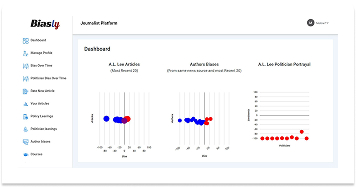
- Journalist Bias Analytics Platform: Explore how individual journalists contribute to bias within their publications.
- Politician Bias Analytics Platform: Compare how politicians are framed differently by HuffPost and other outlets.
- Media Literacy Education Platform: Learn how to critically assess media sources, bias techniques, and news reliability.
Frequently Asked Questions
HuffPost is rated as Somewhat Left based on Biasly’s media bias algorithm, which assesses sentiment, article framing, and policy favorability.
Yes, HuffPost has faced occasional accusations of misinformation and bias, including claims from readers that its reporting lacked neutrality. One such case involved HuffPost being accused of inaccurately reporting on the Environmental Protection Agency (EPA) and former acting administrator Andrew Wheeler. The EPA’s response is available here.
Biasly uses a combination of AI sentiment analysis and human analyst review to assess tone, fact accuracy, source quality, and media bias indicators. Learn more on our Bias Meter page.
Generally, yes, though partisan framing and selective reporting can affect perceived reliability.
Ratings are based on recent news using data science and A.I. technology.
Military Spending
| Date | Sentiment | Associated Article | Snippet |
|---|---|---|---|
| 08/25/2019 | 75% For | Trump Family Detentions Flores Agreement (link) | So, of course, the Trump administration is doing the opposite in a baldfaced |