




-2% Center
Bias Meter
Extremely
Liberal
Very
Liberal
Somewhat Liberal
Center
Somewhat Conservative
Very
Conservative
Extremely
Conservative
-100%
Liberal
100%
Conservative
Biasly determines media bias ratings through a dual-layered approach combining artificial intelligence and analyst review. The platform’s proprietary bias detection engine, Bias Meter, evaluates sentiment, policy position alignment, and language framing across thousands of data points in news articles. Analysts then verify and interpret the AI’s findings, providing additional context where needed. Learn more about ratings
- Profile
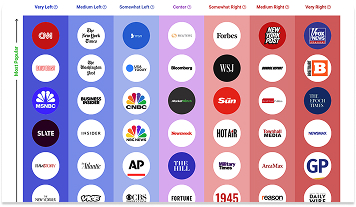
International Business Times on the media bias chart
- Bias Rating
-2% Center
- Reliability76% Reliable GoodPolicy Leanings
-2% Center
Extremely
LiberalVery
LiberalModerately
LiberalSomewhat Liberal
Center
Somewhat Conservative
Moderately
ConservativeVery
ConservativeExtremely
Conservative-100%
Liberal100%
Conservative
Average Reliability
*Our bias meter rating uses data science including sentiment analysis, machine learning and our proprietary algorithm for determining biases in news articles. Bias scores are on a scale of -100% to 100% with higher negative scores being more liberal and higher positive scores being more conservative and 0% being neutral. The rating is an independent analysis and is not affiliated nor sponsored by the news source or any other organization.
Politician Portrayal57% negative
Continue For Free
Create your free account to see the in-depth bias analytics and more.
By creating an account, you agree to our Terms and Privacy Policy, and subscribe to email updates.
Log In
Log in to your account to see the in-depth bias analytics and more.
Analysis of International Business Times Articles
Analysis of Bias in International Business Times Online Articles
To evaluate this, we can analyze select International Business Times articles through several of Biasly’s bias rating criteria: Tone, Tendency, Author, Diction, and Expediency Bias.
- Tone: The overall attitude conveyed by the article
- Diction: Specific word choices made by the writer
- Author: The background and social presence of the journalist
- Tendency: Patterns of bias in the writer’s broader body of work
- Expediency Bias: Quick visual or textual indicators like headlines and photos that imply bias
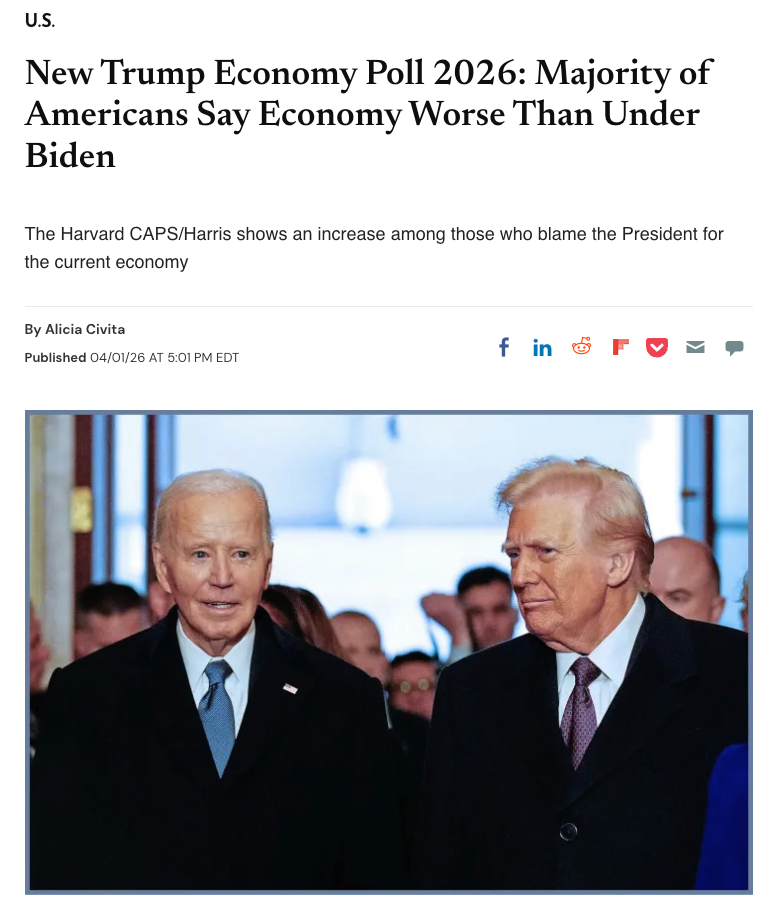
A good starting point for evaluating bias at International Business Times is the article “New Trump Economy Poll 2026: Majority of Americans Say Economy Worse Than Under Biden,” by Alicia Civita. The piece draws on the Harvard CAPS/Harris survey, finding that 53% of respondents say the economy is worse under Trump than under Biden, and that 62% blame Trump for current economic conditions.
Source: International Business Times
The hero image places Joe Biden and Donald Trump side by side, which can be read as reinforcing the headline’s before-and-after comparison. The expediency bias here is limited. The headline labels the story a “New Trump Economy Poll 2026” before stating the majority finding, so readers are told up front that the claim is a poll result, while the subheadline highlights an increase in the share of Americans who blame the president for the current economy. The article reports the 47% who said conditions have improved in its second paragraph, directly after the 53% figure.
The headline framing and the selection of this particular story illustrate a pattern seen in several of the political articles reviewed, leading with polling data that reflects negatively on the Republican administration. The reporting itself is factually grounded and properly attributed, but the story selection and headline emphasis represent a choice to amplify unflattering polling rather than equally prominent data that might support a more complex economic picture.
The article, which first appeared on IBT Media’s sister site Latin Times, also includes a response from White House spokesman Kush Desai, who said the administration remains focused on tax cuts, deregulation and energy production.
Author Alicia Civita’s public posts from before May 2025 frequently share criticism of the Trump administration’s deportation policies, and in her own words she argued that ignoring due process for undocumented immigrants threatens “the balance of power and respect of the law.” That view is consistent with a left-leaning perspective on immigration enforcement. The article itself is more restrained: it reports the poll figures in sequence and includes a White House response, so her social media lean does not carry over strongly into this piece.
Every time the government ignores due process, it expands the possibility of neglecting it for everybody else. The U.S. legal system is anchored in precedent. It’s not about undocumented immigrants only. This is about the balance of power and respect of the law.
— Alicia Civita (@aliciacivita) March 18, 2025
A contrasting article, “Stocks Jump As U.S. And Iran Halt Hostilities And Resume Negotiations; Dow Closes At New Record,” by Demian Bio, demonstrates what International Business Times’s financial reporting looks like when it’s covering market data rather than political polling. It reports on stock market movements and U.S.-Iran negotiations in a notably restrained, market-focused tone, presenting developments as factual events with market implications rather than through a partisan frame. The article also notes, citing Reuters, that Trump vowed to keep trying to remove Federal Reserve Governor Lisa Cook after an adverse Supreme Court ruling. In the articles reviewed, this split between poll-driven political coverage that emphasizes unfavorable findings and more neutral financial coverage is International Business Times’s clearest editorial pattern.
Overall, the articles reviewed are consistent with International Business Times’s Center rating: its news language is largely restrained, and its emphasis leans mainly in the selection and headlines of its political poll stories. Its financial reporting is more neutral, reflecting the business journalism focus the outlet was built on.
Much of International Business Times’s political news coverage aggregates outside polls and economic data, and the way those stories are assembled can shape the overall impression they leave.
The article “Most Americans Believe Trump Has The Wrong Priorities, Poll Shows. 7 in 10 Disapproved Of His Economic Performance,” by Brian Slupski, illustrates this pattern clearly. The headline combines two polling findings to construct a negative portrait of the administration’s standing with the public. The body of the article draws on multiple polls consistently showing low approval ratings for Trump’s economic handling, presenting them in sequence without a response from administration officials, although it does report that Americans trust the two parties about equally on the economy.
This kind of political polling coverage, which presents a series of unflattering approval ratings in sequence, is not opinion writing, but the cumulative presentation may give greater prominence to negative assessments of the administration.
Another article by Brian Slupski, “Speaker Johnson Says Trump Would Not Have The Final Say On His $5,000 Check Plan,” takes a more balanced approach, quoting House Speaker Mike Johnson’s cautious response and including a direct quote from Republican Senator Susan Collins expressing fiscal concern:
“Tax and spending decisions should be made based on the needs of the American people and the state of the economy; they should not appear to be tied to election results.”
The quotation adds an intra-party perspective and shows that criticism of the proposal was not confined to Democrats.
Analysis of International Business Times Opinion Articles
International Business Times runs an Opinion section that mainly carries contributed columns on business, technology and leadership, alongside occasional policy commentary.
One column, headlined “John Chachas: An America First Partnership Must Also Mean a Stronger Greece,” is written in the first person by investor John Chachas, a former vice chairman of the American College of Greece’s board of trustees. It uses Secretary of State Marco Rubio’s Athens address to argue for deeper U.S.-Greek cooperation in shipbuilding, industry, technology and energy, and it embraces the administration’s “America First” framing:
“An America First foreign policy should recognize a fundamental principle: a stronger, more prosperous Greece is not merely good for Greece. It is decidedly in America’s national interest.”
The column aligns with the administration’s America First foreign policy framing, although its case for investment and alliance-building abroad is not tied to a partisan domestic issue.
Another piece in the Opinion section, “Californians Deserve Greater Drug Transparency,” argues that California should go further on prescription-drug transparency. It points to misleading pharmaceutical marketing, Attorney General Rob Bonta’s 2023 lawsuit against insulin makers and pharmacy benefit managers, and the pharmacy benefit manager reforms signed by Governor Gavin Newsom, and it calls on the state to enforce its consumer-protection laws. In arguing for stronger disclosure rules, it takes a consumer-protection stance on health care regulation:
“Transparency is not an argument against innovation, it is a basic part of protecting patients.”
The two pieces take different policy approaches, which suggests that, in the pieces reviewed, International Business Times’s Opinion section does not follow a single partisan line.
Analysis of Reliability in International Business Times’s Online News Articles
International Business Times aims to provide global coverage of business, markets, technology and world affairs, and its editorial guidelines say that facts, data and quotations are checked by editors before publication and that errors are corrected with a note. Reliability can still vary by article, author and section, and much of its political coverage aggregates outside polls and reporting. Readers can check individual International Business Times stories with Biasly’s Bias Check Chrome Extension.
In the polling-heavy political coverage, the main issue is framing and emphasis rather than accuracy. Articles like “New Trump Economy Poll 2026” accurately report the polling figures they cite; the Harvard CAPS/Harris survey data is real, and the numbers are correctly reported, but the selection of which polls to highlight and how to headline their findings reflects an editorial choice that shapes reader perception beyond what the underlying data alone would support. That is consistent with International Business Times’s Good reliability score, which reflects accuracy: the figures are accurately attributed, and the framing choices are a matter of emphasis rather than factual reliability.
The financial market coverage holds up more consistently. The stock market article reports index moves and oil prices, cites Trump’s social media posts and Axios reporting on the talks, and links Reuters for the Lisa Cook ruling.
Readers should also be aware of IBT Media’s corporate legal history. In 2020, IBT Media co-founder Etienne Uzac pleaded guilty to money laundering and fraud charges in a $35 million loan scheme involving IBT Media; the case concerned the company’s financing rather than the accuracy of its journalism.
Quality of Sources and Facts Used
International Business Times often uses polling data and outside research to report on political issues. However, the framing of poll results can affect how readers interpret the overall political situation.
Consider the headline: “Most Americans Believe Trump Has The Wrong Priorities, Poll Shows. 7 in 10 Disapproved Of His Economic Performance.” The headline immediately emphasizes negative polling numbers about President Donald Trump, while the subheadline states, “Several polls paint a bleak picture for Republicans.” This framing presents the polling results as evidence of political problems for Trump and Republicans before the article explains the specific numbers behind those claims.
The article contains 3 direct quotes in quotation marks (counting partial quotes): “Six-in-ten Americans now say that Trump’s economic policies have worsened economic conditions in the country. This is up from the 52% who said this in January and the 53% who held this view last fall” (35 words), “very concerned” (2 words) and “extremely motivated” (2 words). The shortest quote is 2 words, the longest is 35 words, and the average quote length is about 13 words.
The longer quote provides substantial context because it gives readers the exact wording and historical comparison from Pew Research Center. This makes the use of the poll more transparent because readers can see that the 60% figure is not presented without its previous polling numbers. The shorter “very concerned” quote is less informative on its own, but the article immediately explains that 56% of respondents used that description when asked about gas prices.
The article links to 5 outside sources in its body: CNN’s July poll, the DocumentCloud copy of that poll, the Pew Research Center survey, Trading Economics’ inflation data and a Fox News poll. Excluding the author page, a International Business Times topic page and two International Business Times “Read more” articles, the breakdown by leaning is Left = 1 (CNN), Center = 0 and Right = 1 (Fox News), plus 3 institutional references.
- CNN, July 2026 poll conducted by SSRS on Trump’s priorities and economic approval (Left)
- DocumentCloud, hosted copy of the CNN/SSRS poll document (institutional reference)
- Pew Research Center, July 6–12, 2026 survey on the economy and the midterms (institutional reference)
- Trading Economics, U.S. inflation data (institutional reference)
- Fox News, poll on voters’ motivation to vote in the midterms (Right)
The sourcing is mostly centered on established polling and research organizations rather than partisan political sources. CNN and Pew provide the main evidence for the article’s claims about Trump, the economy, and the midterm elections. The article quotes no Republican or Democratic political figures to offer an opposing interpretation of the polling numbers. The Fox News poll on voter motivation is the only right-leaning source linked.
The author uses the polling data to emphasize negative public opinion toward Trump and the Republican Party. For example, the article opens by saying that “most Americans believe” Trump has not put America first and that his policies have worsened economic conditions. However, the article does include information that complicates a purely negative interpretation, including the finding that Americans trust Democrats and Republicans about equally on the economy, with 37% preferring Democrats and 36% preferring Republicans.
The article also gives more attention to negative polling results than positive or neutral findings. The headline focuses on Trump having the “wrong priorities” and economic disapproval, while the subheadline describes the polls as a “bleak picture” for Republicans. The article later mentions that the Democratic advantage on the generic congressional ballot was six points, but it also notes the nearly even party preference on the economy. Because the headline, subheadline and opening paragraphs foreground the most negative findings and no administration response is included, the author’s bias in this article is best described as left-leaning.
On factual accuracy, the article’s central polling claims are supported by the underlying sources. Pew Research Center’s July 6–12, 2026 survey of 3,554 U.S. adults found that 60% said Trump’s economic policies had worsened economic conditions, matching the figure used in the article. Pew also reported that 20% said the policies had made conditions better and 19% said they had little effect, providing additional context that the International Business Times article does not emphasize.
The CNN polling figures are also consistent with CNN’s reporting from July 29, 2026. CNN reported that 73% of American adults said Trump had not paid enough attention to the country’s most important problems, which matches the figure used by International Business Times. CNN’s reporting also described Trump’s overall approval and issue-specific numbers as being low at the time of the poll.
The article’s inflation discussion is also generally consistent with available economic data. Trading Economics reported that U.S. annual inflation reached 4.2% in May 2026 before falling to 3.5% in June. This supports the article’s description of inflation rising earlier in the year and then cooling in June, although the article links the rise partly to the Iran war and higher gas prices, which is an interpretation that should be distinguished from the underlying inflation figures.
Overall, the article relies on recognizable polling and economic sources and accurately reports several of the major figures from those sources. Its main limitation is not the underlying polling data but the way the results are framed: the headline, subheadline, and opening paragraphs emphasize negative findings about Trump and Republicans more heavily than the findings that complicate that narrative. The article therefore provides real polling information, but readers should distinguish the underlying survey results from the author’s characterization of what those results mean politically.
Selection and Omission Bias
Selection and omission bias at International Business Times is the clearest bias concern in the articles reviewed. In those articles, the outlet’s political coverage shows a pattern of selection of polling data, economic indicators, and political developments that reflect negatively on the current Republican administration, while giving less prominent coverage to data points that might suggest a more complicated or mixed picture.
A review of International Business Times’s 2026 political headlines shows a strong focus on polls about Trump’s economic handling, from “Majority of Americans Say Economy Worse Than Under Biden” and “7 in 10 Disapproved Of His Economic Performance” to “Trump’s Approval Hits Record Low.” Even mixed results are often headlined around the negative finding, as in “Trump Claws Back From Record-Low Approval, But Democrats Open Biggest Lead Since His Return.” Positive economic data, such as record stock market closes, does appear, but mainly in market coverage rather than in the political poll stories.
This pattern of coverage does not involve fabricating unfavorable data; the polls and economic indicators cited are real. But the consistent selection of which data to foreground and which to background is a meaningful form of omission bias that shapes the overall picture readers receive from the outlet. These examples show an emphasis in the coverage reviewed, but a broader, systematically sampled review would be needed to establish a consistent pattern.
International Business Times Bias Overview
International Business Times launched in 2006, according to its About page, and is published by IBT Media, the company co-founded by Etienne Uzac and Johnathan Davis. Based in New York City, it grew rapidly in the late 2000s and early 2010s and is now published in five national editions, of which IBT Media owns and operates the U.S. edition. The site drew roughly 573,600 visits in September 2026, according to Similarweb estimates.
That growth was accompanied and ultimately disrupted by significant institutional and legal turmoil. In 2013, IBT Media acquired Newsweek. By 2018, the company’s finances had become the subject of a Manhattan District Attorney investigation. In 2020, co-founder Etienne Uzac pleaded guilty to money laundering and fraud in a $35 million scheme. Newsweek had already been spun off as a separate entity in 2018, and the parent company, which had renamed itself Newsweek Media Group in 2017, returned to the IBT Media name. The case is relevant to IBT Media’s corporate history, although the criminal conduct concerned financing and corporate records rather than the accuracy of International Business Times journalism.
According to Pew Research Center, 62% of U.S. adults said in September 2026 that they have at least some trust in information from national news organizations, up six points from 2025 but lower than a decade ago.
Is International Business Times Biased?
Based on Biasly’s evaluations, International Business Times is rated as Center.
By examining content patterns and the broader context of media influence, we aim to offer a balanced perspective on International Business Times’s political bias—and contribute to the ongoing discussion about bias in the news.
How Does Biasly Rate News Sources?
Biasly uses proprietary algorithms and a team of analysts to provide comprehensive bias evaluations across thousands of news outlets. Over 200,000 articles from more than 3,200 sources have been analyzed to identify the most accurate and unbiased stories.
Biasly assigns each outlet three key scores:
- Reliability Score – Reflects factual accuracy
- AI Bias Score – Generated via natural language processing
- Analyst Bias Score – Assessed by human political analysts
These scores are based on seven core metrics: Tone, Tendency, Diction, Author Check, Selection/Omission, Expediency Bias, and Accuracy. These elements help analysts and algorithms evaluate the political attitude conveyed by each article.
Biasly’s Bias Meter ranges from -100% (most left) to +100% (most right), with 0% indicating neutrality. The system evaluates individual articles based on political terms, policies, figures, and sentiment to calculate precise bias ratings.
Is International Business Times Politically Biased?
International Business Times earns a Center rating for its AI Bias Score and a Somewhat Left for its Analyst Bias Score. The Analyst Bias Score is generated by reviewers from liberal, moderate, and conservative backgrounds.
Where International Business Times’s coverage does lean, it is most visible in its political coverage pattern rather than in explicitly biased language. Former journalists who worked at International Business Times told The Guardian as early as 2014 that the outlet at times operated more as a “content farm,” demanding high-volume output and pressuring reporters to maximize readership, than as a source of quality journalism. That emphasis on volume and traffic, while not ideologically driven, is relevant context for how headlines are written.
How to Evaluate Bias
Although Biasly rates International Business Times as Center, it’s important to remember that bias can vary from article to article. International Business Times also covers markets, business and politics for a national and international audience, and its tone can differ between its financial and political coverage. This complexity underscores the importance of examining each article individually. So, let’s learn how to evaluate media bias.
Recognizing media bias requires awareness and critical thinking. Often, readers trust news sources that affirm their existing beliefs—a psychological tendency known as confirmation bias. This makes it harder to identify slanted narratives or one-sided reporting.
To address this, it’s essential to challenge your assumptions by consulting multiple perspectives and verifying information through third-party analysis. Tools like Biasly’s media bias ratings allow readers to compare the same news story across the political spectrum.
Ultimately, bias isn’t always a matter of what is said—it’s also about what is left out, how topics are framed, and which stories are chosen for coverage. Learning to recognize these patterns can help readers make more informed decisions and develop greater media literacy.
To start comparing news outlets and gain a better understanding of bias, sign up for Biasly’s Media Bias & News Analytics Platform to see how stories vary between sources.
International Business Times Reliability Overview
Is International Business Times Reliable?
International Business Times holds a Good Reliability Score on Biasly, reflecting generally competent journalism in its core coverage areas. That assessment reflects the outlet’s current journalism rather than its corporate history, which presents a more complicated picture.
The outlet’s polling coverage accurately reports data from credible survey organizations. Its financial coverage draws on named institutional sources with verifiable data. The political articles examined for this narrative generally reported their central polling figures accurately.
How to Evaluate Reliability?
Reliability refers to how trustworthy or accurate a news source is. If we can’t trust what we read, then continuing to consume content from that outlet serves little purpose. So how do we evaluate a news outlet’s reliability?
There are several key indicators of reliability to consider when assessing a media source. Red flags of an unreliable article can include wild, unsubstantiated claims, facts that depend on other unreliable sources, heavy use of opinionated language, and more. In contrast, hallmarks of a reliable source include:
- Absence of subjective language
- Citing credible sources (e.g., .gov, .edu, academic references)
- Verifiable facts and statistics from multiple outlets
- Use of primary sources, like interviews or transcripts
- Consistency with coverage across other platforms
Biasly’s reliability scores incorporate these elements in evaluating media outlets.
So How Does International Business Times Fare in Its Reliability?
The political reliability index developed by Biasly assesses both accuracy and trustworthiness. International Business Times currently holds Good Reliability Score, which is calculated as a weighted average of:
- Fact Analysis Score – Evaluates the accuracy of claims, facts, and evidence.
- Source Analysis Score – Assesses the number, diversity, and credibility of sources and quotes used.
International Business Times’s Source Analysis Score is Average at 59% Reliable. This reflects how Biasly rates the trustworthiness of its sourcing practices. The score is AI-generated and considers quote length, frequency, diversity, and quality.
The Fact Analysis Score of International Business Times is Good at 81% Reliable. This further shows how well International Business Times supports its claims, addresses selection and omission bias, and presents verifiable evidence.
International Business Times’s Accuracy and Reliability
According to Biasly’s analysis, International Business Times maintains Good Reliability Score, but individual articles may vary significantly. Let’s dive into the details.
The two most common reliability concerns in International Business Times’s coverage are:
- Selection Bias – foregrounding, in the articles reviewed, polling data and economic indicators that reflect negatively on the current Republican administration while backgrounding comparable data that might complicate the narrative
- Framing Issues – constructing cumulative negative portraits of the administration through sequences of unflattering polling figures, in ways that go beyond neutral reporting while stopping short of explicit editorializing
The Trump economy polling articles discussed earlier are the clearest examples, individually accurate in their data, but collectively constructing a one-sided picture of economic conditions and public opinion through consistent story selection.
By contrast, the stock market and financial coverage holds up well under scrutiny, drawing on verifiable institutional data and presenting market movements in a generally neutral, informative register.
In the articles reviewed, International Business Times’s political poll coverage should be read with awareness of its selection patterns, and IBT Media’s corporate legal history is relevant context, although it concerned financing rather than the accuracy of its journalism.
So, is International Business Times Reliable?
Overall, International Business Times can be considered to be an outlet that is very reliable. The articles reviewed generally support their central factual claims with polling data, financial information, named sources, and attributable quotations. Occasional omissions and framing bias do appear, particularly in political poll coverage.
As media literacy improves, readers can more easily detect issues with selection bias, omission bias, and factuality. To strengthen your ability to assess reliability across the political spectrum, use Biasly’s News Bias Checker to compare how multiple outlets report the same story.
This empowers you to consume more accurate, balanced, and dependable news.
International Business Times Editorial Patterns
International Business Times’s coverage of political topics often reflects a Center bias, with consistent patterns in phrasing, source selection, and thematic focus that are Neutral. The outlet was founded as a business news platform rather than a political advocacy outlet, and that founding identity is still visible in the quality and balance of its core financial coverage, even as some of its political poll coverage, in the articles reviewed, emphasizes findings unfavorable to the administration.
Coverage of Liberal vs. Conservative Topics
International Business Times’s coverage of economic performance under Republican governance often emphasizes public dissatisfaction, declining approval ratings, and economic anxiety. Stories highlighting 53% of Americans saying the economy is worse than under Biden and 7 in 10 Americans disapproving of Trump’s economic performance appeared as prominent political stories in 2026, and even a story reporting that Trump’s approval had edged up from a record low paired that finding with Democrats opening their biggest lead since his return.
The articles reviewed here provide clearer evidence of negative framing toward the Republican administration than of how International Business Times treats comparable Democratic policies. The article on Trump’s $5,000 check proposal is notable as one of the more balanced pieces reviewed; it includes Republican Senator Susan Collins’ fiscal criticism of the proposal, which adds an intra-party perspective to what could have been a straightforwardly negative piece about a Republican initiative.
Policy and Issue Framing
On economic policy, International Business Times often foregrounds public dissatisfaction with the current administration’s handling of inflation, household costs, and economic direction, concerns that are real and documented, while giving less prominent coverage to economic data the administration cites as positive indicators. Coverage of tax and spending proposals, such as the $5,000 check plan, often centers on cost and the national debt. On monetary policy, its market coverage noted Trump’s vow to keep trying to remove Federal Reserve Governor Lisa Cook after the Supreme Court ruled against him, without added commentary.
On foreign policy and the Iran war coverage, International Business Times reports developments primarily through their market impact, how oil prices and stock markets respond to diplomatic developments — which produces a notably more neutral framing than its domestic political polling coverage.
Coverage and Relevance
International Business Times’s coverage is particularly relevant to readers interested in the intersection of financial markets and political developments, an area where its business journalism heritage produces more balanced and better-sourced reporting than its domestic political polling coverage. For readers primarily interested in how political events affect markets, trade, and the broader economy, International Business Times offers useful coverage that benefits from its global business news infrastructure.
Readers who want to explore how International Business Times’s framing compares to other outlets can visit Biasly’s Media Bias Chart to analyze tone and word choice across outlets in real time.
Funding and Ownership
Who Owns International Business Times?

Source: Wikimedia Commons
International Business Times is published and owned by IBT Media Inc. and operated by IBTimes LLC, based in New York City. The outlet was co-founded by Etienne Uzac and Johnathan Davis. In August 2026, IBT Media announced that all of its shares had been transferred to a Delaware perpetual purpose trust with no beneficiaries, overseen by an independent institutional trustee.
In February 2020, Uzac pleaded guilty in Manhattan Criminal Court to money laundering in the second degree and scheme to defraud in the first degree, in connection with a $35 million fraudulent loan scheme that involved IBT Media and its former partner, Christian Media Corporation. IBT Media itself also pleaded guilty to a scheme to defraud and paid $50,000 in forfeiture. The scheme involved falsifying business records and misrepresenting Newsweek’s financial health to obtain fraudulent loans. Uzac received no jail time under the plea agreement, with his attorney noting that the loans had been repaid.
International Business Times’s About page lists Etienne Uzac as chief executive officer, Timothy Manni as editorial director and Demian Bio as deputy editor. It describes the outlet’s mission this way:
“We aim to combine breaking news with analytical depth, data-driven reporting, and long-form journalism that explains how economic forces, institutions, and ideas shape outcomes in the modern world. We pursue truth without narrative distortion and apply consistent standards across our coverage.”
Who Funds International Business Times?
International Business Times is a for-profit media company funded primarily through digital advertising revenue. Beyond display advertising, the site runs sponsored and partner sections such as Spotlight, CEO Spotlight and Press Release, along with a Deals & Reviews section. Its 2013 revenues were reported at approximately $21 million. IBT Media is privately held and does not publish financial results, so the exact revenue mix cannot be independently assessed.
The most significant and unusual element of International Business Times’s funding history is the connection between IBT Media and David Jang, a South Korean-born pastor and founder of the World Olivet Assembly, a faith-based organization. Both Uzac and Davis were reportedly supporters of Jang’s teachings, and Jang’s organization, Olivet University, was implicated in the 2018 fraud investigation that eventually led to Uzac’s guilty plea. Olivet University itself pleaded guilty to conspiracy and falsifying business records and was ordered to pay $1.25 million in forfeiture.
These connections are part of IBT Media’s corporate history; they concern how the company was financed and do not by themselves establish bias in International Business Times’s reporting.
Newsweek, which IBT Media acquired in 2013 and which was separated from IBT Media in 2018, sued IBT Media in 2022 seeking more than $35 million in damages. In June 2026, a New York court entered a judgment of nearly $11 million against IBT Media over payroll-tax obligations that Newsweek had paid, while IBT Media continues to dispute the 2018 separation.
Additional Insights
News Source Comparison
International Business Times is best compared to other digital-native global business news outlets that have expanded into political coverage, publications like Business Insider, which similarly emerged from business and financial journalism traditions before becoming broader general news platforms. Among Center-rated outlets, International Business Times distinguishes itself through its global footprint, with five national editions (the United States, United Kingdom, Australia, India and Singapore), which gives it broader international coverage than most comparable U.S.-based outlets. Only the U.S. edition is owned by IBT Media; the other four are independently owned. Readers seeking more explicit financial coverage may find The Wall Street Journal or Bloomberg worth comparing, while readers interested in international business news may find International Business Times’s global edition structure useful for comparing how economic developments are framed across different national markets.
Notable Contributors and Authors
International Business Times’s news coverage is primarily staff-written. Deputy Editor Demian Bio covers markets and the economy, while reporters such as Brian Slupski and Matias Civita write much of its poll-driven political coverage, and some of its political stories, including pieces by Slupski and Alicia Civita, first appear on IBT Media’s sister site Latin Times. Its Opinion section mainly carries contributed columns on business, technology and leadership.
Former journalists who spoke to The Guardian in 2014 described an editorial culture that emphasized high-volume output and readership metrics above all else, a content farm model that prioritized traffic over quality. Whether that culture has changed since then is not publicly documented.
Related Tools and Resource Pages
To better understand how International Business Times fits into the broader media landscape, we recommend exploring these helpful resources:
- Media Bias Chart: See where International Business Times ranks among hundreds of media outlets across the political spectrum.
- Political Bias Chart: Visualize political slants of news sources across various policy areas.
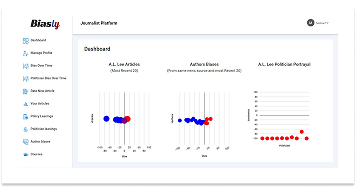
- Journalist Bias Analytics Platform: Explore how individual journalists contribute to bias within their publications.
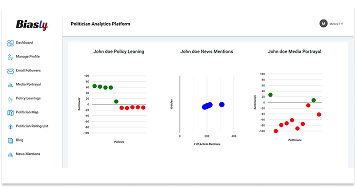
- Politician Bias Analytics Platform: Compare how politicians are framed differently by International Business Times and other outlets.
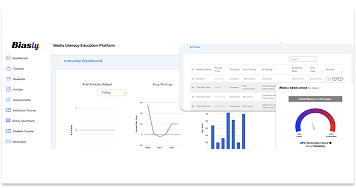
- Media Literacy Education Platform: Learn how to critically assess media sources, bias techniques, and news reliability.
Frequently Asked Questions
International Business Times is rated as Center based on Biasly’s media bias algorithm, which assesses sentiment, article framing, and policy favorability.
International Business Times has faced two distinct types of credibility concerns, one journalistic and one institutional. On the journalistic side, a 2026 Snopes fact check found that a International Business Times story had wrongly attributed a list of likely U.S. target cities to a nuclear historian, and former staff told The Guardian in 2014 that the outlet at times operated as a high-volume “content farm.” On the institutional side, the 2020 criminal case involving IBT Media and its co-founder concerned the company’s financing rather than its journalism, and it is covered in the Funding and Ownership section above.
Biasly uses a combination of AI sentiment analysis and human analyst review to assess tone, fact accuracy, source quality, and media bias indicators. Learn more on our Bias Meter page.
Generally, yes, though partisan framing and selective reporting can affect perceived reliability.
Military Spending
| Date | Sentiment | Associated Article | Snippet |
|---|---|---|---|
| 08/25/2019 | 75% For | Trump Family Detentions Flores Agreement (link) | So, of course, the Trump administration is doing the opposite in a baldfaced |