




38% Somewhat Right
Bias Meter
Extremely
Liberal
Very
Liberal
Somewhat Liberal
Center
Somewhat Conservative
Very
Conservative
Extremely
Conservative
-100%
Liberal
100%
Conservative

Biasly determines media bias ratings through a dual-layered approach combining artificial intelligence and analyst review. The platform’s proprietary bias detection engine, Bias Meter, evaluates sentiment, policy position alignment, and language framing across thousands of data points in news articles. Analysts then verify and interpret the AI’s findings, providing additional context where needed. Learn more about ratings
- Profile
Lew Rockwell on the media bias chart

- Bias Rating
38% Somewhat Right
- Reliability59% Reliable AveragePolicy Leanings
30% Somewhat Right
Extremely
LiberalVery
LiberalModerately
LiberalSomewhat Liberal
Center
Somewhat Conservative
Moderately
ConservativeVery
ConservativeExtremely
Conservative-100%
Liberal100%
Conservative
Average Reliability
*Our bias meter rating uses data science including sentiment analysis, machine learning and our proprietary algorithm for determining biases in news articles. Bias scores are on a scale of -100% to 100% with higher negative scores being more liberal and higher positive scores being more conservative and 0% being neutral. The rating is an independent analysis and is not affiliated nor sponsored by the news source or any other organization.
Politician Portrayal99% negative
Continue For Free
Create your free account to see the in-depth bias analytics and more.
By creating an account, you agree to our Terms and Privacy Policy, and subscribe to email updates.
Log In
Log in to your account to see the in-depth bias analytics and more.
Analysis of Lew Rockwell Articles
Analysis of Bias in Lew Rockwell Online Articles
To evaluate this, we can analyze select Lew Rockwell articles through several of Biasly’s bias rating criteria: Tone, Tendency, Author, Diction, and Expediency Bias.
- Tone: The overall attitude conveyed by the article
- Diction: Specific word choices made by the writer
- Author: The background and social presence of the journalist
- Tendency: Patterns of bias in the writer’s broader body of work
- Expediency Bias: Quick visual or textual indicators like headlines and photos that imply bias
Source: Lew Rockwell
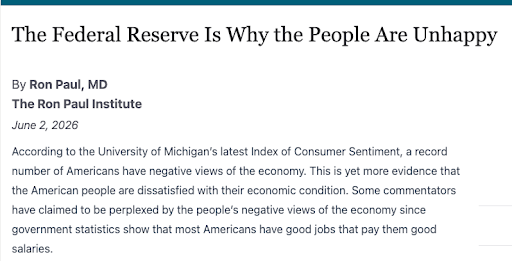
A good starting point for evaluating bias at Lew Rockwell is the article “The Federal Reserve Is Why the People Are Unhappy,” by Ron Paul, published June 2, 2026. The piece argues that the Federal Reserve’s monetary policy is the root cause of American economic dissatisfaction, declining purchasing power, and growing consumer debt. The expediency bias here is built into the headline itself by asserting causation as established fact; the title presents a contested economic argument as settled truth before the reader has seen a single piece of evidence.
Inside the piece, the diction consistently reflects the libertarian framework driving the site’s editorial identity. The site describes government statistics as “manipulated,” characterizes the Federal Reserve as enabling “the welfare-warfare state,” and rests its premise on Austrian School economic assumptions that mainstream economists do not share. A representative passage reads:
“The main reason why even many Americans with above-average incomes are dissatisfied with the economy is high prices. According to the latest Personal Consumption Expenditures (PCE) price index, which is known as the Federal Reserve’s favorite measure of inflation, prices have increased by an understated 3.8 percent over the past year.”
The word “understated” is found in a lot of editorial work here; it presupposes that official inflation data is deliberately minimized by the government. While the author attempts to substantiate this by citing alternative commentators, such as Trip Powers on Substack regarding unemployment metrics and economist Mike Shedlock on household debt, these citations rely on fringe or ideological alternative frameworks rather than mainstream economic consensus. This pattern, presenting ideological premises as established facts while dismissing official data as manipulated, is one of the most consistent features of Lew Rockwell’s content across its many contributors.
A second article, “The American Presidency and Perpetual War,” by Andrew Napolitano, published July 23, 2026, is more analytically grounded. The piece argues that modern presidents have systematically bypassed Congress’s constitutional authority to declare war, drawing on specific historical examples across both Democratic and Republican administrations. The framing is consistent with Lew Rockwell’s anti-interventionist philosophy, but the argument is built on verifiable constitutional and historical facts rather than fringe claims:
“One of the defining failures of modern American government has been the steady erosion of Congress’s constitutional authority over war. The Constitution grants Congress – not the president – the power to declare war.”
This critique of executive war-making power is not fringe; it is shared by constitutional scholars across the political spectrum. The article’s analysis of the last six presidents as representing “a uniparty continuum of executive overreach” reflects Lew Rockwell’s libertarian skepticism of both major parties, which is one of the ways its editorial orientation doesn’t map neatly onto a single left-right axis.
Trump’s Iran War Is Crushing Us … And The American People Have Made The Connection https://t.co/XLJYZ3podT
— Ron Paul (@RonPaul) October 7, 2026
Prominent contributor Ron Paul frequently utilizes social media to highlight key libertarian stances on foreign policy and military intervention. In posts like the one above, Paul criticizes U.S. involvement in foreign conflicts, arguing that foreign interventionism poses a severe economic and personal burden on the American public. This framing exemplifies Lew Rockwell’s overarching editorial focus on non-interventionism, government skepticism, and anti-war advocacy.
Overall, Lew Rockwell’s content reflects a consistent and explicitly stated ideological orientation: anti-government, anti-Federal Reserve, anti-interventionist, and deeply skeptical of mainstream institutions and official narratives. That orientation produces content ranging from constitutionally grounded foreign policy criticism to economic analysis built on contested Austrian School premises to outright fringe claims about vaccines, conspiracies, and pseudoscience. Readers should approach individual articles with awareness of which category they’re reading.
Analysis of Lew Rockwell Opinion Articles
Lew Rockwell primarily publishes and republishes opinion, commentary, and ideological analysis rather than operating as a conventional straight-news newsroom, a distinction the site itself does not always make explicitly clear. Unlike traditional newspapers that label editorial content separately from news, Lew Rockwell presents virtually all of its articles as analysis or commentary without drawing a clear line between factual reporting and advocacy. This is consistent with the site’s identity as an explicitly ideological platform rather than a journalism outlet in the conventional sense.
The article “We Are Facing Satan’s Victory,” by Paul Craig Roberts, published in July 2026, illustrates the most extreme end of Lew Rockwell’s content spectrum. The piece characterizes U.S. and NATO foreign policy as a “permanent war designed to weaken and destroy Russia and Iran,” frames geopolitical events through a conspiratorial lens, and draws conclusions that go well beyond what the cited evidence supports. This type of content is not merely opinionated, but rather presents ideological interpretation as factual analysis without adequate evidentiary grounding.
By contrast, the article “July 4, 2026,” by Andrew Napolitano, demonstrates what the site’s better analytical content looks like. The piece uses James Madison’s arguments against a national bank as a vehicle for examining the constitutional limits of a federal power, drawing on primary historical sources and making arguments that are internally consistent and factually grounded even if readers may disagree with their conclusions. The diction is elevated, and the argument is structured.
“In his famous Bank Speech, Madison argued eloquently against legislation chartering a national bank because the authority to create a bank was not in the Constitution and was retained by the states and reserved to them.”
That kind of historically grounded argumentation is a different beast from the conspiratorial framing that appears elsewhere on the same site. The variability between Lew Rockwell’s best and worst content is one of its defining characteristics, making individual article evaluation particularly important.
Analysis of Reliability in Lew Rockwell’s Online News Articles
Lew Rockwell presents significant reliability concerns that set it apart from the majority of other sources covered by Biasly. The Southern Poverty Law Center has placed the site on its Hatewatch list. These are not assessments that Biasly endorses wholesale; rating organizations can disagree significantly on methodology, but they reflect real and documented reliability concerns that readers should be aware of.
The most well-documented reliability issue at Lew Rockwell is its history of promoting COVID-19 misinformation. In March 2020, Ron Paul published an article on the site titled “The Coronavirus Hoax,” arguing that the threat was being exaggerated and used to justify expansive government intervention. During the COVID vaccine rollout, the site published articles from figures like Peter McCullough urging “unbreakable resistance” to vaccines for children, sourced from other outlets that independent fact-checkers had found to be consistently unreliable. This pattern, amplifying health misinformation from a network of mutually reinforcing fringe sources, is the clearest documented example of how Lew Rockwell’s reliability problems operate in practice.
The economic content presents a different kind of reliability issue. Articles like “The Permanent Bailout” and “America’s Sovereign Debt Crisis Has Already Begun” contain some accurate macroeconomic observations embedded in an Austrian School framework. The articles interpret macroeconomic data through Austrian School Theory, which differs substantially from dominant approaches in contemporary academic macroeconomics. The primary data points cited are verifiable, such as rising federal debt, the Federal Reserve’s open market purchases of Treasury securities, and declining purchasing power. The conclusions drawn and the causal mechanisms proposed reflect a specific ideological perspective rather than the broader consensus among mainstream economists.
Quality of Sources and Facts Used
Lew Rockwell regularly publishes opinion articles from a libertarian, anti-government perspective. While many articles cite economic data and current events, they typically interpret those facts through a strong ideological lens that favors limited government, sound money, and reduced federal power.
Consider the article “The Federal Reserve Is Why the People Are Unhappy.” Ron Paul argues that the Federal Reserve is the primary cause of Americans’ economic frustration, claiming that inflation, declining purchasing power, and rising debt all stem from the central bank’s monetary policies. Throughout the article, alternative economic explanations receive little attention, and nearly every argument supports the author’s longstanding criticism of the Federal Reserve.
But can readers find evidence supporting the opposing viewpoint? Paul briefly acknowledges that “government statistics show that most Americans have good jobs that pay them good salaries,” but he immediately dismisses those figures as manipulated without discussing why many economists continue to rely on them. Instead, the article consistently presents evidence supporting the author’s own conclusions.
“Government statistics are manipulated to understate the true rates of inflation and unemployment.”
“The culprit behind the price increases is the Federal Reserve.”
“Without the Federal Reserve, the US government would have to finance the welfare-warfare state via direct taxation.”
The article concludes by arguing that the current monetary system will eventually collapse and that a “restoration of liberty” depends on replacing the Federal Reserve’s system. Because opposing economic perspectives are almost entirely absent, readers are presented with only one explanation for today’s economic conditions.
The article contains 4 direct quotes in quotation marks (counting partial quotes): “government statistics show that most Americans have good jobs that pay them good salaries” (12 words), “affordability” (1 word), “government statistics are manipulated to understate the true rates of inflation and unemployment” (11 words), and “The culprit behind the price increases is the Federal Reserve” (10 words). The shortest quote is 1 word, the longest is 12 words, and the average quote length is 8.5 words.
Because the article is almost entirely written in Ron Paul’s own voice, it contains very few attributed quotations from outside sources. Longer quotations generally improve reliability because they provide readers with more context and reduce selective editing, but in this article the quotations primarily reinforce the author’s own argument rather than presenting competing viewpoints.
On linked sources, the article uses a small number of supporting references. It mentions the University of Michigan Consumer Sentiment Index, economist Trip Powers’ Substack, an analysis by economist Mike Shedlock, Federal Reserve data, and the Personal Consumption Expenditures (PCE) Price Index. By political classification, the sourcing is approximately Left = 0, Center = 4, and Right = 2. Most of the factual references come from center/institutional economic data, while the interpretation comes almost entirely from libertarian commentators.
- Ron Paul, former U.S. Representative and opinion author (Right/Libertarian)
- The Ron Paul Institute, publisher (Right/Libertarian)
- LewRockwell.com, news and opinion website (Right/Libertarian)
- University of Michigan Consumer Sentiment Index, economic survey (Center/Institutional)
- Federal Reserve, U.S. central banking system (Center/Institutional)
- Personal Consumption Expenditures (PCE) Price Index, federal inflation measure (Center/Institutional)
- Trip Powers, Substack economic commentator (Right/Libertarian)
- Mike Shedlock, economist and financial analyst (Center-Right)
- President Donald Trump, referenced regarding his 2024 campaign promises (Right)
- Democratic Party, referenced in affordability discussion (Left)
- President Richard Nixon, referenced for ending the dollar’s link to gold (Center/Historical)
The sourcing is not balanced because the article overwhelmingly relies on sources and commentary that support the author’s libertarian economic philosophy. Institutional data from the Federal Reserve and the University of Michigan are referenced, but primarily to argue that official statistics underestimate economic problems. Alternative explanations from mainstream economists or Federal Reserve officials are not presented, leaving Ron Paul’s interpretation to dominate nearly the entire article.
In how sources are used, Paul consistently directs skepticism toward the Federal Reserve and the federal government while treating alternative economic viewpoints as either incomplete or misleading. Statements such as “Government statistics are manipulated to understate the true rates of inflation and unemployment” and “The culprit behind the price increases is the Federal Reserve” frame the central bank as the primary cause of nearly every economic problem discussed.
Little effort is made to acknowledge competing explanations, such as global supply-chain disruptions, fiscal policy, labor markets, or international economic conditions. Because the article consistently advances libertarian monetary theory while providing minimal space for opposing viewpoints. Biasly’s rating system classified the authors’ overall bias as Right, reflecting the article’s consistent alignment with libertarian economic and foreign policy perspectives.
On factual accuracy, the article correctly states that President Nixon ended the U.S. dollar’s convertibility into gold in 1971 and that inflation has reduced purchasing power over time. It is also accurate that household debt and federal debt have increased significantly over the past several decades. However, many of the article’s broader conclusions—particularly that the Federal Reserve is the primary cause of inflation, that official unemployment statistics are intentionally manipulated, and that the current monetary system is likely to collapse—are matters of economic interpretation rather than settled fact.
Mainstream economists generally attribute inflation to multiple factors, including monetary policy, fiscal policy, consumer demand, global supply chains, and energy prices. As a result, while the underlying facts cited are generally accurate, many of the article’s central arguments reflect Ron Paul’s libertarian economic philosophy rather than broad economic consensus.
Selection and Omission Bias
Selection and omission bias at Lew Rockwell operates at a more fundamental level than at conventional news outlets. The site’s entire editorial model is built around platforming perspectives that are systemically excluded from mainstream media, which means that by design, most articles present one side of a debate without engaging seriously with the mainstream counterargument.
The Federal Reserve article is a clear example. The argument that the Fed’s monetary policy is the primary driver of American economic discontent is presented as self-evident, with the government inflation data dismissed as manipulated and mainstream economic consensus ignored entirely. A reader who consumed only this article would have no way of knowing that most economists, including those who are critical of the Federal Reserve on other grounds, do not accept the Austrian School’s causal framework for understanding monetary policy and inflation.
This pattern, presenting the libertarian or anarcho-capitalist position as established truth while treating mainstream institutional perspectives as inherently corrupt or dishonest, is the defining selection and omission issue at Lew Rockwell and is more fundamental than the framing choices seen at conventional news outlets with a political lean.
The Paul Craig Roberts piece on U.S. foreign policy shows a similar dynamic. While there are legitimate constitutional and strategic critiques of American military interventionism, critiques shared by scholars across the political spectrum, Roberts’ framing characterizes the entire geopolitical situation through a conspiratorial lens that goes well beyond those legitimate critiques, without engaging with any contrary evidence or alternative interpretation.
Lew Rockwell Bias Overview
Lew Rockwell was launched in 1999 by Lew Rockwell and Burt Blumert. Rockwell, who describes the site’s purpose as providing “a daily dose of news and opinions questioning the ‘official’ narrative on the economy, foreign policy, and every other topic of interest to libertarians,” is also the co-founder and chairman of the Ludwig von Mises Institute. He previously served as chief of staff to Congressman Ron Paul and as editorial assistant to Ludwig von Mises. The site is owned by Lew Rockwell LLC and generates revenue through advertising and donations.
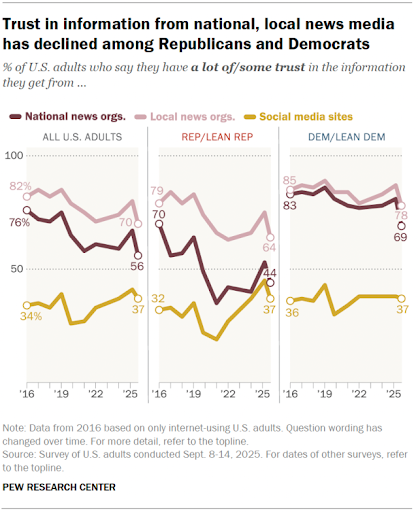
Understanding why a site like Lew Rockwell attracts hundreds of thousands of monthly visitors requires understanding the current media environment. According to a Pew Research Center survey conducted in December 2025, trust in national news organizations has declined significantly, with only 56% of U.S. adults saying they have at least some trust in the information they get from national news organizations, down 11 percentage points since March 2025.
Source: Pew Research
That declining trust in mainstream institutions is the ecosystem in which Lew Rockwell operates and thrives. Readers who feel that conventional media consistently fails to represent their perspective, particularly those skeptical of government power, central banking, and military interventionism, turn to Lew Rockwell for commentary that challenges mainstream institutional narratives.
Is Lew Rockwell Biased?
Based on Biasly’s evaluations, Lew Rockwell is rated as Somewhat Right.
By examining content patterns and the broader context of media influence, we aim to offer a balanced perspective on Lew Rockwell’s political bias—and contribute to the ongoing discussion about bias in the news.
How Does Biasly Rate News Sources?
Biasly uses proprietary algorithms and a team of analysts to provide comprehensive bias evaluations across thousands of news outlets. Over 200,000 articles from more than 3,200 sources have been analyzed to identify the most accurate and unbiased stories.
Biasly assigns each outlet three key scores:
- Reliability Score – Reflects factual accuracy
- AI Bias Score – Generated via natural language processing
- Analyst Bias Score – Assessed by human political analysts
These scores are based on seven core metrics: Tone, Tendency, Diction, Author Check, Selection/Omission, Expediency Bias, and Accuracy. These elements help analysts and algorithms evaluate the political attitude conveyed by each article.
Biasly’s Bias Meter ranges from -100% (most left) to +100% (most right), with 0% indicating neutrality. The system evaluates individual articles based on political terms, policies, figures, and sentiment to calculate precise bias ratings.
Is Lew Rockwell Politically Biased?
Lew Rockwell earns a Somewhat Right rating for its AI Bias Score and a Somewhat Right for its Analyst Bias Score. The Analyst Bias Score is generated by reviewers from liberal, moderate, and conservative backgrounds.
Lew Rockwell presents an unusual case for bias analysts because its libertarian anarcho-capitalist philosophy doesn’t map cleanly onto the conventional left-right spectrum. The site opposes military intervention and government surveillance, positions often associated with the left, while also opposing taxation, regulation, and social welfare programs, positions associated with the right. What makes it consistently right-leaning in Biasly’s assessment is its rejection of government authority across all domains, its framing of virtually all state action as coercive and illegitimate, and its sourcing from a network of contributors and outlets classified as right-leaning.
Lew Rockwell has been notably transparent about its ideological mission since its founding. The site’s motto, “Anti-State, Anti-War, Pro-Market,” is displayed prominently on its homepage, and Rockwell has consistently described the site’s purpose as challenging official narratives rather than reporting news neutrally. The site’s openly ideological mission differs from the conventional straight-news norm of separating reporting from advocacy.
How to Evaluate Bias
Although Biasly rates Lew Rockwell as Somewhat Right, it’s important to remember that bias can vary from article to article. Lew Rockwell also covers a wide range of topics with varying degrees of analytical rigor. This complexity underscores the importance of examining each article individually. So, let’s learn how to evaluate media bias.
Recognizing media bias requires awareness and critical thinking. Often, readers trust news sources that affirm their existing beliefs—a psychological tendency known as confirmation bias. This makes it harder to identify slanted narratives or one-sided reporting.
To address this, it’s essential to challenge your assumptions by consulting multiple perspectives and verifying information through third-party analysis. Tools like Biasly’s media bias ratings allow readers to compare the same news story across the political spectrum.
Ultimately, bias isn’t always a matter of what is said—it’s also about what is left out, how topics are framed, and which stories are chosen for coverage. Learning to recognize these patterns can help readers make more informed decisions and develop greater media literacy.
To start comparing news outlets and gain a better understanding of bias, sign up for Biasly’s Media Bias & News Analytics Platform to see how stories vary between sources.
Lew Rockwell Reliability Overview
Is Lew Rockwell Reliable?
Lew Rockwell presents serious reliability concerns that distinguish it from most other outlets evaluated on Biasly’s platform. Unlike publications where reliability issues emerge primarily through framing and omission, Lew Rockwell has a documented history of publishing content that independent fact-checkers have found to be factually false, especially on public health topics during the COVID-19 pandemic.
The main reliability concerns involve questionable sourcing, propaganda, conspiracy theories, and failed fact checks. Given the documented reliability problems in some areas, readers should independently verify consequential factual claims, particularly in health, science, and conspiracy-related content.
How to Evaluate Reliability?
Reliability refers to how trustworthy or accurate a news source is. If we can’t trust what we read, then continuing to consume content from that outlet serves little purpose. So how do we evaluate a news outlet’s reliability?
There are several key indicators of reliability to consider when assessing a media source. Red flags of an unreliable article can include wild, unsubstantiated claims, facts that depend on other unreliable sources, heavy use of opinionated language, and more. In contrast, hallmarks of a reliable source include:
- Absence of subjective language
- Citing credible sources (e.g., .gov, .edu, academic references)
- Verifiable facts and statistics from multiple outlets
- Use of primary sources, like interviews or transcripts
- Consistency with coverage across other platforms
Biasly’s reliability scores incorporate these elements in evaluating media outlets.
So How Does Lew Rockwell Fare in Its Reliability?
The political reliability index developed by Biasly assesses both accuracy and trustworthiness. Lew Rockwell currently holds Average Reliability Score, which is calculated as a weighted average of:
- Fact Analysis Score – Evaluates the accuracy of claims, facts, and evidence.
- Source Analysis Score – Assesses the number, diversity, and credibility of sources and quotes used.
Lew Rockwell’s Source Analysis Score is Average at 59% Reliable. This suggests moderate trustworthiness in its sourcing practices. The score is AI-generated and considers quote length, frequency, diversity, and quality.
The Fact Analysis Score of Lew Rockwell is Pending at N/A. This further shows how well Lew Rockwell supports its claims, addresses selection and omission bias, and presents verifiable evidence.
Lew Rockwell’s Accuracy and Reliability
According to Biasly’s analysis, Lew Rockwell maintains Average Reliability Score, but individual articles may vary significantly. Let’s dive into the details.
The two most common reliability concerns in Lew Rockwell’s content are:
- Selection Bias – presenting the libertarian or anarcho-capitalist position as established truth while treating mainstream institutional perspectives as inherently corrupt or dishonest.
- Source Verification Gaps – republishing content from other outlets and contributors that independent fact-checkers have found to be consistently unreliable, particularly on health and science topics.
The COVID-19 coverage discussed earlier is the clearest documented example of the second concern, not merely framing bias, but publication of factually false claims from sources that lacked scientific credibility. The Federal Reserve and sovereign debt articles illustrate the first concern: accurate individual data points embedded in an ideological framework that leads to conclusions mainstream economists do not support.
By contrast, the Andrew Napolitano constitutional articles demonstrate that Lew Rockwell does publish content that meets basic standards of analytical rigor and factual grounding. The site is not uniformly unreliable, but its lack of editorial standards for filtering out fringe content means readers cannot assume any given article meets those standards without independently verifying its claims.
Overall, Lew Rockwell can be considered moderately reliable. Its reliability varies more dramatically across individual articles than at almost any other source on Biasly’s platform. Readers who use Biasly’s News Bias Checker to evaluate individual articles and cross-reference claims against mainstream sources will be better positioned to extract value from the site’s more analytically grounded content while avoiding its least reliable material.
So, is Lew Rockwell Reliable?
Overall, Lew Rockwell can be considered to be an outlet that is moderately reliable. The site often prioritizes opinion-driven content, with variable sourcing and occasional editorial framing on sensitive international topics. While some claims are supported with evidence, consistency in sourcing and balance could be improved to meet stronger journalistic standards.
As media literacy improves, readers can more easily detect issues with selection bias, omission bias, and factuality. To strengthen your ability to assess reliability across the political spectrum, use Biasly’s News Bias Checker to compare how multiple outlets report the same story.
This empowers you to consume more accurate, balanced, and dependable news.
Lew Rockwell Editorial Patterns
Lew Rockwell’s coverage of political topics often reflects a Somewhat Right bias, with consistent patterns in phrasing, source selection, and thematic focus that are Slightly Conservative. Unlike conventional news outlets where bias emerges through editorial choices within a journalism framework, Lew Rockwell’s bias is structural; it is built into the site’s founding mission, contributor network, and explicit rejection of mainstream institutional authority. This section examines how those patterns play out across different topic areas.
Coverage of Liberal vs. Conservative Topics
Lew Rockwell’s coverage doesn’t follow a simple liberal-versus-conservative pattern. The site opposes military intervention and the national security state, positions often associated with left-leaning outlets, while simultaneously opposing taxation, government regulation, central banking, and social welfare programs, positions often associated with conservative outlets. What ties these positions together is a consistent anti-statist framework that treats virtually all government action as coercive and illegitimate.
In practice, this means Lew Rockwell publishes content that is sharply critical of both major parties, characterizing them as a “uniparty” serving the interests of the state rather than the people. Republican presidents who expand government power or engage in military intervention receive the same criticism as Democratic presidents who do so. This cross-partisan critique is one of the ways Lew Rockwell’s orientation genuinely differs from more conventionally partisan outlets.
However, the site’s sourcing network, which draws heavily from far-right and conspiracy-adjacent outlets, and its specific positions on issues like immigration, vaccines, and monetary policy align it more consistently with right-leaning and far-right perspectives than with left-leaning ones in practice.
Policy and Issue Framing
On economic policy, Lew Rockwell consistently frames the Federal Reserve as the primary driver of American economic problems, government spending as inherently wasteful and destructive, and free markets as the solution to virtually every economic challenge. These positions reflect Austrian School economic theory rather than mainstream economic consensus, and they are presented as established truth rather than one perspective among several.
On foreign policy, Lew Rockwell typically emphasizes interpretations centered on imperial overreach and the military-industrial complex while giving less weight to national-security rationales advanced by U.S. officials. The site’s anti-interventionist positions have produced some of its most analytically rigorous content, such as constitutional critiques of executive war-making grounded in historical and legal precedent, alongside content that adopts conspiratorial framings of geopolitical events.
Coverage and Relevance
Lew Rockwell occupies a unique and important position in the current conversation about media bias. As one of the most widely read explicitly ideological websites in the libertarian tradition, it provides a useful case study for understanding how outlets that explicitly reject journalistic norms of objectivity operate, and what risks and benefits that model produces for readers.
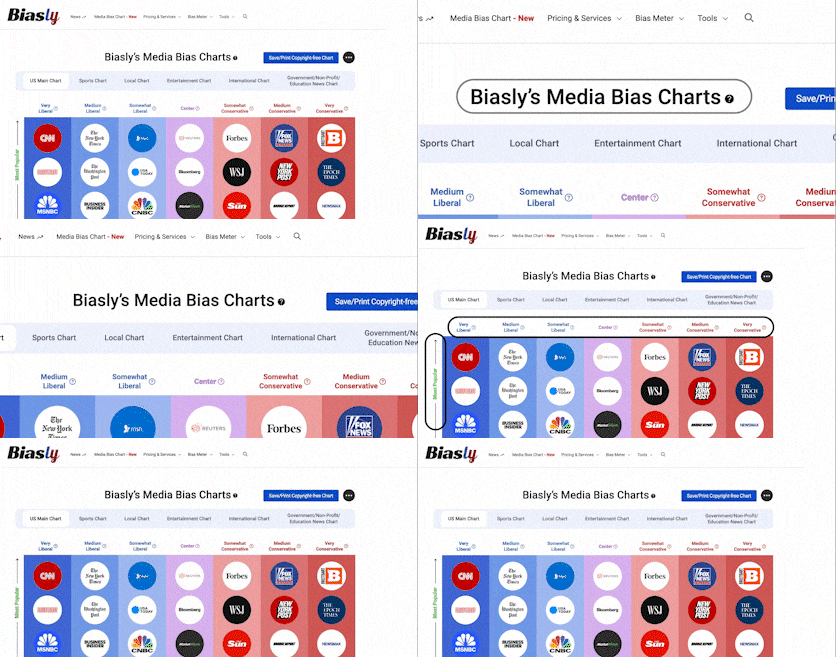
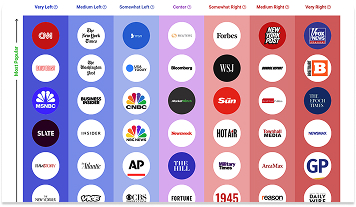
Readers who want to see how Lew Rockwell’s framing compares to other publications can visit Biasly’s Media Bias Chart to analyze tone and word choice across outlets in real time.
Funding and Ownership

Lew Rockwell is owned and operated by Lew Rockwell LLC, a private company controlled by its founder Llewellyn H. Rockwell, Jr. Rockwell founded the site in 1999 and continues to serve as its editor, describing its purpose as carrying on “the anti-war, anti-state, pro-market work of Murray N. Rothbard.” Rockwell also chairs the Ludwig von Mises Institute, which he co-founded with Rothbard in 1982.
Rockwell’s background matters when evaluating the site’s content. In addition to his libertarian intellectual work, Rockwell was listed as a contributing editor on Ron Paul newsletters that, when uncovered by journalists in 2008, were found to contain racist, homophobic, and conspiratorial content. Multiple sources alleged Rockwell had ghostwritten portions of those newsletters, a claim he publicly denied. That historical context is relevant to understanding both the site’s ideological orientation and the criticism it has received from across the political spectrum.
Who Funds Lew Rockwell?
Lew Rockwell generates revenue through advertising and reader donations. Unlike nonprofits that publish financial disclosures or publicly traded companies whose finances are available through SEC filings, Lew Rockwell LLC does not publicly disclose detailed financial information. The site does not appear to carry conventional display advertising from major brands; its advertising tends to consist of gold dealers, libertarian book publishers, and similar ideologically aligned commercial partners, which is consistent with its anti-establishment editorial identity.
The site’s privately owned structure provides less publicly visible information about editorial oversight and accountability mechanisms than many larger institutional newsrooms. Readers should evaluate content accordingly, recognizing that publication decisions reflect the outlet’s explicit ideological orientation.
Additional Insights
News Source Comparison
Lew Rockwell is best compared not to conventional news outlets but to other explicitly ideological websites that operate outside the mainstream journalism framework. Among libertarian and anarcho-capitalist outlets, it is most comparable to sites like Mises.org, AntiWar.com, and the Ron Paul Institute for Peace and Prosperity, all of which share its anti-interventionist, anti-central banking orientation while varying in their sourcing rigor and reliability. Among right-leaning outlets more broadly, it sits well to the right of conventional conservative publications like National Review or the Wall Street Journal, outlets that, despite their own conservative orientation, maintain mainstream journalistic standards that Lew Rockwell does not consistently meet.
Readers seeking content that engages with libertarian ideas from a more reliable sourcing perspective may find outlets like Reason Magazine, a more analytically rigorous alternative. Readers seeking to understand how Lew Rockwell fits into the broader media landscape can visit Biasly’s Media Bias Chart to compare it against other outlets across the political spectrum.
Notable Contributors and Authors
Lew Rockwell features a wide range of contributors united by their commitment to libertarian and anarcho-capitalist principles. Ron Paul, the former congressman and presidential candidate, is one of the site’s most prolific contributors, publishing regular columns on economics, foreign policy, and government overreach. Andrew Napolitano, a former New Jersey Superior Court judge and Fox News commentator, contributes constitutionally grounded analysis of executive power and civil liberties. Paul Craig Roberts, a former Reagan administration official, contributes geopolitical analysis that sometimes crosses into conspiratorial territory.
The site also regularly republishes content from David Stockman, a former Reagan administration budget director whose economic commentary draws on verifiable fiscal data even while framing that data within a strongly anti-government narrative. The broad spectrum of editorial perspectives represented across Lew Rockwell’s contributors highlights why evaluating individual articles is especially important when assessing content from this publication.
Related Tools and Resource Pages
To better understand how Lew Rockwell fits into the broader media landscape, we recommend exploring these helpful resources:
- Media Bias Chart: See where Lew Rockwell ranks among hundreds of media outlets across the political spectrum.
- Political Bias Chart: Visualize political slants of news sources across various policy areas.
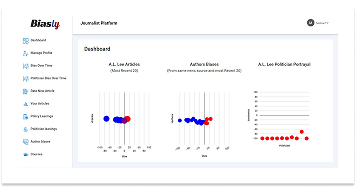
- Journalist Bias Analytics Platform: Explore how individual journalists contribute to bias within their publications.
- Politician Bias Analytics Platform: Compare how politicians are framed differently by Lew Rockwell and other outlets.
- Media Literacy Education Platform: Learn how to critically assess media sources, bias techniques, and news reliability.
Frequently Asked Questions
Lew Rockwell is rated as Somewhat Right based on Biasly’s media bias algorithm, which assesses sentiment, article framing, and policy favorability.
Yes, during the COVID-19 pandemic, the site published content, including Ron Paul’s 202 article titled “The Coronavirus Hoax,” that dismissed the pandemic as manufactured and later promoted vaccine misinformation from sources independent fact-checkers found to be unreliable. The site has also been placed on the Southern Poverty Law Center’s Hatewatch list. Founder Lew Rockwell has faced allegations of having ghostwritten racist and conspiratorial content in Ron Paul’s newsletter that became a major controversy in 2008, though Rockwell denied those specific allegations.
Biasly uses a combination of AI sentiment analysis and human analyst review to assess tone, fact accuracy, source quality, and media bias indicators. Learn more on our Bias Meter page.
No, not consistently. While some content, particularly grounded foreign policy analysis from contributors like Andrew Napolitano, meets basic standards of analytical rigor, the site has a documented history of publishing health misinformation, promoting conspiracy theories, and sourcing from outlets that independent fact-checkers have found to be unreliable. Readers should independently verify factual claims from any Lew Rockwell article before accepting them as accurate.
Military Spending
| Date | Sentiment | Associated Article | Snippet |
|---|---|---|---|
| 08/25/2019 | 75% For | Trump Family Detentions Flores Agreement (link) | So, of course, the Trump administration is doing the opposite in a baldfaced |