




-14% Somewhat Left
Bias Meter
Extremely
Liberal
Very
Liberal
Somewhat Liberal
Center
Somewhat Conservative
Very
Conservative
Extremely
Conservative
-100%
Liberal
100%
Conservative

Biasly determines media bias ratings through a dual-layered approach combining artificial intelligence and analyst review. The platform’s proprietary bias detection engine, Bias Meter, evaluates sentiment, policy position alignment, and language framing across thousands of data points in news articles. Analysts then verify and interpret the AI’s findings, providing additional context where needed. Learn more about ratings
- Profile
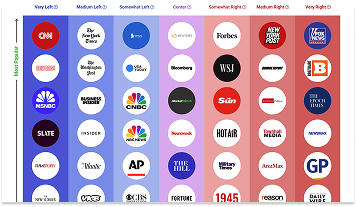
Los Angeles Times on the media bias chart
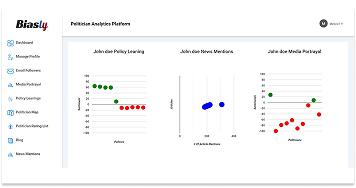
Los Angeles Times has a Bias Score of -14% Somewhat Left which is based on a variety of factors including its policy and politician leanings, article ratings, and the use of biased language. Its Reliability is rated as Good, and additional analytical insights are available in the other tabs.

- Bias Rating
-14% Somewhat Left
- Reliability84% Reliable GoodPolicy Leanings
0% Center
Extremely
LiberalVery
LiberalModerately
LiberalSomewhat Liberal
Center
Somewhat Conservative
Moderately
ConservativeVery
ConservativeExtremely
Conservative-100%
Liberal100%
Conservative
Average Reliability
*Our bias meter rating uses data science including sentiment analysis, machine learning and our proprietary algorithm for determining biases in news articles. Bias scores are on a scale of -100% to 100% with higher negative scores being more liberal and higher positive scores being more conservative and 0% being neutral. The rating is an independent analysis and is not affiliated nor sponsored by the news source or any other organization.
Politician Portrayal2% positive
Continue For Free
Create your free account to see the in-depth bias analytics and more.
By creating an account, you agree to our Terms and Privacy Policy, and subscribe to email updates.
Log In
Log in to your account to see the in-depth bias analytics and more.
Policy Leanings Analysis
Policy | Bias score |
|---|
Los Angeles Times Editorial Patterns
Los Angeles Times’s coverage of political topics often reflects a Somewhat Left bias, with consistent patterns in phrasing, source selection, and thematic focus that are Slightly Liberal. While the publication demonstrates journalistic standards, Los Angeles Times has been accused multiple times of omitting facts, suggesting a political slant. This content analysis examines how Los Angeles Times handles liberal and conservative issues and whether there are consistent editorial patterns that demonstrate bias in reporting.
Coverage of Liberal vs. Conservative Topics
Los Angeles Times’s articles address progressive and social causes, such as immigration, civil rights, and healthcare, and tend to use sympathetic and supportive language. This aligns with a Somewhat Left media bias, especially in Los Angeles, where the culture tends to reflect more liberal values. Other topics, like the border wall and assisted suicide, are reported neutrally.
Additionally, Los Angeles Times tends to criticize Conservative or Republican legislators, officials, and legislation. Framing and story selection will take little digs at Republican leaders and paint them in a negative light.
Policy and Issue Framing
When covering abortion, Los Angeles Times often frames increased access to reproductive healthcare favorably, aligning with pro-choice positions. This aligns with a Somewhat Left media bias. Similarly, border control coverage often adopts a sympathetic framing towards migrants and urges lawmakers to make immigration policy changes. Articles will also highlight or frame any conservative figures and policies regarding immigration and border control in a negative light.
Certain policies covered by Los Angeles Times are framed more conservatively, such as affirmative action. However, Los Angeles Times mainly remains centered in reporting on policies like anti-discrimination laws, border asylum for refugees, and campaign finance restrictions.
Coverage and Relevance
Los Angeles Times’s reporting ranges from politics to lifestyle to entertainment. It primarily focuses on the U.S. but also covers international politics. Los Angeles Times has become one of the largest metropolitan newspapers outside the East Coast. According to Similar Web, as of December 2025, Los Angeles Times had over 47 million monthly visitors. With such a huge following, Los Angeles Times serves as a compelling case study for examining source bias and news media bias in state-focused reporting.
Readers who wish to further explore how Los Angeles Times compares with other publications can visit Biasly’s Media Bias Chart to analyze tone and word choice in real time.
Los Angeles Times Bias Analysis
Bias Analysis
Los Angeles Times was established on December 4th, 1881, to serve the growing population of Los Angeles as it transformed from a small town to a major city. Today, Los Angeles Times covers politics, business, sports, and technology. Since Los Angeles Times is located at the heart of the entertainment industry, exclusive and extensive coverage of the Hollywood and film industry is present as well.
According to Los Angeles Times, Los Angeles Times is one of the largest daily newspapers in the United States by reach and influence, with a local weekly audience of 4.4 million people. When it comes to media bias, both AI and media analysts have evaluated its content, sources, and funding to determine its political leaning.
Given Los Angeles Times’s high monthly and weekly audience, it is clear that Los Angeles Times can significantly influence public perception. Readers’ trust in the accuracy of local news may mirror the conclusions reached by Biasly’s media bias ratings. This article delves into Los Angeles Times’s ability to avoid editorial tendencies and give readers neutral and clear information.
Is Los Angeles Times Biased?
Based on Biasly’s evaluations, Los Angeles Times is rated as Somewhat Left.
By examining content patterns and the broader context of media influence, we aim to offer a balanced perspective on Los Angeles Times’s political bias—and contribute to the ongoing discussion about bias in the news.
How Does Biasly Rate News Sources?
Biasly uses proprietary algorithms and a team of analysts to provide comprehensive bias evaluations across thousands of news outlets. Over 200,000 articles from more than 3,200 sources have been analyzed to identify the most accurate and unbiased stories.
Biasly assigns each outlet three key scores:
- Reliability Score – Reflects factual accuracy
- AI Bias Score – Generated via natural language processing
- Analyst Bias Score – Assessed by human political analysts
These scores are based on seven core metrics: Tone, Tendency, Diction, Author Check, Selection/Omission, Expediency Bias, and Accuracy. These elements help analysts and algorithms evaluate the political attitude conveyed by each article.
Biasly’s Bias Meter ranges from -100% (most left) to +100% (most right), with 0% indicating neutrality. The system evaluates individual articles based on political terms, policies, figures, and sentiment to calculate precise bias ratings.
Is Los Angeles Times Politically Biased?
Los Angeles Times earns a Somewhat Left rating for its AI Bias Score and a Somewhat Left for its Analyst Bias Score. The Analyst Bias Score is generated by reviewers from liberal, moderate, and conservative backgrounds. Analysts reviewed 15 Los Angeles Times articles and noted preferences in areas like coverage of liberal politicians and policy topics such as abortion rights and affirmative action. However, the paper maintained objectivity on topics like education and national security.
An article titled, “NSA employee sues Trump administration over order on transgender rights and two ‘immutable’ genders” was rated Moderately Liberal by Biasly. This Bias score is determined through natural language processing that evaluates the tone, word choice, and opinion embedded in the reporting. The NSA employee is suing the Trump administration over a presidential executive order and other policies that the employee believes violate federal civil rights law. The article’s 6 negative sentiments toward President Trump and its limited representation of opposing viewpoints contribute to the article’s Bias Score. The author frames the article in support of the employee, but does not include a response from the Trump administration
Analysis of Bias in Los Angeles Times Online Articles
To evaluate the bias of online articles, we can analyze select Los Angeles Times articles through several of Biasly’s bias rating criteria: Tone, Tendency, Author, Diction, and Expediency Bias.
- Tone: The overall attitude conveyed by the article
- Diction: Specific word choices made by the writer
- Author: The background and social presence of the journalist
- Tendency: Patterns of bias in the writer’s broader body of work
- Expediency Bias: Quick visual or textual indicators like headlines and photos that imply bias
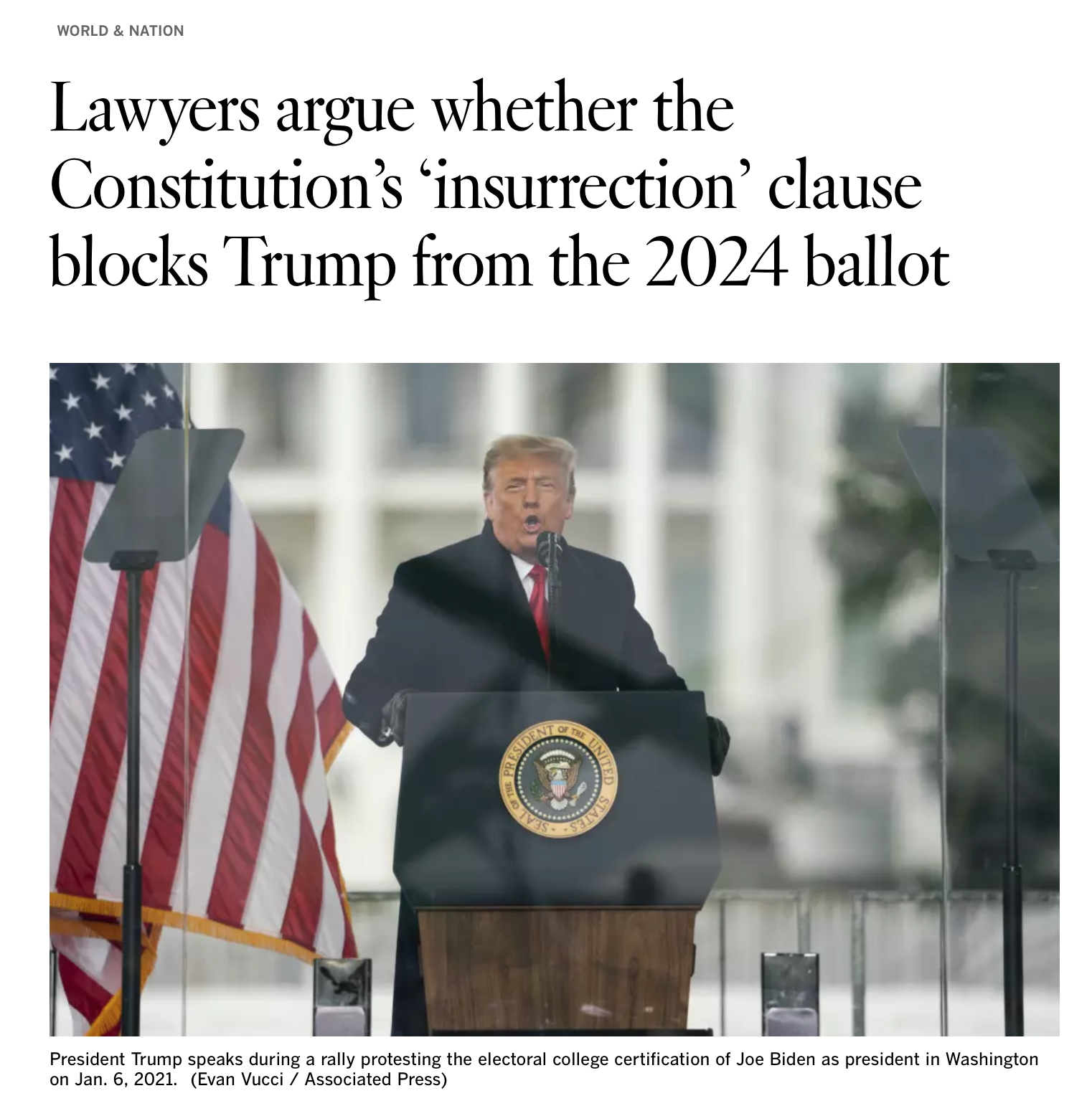
An article titled, “Lawyers argue whether the Constitution’s ‘insurrection’ clause blocks Trump from the 2024 ballot” is rated Centered by Biasly. The article adopts a neutral tone and avoids strong, emotional language. An example of the matter-of-fact speaking displayed in the article is here:
“The case will pivot on whether the Jan. 6 attack meets the meaning of “insurrection” in the 14th Amendment. It will also hinge on whether Trump’s action meets the definition of “engaging” and whether the rarely used provision was meant to apply to the presidency.”
However, bias may still be present in the article through selective quotation. The quotes the authors include in their articles can reveal their opinion and frame the article toward a particular political stance or party. Direct quotes such as “‘This is a legal Hail Mary by the Democrats,’ said Mike Davis” demonstrate strong diction and can influence the rating of the article. In the end, author Nicholas Riccardi does a good job of keeping his personal opinions and beliefs out of the article. His X account shows no overt biases. He posts about a broad range of political topics and rarely gives an opinion, unless to point out flawed reasoning or the misuse of statistics. His posts include:
This might be the single strongest counter-argument to the Stong Towns thesis, at least as applied to major metros. The physical infrastructure and density is nowhere near the key determinant of urban cost structure. The key determinant is the political power of public employees https://t.co/RenWfqkVpu
— Dirty Texas Hedge (@HedgeDirty) February 19, 2026
The age-standardized cancer mortality rate in the US has fallen by almost 40% since 1990. Technological progress and economic growth is not just new entertainment gadgets that fit in our pockets! https://t.co/oXkPdW3fWu pic.twitter.com/2CFpZBvj74
— Jeremy Horpedahl 🥚📉 (@jmhorp) February 17, 2026
Riccardi also used sources from both sides of the political spectrum, helping establish his credibility. The prosecution, defense, and judge are all quoted extensively, along with some witnesses. This is as close to unbiased as you can possibly be. In this piece, the author shows he’s done his homework and provides readers with important information about this case.
Another article titled, “The Republicans fight over Israel funding, explained” by Erin Logan has a slightly Liberal Bias. Logan does a good job of having a cut-and-dry tone throughout the article. However, Logan focuses on facts and people that paint the GOP as disorganized and unproductive. For example, her use of the words ‘problem’ and ‘cheap’ clearly indicates her bias.
“newly elected House Speaker Mike Johnson has put forth legislation to send Israel more than $14 billion. The only problem? He wants to gut Biden administration domestic initiatives to do it.”
“prompted lawmakers to issue statements and file resolutions affirming America’s unflinching commitment to Israel. But talk is cheap. Many lawmakers want to go farther — and send Israel more money.”
Logan’s disapproving tone toward Republican members of Congress is evident throughout the article, which makes her seem less credible. Her X account clearly demonstrates her liberal bias. She focuses on liberal issues, including her support for Palestine, and comments on U.S. foreign policy. Some of the quotes she’s retweeted can be found here.
Palestinians face beatings, fires and drones from Israeli settlers in the Occupied West Bank. Story by @JeffreyLAT #IsraelHamasWar https://t.co/yktorBbfex pic.twitter.com/hQoqjHMy30
— Marcus Yam 文火 (@yamphoto) December 18, 2023
Here is a tweet from Logan herself:
NEW: California’s Sen. Alex Padilla personally warned Biden not to fold to GOP on immigration to aid Ukraine w/ @cmsub @andreamcastillo https://t.co/ZvFevWdUy7
— erin b. logan (@erinblogan) December 15, 2023
Analysis of Los Angeles Times Opinion Articles
There is a difference between opinion and reporting. The goal of reporting is to present facts and let readers form their own conclusions, while opinion articles express personal perspectives on current issues. In this section, we will look at how bias surfaces in Los Angeles Times’s opinion content.
Consider the op-ed, “Opinion: Bombings in Gaza add to generations of Palestinians displaced from their homes.” The title of the article is filled with bias because it implies that Palestinians have been victimized for generations without giving any consideration or discussion to why Israel exists. The article displays a strong selection bias for Palestine. The author gives the history behind Palestinian displacement, but omits any information about the Israeli perspective. The author also downplays the conflict. At the end of the article, the author seems to imply that Israel’s conception as a Jewish state is one of the key problems in the Israel-Palestine situation, which clearly shows the author’s stance on the issue. Not listing more reasons for why the conflict exists not only does not fully inform readers, but it also downplays the significance of the conflict.
Another opinion piece titled “In War and Peace, the fates of Israel and the Palestinians are inextricably bound together” by Daniel Bral is far less opinionated. While Bral does strongly state his stance on the Israel-Palestine conflict, he maintains a more neutral tone and provides perspectives and makes points from both sides of the conflict. This piece demonstrates that even though this is an opinion, the article can still have neutrality and bring readers additional insight that they may appreciate.
While these articles are just some of Los Angeles Times’s content, they suggest that the publication can incorporate a blend of opinion and factual coverage, and discern between subjective reporting and journalistic reporting.
How to Evaluate Bias
Although Biasly rates Los Angeles Times as Somewhat Left, it’s important to remember that bias can vary from article to article. Los Angeles Times also covers a liberal-leaning state with objectivity on many issues, from state legislation to social developments. This complexity underscores the importance of examining each article individually. So, let’s learn how to evaluate media bias.
Recognizing media bias requires awareness and critical thinking. Often, readers trust news sources that affirm their existing beliefs—a psychological tendency known as confirmation bias. This makes it harder to identify slanted narratives or one-sided reporting.
To combat this, it’s essential to challenge your assumptions by consulting multiple viewpoints and verifying news through third-party analysis. Tools like Biasly’s media bias ratings allow readers to compare the same news story across the political spectrum.
Ultimately, bias isn’t always a matter of what is said—it’s also about what is left out, how topics are framed, and which stories are chosen for coverage. Learning to recognize these patterns can help readers make more informed decisions and develop greater media literacy.
To start comparing news outlets and gain a better understanding of bias, sign up for Biasly’s Media Bias & News Analytics Platform to see how stories vary between sources.
Los Angeles Times Reliability Analysis
Is Los Angeles Times Reliable?
Los Angeles Times demonstrates high reliability. It is the largest newspaper on the West Coast of the United States and attracts more than 40 million monthly visitors. Additionally, Los Angeles Times has won 51 Pulitzer Prizes, indicating a good reputation for quality journalism. Given such high viewership and praise, further investigation is needed to determine whether bias or other factors affect its accuracy. At Biasly, we specialize in evaluating not just bias but also the reliability of media outlets. Let’s explore the accuracy and trustworthiness of Los Angeles Times.
How to Evaluate Reliability?
Reliability refers to how trustworthy or accurate a news source is. If we can’t trust what we read, then continuing to consume content from that outlet serves little purpose. So how do we evaluate a news outlet’s reliability?
There are several potential measures of reliability to look out for when trying to determine whether a media source is reliable or not. Red flags for an unreliable article can include the presence of wild, unsubstantiated claims, facts dependent on other unreliable sources, heavy use of opinionated language, and more. In contrast, hallmarks of a reliable source include:
- Absence of subjective language
- Citing credible sources (e.g., .gov, .edu, academic references)
- Verifiable facts and statistics from multiple outlets
- Use of primary sources, like interviews or transcripts
- Consistency with coverage across other platforms
Biasly’s reliability scores incorporate these elements in evaluating media outlets.
So How Does Los Angeles Times Fare in Its Reliability?
The political reliability index developed by Biasly assesses both accuracy and trustworthiness. Los Angeles Times currently holds Good Reliability Score, which is calculated as a weighted average of:
- Fact Analysis Score – Evaluates the accuracy of claims, facts, and evidence.
- Source Analysis Score – Assesses the number, diversity, and credibility of sources and quotes used.
Los Angeles Times’s Source Analysis Score is Average at 52% Reliable. This suggests moderate trustworthiness in its sourcing practices. The score is AI-generated and considers quote length, frequency, diversity, and quality.
The Fact Analysis Score of Los Angeles Times is Excellent at 93% Reliable. This further shows how well Los Angeles Times supports its claims, addresses selection and omission bias, and presents verifiable evidence.
While Los Angeles Times leans toward factual reporting, occasional lapses—such as unbalanced viewpoints or incomplete data—can affect its reliability rating. These nuances emphasize the importance of analyzing individual articles.
Los Angeles Times’s Accuracy and Reliability
According to Biasly’s analysis, Los Angeles Times maintains Good Reliability Score, but individual articles may vary significantly. Let’s dive into the details.
Political orientation plays a crucial role in how audiences perceive reliability. Los Angeles Times has been accused of favoring a liberal narrative, potentially at the expense of factual reporting. To validate such claims, it’s essential to analyze whether the publication backs its assertions with sufficient evidence and diverse viewpoints.
Two common types of bias that affect factuality include:
- Selection Bias – Highlighting or omitting stories to fit a particular narrative.
- Omission Bias – Leaving out differing perspectives or relevant details to skew perception.
Biasly’s accuracy ratings use a scale from 1% (least accurate) to 100% (most accurate). Factors include the presence of supporting evidence, internal and external reliable sources, and balanced viewpoints.
For instance, Biasly gave The Washington Times a Medium Right Bias and a Low Analyst Reliability Score. One Washington Times article titled, “Denmark, Greenland reject U.S. territorial claims after Trump appoints special envoy” showed an average reliability score for its limited opposing sources and critical language towards Denmark and Greenland officials.
We will take a closer look at more examples like this below to provide a further investigation into the reliability of Los Angeles Times’s articles. This will include its use of selection bias, omission bias, and the quality of its sources and the facts it uses.
Analysis of Reliability in Los Angeles Times’s Online News Articles
Los Angeles Times aims to serve the people of Los Angeles with objective, fact-based reporting. Its staff includes writers from varying ideological backgrounds, which can help balance coverage. However, readers should distinguish between news reporting and opinion pieces when evaluating credibility.
For example, an article titled, “Biden signs historic $1-trillion bipartisan infrastructure bill” is rated Somewhat Left but close to Center. The author draws on sources from both sides of the political spectrum, including Biden, Trump, Pelosi, and McConnell. This provides readers with a well-rounded perspective on the infrastructure bill. To exemplify:
“Republican lawmakers who crossed the aisle are greatly jeopardizing their chances of winning reelection”, while Biden is quoted stating that “Democrats and Republicans can come together and deliver results”.
Overall, the article presents a centrist view of the bipartisan infrastructure bill, and the author draws on a variety of sources without attempting to lead readers to a specific conclusion. Furthermore, the article adopts a neutral tone and does not introduce its own opinion, making it highly reliable.
Quality of Sources and Facts Used
Los Angeles Times does a good job of providing readers with both sides of the political spectrum and citing facts as evidence. However, the quality of journalism varies from article to article. For example, in “Editorial: Biden should balance support for Israel with pushing for peace in a volatile region,” the author only uses six quotes. Three of the quotations are short, and the others are medium-length. Additionally, all quotations are from Joe Biden.
Having Joe Biden as a direct source elevates the article in quality; however, relying on a single source to write an article is a poor practice. Although the author advocates increased humanitarian aid to the Gaza Strip, an Israeli Defense Forces perspective on why it opposes such aid would make the article more balanced. If the author added a broad range of perspectives, the article would be more credible. It is difficult to assign foreign affairs to the liberal-conservative spectrum; however, liberals are generally more empathetic to the plight of Palestinians, so the article has a slight liberal bias.
In “A federal judge’s gag order against Trump may be satisfying. But it isn’t constitutional” (Los Angeles Times Opinion), Erwin Chemerinsky argues that Judge Tanya Chutkan’s restriction on Donald Trump’s speech in the Jan. 6 federal case likely crosses a First Amendment line. The piece is written in a legal-analytical style, but the tone isn’t neutral: it’s openly critical of Trump’s conduct (“vitriol,” “unpleasant and offensive”) while still defending his speech rights on constitutional grounds. Overall, the bias appears institutionalist/civil-libertarian—skeptical of government restraints on speech—even though the author’s personal disdain for Trump is explicitly stated.
The article contains 8 direct quotes (including partial phrases in quotation marks). The longest quote is 32 words, the shortest is 1 word, and the average quote length is about 10.6 words. Reliability-wise, most of the quoted material is either (a) paraphrased courtroom reasoning captured in short fragments, (b) Trump’s own inflammatory phrases, or (c) canonical Supreme Court language. In general, longer quotes presented with clear attribution and minimal editorial “spin” tend to be more reliable because readers can evaluate the speaker’s intent without the author’s tone doing the work. Here, the longest quote (from New York Times v. Sullivan) is the most context-rich and least dependent on the columnist’s framing, while the very short quoted words/labels (especially insults) are easy to deploy as rhetorical signals rather than as evidence.
On linked sourcing, the article uses 4 distinct linked sources total, and they break down as Left: 3, Center: 1, Right: 0. Three of the links are internal Los Angeles Times Opinion pieces (typically left-of-center in editorial positioning), while the one “center” link is a primary document: the court order hosted on CourtListener. While the argument cites well-known Supreme Court cases, the clickable sourcing leans heavily toward in-house commentary rather than a broad range of external reporting.
Sources referenced (people/institutions), in the requested style:
- Tanya Chutkan, U.S. District Judge for the District of Columbia.
- Donald Trump, former U.S. President and 2024 presidential candidate (at the time).
- Jack Smith, U.S. Department of Justice Special Counsel.
- Mike Pence, former U.S. Vice President.
- William Barr, former U.S. Attorney General.
- S. Supreme Court, the highest court in the United States (constitutional precedent).
- CourtListener, legal document repository (host of the linked gag-order filing).
- Los Angeles Times Opinion, newspaper opinion section (linked to related commentary).
By the numbers, the sourcing is not balanced left/center/right—there are no right-leaning linked sources, and most links route readers back into the LA Times’ own opinion ecosystem. In terms of prominence, the single strongest “anchor” is the primary-source court order (center/neutral), but it’s outnumbered by internal opinion links. In quoted-word share, the biggest chunk goes to Supreme Court language (neutral) and to Trump’s own statements (not “right sources,” but certainly politically aligned with the right), yet those Trump quotes function more as examples of misconduct than as arguments being engaged on their own terms.
Chemerinsky uses sources in a way that keeps legal doctrine in the driver’s seat: Supreme Court precedent is treated positively and as authoritative; Trump’s quotes are used negatively as illustrations of why a gag order might feel tempting; and Chutkan’s bench statements are presented respectfully but ultimately challenged as constitutionally overbroad. The framing is set by the author from the first line (“Although I often wish…”) and the central claim—prior restraint is presumptively unconstitutional—largely goes unchallenged inside the piece, because there’s little engagement with strong countervailing arguments beyond acknowledging the case is “unique,” and that witness intimidation is a “harder question.” Skepticism is directed primarily at the gag order’s breadth and its restriction of criticism of government officials. Based on the linked-source distribution (Left-leaning internal links, one neutral primary doc) and the overall framing, an author-bias rating of Somewhat Left fits best—even though the civil-liberties conclusion (defending Trump’s right to speak) may resonate across ideological lines.
On factual accuracy, the article’s core legal claims align with widely reported and broadly accepted First Amendment principles: prior restraints face steep scrutiny; New York Times v. United States and Nebraska Press Assn. v. Stuart are standard citations for the presumption against speech-suppressing orders; and New York Times v. Sullivan is routinely quoted for the “uninhibited, robust, and wide-open” standard. The factual descriptions of the gag order’s targets (prosecutors, court staff, witnesses) and the presence of a filed order are also consistent with contemporaneous coverage of the case, and the linked primary document helps. Where the piece becomes more debatable is less about “wrong facts” and more about predictive/interpretive judgments—for example, the confidence that Trump’s attacks won’t prejudice jurors or affect prosecutors is plausible, but it’s not a verifiable fact claim in the same way as quoting a ruling or a case holding.
Selection and Omission Bias
An article by The Times editorial board investigates the election of Rep. Mike Johnson of Louisiana to the role of Speaker of the House. The article, “Editorial: House Republicans just elected an election denier as speaker. American democracy is in trouble, delves into Mike Johnson’s past, and that information serves as opposition research. The author only utilizes two quotes, one from Trump and one from Rep. Matt Gaetz. The author uses these quotes to disparage Johnson by aligning him with two very conservative figures.
“House Republicans on Wednesday unanimously elected as speaker a man who actively tried to overturn the 2020 presidential election results and would like to lock up people who get an abortion or provide gender-affirming care to minors,” and “If there was any hope that the GOP would steer toward sanity and distance itself from the Trump sideshow, that hope is gone.”
These statements indicate a clear slant because the author paints in extreme terms without providing balanced perspectives or acknowledging any positive aspects of Johnson becoming House Speaker. The article also doesn’t highlight any diverse opinions within the GOP. Furthermore, the language used, such as “extremists have taken control of the Republican Party” and the suggestion that the 2024 presidential election may have been “stolen” with GOP assistance, further cements the author’s bias. The omission of counterarguments or moderate Republican opinions contributes to the article’s framing: a negative narrative about the Republican Party.
The article discussed earlier, “Editorial: Biden should balance support for Israel with pushing for peace in a volatile region,” only uses quotes from Joe Biden. This shows selection bias. While he is a reliable source, quote diversity gives the article more credibility. Only selecting quotes from Joe Biden shows readers a narrow perspective that the author wants them to see. Giving readers both sides allows them to know the full story.
Opinion pieces can have issues with factuality, selection, and omission. The articles covered above all have strong opinions, but varying degrees of information and context that could contradict the author’s stance. As a news organization with a slight liberal slant, Los Angeles Times has a minor incentive to continue appealing to liberal viewpoints. Readers need to know that the information they are ingesting is clear, correct, and concise.
So, is Los Angeles Times Reliable?
Overall, Los Angeles Times can be considered to be an outlet that is very reliable. It demonstrates a consistent goal of journalistic integrity and typically supports claims with sources and quotes. Occasional omissions and framing bias do appear, particularly on culturally sensitive or partisan issues.
As media literacy improves, readers can more easily detect issues with selection bias, omission bias, and factuality. To strengthen your ability to assess reliability across the political spectrum, use Biasly’s News Bias Checker to compare how multiple outlets report the same story.
This empowers you to consume more accurate, balanced, and dependable news
Funding and Ownership
Who Owns Los Angeles Times?
In 2018, Los Angeles Times was purchased by billionaire Patrick Soon-Shiong for $500 million from Tribune Publishing. Soon-Shiong said in a statement:
“Our hometown of Los Angeles and the state of California – really, the West Coast – needs a strong, independent news organization. We believe in the LA Times and are committed to its future.”

Patrick Soon-Shiong, Source: Wikipedia
Soon-Shiong has been accused of lacking sufficient experience to run a media company. Furthermore, it has been reported that Soon-Shiong’s daughter exerts undue influence over the company’s decisions. She is outspoken on criminal justice issues and, if true, would have a strong liberal effect on the newspaper.
Who Funds Los Angeles Times?
Owner Soon-Shiong has invested more than $750 million in the company and is working to take it public (IPO). As recently as October 2025, Los Angeles Times has stated that the private placement offering will consist of Series A stock that carries a 7% annual interest rate and is convertible into a common stock at a 25% discount of the potential price of shares offered to the public. Accredited investors can invest as little as $5,000. Additionally, Los Angeles Times generates revenue through ad placements and digital subscriptions, with a weekly average of about 100,000 print newspapers circulated and 243,000 paid digital subscriptions.
Additional Insights
News Source Comparison
Los Angeles Times is often compared with Somewhat Left national outlets. Sources like NBC News, USA Today, or CNBC often present similar tones and editorial philosophies. While Los Angeles Times exhibits a Somewhat Left media bias, it differs from other sources in that it occasionally includes opposing viewpoints and strives to achieve a balanced national coverage.
This contrasts with outlets that present consistently one-sided narratives with few factual counterpoints. Readers seeking balanced political coverage may compare Los Angeles Times’s framing of issues with outlets rated as Center, Somewhat Right, or Lean Right on our Media Bias Chart, or explore other national papers on our Similar Sources page.
Notable Contributors and Authors
Los Angeles Times features a diverse range of reporters and columnists, many of whom are deeply familiar with the Los Angeles political and social climate and United States politics. Editorial writer Robert Greene covers water, drought, criminal justice reform, policing, mental health, and Los Angeles County government. He won the Pulitzer Prize for Editorial Work in 2021 for his reporting on the Los Angeles criminal justice system. Another notable example is Molly O’Toole, an immigration and security reporter based in Washington D.C. for Los Angeles Times. She was awarded the first-ever Pulitzer Prize for audio reporting after investigating the Trump administration’s “Remain in Mexico“ policy on asylum officers and asylum seekers.
Related Tools and Resource Pages
To better understand how Los Angeles Times fits into the broader media landscape, we recommend exploring these helpful resources:
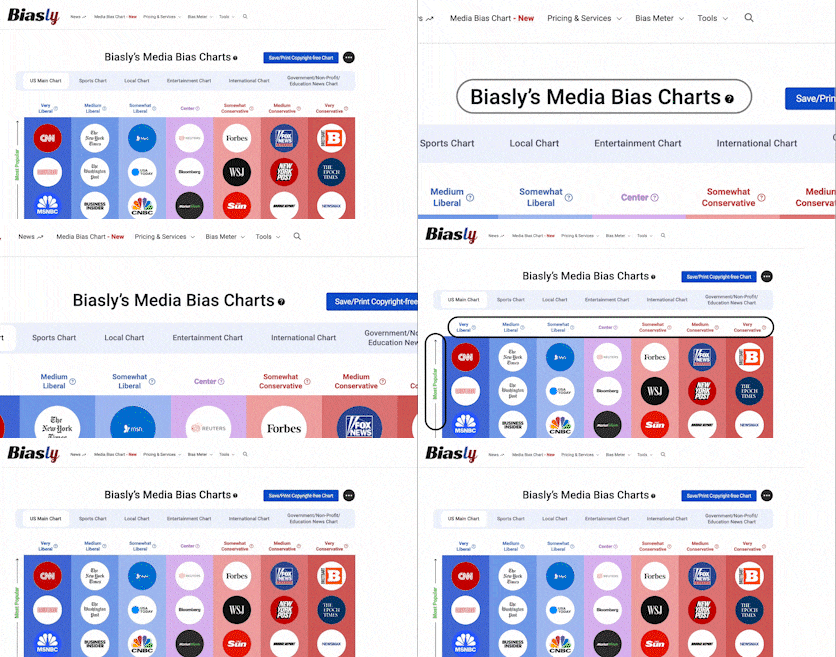
- Media Bias Chart: See where Los Angeles Times ranks among hundreds of media outlets across the political spectrum.
- Political Bias Chart: Visualize political slants of news sources across various policy areas.
- Journalist Bias Analytics Platform: Explore how individual journalists contribute to bias within their publications.
- Politician Bias Analytics Platform: Compare how politicians are framed differently by Los Angeles Times and other outlets.
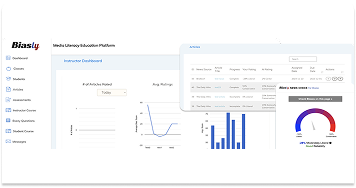
- Media Literacy Education Platform: Learn how to critically assess media sources, bias techniques, and news reliability.
Frequently Asked Questions
Los Angeles Times is rated as Somewhat Left based on Biasly’s media bias algorithm, which assesses sentiment, article framing, and policy favorability.
Los Angeles Times has often been accused of omitting facts and having a bias in reporting. In 2016, Los Angeles Times posted two reader letters about the World War II mass incarceration of Japanese Americans. The letters employed racial stereotypes and misinformation to argue in favor of the incarceration of Japanese Americans. Los Angeles Times acknowledged wrongdoing and stated that the article was not of its standard. New owner Patrick Soon-Shiong is planning to implement an intelligence-powered “bias meter” on the paper’s news articles. More on this is available here.
Biasly uses a combination of AI sentiment analysis and human analyst review to assess tone, fact accuracy, source quality, and media bias indicators. Learn more on our Bias Meter page.
Generally, yes, though partisan framing and selective reporting on opinion pieces can affect perceived reliability.
Ratings are based on recent news using data science and A.I. technology.
Military Spending
| Date | Sentiment | Associated Article | Snippet |
|---|---|---|---|
| 08/25/2019 | 75% For | Trump Family Detentions Flores Agreement (link) | So, of course, the Trump administration is doing the opposite in a baldfaced |