




6% Center
Bias Meter
Extremely
Liberal
Very
Liberal
Somewhat Liberal
Center
Somewhat Conservative
Very
Conservative
Extremely
Conservative
-100%
Liberal
100%
Conservative
Biasly determines media bias ratings through a dual-layered approach combining artificial intelligence and analyst review. The platform’s proprietary bias detection engine, Bias Meter, evaluates sentiment, policy position alignment, and language framing across thousands of data points in news articles. Analysts then verify and interpret the AI’s findings, providing additional context where needed. Learn more about ratings
- Profile
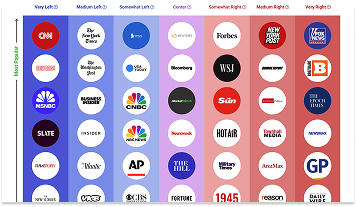
Voice of America on the media bias chart
- Bias Rating
6% Center
- Reliability83% Reliable GoodPolicy Leanings
26% Somewhat Right
Extremely
LiberalVery
LiberalModerately
LiberalSomewhat Liberal
Center
Somewhat Conservative
Moderately
ConservativeVery
ConservativeExtremely
Conservative-100%
Liberal100%
Conservative
Average Reliability
*Our bias meter rating uses data science including sentiment analysis, machine learning and our proprietary algorithm for determining biases in news articles. Bias scores are on a scale of -100% to 100% with higher negative scores being more liberal and higher positive scores being more conservative and 0% being neutral. The rating is an independent analysis and is not affiliated nor sponsored by the news source or any other organization.
Politician Portrayal84% positive
Continue For Free
Create your free account to see the in-depth bias analytics and more.
By creating an account, you agree to our Terms and Privacy Policy, and subscribe to email updates.
Log In
Log in to your account to see the in-depth bias analytics and more.
Analysis of Voice of America Articles
Analysis of Bias in Voice of America Online Articles
To evaluate this, we can analyze select Voice of America articles through several of Biasly’s bias rating criteria: Tone, Tendency, Author, Diction, and Expediency Bias.
- Tone: The conveyed attitude in an article
- Diction: The word choices made by the writer
- Author: The background and past biases of the journalist
- Tendency: Patterns of bias in the writer’s other works
- Expediency Bias: Quick visual or textual indicators, like quotes or photos, that imply bias
Having received a Score of Center, Voice of America can generally be understood to publish stories that are relatively free of significant bias. However, in the case of individual articles, some may present more bias than others. This section will seek to understand whether bias exists within their fact-based articles.

Source: Voice of America
One article, “Homeland Security Chief Cites Progress at US-Mexico Border”, describes the actions and resulting progress of policy changes the Biden administration made regarding the separation of children and parents at the Mexican border. This story is rated as Somewhat Left according to Biasly, maintaining a slight liberal tone and tendency throughout. As you can see in the article title and picture, it is very center-leaning without much emotion added; therefore, the expediency bias is low here.
An example of this tendency can be seen in the article’s choice of source:
“Mayorkas told U.S. lawmakers Thursday that the Biden administration has reduced the number of unaccompanied minors held at border stations from the thousands to the hundreds, and cut the average holding time from more than five days to less than 24 hours.”
“Mayorkas said a sustained effort is needed because ‘surges arise periodically,’ and migration is a very dynamic and fluid challenge that we have faced for many, many years.”
While these quotes do not contain much outright bias by themselves, they display a disparity in the sources used throughout the article; the author appears to rely more on liberal-leaning sources compared to those with opposing viewpoints. This rift may lead the reader to engage more with the arguments Biden’s administration has made, rather than considering both sides of the issue equally.
In terms of diction, referring to the use of extreme language, or trigger words, the author does not make use of these within the article. In his paraphrasing, in addition to the author’s own words, he did not use any of these biased words. One example of this is located in the conclusion of the article, where the author states:
“Overall, the White House envisions a multibillion-dollar four-year effort to reduce the impetus of people from Guatemala, Honduras, and El Salvador to migrate north.”
The author does not use any language that would taint the argument the Biden administration made regarding the policy changes and their effects.
Expediency bias, or the use of titles or imagery to introduce bias, is somewhat relevant in this article. Although the image used below the headline of the article does not contain much bias, it solely shows Homeland Security Secretary Alejandro Mayorkas testifying before a committee. The title, however, does contain bias as it could be misinterpreted as an overall reduction in illegal immigration since the specific issue of child separation was not mentioned. The word “progress” could also be misunderstood as a greater number than reality because the title does not reference specific metrics.
The author of an article has a significant impact on the amount of bias that can be seen throughout. One way to check if the author may be inclined to introduce bias into the articles they write is to look into their past work or comments they make on other platforms. The author of this article, Aline Barros, on her X account often reposts liberal-leaning comments such as these:
It’s become a common scene on the New York City trains and subway platforms as more than 195K migrants have made their way through city care since last spring: families and their children, offering candy to New Yorkers in transit across the city.https://t.co/O8ymGPZzqO
— Documented (@Documentedny) June 29, 2024
Rich Americans are reaping the rewards of soaring prices for stocks and houses as lower-income Americans struggle.
Here’s why that divide is central to understanding the economy and politics of 2024. https://t.co/EuqmDkfQpV
— Axios (@axios) May 25, 2024
Although this article does contain some liberal bias, there are articles published on Voice of America that do not contain the same levels of bias, such as “Nauru Changes Diplomatic Recognition from Taiwan to China”. This story was rated as Center according to Biasly and does not contain any significant bias within the parameters discussed in this section.
Reactions to content published by an agency can also provide insight into potential bias; one example of this can be seen in Voice of America’s X profile, where they post content regarding recently published articles and videos. In one post, promoting the article “Russia Hits Kyiv Children’s Hospital in Deadly Missile Attacks on Several”
Russians are monsters. Unfit to live in a civilized world.
— Larry Rodrigue (@larry_rodrigue1) July 9, 2024
Time to negotiate. Give them Ukraine so they won’t do it again?
— Sasha (@SashaEberhard) July 8, 2024
Analysis of Voice of America Opinion Articles
Opinion articles provide a framework for authors to discuss their perspectives and beliefs within a story. This type of article must be differentiated from traditional fact-based articles, where it is expected that the author remains free of bias. While opinion articles can contain valuable information and provide a fresh perspective on an issue, it is helpful to understand that the content often contains far more bias than traditional fact-based reporting.
The article “NATO Summit Marks 75 Years of Success” is an example where opinion articles can contain bias, as the title alone shows that the author clearly favors the actions that NATO has taken over the past 75 years. A title like this can prime the reader to favor the author’s points and subsequent arguments about NATO’s actions.
Voice of America’s Editorial section does not include articles with heavily emotionally loaded titles as often as other news sources do. Rather, all of Voice of America’s editorials have short, unbiased titles that suggest unification between Americans, such as “Thanksgiving 2023,” “For Peace to Reign,” and “Banding Together to Fight Ransomware Attacks.”
These articles, including the ones analyzed above, only form a small section of Voice of America News’ overall coverage, meaning that there is the potential for articles out there to have far more media bias than what has been analyzed in this specific article. That said, it is highly unlikely that a Voice of America News opinion article will use emotionally loaded language and a great deal of opinion that impairs its writing, yet this highlights why it is so important to look for signs of bias to support genuine reporting.
Analysis of Reliability in Voice of America’s Online News Articles
The political reliability index developed by Biasly objectively assesses news organizations’ accuracy and trustworthiness. Voice of America’s overall Reliability Score has been rated as ‘Good’ by Biasly.
Voice of America’s Source Analysis Score is ‘Center,’ which suggests readers can trust some of the sources, links, and quotes provided by the news source. This score, which is based on A.I., focuses on assessing the quality of sources and quotes used, including their number, length, uniqueness, and diversity.
However, since these scores are based on percentages and averages, individual articles could be more or less trustworthy depending on the context, author, and other factors. Later, we will analyze individual articles and see how some of these components can affect reliability.
Quality of Sources and Facts Used
The article “NATO Stands Firm on Aiding Ukraine” presents a clear, policy-oriented argument in favor of continued Western support for Ukraine amid its conflict with Russia. Framed as an official editorial, the tone is assertive and supportive of NATO’s stance, emphasizing unity, deterrence, and the necessity of continued assistance. Rather than offering a neutral overview, the piece reflects a pro-alliance perspective, reinforcing the legitimacy of NATO’s actions while portraying opposition, implicitly Russia, as destabilizing. This sets the stage for a narrative that is more advocacy-driven than analytically balanced.
The article contains 8 direct quotes (including partial quotes). The longest quote is approximately 36 words, the shortest is about 10 words, and the average quote length is around 21 words. These moderately long quotes help preserve the intended meaning of official statements, which generally improves reliability. However, since the quotes are primarily drawn from aligned NATO or U.S. officials, their reliability reflects consistency within a single perspective rather than a diversity of viewpoints. Longer quotes here reinforce authority, but not necessarily neutrality.
In terms of sourcing, the article uses zero distinct hyperlinked external sources. While it references institutions like NATO and statements from government officials, there are no clickable links to outside reporting or independent verification. As a result, there is no measurable breakdown across left, center, or right-leaning outlets. This lack of linked sourcing limits transparency and underscores the editorial nature of the piece rather than a reported, evidence-linked analysis.
Sources referenced in the article:
- Jens Stoltenberg, NATO Secretary General
- Antony Blinken, U.S. Secretary of State
- NATO alliance statements
- U.S. government officials
The sourcing is not ideologically balanced. It is heavily weighted toward Western governmental and institutional voices, with no representation from opposing perspectives (such as Russian officials or independent critics of NATO policy). This creates a clear imbalance both in the number of sources and in total quoted word share, as all quoted material supports the same general position. The prominence of NATO leadership further amplifies this one-sided framing.
The author uses sources almost entirely in a supportive and affirming manner, reinforcing the central argument rather than interrogating it. Jens Stoltenberg’s statements largely set the tone, framing NATO’s actions as necessary and justified, while U.S. officials echo similar themes. No claims from these sources are meaningfully challenged, and skepticism is directed exclusively outward—toward Russia’s actions or broader threats. Based on this pattern, the article’s bias can be categorized as Medium Right / pro-Western policy, reflecting a government-aligned stance rather than an ideologically neutral analysis.
Regarding factual accuracy, the article’s core claims align with widely reported information from major outlets such as Reuters, BBC, and The New York Times—particularly NATO’s continued commitment to Ukraine and the framing of the conflict as a defense of sovereignty. However, those outlets typically include additional context, such as debates over aid levels, internal NATO disagreements, or critiques of long-term strategy. The Voice of America editorial omits much of that nuance. As a result, the facts themselves are generally accurate, but selectively presented to support a specific narrative, limiting the overall completeness of the analysis.
Selection and Omission Bias
One article portraying the use of selection and omission bias by Voice of America is “Trump Lawyers Lay Out Case for Reversing Hush Money Conviction,” where the author details methods by which Trump may be able to circumvent the conviction he recently received. The author also attempts to outline how a reversal of the conviction would be possible; however, their sourcing for this information came heavily from Trump’s lawyers, who portrayed it as one that is likely for Trump to succeed:
“The use of official-acts evidence was a structural error under the federal Constitution,” defense lawyers Todd Blanche and Emil Bove wrote. “The jury’s verdicts must be vacated.”
How this information was portrayed could lead the reader to infer that the former president is more likely to achieve a reversal of the decision than he is in reality. This is unfortunate as it does not provide a balanced point of view for the reader, while the author does mention once that there may be points of contention in Trump’s lawyers’ position on the subject, the majority of the article does not contain opposing points of view.
Regarding the article discussed in the previous section, “Iran Flouting Its Nuclear Commitments”, this article runs into many of the same issues. The article’s sources lean primarily toward liberal viewpoints; the author made no effort to provide opposing viewpoints in the form of a conservative stance or an Iranian position concerning the
issue. This article provides the reader with little context regarding the situation beyond the Biden administration’s standpoint, leaving the reader without a balanced viewpoint.
Another example from Voice of America that can be analyzed in terms of its selection and omission bias is titled “The Future of Feeding Africa’s Hungry.” The article focuses on a five-alarm food security crisis in Africa, highlighted by the Red Cross’ horrifying statistics:
“Communities across Africa are facing the worst food crisis in 40 years. Conflict, economic shocks, climate extremes, and rising prices of fertilizer and food stuff are combined to create a crisis of unprecedented proportions. According to the Red Cross, some 160 million Africans go to bed hungry nearly every night.”
Rather than placing blame across a certain country or group, the article focuses on how to help Africa as a whole, instead of having a bias and planting it throughout the article. A call to action is found in the article:
“Food aid and other humanitarian assistance are well and good, but they’re not enough. ‘We need to invest in renewable energy; to sow the seeds of peace in areas of intense conflict; and to partner across governments, between people, and with the private sector,’ said Ambassador Thomas-Greenfield.”
“Millions of lives are at stake. And global security is at stake, too. Because we know that while conflict is the number one driver of hunger, hunger is also a core indicator of conflict. And so, this crisis has to be at the top of all our agenda.”
There is no extreme language, no political divide (other than a worldwide divide in the call to action), and rather this article prompts unity and solving conflict regardless of any political ideology or belief.
Unlike many opinion pieces from CNN or Fox News, Voice of America’s editorials tend to stay more firmly reliable. Again, while opinion pieces have issues with factuality, sources, selection, and omission bias are frequently present. The articles we’ve covered so far still have limited to no bias– Voice of America has a sort of incentive to continue to appeal to the central political ideology.
Voice of America Bias Overview
Voice of America was established in 1942. The publication mainly distributes articles, radio, and television programming globally, targeting a large international audience as it releases content in 48 different languages.
The agency is enveloped in an interesting history as it was established and continues to be funded by the United States government, leading to some individuals and groups questioning the integrity of the content it produces. According to Similar Web Voice of America received 9.7 million total visits in June 2024, making it a popular news source for many in the United States and around the globe.
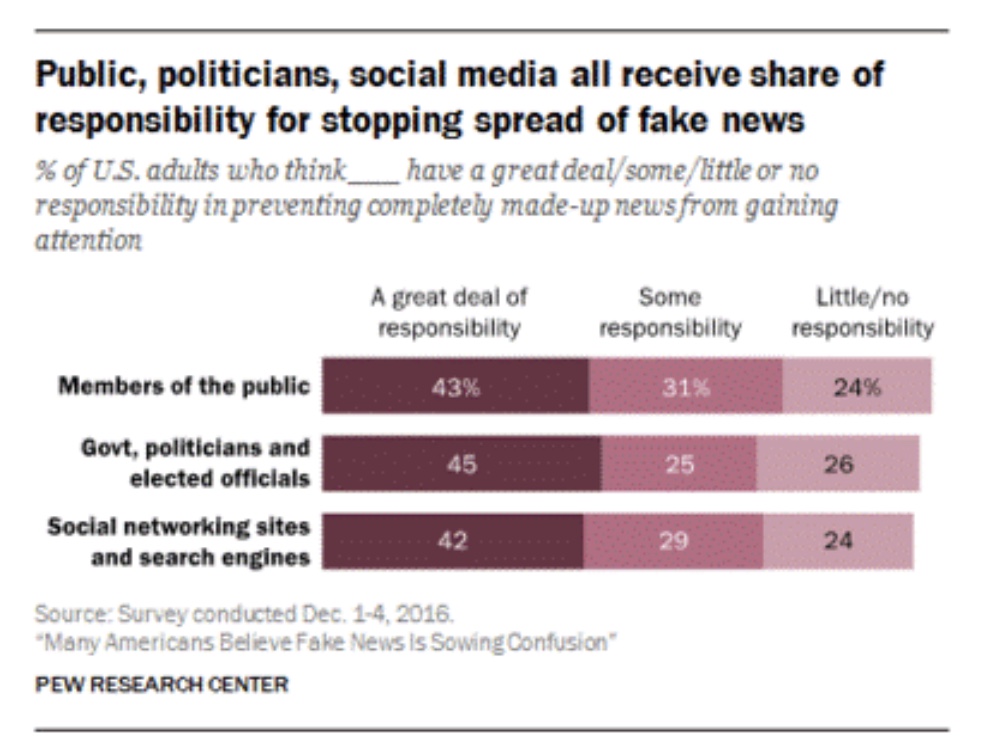
Source: Pew Research
According to this Pew Research study, Americans feel as though the government is responsible for curbing the spread of misinformation and fake news. Voice of America is a news platform that the United States government funds, meaning they can influence, at the very least, their funding levels, or potentially strategic direction through independence protections, such as the integrated strategic counterterrorism communications initiative, which affected the Voice of America’s parent agency. Considering these facts, it is important to discern whether the publication is biased due to the government’s direct involvement in the agency’s operations.
Is Voice of America Biased?
Based on Biasly’s evaluations, Voice of America is rated as Center.
By examining content patterns and the broader context of media influence, we aim to offer a balanced perspective on Voice of America’s political bias—and contribute to the ongoing discussion about bias in the news.
How Does Biasly Rate News Sources?
Biasly uses proprietary algorithms and a team of analysts to provide comprehensive bias evaluations across thousands of news outlets. Over 200,000 articles from more than 3,200 sources have been analyzed to identify the most accurate and unbiased stories.
Biasly assigns each outlet three key scores:
- Reliability Score – Reflects factual accuracy
- AI Bias Score – Generated via natural language processing
- Analyst Bias Score – Assessed by human political analysts
These scores are based on seven core metrics: Tone, Tendency, Diction, Author Check, Selection/Omission, Expediency Bias, and Accuracy. These elements help analysts and algorithms evaluate the political attitude conveyed by each article.
Biasly’s Bias Meter ranges from -100% (most left) to +100% (most right), with 0% indicating neutrality. The system evaluates individual articles based on political terms, policies, figures, and sentiment to calculate precise bias ratings.
Is Voice of America Politically Biased?
Voice of America earns a Center rating for its AI Bias Score and a Center for its Analyst Bias Score. The Analyst Bias Score is generated by reviewers from liberal, moderate, and conservative backgrounds. Analysts reviewed 15 Voice of America articles and noted preferences in areas like coverage of liberal politicians and policy topics such as abortion rights and clean energy. However, the paper maintained objectivity on topics like education and national security.
Biasly has given Voice of America a Computer Bias Score of Center. This score is given based on A.I. algorithms. The AI analysis determines bias through the evaluation of authors’ tone, opinions, diction, and tendencies. For example, Biasly’s AI rated its leanings for the policies of government spending, abortion, affirmative action, and the border wall as Center, which means on average, they report on these issues from a neutral perspective. Biasly also found that they cover politicians from both sides in a relatively balanced manner; for example, they covered both Republican Alex Azar and Democrat Alcee Hastings in a positive light.
Before we begin, we need to discuss bias. Bias is a natural function of humans, and we can express it both consciously and unconsciously. Bias is one of the most fundamental forms of pattern recognition in humans. This isn’t to lower the bar and say that “all things are biased,” but to explain how we may come to trust certain news organizations that display coverage patterns.
On the media’s part, there is an incentive to retain audiences, encourage them to purchase subscriptions, and rate products positively. Bias is a two-way street; people want to see news stories about things they care about, and the media needs viewers to continue their operations. This creates a positive feedback loop that influences what stories are covered and from what perspective. This also explains the actions of more liberal news organizations.
How to Evaluate Bias
Although Biasly rates Voice of America as Center, it’s important to remember that bias can vary from article to article. Voice of America also covers a conservative-leaning state with objectivity on many issues, from state legislation to social developments. This complexity underscores the importance of examining each article individually. So, let’s learn how to evaluate media bias.
Recognizing media bias requires awareness and critical thinking. Often, readers trust news sources that affirm their existing beliefs—a psychological tendency known as confirmation bias. This makes it harder to identify slanted narratives or one-sided reporting.
To address this, it’s essential to challenge your assumptions by consulting multiple perspectives and verifying information through third-party analysis. Tools like Biasly’s media bias ratings allow readers to compare the same news story across the political spectrum.
Ultimately, bias isn’t always a matter of what is said—it’s also about what is left out, how topics are framed, and which stories are chosen for coverage. Learning to recognize these patterns can help readers make more informed decisions and develop greater media literacy.
To start comparing news outlets and gain a better understanding of bias, sign up for Biasly’s Media Bias & News Analytics Platform to see how stories vary between sources.
Voice of America Reliability Overview
Is Voice of America Reliable?
Voice of America is a news agency that mainly reports on the United States domestic and international policy issues. The United States government, which funds and allows Voice of America to operate, significantly impacts the publication. Although there are protections in place that ensure the freedom of the authors to produce the content they desire, the funding and appointed leadership of the institution’s parent agency (U.S. Agency for Global Media) varies in different administrations, which may affect the content that Voice of America can produce. For example, the Trump administration appointed a new CEO for the agency, Michael Pack, who, according to some of the agency staffers, had attempted to fire left-leaning employees.
Some have questioned the integrity of the content of Voice of America, claiming that the United States government impacts the content they produce. Considering these concerns, it is important to discern whether the content Voice of America produced is reliable. Within this article, we will seek to understand if the publication is trustworthy or if any bias leads to lackluster evidence regarding the claims they make.
How to Evaluate Reliability?
Reliability refers to how trustworthy or accurate a news source is. If we can’t trust what we read, then continuing to consume content from that outlet serves little purpose. So how do we evaluate a news outlet’s reliability?
There are several key indicators of reliability to consider when assessing a media source. Red flags of an unreliable article can include wild, unsubstantiated claims, facts that depend on other unreliable sources, heavy use of opinionated language, and more. In contrast, hallmarks of a reliable source include:
- Absence of subjective language
- Citing credible sources (e.g., .gov, .edu, academic references)
- Verifiable facts and statistics from multiple outlets
- Use of primary sources, like interviews or transcripts
- Consistency with coverage across other platforms
Biasly’s reliability scores incorporate these elements in evaluating media outlets.
So How Does Voice of America Fare in Its Reliability?
The political reliability index developed by Biasly assesses both accuracy and trustworthiness. Voice of America currently holds Good Reliability Score, which is calculated as a weighted average of:
- Fact Analysis Score – Evaluates the accuracy of claims, facts, and evidence.
- Source Analysis Score – Assesses the number, diversity, and credibility of sources and quotes used.
Voice of America’s Source Analysis Score is Average at 35% Reliable. This suggests moderate trustworthiness in its sourcing practices. The score is AI-generated and considers quote length, frequency, diversity, and quality.
The Fact Analysis Score of Voice of America is Excellent at 96% Reliable. This further shows how well Voice of America supports its claims, addresses selection and omission bias, and presents verifiable evidence.
Voice of America’s Source Analysis Score is ‘Average,’ which suggests readers can trust some of the sources, links, and quotes provided by the news source. This score, which is based on A.I., focuses on assessing the quality of sources and quotes used, including their number, length, uniqueness, and diversity.
However, since these scores are based on percentages and averages, individual articles could be more or less trustworthy depending on the context, author, and other factors. Later, we will analyze individual articles and see how some of these components can affect reliability.
Voice of America’s Accuracy and Reliability
According to Biasly’s analysis, Voice of America maintains Good Reliability Score, but individual articles may vary significantly. Let’s dive into the details.
When choosing a news source to read or watch, its reliability is important to examine. Considering this source’s relation to the government, there are additional concerns when studying the publication, such as the concerns regarding the Voice of America’s ability to remain independent. Within this section, we will seek to understand if Voice of America is consistent in its reliability concerning its fact-based reporting.
Two common types of bias that affect factuality include:
- Selection Bias – Highlighting or omitting stories in a particular way to push a narrative.
- Omission Bias – Leaving out differing perspectives or important details to skew audience perception.
Biasly’s accuracy ratings use a scale from 1% (least accurate) to 100% (most accurate). Factors include supporting evidence, reliable internal and external sources, and balanced viewpoints.
It is helpful to understand, however, that ratings may vary across different articles from a publisher; many factors can affect the reliability of an article, as mentioned previously. One example of this can be seen in the Daily Mail, which Biasly gave an Overall Reliability Rating of Good. One article they published, “Putin Says Russia is in Dialogue With the US on Exchanging Jailed Americans Gershkovich and Whelan,” received a Reliability Rating of Good, while the article “Boston’s Democrat Mayor Michelle Wu Defends ‘no whites’ Holiday Party” received a Reliability Rating of Poor. While both of these articles were published by the Daily Mail, there is a variety in the reliability of individual articles.
Selection bias is when stories and facts are selected or deselected, often on ideological grounds, to create a narrative in support of the new sources’ ideology. Omission bias, on the other hand, is when different opinions and political views regarding a situation are left out so that the reader is only exposed to the ideological perspective supported by the author. It’s important to keep in mind these two types of biases when trying to assess an article’s level of accuracy.
One example of this can be seen in the Voice of America article “Poll: 60% of US adults support protection of access to in vitro fertilization,” which was given a Bias Rating of Somewhat Liberal and a Reliability Rating of Fair. In this article, the author does a good job of referencing data that came from a new poll, which shows support for protecting in vitro fertilization. Additionally, the author displays the opinions of individuals regarding this issue:
“I believe that it’s a woman’s right to determine what she wants to do with her pregnancy, and she should be cared for. There should be no question about that,” said John Evangelista, 73. “And IVF, I mean, for years, it’s saved a lot of people grief — because they want to have a child. Why would you want to limit this for people?”
The issue regarding selection and omission in this article surrounds the opinions he shares; the author heavily favors those who support the protection of the procedure, and virtually leaves out entirely the opinions of those who do not support it. According to the poll he referenced, 4 in 10 Americans still may not support the protections being introduced; the omission of those opinions may hamper a reader’s ability to gain a balanced perspective on this issue if they solely rely on the information provided in this article.
So, is Voice of America Reliable?
Overall, Voice of America can be considered to be an outlet that is very reliable. It demonstrates a consistent goal of journalistic integrity and typically supports claims with sources and quotes. Occasional omissions and framing bias do appear, particularly on culturally sensitive or partisan issues.
As media literacy improves, readers can more easily detect issues with selection bias, omission bias, and factuality. To strengthen your ability to assess reliability across the political spectrum, use Biasly’s News Bias Checker to compare how multiple outlets report the same story.
This empowers you to consume more accurate, balanced, and dependable news.
Voice of America Editorial Patterns
Voice of America’s coverage of political topics often reflects a Center bias, with consistent patterns in phrasing, source selection, and thematic focus that are Neutral. While the publication demonstrates journalistic standards in many of its reports, the choice of issues, framing, and word usage can indicate a political slant. This content analysis examines how Voice of America handles liberal and conservative issues and evaluates its language choices and editorial tendencies.
Coverage of Liberal vs. Conservative Topics
Articles by Voice of America include topics with democratic or human rights themes. For example, subjects such as press freedom, civil liberties, and migration tend to be covered in a supportive, institutionally sympathetic tone. Its coverage of topics like elections, political repression, and anti-discrimination issues often aligns with pro-democracy viewpoints.
On the other hand, some articles that cover conservative figures or Republican-led initiatives receive a more critical tone. Voice of America’s articles on recent conservative political developments sometimes highlight controversy, legal scrutiny, or backlash, while providing less emphasis on some inconvenient truths.
When this source is biased, it appears to slightly favor some liberal causes in its word choices in certain articles. Words like “freedom,” “rights,” or “democracy” are used more frequently in stories supporting liberal causes, while conservative stories can focus on criticism and controversy.
Policy and Issue Framing
Voice of America often emphasizes themes of democratic values, press freedom, and human rights in its reporting. The political coverage tends to highlight transparency, civic participation, and the rule of law. Liberal democratic principles are also clear when this source reports on global conflict and bases its research on dissidents, international watchdogs, and independent journalists.
On the other hand, the topics of security policy or Western intervention, for example, can become framed in a specific way. The pro-Western bias can be seen in subtle but key observations surrounding the source’s word choices. Voice of America is more likely to describe a democratic reform as “strengthening” or “advancing”, per se, while a different or rival government’s choices may be described using negative language.
This type of consistent framing reflects an editorial influence that, while the source may still aim for accuracy, can demonstrate a measurable bias during global news coverage.
Coverage and Relevance
Voice of America’s reporting covers both American and world politics, and the source runs broadcasting programs about some contemporary news subjects. The American news section publishes many current event stories with an emphasis on foreign policy and national events.
Readers who wish to further explore how Voice of America compares with other publications can visit Biasly’s Media Bias Chart to analyze tone and word choice in real time.
Funding and Ownership
Who Owns Voice of America?
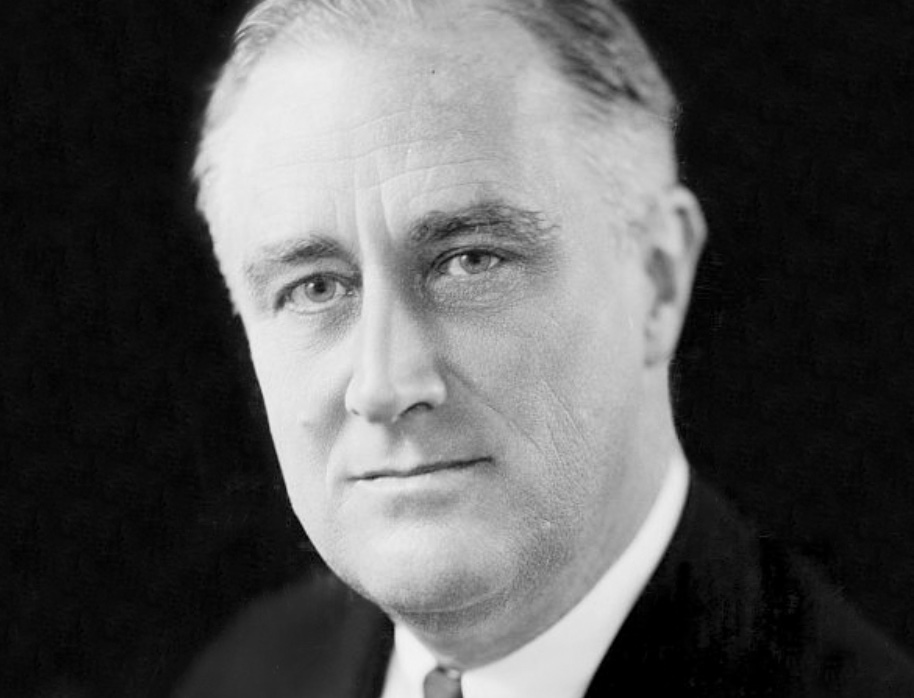
32nd President of the United States
Source: The White House
Voice of America News first began broadcasting in 1942 to combat Nazi propaganda with accurate and unbiased information (Voice of America History) as a unit of the United States Information Agency (USIA). Headquartered in Washington, D.C, they cover content not only in the United States but also in the world, with a section on the following respective parts of the world: Africa, the Americas, East Asia, Europe, the Middle East, and South & Central Asia. More information about the source can be found on its Public Relations page. This source was established by President Franklin D. Roosevelt, pictured above.
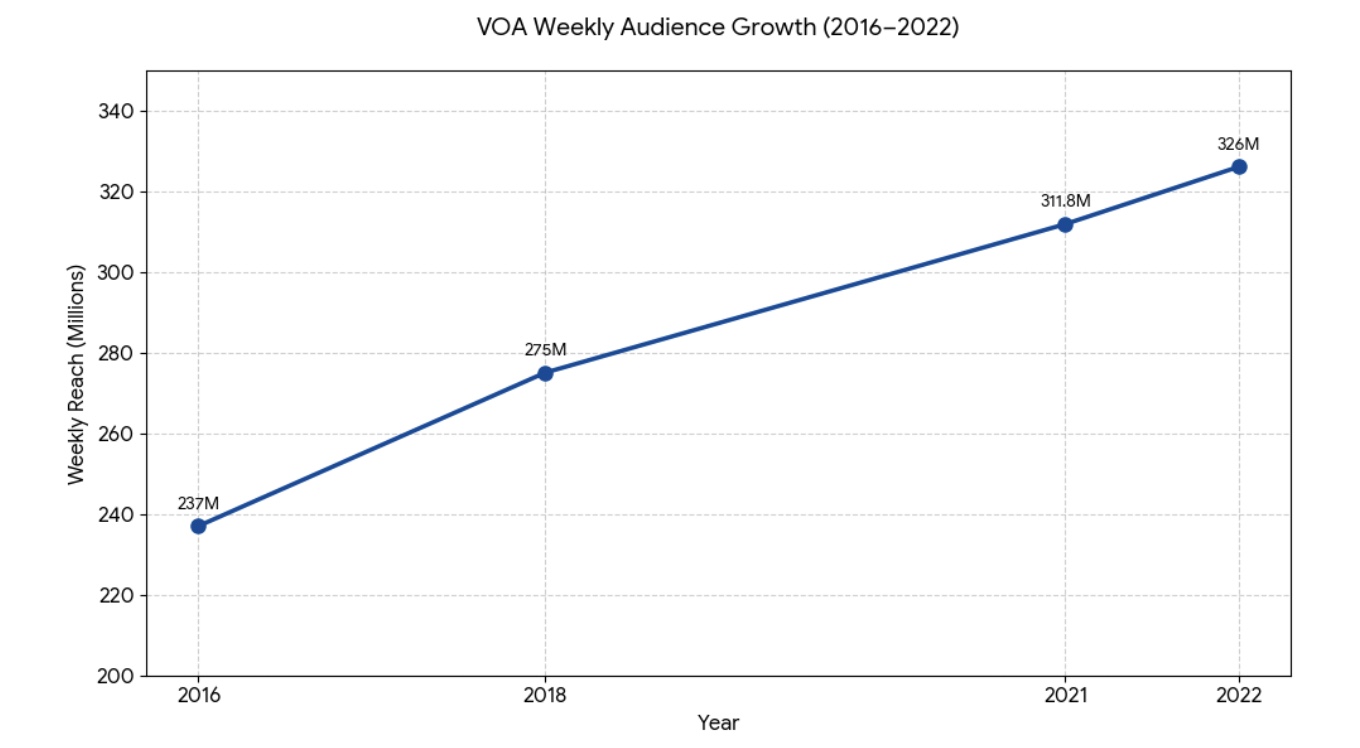
Source: U.S. Agency for Global Media
Voice of America News, the largest U.S. international broadcaster, provides news across the globe in a variety of 40 languages– creating content for digital, television, and radio platforms. Voice of America is a part of the U.S. Agency for Global Media (USAGM), a government agency that oversees all non-military U.S. international broadcasting. As a result, they are funded by the U.S. Congress.
Who Funds Voice of America?
The United States Government funds Voice of America, and there have been calls of concern over time questioning the agency’s ability to remain neutral under such leadership.
Some protections are in place, however, which protect the publication from its content being directly impacted at the behest of whichever administration is in power at the time. The 1994 International Broadcasting Act put protections into law that enshrine freedom of objectivity towards Voice of America, allowing it to operate independently of bias. This legislation has seemed to stand the test of time as even today, 30 years after the law was introduced, Voice of America continues to remain relatively bias-free, as corroborated by Biasly’s rating of Center.
Additional Insights
News Source Comparison
When it comes to other sources that compare to this source, many other international public broadcasters like the BBC, Deutsche Welle, Radio Free Asia, and France 24 are mentioned. This format, designed for both international and domestic news, places the Voice of America so closely with these other outlets, even though some things differ. Radio Free Asia, for example, focuses its efforts on areas where press freedom is constrained, while many of the other outlets simply report the news.
Specifically within the United States, the sources that compare most closely with this one are NPR, PBS, and AP News. NPR is very close in tone to the articles published by Voice of America, and many of these news media outlets explore topics across various subjects like Voice of America. These news media organizations are also not often the center of controversy or debate because of their low-sensationalist nature and tone.
Notable Contributors and Authors
Voice of America features a large array of reporters and columnists. Amanda Bennett is an ex-Voice of America director and Pulitzer Prize-winning journalist/author who often wrote for the source. Alan Heil, a seasoned journalist, worked at this source for decades and wrote a book about the organization’s history. The staff at this news source comprises a range of journalists and broadcasters who specialize in various reporting topics and styles.
Related Tools and Resource Pages
To better understand how Voice of America fits into the broader media landscape, we recommend exploring these helpful resources:
- Media Bias Chart: See where Voice of America ranks among hundreds of media outlets across the political spectrum.
- Political Bias Chart: Visualize political slants of news sources across various policy areas.
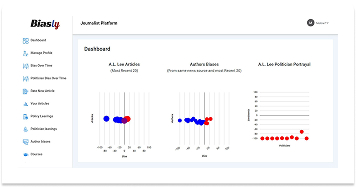
- Journalist Bias Analytics Platform: Explore how individual journalists contribute to bias within their publications.
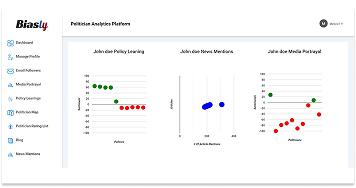
- Politician Bias Analytics Platform: Compare how politicians are framed differently by Voice of America and other outlets.
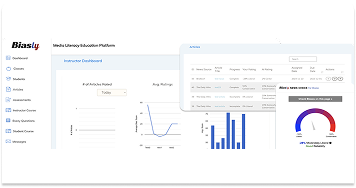
- Media Literacy Education Platform: Learn how to critically assess media sources, bias techniques, and news reliability.
Frequently Asked Questions
Voice of America is rated as Center based on Biasly’s media bias algorithm, which assesses sentiment, article framing, and policy favorability.
Voice of America is not usually discussed as an overtly partisan news source but has recently come under fire for propagandistic publications. For example, in 2020, the White House accused the source of defending America’s adversaries, and in 2025, the White House issued an executive order that put the source on administrative leave. Due to the fact that several executives have been vocal critics of this source, it is important to remember that Voice of America probably reports in a fair and accurate way most of the time. When topics are increasingly politicized, they can become a hotbed for criticism and misinformation allegations, especially at the White House.
Biasly uses a combination of AI sentiment analysis and human analyst review to assess tone, fact accuracy, source quality, and media bias indicators. Learn more on our Bias Meter page.
Yes, though occasionally partisan or pro-Western framing can cloud the story and affect perceived reliability.
Military Spending
| Date | Sentiment | Associated Article | Snippet |
|---|---|---|---|
| 08/25/2019 | 75% For | Trump Family Detentions Flores Agreement (link) | So, of course, the Trump administration is doing the opposite in a baldfaced |