




-6% Center
Bias Meter
Extremely
Liberal
Very
Liberal
Somewhat Liberal
Center
Somewhat Conservative
Very
Conservative
Extremely
Conservative
-100%
Liberal
100%
Conservative
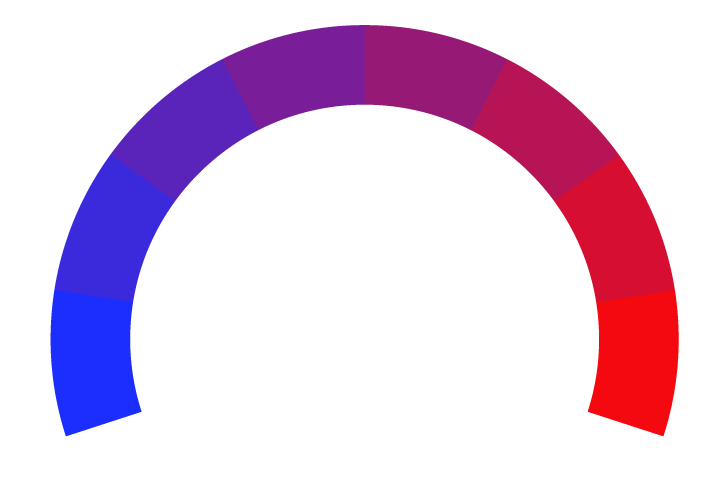
Biasly determines media bias ratings through a dual-layered approach combining artificial intelligence and analyst review. The platform’s proprietary bias detection engine, Bias Meter, evaluates sentiment, policy position alignment, and language framing across thousands of data points in news articles. Analysts then verify and interpret the AI’s findings, providing additional context where needed. Learn more about ratings
- Profile
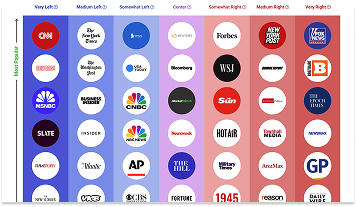
Sky News on the media bias chart

Sky News has a Bias Score of -6% Center which is based on a variety of factors including its policy and politician leanings, article ratings, and the use of biased language. Its Reliability is rated as Average, and additional analytical insights are available in the other tabs.
- Bias Rating
-6% Center
- Reliability67% Reliable AveragePolicy Leanings
6% Center
Extremely
LiberalVery
LiberalModerately
LiberalSomewhat Liberal
Center
Somewhat Conservative
Moderately
ConservativeVery
ConservativeExtremely
Conservative-100%
Liberal100%
Conservative
Average Reliability
*Our bias meter rating uses data science including sentiment analysis, machine learning and our proprietary algorithm for determining biases in news articles. Bias scores are on a scale of -100% to 100% with higher negative scores being more liberal and higher positive scores being more conservative and 0% being neutral. The rating is an independent analysis and is not affiliated nor sponsored by the news source or any other organization.
Politician Portrayal80% negative
Continue For Free
Create your free account to see the in-depth bias analytics and more.
By creating an account, you agree to our Terms and Privacy Policy, and subscribe to email updates.
Log In
Log in to your account to see the in-depth bias analytics and more.
Policy Leanings Analysis
Policy | Bias score |
|---|
Sky News Editorial Patterns
Sky News’s coverage of political topics often reflects a Center bias, with consistent patterns in phrasing, source selection, and thematic focus that are Neutral. This content analysis examines how Sky News handles liberal and conservative issues and evaluates its language choices and editorial tendencies.
Coverage of Liberal vs. Conservative Topics
Based on a random sampling of articles, Sky News tends to somewhat favor the liberal positions on issues in America. For example, it commonly adopts the pro-vaccine position in articles related to the coronavirus pandemic. Multiple articles are critical of President Donald Trump or the GOP. Others support the liberal position on subjects such as vaccines and climate change.
Policy and Issue Framing
Sky News appears to place significant emphasis on the seriousness of global warming. It amplifies stories that show the effects of climate change, underscoring how underdeveloped countries are most affected. They also publish articles criticizing President Donald Trump for fighting against climate change legislation. On social issues like abortion and conversion therapy, Sky News describes abortion as part of the “fabric of American life” and offers a slightly negative assessment of conversion therapy, again underscoring a Center bias.
Their opinion pieces tend to be more outwardly biased, as is typical. In these cases, the authors exhibit a strong liberal slant toward foreign policy and social causes such as racism. However, it is worth pointing out that Sky News’s opinion section is outdated, with the last entry published in May 2023.
Generally speaking, Sky News tends to adopt a negative, somewhat sensational tone. On issues of climate change and crime, and in coverage of world leaders like Donald Trump and Xi Jinping, they paint a dark picture of the problems and take a critical tone toward the politicians.
Coverage and Relevance
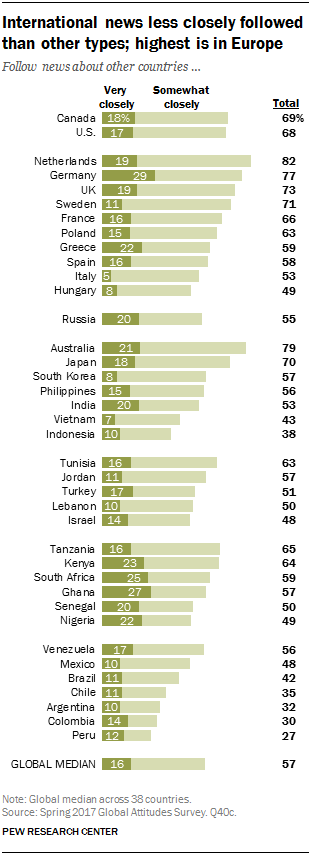
Sky News tends to serve an older, right-leaning audience. Other demographic variables, such as gender, appear to be more evenly split. As demonstrated in the image below, a significant majority of residents of the United Kingdom pay at least some attention to international affairs, even if their primary focus is on domestic issues. Given these facts, it makes sense for Sky News to pay close attention to media political bias discussion broadly and in their own work. This way, the organization can highlight timely, relevant, neutral information.
Readers who wish to further explore how Sky News compares with other publications can visit Biasly’s Media Bias Chart to analyze tone and word choice in real time.
Sky News Bias Analysis
Founded by Rupert Murdoch and British Satellite Broadcasting on February 5, 1989, Sky News became the first 24-hour news channel in the UK. Providing around-the-clock coverage of politics, business, and international affairs and impartial reporting, it has become a trusted source of information for viewers across the UK and internationally. Over the years, the organization has faced controversy regarding perceived biases in its news stories. In 2003, it was criticized for its coverage of the Iraq War, with detractors accusing it of biased reporting and a lack of balanced perspectives. In 2016, it again came under fire for perceived bias in its coverage of the Brexit referendum debate.
In this article, we will examine the newspaper’s coverage and editorial choices to identify any potential biases in their articles. By equipping you with these tools, we aim to provide a comprehensive analysis that will help you determine whether a news outlet is biased.
Is Sky News Biased?
Based on Biasly’s evaluations, Sky News is rated as Center.
By examining content patterns and the broader context of media influence, we aim to offer a balanced perspective on Sky News’s political bias and contribute to the ongoing discussion about bias in the news.
How Does Biasly Rate News Sources?
Biasly uses proprietary algorithms and a team of analysts to provide comprehensive bias evaluations across thousands of news outlets. Over 200,000 articles from more than 3,200 sources have been analyzed to identify the most accurate and unbiased stories.
Biasly assigns each outlet three key scores:
- Reliability Score – Reflects factual accuracy
- AI Bias Score – Generated via natural language processing
- Analyst Bias Score – Assessed by human political analysts
These scores are based on seven core metrics: Tone, Tendency, Diction, Author Check, Selection/Omission, Expediency Bias, and Accuracy. These elements help analysts and algorithms evaluate the political attitude conveyed by each article.
Biasly’s Bias Meter ranges from -100% (most left) to +100% (most right), with 0% indicating neutrality. The system evaluates individual articles based on political terms, policies, figures, and sentiment to calculate precise bias ratings.
Is Sky News Politically Biased?
Sky News earns a Center rating for its AI Bias Score and a Somewhat Left for its Analyst Bias Score. The Analyst Bias Score is generated by reviewers from liberal, moderate, and conservative backgrounds.
Biasly’s rating for Sky News gives the paper a Computer AI Bias Score of Center, based on its AI-based algorithms. Biasly’s AI bias analysis focuses on the author’s leaning in tone, opinion, and diction, and their respective tendencies. For example, Biasly has rated its stance on policies such as Free College Education and Gun Control as centered.
Biasly has assigned a Somewhat Left as an Analyst Bias Score. Typically, alongside the Computer Bias Score, Biasly presents an Analyst Bias Score. This score is curated based on a review of at least 15 articles by a team of analysts representing liberal, moderate, and conservative viewpoints. Different types of bias in articles, as well as preferences for liberal or conservative politicians and policies, all factor into the generation of these scores. The more articles the Biasly analyst team reviews and rates, the more precise the analyst score becomes.
Before we begin, we need to discuss bias. Bias is a natural human function, and we can express it both consciously and unconsciously. Bias is one of the most fundamental forms of pattern recognition in humans. This isn’t to lower the bar and say that “all things are biased,” but to explain the process by which we may come to trust certain news organizations that display patterns of coverage.
On the media’s part, there is an incentive to retain audiences, encourage them to purchase subscriptions, and rate products positively. Bias is a two-way street: people want to see news stories about things they care about, and the media needs viewers to stay in business. This creates a positive feedback loop that influences what stories are covered and from what perspective. This also explains the actions of more liberal news organizations.
Analysis of Bias in Sky News Online Articles
Understanding Sky News’s target audience demographics is crucial for grasping how the company tailors its content. Given its influence in the United Kingdom and beyond, its audience’s political affiliations and ideologies can vary by country or region. According to Pew Research, 55% of adults in the UK generally trust Sky News, with 49% of left-wing individuals and 59% of right-wing individuals expressing this trust.
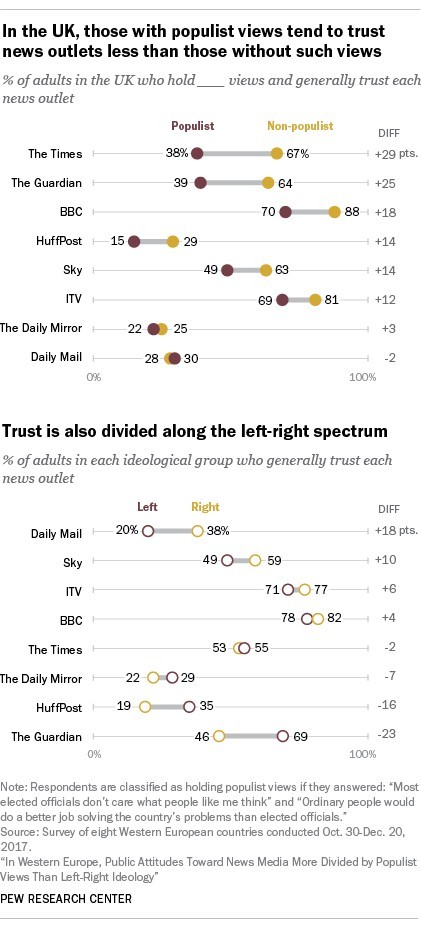
Source: Pew Research Center
Sky News has an older audience than other news channels, particularly among viewers aged 35 to 64. The gender balance among its viewers is relatively equal, comprising both male and female audiences. Additionally, it attracts individuals with college degrees who typically come from middle to upper-income brackets. While the audience is predominantly conservative, Sky News caters to viewers with right-leaning and independent perspectives. Given its specific audience, how does Sky News ensure its impartial content appeals to liberal and conservative readers worldwide?
When determining bias, some of the most common metrics include Tone, Tendency, Author, Diction, and Expediency Bias; we’ll focus on these primary metrics below.
- Tone: This represents the attitude of the writing, formed distinctively but related to the author’s word choices or diction.
- Diction: The specific words chosen by the writer.
- Author: A metric related to the article’s author, taking into account their history of stance on issues based on past articles and social media posts.
- Tendency: measures how consistently an author shows bias in their work, including factors like their tone and perspective.
- Expediency Bias: relates to the immediate impression created by elements like the article’s headline, images, or summary, indicating if they favor a particular viewpoint.

An example of this is “George Clooney calls on Biden to drop out of presidential race to give Democrats chance of beating Trump”. The expediency bias is evident in the headline, which indicates pressure on Joe Biden to decide whetherto run for a second term in the White House due to concerns about his age and performance. The article’s headline and content create an immediate impression that supports the idea of Biden stepping down.
The author’s tone conveys urgent concern about Joe Biden’s ability to win the election and its implications for the Democratic Party.
“We’re all so terrified by the prospect of a second Trump term that we’ve opted to ignore every warning sign. The George Stephanopoulos interview only reinforced what we saw the week before.”
The author tends to show bias against Biden, yet still leans liberal, using a critical tone and perspective to express concerns about his performance and suitability for a second term in the White House. The diction is direct and urgent, as evidenced by George Clooney’s statement about President Biden’s performance. He describes it as “devastating” and emphasizes that Biden remains “the same man we all witnessed at the debate.” These words are deliberately chosen to underscore the seriousness of the situation, suggesting that Biden’s candidacy and performance could have dire consequences.
Regarding the author’s bias, James Matthews is a US correspondent for Sky News, based in Washington. His X (Twitter) account does not disclose many personal opinions on politics. Instead, his feed primarily features video clips of his coverage of US political news, along with reposts of interviews and reports from his colleagues at Sky News.
Prime Minister Keir Starmer will meet President Joe Biden today to discuss supporting Ukraine, focusing on whether to allow Western missiles to target Russia.@jamesmatthewsky has all the details.https://t.co/PAiZ4D1jU3
📺 Sky 501, Virgin 602, Freeview 233 and YouTube pic.twitter.com/X8h2ZB4bfT
— Sky News (@SkyNews) September 13, 2024
It’s less than a month to go until the US election.@marthakelner is in the swing state of Arizona, and with Hurricane Milton hitting Florida, @jamesmatthewsky & @Stone_SkyNews are in Sarasota and St Petersburg, discussing the impact of misinformation.
— Sky News (@SkyNews) October 11, 2024
Analysis of Sky News Opinion Articles
Before addressing this question, it is essential to distinguish between reporting and opinion. Reporting is intended to be neutral, focusing on presenting facts and quotes from primary sources so that readers can form their own opinions. In contrast, opinion articles provide columnists with a platform to express their personal views on current issues. While Sky News strives to maintain neutrality as a publication, it also features an Opinion section where columnists can share their perspectives.
Consider the Opinion article posted in June 2020, “Racism won’t change until black people no longer seen as police ‘property’ – former Met diversity chief”. The title’s language is direct and confrontational, using strong words like “racism” and “policy property policy” to immediately capture the reader’s attention and evoke strong emotions. The tone suggests urgency and a call to action, which may attract readers passionate about social justice. Additionally, referring to the “former Met diversity chief” lends credibility to the perspective, encouraging readers to take the argument seriously and reflect on the systemic nature of the problem. However, the title’s phrasing might alienate some readers who perceive the language as overly accusatory or one-sided, potentially shaping their view of the article’s bias.
In the article, the author argues:
“Yet, for black people, evolving changes in the language and style of UK policing are shifting towards more of an ‘enforcement’ style than ‘service’.”
“The answer is to stop stereotyping black people as low status, unintelligent, aggressive, dangerous, self-destructive, and sub-human.”
The author’s language is assertive and unyielding, choosing words that emphasize the gravity and urgency of the issue, such as “enforcement” and “sub-human”, directly challenging readers to confront uncomfortable truths. Consequently, the unequivocal stance, terminology, and tone may alienate those who share a different perspective or feel the article needs a balanced viewpoint. The perceived bias in framing police practices as inherently problematic may alienate supporters of law enforcement or those who favor a more balanced view, potentially limiting the article’s reach to a broader audience.
Another example is an opinion article from Sky News is “Trump’s reckless Middle East rampage makes mad Bush’s rush to war look thoughtful”. The article’s title employs provocative, charged language, featuring words like “reckless,” “rampage,” and “mad,” which evoke a sense of chaos and responsibility. By comparing Trump’s actions to those of Bush, the article creates a dramatic contrast that engages readers and prompts them to reflect on the seriousness of the situation.
In the article, the author claims:
“America continues to pay a huge price for Republican misadventures in the region.”
“And like Bush’s long-lost Iraq War, Trump’s thoughtless drone strike will likely mark an extended period of US turmoil for American forces and their standing in the region.”
Both examples use charged language to provoke strong emotional reactions from readers, effectively engaging those who already share similar viewpoints. However, this approach can alienate individuals with opposing views or those who prefer a more nuanced discussion.
The police reform article challenges readers to confront systemic racism directly, while the opinion piece on Trump’s Middle East policy employs vivid comparisons to critique political decisions. Both pieces emphasize the urgency and seriousness of their respective issues, but may limit their reach to audiences receptive to such direct criticism.
How to Evaluate Bias
Although Biasly rates Sky News as Center, it’s important to remember that bias can vary from article to article. This is particularly true, given that bias can vary from one topic to another or from one journalist to another. This complexity underscores the importance of examining each article individually. So, let’s learn how to evaluate media bias.
Recognizing media bias requires awareness and critical thinking. Often, readers trust news sources that affirm their existing beliefs—a psychological tendency known as confirmation bias. This makes it harder to identify slanted narratives or one-sided reporting.
To combat this, it’s essential to challenge your assumptions by consulting multiple viewpoints and verifying news through third-party analysis. Tools like Biasly’s media bias ratings allow readers to compare the same news story across the political spectrum.
Ultimately, bias isn’t always a matter of what is said; it’s also about what is left out, how topics are framed, and which stories are chosen for coverage. Learning to recognize these patterns can help readers make more informed decisions and develop greater media literacy.
To start comparing news outlets and gain a better understanding of bias, sign up for Biasly’s Media Bias & News Analytics Platform to see how stories vary between sources.
Sky News Reliability Analysis
Is Sky News Reliable?
For 35 years, Sky News has established itself as a prominent player in global journalism, known for its commitment to reliable reporting and comprehensive coverage of international events. However, the network has faced scrutiny regarding its reliability and credibility as a news source. Critics have pointed out instances of reporting errors and inaccuracies in its coverage. Additionally, concerns have been raised about the blurred lines between news reporting and opinion, which can create confusion about the distinction between factual news and editorial content.
In September 2024, Sky News faced criticism for sensationalism when one of its reporters compared Israel’s actions in Gaza to Nazi Germany during the Holocaust. At Biasly, we strive to evaluate the reliability and accuracy of all media outlets. Let us investigate the reliability and accuracy of Sky News.
How to Evaluate Reliability?
Reliability refers to how trustworthy or accurate a news source is. If we can’t trust what we read, then continuing to consume content from that outlet serves little purpose. So how do we evaluate a news outlet’s reliability?
There are several potential measures of reliability to look out for when trying to determine whether a media source is reliable or not. Red flags for an unreliable article can include the presence of wild, unsubstantiated claims, facts dependent on other unreliable sources, heavy use of opinionated language, and more. In contrast, hallmarks of a reliable source include:
- Absence of subjective language
- Citing credible sources (e.g., .gov, .edu, academic references)
- Verifiable facts and statistics from multiple outlets
- Use of primary sources, like interviews or transcripts
- Consistency with coverage across other platforms
Biasly’s reliability scores incorporate these elements in evaluating media outlets.
So How Does Sky News Fare in Its Reliability?
The political reliability index developed by Biasly assesses both accuracy and trustworthiness. Sky News currently holds Average Reliability Score, which is calculated as a weighted average of:
- Fact Analysis Score – Evaluates the accuracy of claims, facts, and evidence.
- Source Analysis Score – Assesses the number, diversity, and credibility of sources and quotes used.
Sky News’s Source Analysis Score is Average at 40% Reliable. This suggests moderate trustworthiness in its sourcing practices. The score is AI-generated and considers quote length, frequency, diversity, and quality.
The Fact Analysis Score of Sky News is Good at 74% Reliable. This further shows how well Sky News supports its claims, addresses selection and omission bias, and presents verifiable evidence.
These values suggest that readers can trust most of Sky News’s content in terms of factuality. However, readers may need to exercise some caution when trusting the types of sources that Sky News uses in their reporting of major events.
Sky News’s Accuracy and Reliability
According to Biasly’s analysis, Sky News maintains Average Reliability Score, but individual articles may vary significantly. Let’s dive into the details.
Sky News is known for its centralized reporting, but it has a controversial history marked by reporting errors, sensationalism, and the blending of opinions with factual news. At Biasly, we will assess the credibility of Sky News’s news stories by evaluating the quality of the sources used, the accuracy of the reporting, and any potential bias in the articles.
Selection bias occurs when stories and facts are selected or deselected, often on ideological grounds, to create a narrative that supports the new sources’ ideology. Omission bias, on the other hand, is when different opinions and political views regarding a situation are left out so that the reader is only exposed to the ideological perspective supported by the author. It’s essential to keep in mind these two types of biases when trying to assess an article’s level of accuracy.
Biasly assigns a percentage score to accuracy, with one being the least accurate and 100 being the most. Ratings are calculated by weighing assertions with supporting evidence, the number of reliable internal sources, and the number of reliable external sources employed. According to the reports that analytics have assessed, Sky News has a Average reliability score. This score can vary from article to article, though, and the most extreme variations in dependability are caused by bias, notably omission and selection bias.
We will examine additional examples to assess the reliability of articles from Sky News. This analysis will focus on selection bias, omission bias, and the quality of the sources and facts presented.
Analysis of Reliability in Sky News’s Online News Articles
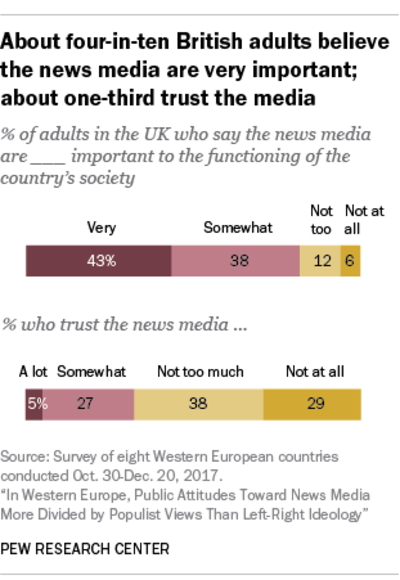
Source: Pew Research Center
According to Pew Research, 43% of British adults consider the news media very important to society. However, only around a third (32%) say they trust the news media, including 5% who trust the media a lot.
Sky News offers a variety of online articles covering topics such as current events, politics, technology, and entertainment, keeping readers informed about the latest developments, both locally and globally. Like other news outlets, Sky News features an Opinion section that presents various viewpoints, which may not always reflect the publication’s overall stance. This section allows columnists and guest contributors with specific ideological perspectives to openly share their opinions and engage in subjective analysis.
Eyewitness Articles are reports that provide first-hand accounts of events or situations by journalists who witnessed them firsthand. These articles often include images or narratives captured during political events, natural disasters, or conflicts. The goal of these articles is to deliver a detailed and authentic representation of the events being reported.
Analysis articles offer an in-depth examination of current events, issues, and topics. They typically include expert opinions, data-driven insights, and diverse perspectives to help readers understand the context, implications, and significance of the reported events.
Each type of article impacts the reliability and readership of Sky News in different ways. While opinion pieces offer diverse viewpoints, they may be perceived as biased if readers mistake them for factual reporting, potentially eroding trust among audiences seeking objective news. Eyewitness Articles enhance reliability by providing unfiltered information but heavily rely on the journalist’s perspective, which can introduce subjective interpretations. Analysis articles can enhance the credibility of reporting by incorporating expert insights and data, attracting readers seeking a comprehensive understanding. However, they require careful vetting to ensure accuracy and balanced representation.
Quality of Sources and Facts Used
Sky News has been accused of factual errors and inaccuracies in its reporting, as it has a reputation for being the first outlet to report on an incident. These inaccuracies can undermine the trust and credibility audiences place in the outlet, leading to skepticism about the outlet’s information. When readers encounter errors or misleading information, they may question the news organization’s overall integrity, potentially leading to a decline in viewership and engagement.
For example, “Kemi Badenoch claims maternity pay remarks were ‘misrepresented’” by Jennifer Scott. The article received a “Fair” rating for its Source Analysis Score and a “Good” Rating for its Multiple Source Rating, with 50% and 75%, respectively. Author Jennifer Scott included 18 quotes of varying lengths: six short, three medium, and nine long. Regarding multiple unique sources, the article references only two: Sky News and WhatsApp.
Scott’s reliance on a limited number of sources may give the audience the impression that the article lacks depth and objectivity. Limited sourcing may suggest that the report does not offer a comprehensive view of the issue, potentially raising concerns about bias or incomplete reporting. Consequently, readers might be less inclined to trust the information presented, ultimately undermining the outlet’s credibility.
Another example is the Sky News Explainer article, “Who is JD Vance? The ‘never Trumper’ who is now Republican vice-president pick”. The article received a “Fair” rating for its Source Analysis Score and a “Good” Rating for its Multiple Source Rating, scoring 65% and 75%, respectively. The article’s author is unlisted and contains four quotes: one short, two medium, and one long. As for multiple unique sources, the article listed only two references:
- Sky News
- PodFollow
Compared to Scott’s article, the Explainer article includes another source, PodFollow, which slightly expands its coverage. Despite this minor increase in source diversity, both articles rely heavily on a limited set of sources, which could affect their reliability.
Limited source diversity can lead to a homogeneous perspective that fails to capture the complexity of an issue, potentially omitting critical viewpoints or alternative narratives. This can result in an incomplete representation of events, potentially misleading readers who rely on diverse information to form well-rounded opinions. Furthermore, when news articles consistently draw on a limited pool of sources, it can perpetuate existing biases, undermining the publication’s perceived objectivity and trustworthiness.
Selection and Omission Bias
Sky News is typically seen as a centrist publication that does not endorse any particular political ideology and does not seek to influence its audience with a specific agenda. However, its Opinion Section invites writers to share their viewpoints. On the other hand, biased articles present information in a manner that disproportionately favors one side or agenda. This can mislead readers and shape their views without offering a balanced perspective.
Let us examine an opinion article from Sky News from January 2020, “Trump’s reckless Middle East rampage makes mad Bush’s rush to war look thoughtful” which is rated as Medium Left. The article discusses the motivations and influences behind the targeted killing of Major General Qassem Soleimani, Iran’s response, and the potential consequences of escalating tensions in the Middle East.
The article draws on various sources, including the insights and experiences of Amed Khan, a former official from the Bill Clinton administration who has worked directly in the Middle East and with individuals displaced from the region since the Iraq war began in 2003. It also references a project from Brown University and the actions, statements, and beliefs of key advisors of President Donald Trump, Secretary of State Mike Pompeo, and Vice President Mike Pence, key advisors to President Donald Trump.
“I have tried to do my best in the years since to, in some small way, make up for the devastation we wrought – rebuilding homes destroyed by fighting in Iraq and running programmes for refugees still migrating to Greece 17 years after the war’s onset – but nothing can ever undo the consequences of America’s original decision to invade Iraq.”
“Both believe there is a battle between good and evil that will end with the “Rapture” – following an apocalyptic war in the Middle East, Jesus Christ will return to Israel, bestowing eternal redemption to Christians, who will be “raptured” or ascended, into heaven. Jews, however, will be punished.”
The author focuses on the negative consequences of the American military’s involvement in the Middle East as well as the potential influence of evangelical extremists, which may lead to a biased portrayal of the situation. The author’s emphasis on the costs, consequences, and motivation behind the targeted killing of Soleimani may not fully represent the complexity of the problem. Furthermore, the author’s decision to omit perspectives that support the Trump administration’s actions or to offer a different interpretation of the events may lead to a one-sided presentation of the issue, potentially influencing readers to adopt a particular viewpoint.
Let us examine another article from September 2020, “Kenosha residents say there is still more to be done after Trump and Biden visit,” which is rated as moderately conservative. The article examines the effects of protests and violence in Kenosha, Wisconsin, particularly following the shooting of Jacob Blake, as well as the reactions of political leaders like Donald Trump and Joe Biden.
The article features insights from residents of Kenosha, Wisconsin, including Sahil Khindri and Sirena Cruz, who share their concerns about how the protests and the shooting of Jacob Blake have affected their lives. Additionally, Pastor Brit Bindel addresses the fear and division within the community, calling for restoration and healing.
“Well I’m definitely happy that Donald Trump did send the National Guard in because it did help, it did calm a lot of things and I don’t try to get into too many politics, but I definitely am thankful for the leaders that are doing something to help the city of Kenosha, especially during this time, you know, so if Joe Biden’s coming here to help, then Amen.”
“People want to feel protected, they want to feel in control. His leadership style, his speaking style I think definitely helps people connect to that. The Democratic Party really tries to tap into a lot of the relational side of things.”
The author’s selection and omission of certain voices and perspectives can significantly shape the narrative and influence readers’ perceptions. It is evident in their choice to include quotes from individuals who express gratitude for Donald Trump’s actions in Kenosha, giving readers the impression that most Kenosha residents support Trump’s approach. Simultaneously, they omitted perspectives from those who might have criticized Trump’s response or supported Joe Biden’s approach, limiting the audience’s understanding of the diverse range of opinions and reactions within the community.
Both articles reveal how media outlets can subtly shape narratives based on their editorial leanings. With its centrist approach, Sky News aims to present a more balanced view by including diverse perspectives. In contrast, outlets with a clear political bias might skew the narrative to align with their audience’s beliefs. This selective reporting can deepen societal divisions by reinforcing prejudices and creating echo chambers where audiences only engage with viewpoints that mirror their own. Consequently, media consumers must be vigilant and seek information from multiple sources to develop a well-rounded understanding of complex issues.
So, is Sky News Reliable?
Overall, Sky News can be considered to be an outlet that is moderately reliable. It demonstrates a consistent goal of journalistic integrity and typically supports claims with sources and quotes. Occasional omissions and framing bias do appear, particularly on culturally sensitive or partisan issues.
As media literacy improves, readers can more easily detect issues with selection bias, omission bias, and factuality. To strengthen your ability to assess reliability across the political spectrum, use Biasly’s News Bias Checker to compare how multiple outlets report the same story.
This empowers you to consume more accurate, balanced, and dependable news.
Funding and Ownership
Who Owns Sky News?
Sky News is owned by Sky Group, a subsidiary of Comcast Corporation, a prominent American telecommunications conglomerate that owns various media properties, including NBCUniversal and Xfinity. Operating across six European countries, Sky connects over 23 million customers worldwide to offer a wide range of digital products and services, including television, radio, and online streaming.
Dana Strong is the current Group Chief Executive Officer of Sky. Before joining Sky, she served as Chief Operating Officer at Virgin Media from 2013, and in 2015 became Senior Vice President and Chief Transformation Officer at Liberty Global. In 2018, she was President of Consumer Services for Comcast Cable before succeeding Jeremy Darroch as Sky’s chief executive in 2021. Strong has fostered long-term partnerships between Sky and UK public service broadcasters, such as Channel 4 and the BBC (Center). Furthermore, she has established agreements with Apple TV+ and Paramount+ to integrate their content into Sky’s Entertainment OS platform.
Who Funds Sky News?
Sky News was established and funded in the 1980s and 1990s by Rupert Murdoch. During this time, it remained the UK’s primary news channel until the creation of the BBC News Channel in 1997. From 2016 to 2018, an international bidding war for the purchase of Sky News ensued, including 21st Century Fox, Disney, and Comcast. On September 22, 2018, Comcast officially acquired Sky News.
Additional Insights
News Source Comparison
When it comes to news source comparison, Sky News is aligned closely with other prominent international organizations such as BBC News, ABC Australia, CTV News, The New Zealand Herald, Deutsche Welle, and Financial Times, among others.
Notable Contributors and Authors
Notable contributors associated with Sky News include Mark Austin, who won BAFTA awards for his coverage of the Hong Kong protests and crises in Syria in 2020 and 2021. Jeremy Thompson won numerous awards throughout his decades-long career covering major breaking news stories. Chris Rogers was prominently known for his coverage of the September 11 terrorist attacks in the United States. Meanwhile, others such as Alex Crawford and Tim Marshall have been known for their coverage of active foreign conflicts. In 2013, Michael Deane was killed while covering events in Egypt.
Related Tools and Resource Pages
To better understand how Sky News fits into the broader media landscape, we recommend exploring these helpful resources:
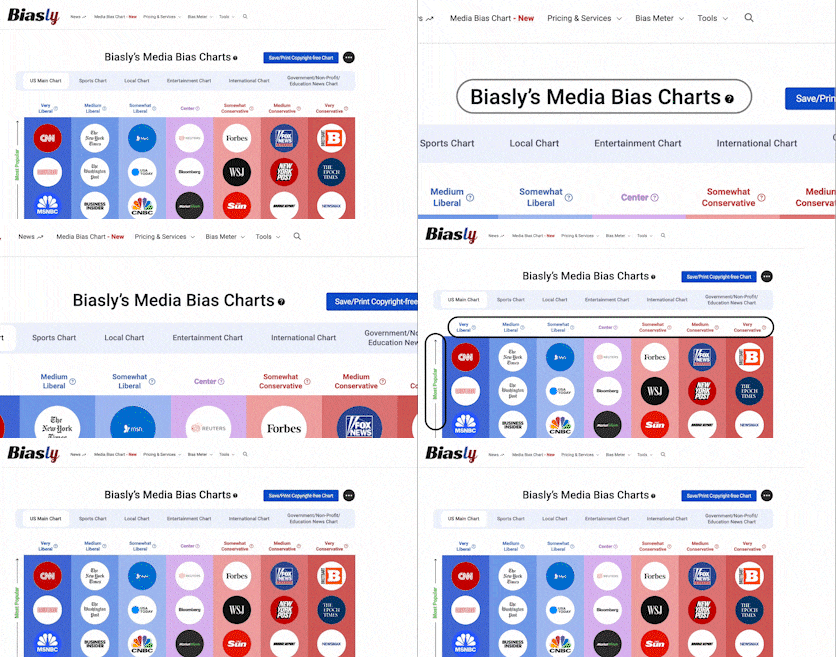
- Media Bias Chart: See where Sky News ranks among hundreds of media outlets across the political spectrum.
- Political Bias Chart: Visualize political slants of news sources across various policy areas.
- Journalist Bias Analytics Platform: Explore how individual journalists contribute to bias within their publications.
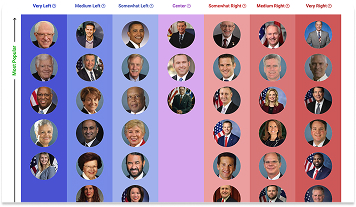
- Politician Bias Analytics Platform: Compare how politicians are framed differently by Sky News and other outlets.
- Media Literacy Education Platform: Learn how to critically assess media sources, bias techniques, and news reliability.
Frequently Asked Questions
Sky News is rated as Center based on Biasly’s media bias algorithm, which assesses sentiment, article framing, and policy favorability.
During the Iraq War, a crew reporting for Sky News appeared to show the live launch of a cruise missile from a submarine. However, the submarine was docked, and no missile was actually launched; the submarine crew simply played along for the cameras. The reporter and his crew were suspended once the fabrication came to light. Months later, the reporter was found dead by suicide.
In 2016, reporters supposedly paid a group of Romanians €2,000 to pretend they were part of a gang selling weapons to terrorists in Syria. Upon arrest, the Romanians claimed they had been paid by Sky News. However, Sky News stands by its reporting that they were legitimate gang members selling arms to terrorists.
Biasly uses a combination of AI sentiment analysis and human analyst review to assess tone, fact accuracy, source quality, and media bias indicators. Learn more on our Bias Meter page.
Yes, Sky News is deemed as providing balanced, factual reporting.
Ratings are based on recent news using data science and A.I. technology.
Military Spending
| Date | Sentiment | Associated Article | Snippet |
|---|---|---|---|
| 08/25/2019 | 75% For | Trump Family Detentions Flores Agreement (link) | So, of course, the Trump administration is doing the opposite in a baldfaced |