




-68% Medium Left
Bias Meter
Extremely
Liberal
Very
Liberal
Somewhat Liberal
Center
Somewhat Conservative
Very
Conservative
Extremely
Conservative
-100%
Liberal
100%
Conservative

Biasly determines media bias ratings through a dual-layered approach combining artificial intelligence and analyst review. The platform’s proprietary bias detection engine, Bias Meter, evaluates sentiment, policy position alignment, and language framing across thousands of data points in news articles. Analysts then verify and interpret the AI’s findings, providing additional context where needed. Learn more about ratings
- Profile
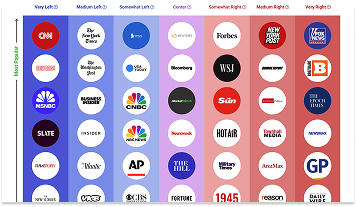
Esquire on the media bias chart
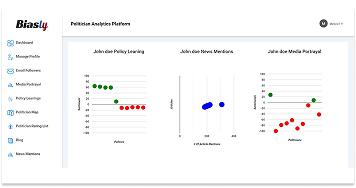

- Bias Rating
-68% Medium Left
- Reliability59% Reliable AveragePolicy Leanings
2% Center
Extremely
LiberalVery
LiberalModerately
LiberalSomewhat Liberal
Center
Somewhat Conservative
Moderately
ConservativeVery
ConservativeExtremely
Conservative-100%
Liberal100%
Conservative
Average Reliability
*Our bias meter rating uses data science including sentiment analysis, machine learning and our proprietary algorithm for determining biases in news articles. Bias scores are on a scale of -100% to 100% with higher negative scores being more liberal and higher positive scores being more conservative and 0% being neutral. The rating is an independent analysis and is not affiliated nor sponsored by the news source or any other organization.
Politician Portrayal14% positive
Continue For Free
Create your free account to see the in-depth bias analytics and more.
By creating an account, you agree to our Terms and Privacy Policy, and subscribe to email updates.
Log In
Log in to your account to see the in-depth bias analytics and more.
Analysis of Esquire Articles
Analysis of Bias in Esquire Online Articles
To evaluate this, we can analyze select Esquire articles through several of Biasly’s bias rating criteria: Tone, Tendency, Author, Diction, and Expediency Bias.
- Tone: The overall attitude conveyed by the article
- Diction: Specific word choices made by the writer
- Author: The background and social presence of the journalist
- Tendency: Patterns of bias in the writer’s broader body of work
- Expediency Bias: Quick visual or textual indicators like headlines and photos that imply bias
Esquire is an American magazine founded in 1933, originally targeting a male audience with content spanning from lifestyle and fashion to culture and current events. While it has long maintained both a print and digital presence, its political coverage has become an increasingly prominent and increasingly opinionated part of its editorial identity. According to Pew Research, 56% of American adults now prefer digital devices as their primary source of news, compared to just 5% who prefer print. That shift makes Esquire’s online political content especially influential, and its bias especially worth examining.
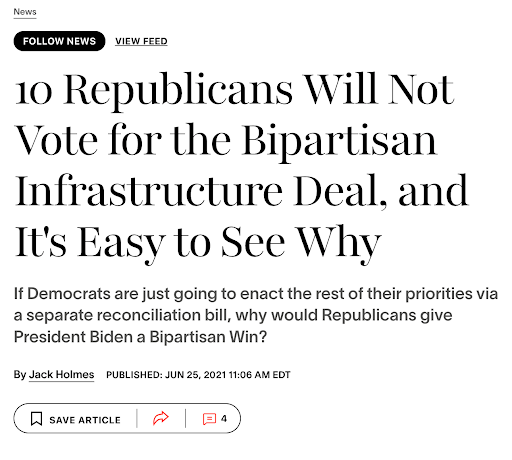
One article that makes the bias in Esquire impossible to miss is “10 Republicans Will Not Vote for the Bipartisan Infrastructure Deal, and It’s Easy to See Why,” by Jack Holmes. The headline alone signals where the article is heading, and the phrase “it’s easy to see why” presupposes that Republican opposition is obviously wrong before the reader gets past the title. The contents of the article follow through on that promise, attacking Republican logic and dismissing conservative arguments without engaging with them substantively. Biasly’s analysis found serious issues involving tone, tendency, diction, and author background, all near the maximum liberal score. Two quotes from the piece illustrate the problem clearly:
“If they hold to that, which they should for the sake of the country, it’s impossible to see why 10 Republicans would vote for the Deal.”
“Democrats should write a reconciliation bill that contains all their infrastructure priorities, pass it through both houses of Congress with or without Republican votes.”
These aren’t neutral observations; they’re advocacy. Phrases like “for the sake of the country” and openly endorsing Democratic legislative strategy without Republican input reflect a clear ideological agenda. The author isn’t reporting on the debate; he’s participating in it. The article caps off with perhaps its most obvious example of bias:
“And Jesus, get some muscle in that climate spending.”
That line is essentially an editorial from someone who was supposed to be reporting; it’s both unprofessional and biased. It’s a good representation of why Esquire earned its Medium Left rating.
Author Jack Holmes has an active online presence that reflects a similar orientation. On social media, he has shown indirect support for Democratic figures and taken shots at right-leaning outlets, suggesting that his personal views consistently bleed into his professional work. A clear example of Jack’s bias for Democratic individuals and opposing bias for Republican bias can be seen in an X post taking a shot at American media supporting Donald Trump back in 2016:
what a perfect moment for members of the national media to reflect on their decision to portray Donald Trump as the more responsible steward of classified information back in 2016
— Jack Holmes (@jackholmes0) June 9, 2023
Another article worth examining for author tendency bias is “Madison Cawthorn Laid Out the Present and Future of Republican Politics,” also by Jack Holmes. Holmes broader body of work at Esquire reflects a consistent pattern of framing Republican figures as symptoms of a larger ideological dysfunction rather than as individual political actors with distinct positions.
This tendency, visible across multiple of Holmes’ pieces, is what Biasly’s tendency metric is specifically designed to capture, not just the bias of a single article, but the directional consistency of a writer’s framing choices over time.
Analysis of Esquire Opinion Articles
It’s worth being clear about something before diving into this section: Esquire doesn’t always draw a clean line between news reporting and opinion content. Unlike outlets that clearly label their opinion pieces, Esquire’s political articles frequently read as opinion pieces even when they aren’t labeled as such. That blurring of the line between reporting and advocacy is itself a form of bias, and it’s one of the defining features of Esquire’s political coverage.
One article that illustrates this clearly is “Greg Abbott Has Jumped Aboard the White History Matters Bandwagon,” which covers Texas Governor Greg Abbott’s policies while simultaneously serving as a platform for the author’s personal opposition to them. Rather than reporting on Abbott’s actions and letting readers draw their own conclusions, the author frames every decision through a lens of liberal critique. The title alone is a judgment call dressed up as a headline.
Similarly, “This Country Has Grown Too Comfortable With the Spector of the Gun in Its Political Life” tackles gun policy in America while painting the entire right side of the political spectrum with a broad brush. The author links all conservatives to militia groups and holds them collectively responsible for the events of January 6, 2021. A framing that prioritizes liberal advocacy over nuanced political analysis:
“Conservatives as a whole are characterized as having embraced political violence, without distinguishing between the actions of a minority and the views of the broader Republican electorate.”
These aren’t just opinion pieces that lean left; they’re examples of reporting that has been replaced by advocacy. Esquire is committed to a political agenda in much of its coverage, and readers looking for balanced perspectives on conservative issues will rarely find them here.
Not all Esquire content falls into this category. The outlet has shown it can publish neutral, well-reported articles on topics like national defense and technology. But when it comes to domestic politics, the pattern is hard to ignore. The consistent selection of politically charged topics, combined with authors who openly editorialize, is what drives Esquire’s Medium Left rating. This underscores the importance of distinguishing between what Esquire does well and where its political agenda gets in the way.
Analysis of Reliability in Esquire’s Online News Articles
Esquire holds an Average reliability score from Biasly. This rating reflects a publication capable of solid reporting in some areas but consistently undermined by bias, omission, and one-sided sourcing in its political coverage. Reliability and bias aren’t the same thing, but at Esquire, they’re closely connected. The outlet’s tendency to inject opinion into reporting and leave out conservative perspectives directly affects how trustworthy its political content is.
One article that illustrates both what Esquire does right and where it falls short is “So After All That, There Is No Border Surge?” The piece challenges media narratives about the border by citing data from Customs and Border Patrol, including the fact that border apprehensions increased 28% in February 2021, and that Trump saw a 31% increase during his own term. This statistic cuts against the framing that the border was uniquely problematic under Biden.
The data sourcing here is genuinely strong, and drawing on a federal agency as the primary source is a good reliability practice. But the article does not include any direct quotes from any officials, politicians, or independent researchers. Strong statistics alone don’t tell the whole story, and the absence of voices from multiple perspectives leaves the article feeling incomplete despite its factual foundation.
In contrast, “Anyone Who Believed Republicans Would Cooperate on a January 6 Investigation Should Lie Down for a Nap,” by Charles Pierce, received an Average reliability rating from Biasly and illustrates what happens when political bias overtakes journalistic standards entirely. The title signals the author’s conclusions before the article even starts. The piece calls for no sympathy toward Republican explanations for January 6 and draws on quotes that represent only one side of a deeply contested political issue:
“Unfortunately, right now, it seems like we’re incapable of having the serious or the real conversations about these things because everybody’s trying to utilize it for electoral gain one way or the other.”
“It’s exactly what I was hoping we wouldn’t have, because it’s going to be politicized.”
Both quotes critique congressional inaction without providing any Republican perspective on why a committee might be opposed. The absence of any counterbalancing voice isn’t just a stylistic choice; it’s a reliability issue. When readers only see one side of a story, they can’t evaluate it fairly.
Quality of Sources and Facts Used
Esquire often draws from credible sources, but its political coverage can rely on narrow sourcing and strongly ideological framing. Charles P. Pierce’s article, “Anyone Who Believed Republicans Would Cooperate on a January 6 Investigation Should Lie Down for a Nap”, is a good example. Republican lawmakers are quoted throughout the piece, but their views are presented mainly so Pierce can criticize or dismiss them. The article includes voices from both sides of the issue, but it does not treat those voices with the same level of skepticism.
This is clearly an opinion column rather than a straight news report. From the title onward, Pierce takes a sarcastic and openly critical approach toward Republican leaders who opposed or questioned a congressional investigation into the January 6 attack on the U.S. Capitol. His central argument is that Republicans were never likely to cooperate with a serious investigation and that their opposition was both predictable and politically motivated.
The article contains eight direct quotations, including partial quotes and short quoted phrases. They range from two words, such as “moderate Republicans,” to a 26-word statement about politicians using the issue for electoral gain. The average quotation is approximately ten words long. Most come from Republican lawmakers whose comments were originally reported by another news outlet, with Pierce adding his own commentary before or after them.
That distinction matters because Republican voices account for most of the quoted material, but they do not control the article’s perspective. Longer quotations occasionally give readers enough context to evaluate a lawmaker’s argument directly. Shorter phrases, however, are often selected for rhetorical effect and used to reinforce Pierce’s criticism. The article is therefore not one-sided because Republican voices are absent; it is one-sided because those voices are consistently framed as unreasonable, evasive, or politically cynical.
The article relies on a relatively small group of sources and political figures. Its main outside source is POLITICO, which supplied several quotations from Republican lawmakers discussing the investigation. Pierce also refers to congressional leaders, individual House members, and the broader political debate surrounding the proposed committee.
The sources and figures referenced include:
- Charles P. Pierce, the article’s author and an Esquire columnist (Left)
- Esquire, the publication that published the column (Center-Left)
- Nancy Pelosi, Speaker of the House at the time (Left)
- POLITICO, the political news organization cited by Pierce (Center)
- Kevin McCarthy, House Minority Leader at the time (Right)
- Kelly Armstrong, Republican representative from North Dakota (Right)
- Peter Meijer, Republican representative from Michigan (Center-Right)
- John Katko, Republican representative from New York (Center-Right)
- Joe Biden, then-president of the United States (Left)
- House Republican leadership, referenced as a political group (Right)
By ideological classification, the article draws from approximately one Left source, two Center sources, and three Right sources. That count makes the sourcing appear more politically diverse than the finished article actually feels. Republican politicians are quoted frequently, but Pierce uses their statements as material for his own argument rather than as competing perspectives to be considered on equal terms. Democratic figures, particularly Pelosi, receive much less scrutiny.
The article’s point of view comes primarily from Pierce rather than from the sources themselves. He quotes Republican lawmakers and then responds with sarcasm, criticism, or direct disagreement. Republican claims are questioned or dismissed, while Pelosi’s decision to establish a select committee is treated more favorably. The imbalance comes less from the number of voices included than from the way those voices are handled.
That makes the article’s overall orientation Very Left. It openly argues for one interpretation of the January 6 investigation and directs substantially more skepticism toward Republicans than Democrats. That is not necessarily inappropriate for an opinion column, but readers should understand that the piece is making a political argument rather than offering a neutral summary of the dispute.
On factual accuracy, the underlying timeline is generally consistent with reporting from June 2021. House Republicans had opposed the creation of a select committee after the Senate blocked legislation establishing an independent commission, and the quotations attributed to Republican lawmakers match statements reported at the time. The article is on firm ground when describing those events and identifying who supported or opposed the investigation.
Its stronger claims about motive are more subjective. Pierce treats Republican opposition as evidence of bad faith and political self-protection, but those conclusions are his interpretation of the available facts rather than facts that can be independently proven in the same way as a vote, quotation, or committee decision. The article’s factual foundation is generally sound; its conclusions are unmistakably partisan.
Selection and Omission Bias
Selection and omission bias is one of the most consistent reliability problems at Esquire. The article “Madison Cawthorn Laid Out the Present and Future of Republican Politics,” by Charles Pierce, is one of the clearest examples. The piece uses Congressman Madison Cawthorn as a stand-in for the entire Republican Party, arguing that the GOP has abandoned policy in favor of media attention. The only Republican directly quoted is Cawthorn himself:
“I have built my staff around comms rather than legislation.”
That quote is used to support a sweeping generalization about the direction of the whole party. But one congressman’s hiring decisions don’t define the broader Republican Party across the country. The author makes no attempt to include voices from Republican politicians who are focused on policy; their absence isn’t accidental; it’s the point. The article goes further, extending the same critique to Republican voters:
“These folks are just Media Stars now, people who were throwing red meat online when suddenly it all got real, and they were elected to Congress because that’s all that Republican primary voters want anyway.”
This is a broad generalization about an entire voting bloc, presented without any evidence of Republican voters who disagree. There are no quotes from constituents, no data on what Republican voters actually prioritize, and no acknowledgement that the author’s framing might not represent the full picture. That’s omission bias operating at its most obvious, and it’s representative of how Esquire handles conservative subjects across its political coverage.
In opinion and political pieces, issues with factuality, sourcing, selection, and omission are common. The articles reviewed here reflect Esquire’s Medium Left views, and in this case, those views do affect reliability. The outlet’s factual accuracy is better in its non-political coverage, but in domestic political reporting, the tendency to omit conservative perspectives and let authors editorialize openly is a meaningful reliability concern.
Esquire Bias Overview
Esquire was founded in 1933 by David Smart, Henry Jackson, and Arnold Gingrich. Originally conceived as a lifestyle magazine for men, it has evolved significantly over the decades and now maintains both a print and digital presence with a strong focus on culture and politics. While its early editorial identity incorporated perspectives from across the political spectrum, Jackson was known to hold Republican views, while Smart leaned liberal Democrat. Today, Esquire has moved firmly to the left, particularly in its political coverage.
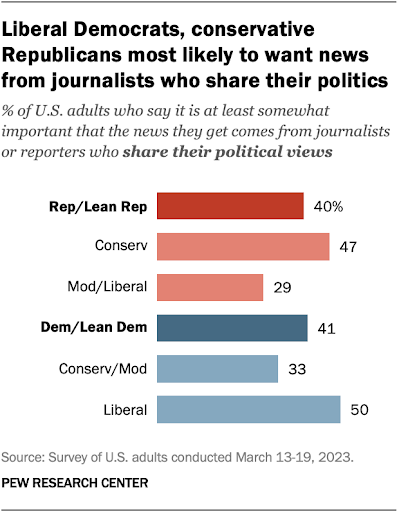
Source: Pew Research
That shift in editorial direction matters because of who Esquire is writing for. According to a 2023 Pew Research Center survey, 50% of liberal Democrats say it is at least somewhat important that the news they get comes from journalists who share their political views, the highest of any group surveyed. Conservative Republicans came in at 47%, while moderate and liberal Republicans sat at just 29%.
This tells us something important about the modern media landscape. Audiences on both ends of the spectrum increasingly want journalism that reflects their own worldview. Esquire has fully leaned into that reality on the left side of the spectrum, producing political content that speaks directly to a progressive audience rather than trying to appeal across ideological lines. As one of the most widely distributed magazines in the country, that editorial choice carries real influence.
Is Esquire Biased?
Based on Biasly’s evaluations, Esquire is rated as Medium Left.
By examining content patterns and the broader context of media influence, we aim to offer a balanced perspective on Esquire’s political bias—and contribute to the ongoing discussion about bias in the news.
How Does Biasly Rate News Sources?
Biasly uses proprietary algorithms and a team of analysts to provide comprehensive bias evaluations across thousands of news outlets. Over 200,000 articles from more than 3,200 sources have been analyzed to identify the most accurate and unbiased stories.
Biasly assigns each outlet three key scores:
- Reliability Score – Reflects factual accuracy
- AI Bias Score – Generated via natural language processing
- Analyst Bias Score – Assessed by human political analysts
These scores are based on seven core metrics: Tone, Tendency, Diction, Author Check, Selection/Omission, Expediency Bias, and Accuracy. These elements help analysts and algorithms evaluate the political attitude conveyed by each article.
Biasly’s Bias Meter ranges from -100% (most left) to +100% (most right), with 0% indicating neutrality. The system evaluates individual articles based on political terms, policies, figures, and sentiment to calculate precise bias ratings.
Is Esquire Politically Biased?
Esquire earns a Medium Left rating for its AI Bias Score and a Medium Left for its Analyst Bias Score. The Analyst Bias Score is generated by reviewers from liberal, moderate, and conservative backgrounds. Esquire articles show consistent patterns of liberal bias, particularly in coverage of abortion, affirmative action, and prominent conservative figures like Brett Kavanaugh and Betsy DeVos, who were covered negatively across multiple pieces. The paper showed very little objectivity on domestic political topics, with writers frequently inserting personal opinions directly into their reporting rather than letting the facts speak for themselves.
How to Evaluate Bias
Although Biasly rates Esquire as Medium Left, it’s important to remember that bias can vary from article to article. Esquire also covers many issues with objectivity, from state legislation to social developments. This complexity underscores the importance of examining each article individually. So, let’s learn how to evaluate media bias.
Recognizing media bias requires awareness and critical thinking. Often, readers trust news sources that affirm their existing beliefs—a psychological tendency known as confirmation bias. This makes it harder to identify slanted narratives or one-sided reporting.
To address this, it’s essential to challenge your assumptions by consulting multiple perspectives and verifying information through third-party analysis. Tools like Biasly’s media bias ratings allow readers to compare the same news story across the political spectrum.
Ultimately, bias isn’t always a matter of what is said—it’s also about what is left out, how topics are framed, and which stories are chosen for coverage. Learning to recognize these patterns can help readers make more informed decisions and develop greater media literacy.
To start comparing news outlets and gain a better understanding of bias, sign up for Biasly’s Media Bias & News Analytics Platform to see how stories vary between sources.
Esquire Reliability Overview
Is Esquire Reliable?
Esquire holds an overall Average reliability score from Biasly. That rating places it in the middle of the reliability spectrum, not among the least reliable outlets, but well short of publications with strong factual accuracy and balanced sourcing. For Esquire, reliability varies significantly depending on the topic. Its non-political coverage on technology, culture, and national defense tends to be more factually grounded and less affected by the selection and omission issues that consistently undermine its political reporting. Readers who approach Esquire with awareness of where its reliability holds up and where it breaks down will be better equipped to get real value from its content.
How to Evaluate Reliability?
Reliability refers to how trustworthy or accurate a news source is. If we can’t trust what we read, then continuing to consume content from that outlet serves little purpose. So how do we evaluate a news outlet’s reliability?
There are several key indicators of reliability to consider when assessing a media source. Red flags of an unreliable article can include wild, unsubstantiated claims, facts that depend on other unreliable sources, heavy use of opinionated language, and more. In contrast, hallmarks of a reliable source include:
- Absence of subjective language
- Citing credible sources (e.g., .gov, .edu, academic references)
- Verifiable facts and statistics from multiple outlets
- Use of primary sources, like interviews or transcripts
- Consistency with coverage across other platforms
Biasly’s reliability scores incorporate these elements in evaluating media outlets.
So How Does Esquire Fare in Its Reliability?
The political reliability index developed by Biasly assesses both accuracy and trustworthiness. Esquire currently holds Average Reliability Score, which is calculated as a weighted average of:
- Fact Analysis Score – Evaluates the accuracy of claims, facts, and evidence.
- Source Analysis Score – Assesses the number, diversity, and credibility of sources and quotes used.
Esquire’s Source Analysis Score is Average at 51% Reliable. This suggests moderate trustworthiness in its sourcing practices. The score is AI-generated and considers quote length, frequency, diversity, and quality.
The Fact Analysis Score of Esquire is Average at 61% Reliable. This further shows how well Esquire supports its claims, addresses selection and omission bias, and presents verifiable evidence.
While Esquire leans toward factual reporting, occasional lapses—such as unbalanced viewpoints or incomplete data—can affect its reliability rating. These nuances emphasize the importance of analyzing individual articles.
Esquire’s Accuracy and Reliability
According to Biasly’s analysis, Esquire maintains Average Reliability Score, but individual articles may vary significantly. Let’s dive into the details. The two most common reliability concerns in Esquire coverage are:
- Selection Bias – Choosing which stories and facts to highlight in ways that favor a particular narrative.
- Omission Bias – Leaving out perspectives or context that would complicate or contradict the dominant framing.
The Madison Cawthorn article is the clearest example of both, using one congressman’s statement to generalize about an entire party and its voters, while leaving out any voices that might complicate the narrative. The January 6 investigation article shows a similar pattern, relying on quotes from only one side of a contested political debate.
On the other hand, the border surge article demonstrates that Esquire can produce factually grounded reporting when its writers prioritize data over advocacy. The use of federal agency statistics and a willingness to challenge media narratives, even ones that might be convenient for a liberal outlet, reflects a degree of journalistic integrity that isn’t always present in the magazine’s political coverage.
Overall, Esquire can be considered
moderately reliable. Its reliability is strongest in non-political areas and weakest in domestic political reporting, where selection and omission bias consistently affect the completeness of its coverage. Readers who use Biasly’s News Bias Checker to evaluate individual articles will be better positioned to identify where Esquire is reporting reliably and where its editorial agenda is getting in the way.
So, is Esquire Reliable?
Overall, Esquire can be considered to be an outlet that is moderately reliable. It demonstrates a consistent goal of journalistic integrity and typically supports claims with sources and quotes. Occasional omissions and framing bias do appear, particularly on culturally sensitive or partisan issues.
As media literacy improves, readers can more easily detect issues with selection bias, omission bias, and factuality. To strengthen your ability to assess reliability across the political spectrum, use Biasly’s News Bias Checker to compare how multiple outlets report the same story.
This empowers you to consume more accurate, balanced, and dependable news.
Esquire Editorial Patterns
Esquire’s coverage of political topics often reflects a Medium Left bias, with consistent patterns in phrasing, source selection, and thematic focus that are Moderately Liberal. While the publication is capable of producing neutral content on non-political topics, its domestic political reporting has become one of the more extreme examples of ideologically driven journalism in mainstream American media.
Coverage of Liberal vs. Conservative Topics
Esquire’s political articles treating progressive causes like climate policy, abortion access, gun control, and criticism of Republican leadership tend to be sympathetic and detailed, giving ample space to liberal arguments and Democratic officials. Coverage of conservative positions on the same issues is far more likely to be dismissive, critical, or framed as obviously wrong.
This isn’t subtle. Headlines like “Greg Abbott Has Jumped Aboard the White History Matters Bandwagon” and “Anyone Who Believed Republicans Would Cooperate on a January 6 Investigation Should Lie Down for a Nap” make the editorial orientation clear before the reader gets past the title. Inside the articles, conservative figures are rarely given space to make their case on their own terms; they’re more often criticized, characterized, or mocked.
The language choices reflect this pattern consistently. Words like “justice,” “rights,” and “democracy” appear in liberal-oriented coverage, whereas conservative positions are more likely to be described as “obstruction,” “extremism,” or “political theater.” This asymmetric framing, present across many Esquire political articles, is what drives its Medium Left rating.
Policy and Issue Framing
On immigration, Esquire frames Republican border security positions as politically motivated and extreme, while Democratic reform proposals are presented as reasonable responses to a humanitarian situation. The border surge article is actually an exception here; it uses data to challenge media narratives rather than reinforcing them, but it’s notable for being an outlier rather than the norm.
On issues like the January 6 investigation, gun policy, and infrastructure spending, Esquire’s framing consistently advantages the liberal position. Conservative arguments aren’t engaged with on their merits; they’re treated as bad faith or politically corrupt. That framing, repeated across articles and authors, reflects an editorial culture that has chosen a side rather than one committed to presenting both perspectives fairly.
Even in articles that appear to be reporting, Esquire’s language choices tend to describe Democratic proposals as protecting democracy or advancing justice, while Republican positions are framed as obstruction, regression, or worse. This consistent editorial direction, intentional or not, contributes meaningfully to the outlet’s place at the far left of Biasly’s Media Bias Chart.
Coverage and Relevance
Esquire’s reporting touches on many of the central issues in the current conversation about media political bias, how major publications cover Republican politics, how authors inject personal opinion into seemingly factual reporting, and how selection and omission bias shape reader perception. As one of the more extreme examples of liberal media bias among mainstream American outlets, it serves as a particularly useful case study for understanding how ideological advocacy can operate within the framework of journalism.
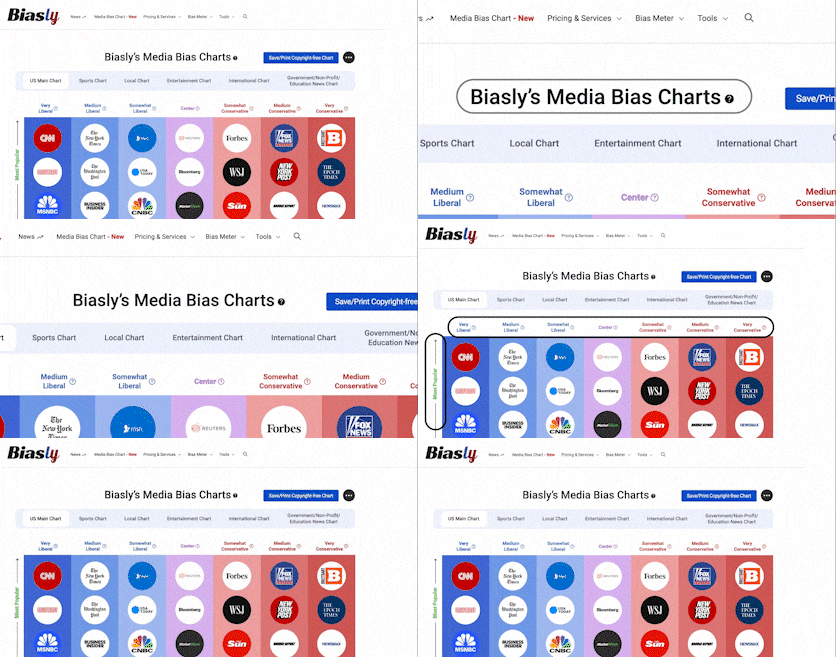
Readers who want to see how Esquire’s framing compares to other publications can visit Biasly’s Media Bias Chart to analyze tone and word choice across outlets in real time.
Funding and Ownership
Who Owns Esquire?

Hearst Tower, New York City, headquarters of Hearst Communications, publisher of Esquire.
Source: Wikimedia Commons
Esquire is published by Hearst Communications, one of the largest privately held media companies in the United States. Hearst owns dozens of well-known media properties across print, digital, and broadcast, making it one of the most influential forces in American journalism. Esquire itself was originally founded in 1933 by David Smart, Henry Jackson, and Arnold Gingrich. In its early years, the editorial direction reflected the founders’ differing politics.
Jackson held Republican-leaning views, while Smart was a liberal Democrat. Over time, the publication has moved significantly to the left, and today it carries a Medium Left rating from Biasly. The current editor-in-chief is Michael Sebastian, though the political voice of Esquire today is driven primarily by its roster of political writers rather than its top editorial leadership.
Who Funds Esquire?
Esquire operates as part of Hearst Communications, a privately held media conglomerate headquartered in the iconic Hearst Tower in Midtown Manhattan. Its revenue comes from a combination of print and digital subscriptions, advertising sales, and licensing arrangements. Hearst Communications does not publicly disclose detailed financial information, and there is no direct evidence that corporate ownership dictates Esquire’s political coverage. However, the magazine’s consistent Medium Left orientation reflects an editorial culture that has developed over decades and appears to be self-reinforcing, with writers with similar political orientations producing content for an audience that shares those views. Readers should be aware of this context when evaluating Esquire’s political framing, particularly on issues where media ownership interests and editorial perspectives can quietly intersect.
Additional Insights
News Source Comparison
When comparing Esquire to similar outlets, it falls at the more extreme end of the left-leaning media landscape. Publications like Mother Jones, The Nation, and Slate share a similarly progressive editorial orientation, while outlets like The Atlantic and The New Yorker, which also lean left, tend to maintain stronger distinctions between reporting and advocacy. What sets Esquire apart is how openly its political writers editorialize within pieces that are presented as news or analysis rather than clearly labeled opinion. Readers seeking more balanced political coverage may find it useful to compare Esquire’s framing with outlets rated as Center or Somewhat Conservative on Biasly’s Media Bias Chart.
Notable Contributors and Authors
Esquire features several writers whose political work drives its overall bias rating. Jack Holmes is one of the magazine’s most prominent political contributors; his social media activity reflects consistent support for Democratic positions and criticism of Republican ones, and that orientation is visible throughout his writing. Charles Pierce is another frequent contributor whose political pieces routinely earn poor reliability ratings from Biasly due to one-sided sourcing, inflammatory language, and a tendency to generalize broadly about conservative politicians and voters.
Not every Esquire writer falls into this category. The magazine’s coverage of defense and technology topics tends to be more factually grounded, and individual writers on those beats demonstrate that the publication is capable of neutral, well-reported journalism. The contrast between Esquire’s political and non-political writing is one of the more striking examples of how bias can be topic-specific rather than uniform across an entire publication.
Related Tools and Resource Pages
To better understand how Esquire fits into the broader media landscape, we recommend exploring these helpful resources:
- Media Bias Chart: See where Esquire ranks among hundreds of media outlets across the political spectrum.
- Political Bias Chart: Visualize political slants of news sources across various policy areas.
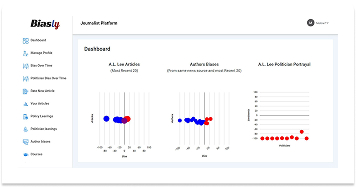
- Journalist Bias Analytics Platform: Explore how individual journalists contribute to bias within their publications.
- Politician Bias Analytics Platform: Compare how politicians are framed differently by Esquire and other outlets.
- Media Literacy Education Platform: Learn how to critically assess media sources, bias techniques, and news reliability.
Frequently Asked Questions
Esquire is rated as Medium Left based on Biasly’s media bias algorithm, which assesses sentiment, article framing, and policy favorability.
Esquire has faced several notable controversies over the accuracy and ethics of its content.
In 1991, Esquire published an article by writer Craig Unger as part of its coverage of the so-called “October Surprise” conspiracy theory, which alleged that the Reagan-Bush campaign had conspired with Iran and Israel to delay the release of American hostages in 1980. The article effectively accused former National Security Advisor Robert McFarlane of having spied for Israel and attending secret meetings with Iranian officials.
McFarlane denied these claims and claimed the article relied on a source with disputed credibility. McFarlane filed a libel lawsuit against Esquire that ultimately reached the U.S. Court of Appeals for the D.C. Circuit. The court upheld the dismissal of McFarlane’s claims, finding that the magazine had not acted with actual malice, but the case drew significant attention to the outlet’s sourcing practices and its reliance on an informant whose credibility its own editors had questioned internally.
In 2019, Esquire published a long-form feature titled “The Life of an American Boy at 17,” a profile of a young man that was later found to contain fabricated quotes and scenes, leading to significant criticism of the outlet’s fact-checking practices and resulting in corrections and editorial accountability measures
More recently, in 2026, Esquire faced backlash over an AI-generated interview controversy in which content produced using artificial intelligence tools was published without adequate disclosure to readers, raising serious questions about editorial transparency and the outlet’s standards for AI-assisted content.
While Esquire is not known for deliberate misinformation in its political reporting, these three episodes reflect recurring concerns about sourcing rigor and editorial oversight that readers should keep in mind.
Biasly uses a combination of AI sentiment analysis and human analyst review to assess tone, fact accuracy, source quality, and media bias indicators. Learn more on our Bias Meter page.
Generally, yes, though partisan framing and selective reporting can affect perceived reliability.
Military Spending
| Date | Sentiment | Associated Article | Snippet |
|---|---|---|---|
| 08/25/2019 | 75% For | Trump Family Detentions Flores Agreement (link) | So, of course, the Trump administration is doing the opposite in a baldfaced |